
ICYMI: We’re hosting our Spring Happy Hour & Election Preview on Tuesday, May 12 at Little Rebel. Over bites (on us) and beers, we’ll walk through the races we’re watching, and their abundance stakes, as we head toward the 2026 primaries.
On Monday, Ezra Klein dropped a two-hour podcast, with co-author Derek Thompson and fellow author (of Why Nothing Works) Mark Dunkelman, offering a retrospective on the past year of abundance.
We’re frequently asked if we have a formal affiliation with Klein and Thompson’s book. Sadly, we do not receive any sort of commission on their book sales. Instead, Abundance New York, like Klein, Thompson, and other groups and leaders across the country are all part of an emergent, decentralized movement. While the contours of each group differ, responsive to local political coalitions and incentives, adherents of the broader movement share a focus on increasing the supply of what people need—housing, transit, energy—and reshaping government to more effectively deliver outcomes.
Klein and Thompson are working at the level of national discourse; we’re working at the level of one state’s coalitions, candidates, and communities. Below we dig into what they discussed, paired with reflections on the New York landscape after a year of Abundance (the book) and nearly two years of Abundance New York.
From vibes to outcomes
While the authors acknowledge the extent to which abundance has permeated left-of-center political discourse, they also point to the gap between ideas and results. It’s great for governors like Newsom, Pritzker, and Hochul to bandy the term about, and even better when they sign critical abundance legislation into law; but what matters at the end of the day is whether new units—or subway stations, or battery storage facilities—are built. (One could argue that even those “outcomes” are actually outputs, in service of greater affordability and quality of life for residents, which is why our agenda opened and closed with a focus on tangible outcomes and corresponding outputs for New Yorkers.)
In California, the focus of much of the book, we’ve seen major YIMBY legislative victories over the past several years, from by-right multifamily in commercial corridors to transit-oriented development to exempting infill housing from CEQA, but only a small increase in new units built. New York has had more modest recent victories; Hochul’s 2023 Housing Compact aspired to similar goals around transit-oriented development as California, but did not succeed, so the movement’s focus over the past two years has been (1) the zoning text amendment City of Yes for Housing Opportunity in 2024, which promised 80,000 new units over 15 years; and (2) the charter amendments in 2025, which modified the ULURP to fast-track some affordable housing and provide a workaround to member deference. In the 10 months after City of Yes passed, the number of permits increased 23% over the same period in the previous year—a promising start.
The importance of implementation—or its lack thereof—is especially evident in the transit space. Mayor Adams promised to be the “bus mayor”—and subsequently failed to meet legally mandated bus lane targets, established in the 2019 Streets Plan, each year of his tenure. For several of our advocacy partners in the transit space, years of work were put into pushing the mayor to implement the law. Naturally, transit advocates were excited by Mamdani’s focus on buses, and his appointment of Mike Flynn as DOT commissioner.
As Flynn previewed the city’s next Streets Plan in March, he suggested a shift from outputs (miles of bus lanes) to outcomes: “We have to be attuned to how the work we do improves the lives of New Yorkers,” he said. “We’ll ask clear, measurable questions. Are buses moving faster? Are fewer people being killed or seriously injured? Are more New Yorkers choosing to bike? Is it easier and more affordable to get around our city without a car? Is the public space we’re creating high quality and equitably distributed? These are metrics that matter.”
These are the right questions—and they’re also harder to be held accountable to than a mileage target. The Adams administration showed how easily statutory benchmarks can be missed; the test for Mamdani’s DOT will be whether outcome metrics produce more delivery than output mandates did.
The abundance mullet
In what I hope does not become a new fashion trend for our community, Thompson coined the term “abundance mullet” to describe a new crop of electeds, from across the political spectrum, who lead their campaigns with populism and follow through with abundance-oriented governance. (For more on this, see recent research from our friends at Inclusive Abundance Initiative and Blue Rose on the effectiveness of hybrid populist-abundance messaging). They cited New Jersey Governor Mikie Sherrill, who campaigned on freezing utility rates and followed through with supply-side solar policies—and, closer to home, Mayor Mamdani, who campaigned on freezing the rent and issued day-one executive orders on fast-tracking siting and permitting.
We’ve been celebrating Mamdani’s supply-side pivot for nearly a year, particularly as we emphasize the notion of abundance as its own axis, rather than a point on the traditional left-to-right spectrum. The comparison between Mamdani and Sherrill, whose political identities are miles apart, but who went through similar pivots, drives home this point (we’ve also discussed how Mamdani and Hochul, strange ideological bedfellows as they are, have found common ground on abundance issues).
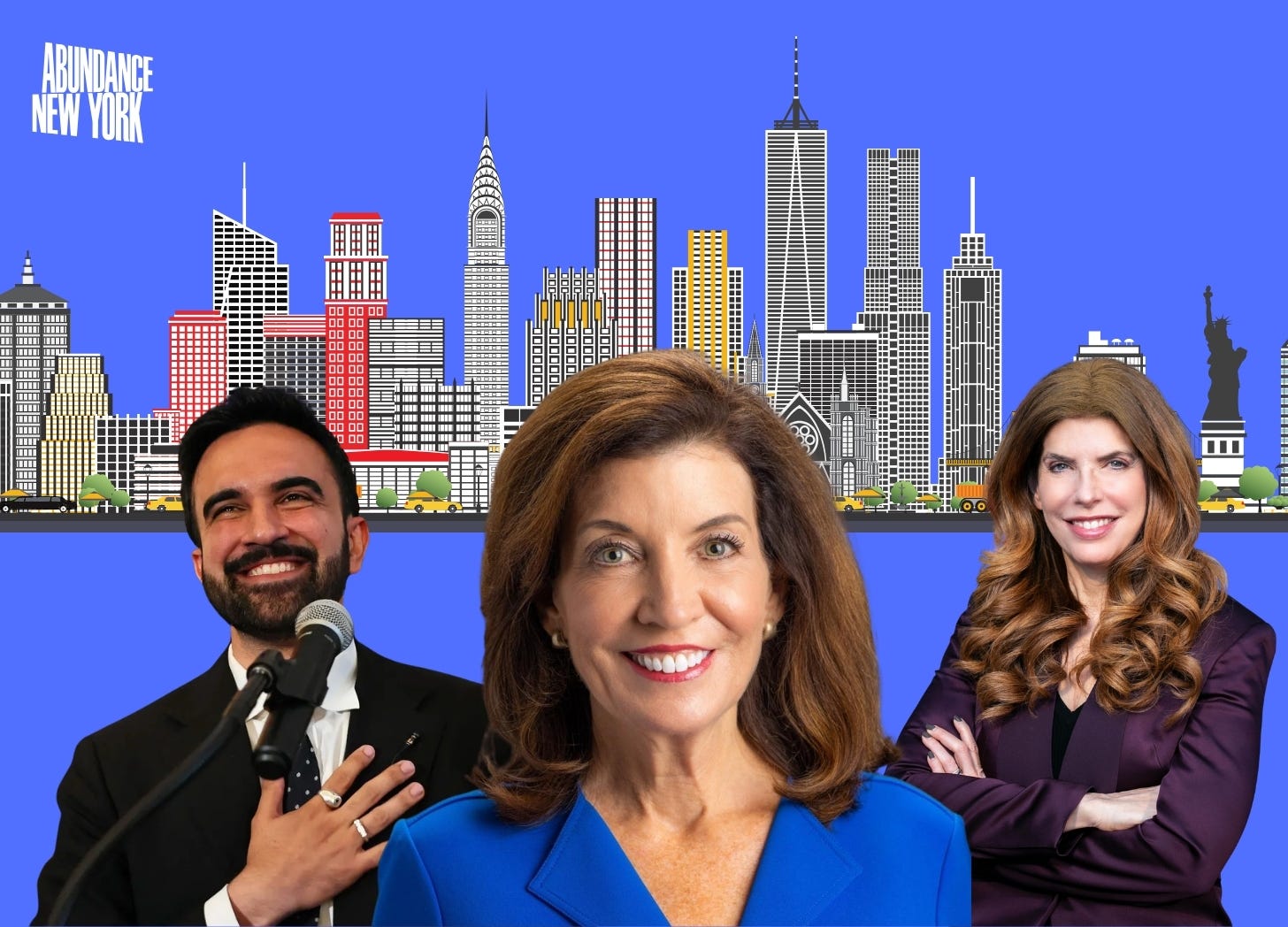
Mamdani and Hochul—and, recently, Mamdani and Menin—have taken pains to show that taxing the rich and cutting red tape are not alternatives to be chosen from, but compatible options in solving a budget crisis. While we previously discussed states where policy outcomes have not caught up to the discourse, in this case, New York’s leaders are a step ahead of the left-infighting seen on X. Last week, the Mayor and Speaker held their first joint press conference to ask Albany to cut NYC’s Pass-Through Entity Tax credit—a roughly $1B revenue raiser falling almost entirely on millionaires—the same week Menin proposed construction code reforms that could unlock up to 35,000 units on small lots without any zoning changes. Tax the rich in front, cut red tape in back.
A positive vision of clean energy abundance
After wrestling with the hostility that has emerged between anti-monopoly progressives and abundance, the authors turn to the tensions between abundance and the climate movement. Here, Klein positions the emphasis on energy affordability as defensive. The left, he argues, has a “worried relationship with energy”—focused on avoiding the harms of fossil fuels (and urging people to “reduce, reuse, recycle,” and “put on a sweater”) rather than on what a future of abundant clean energy would actually look like.
We’ve already taken our swing at this. Our Earth Day post and CLCPA commentary lay out what clean energy abundance could look like in New York: integrated resource planning, transmission rights-of-way, ORES authority over battery storage, nuclear and geothermal as expansionary moves. Notably, Governor Hochul is one of the few executives actively making the affirmative case—fighting for offshore wind, swimming with the federal current on nuclear and geothermal. Still, we see opportunities for her to take the same ambition she’s shown with SEQRA reform to the clean energy space.
Perhaps there’s an “abundance mullet” approach to this work, too—a modification of cap-and-invest to focus more on supporting low-income households transition to clean energy, paired with preserved long-term commitments to the clean energy transition. The deal space between Hochul, the legislature, and climate advocates exists; they all agree that we need to dramatically reduce emissions and build more clean energy, what’s missing is a coalition pushing for the plan to get there. That’s a role abundance is well-positioned to play.
One year after the book, New York is in some ways ahead of the national debate (City of Yes is building, Mamdani’s first 100 days were genuinely supply-oriented) and in some ways behind (the energy conversation is stuck, the construction financing environment is brutal). Our local abundance movement has shown real progress on the level of vibes, and real promise on the level of outcomes. The level where we need to win is implementation: the process of translating a big vision into legislation that produces outputs that reliably lead to outcomes. That’s what our community is focused on, and we’re grateful you’re a part of it.
Comments
Nothing yet. Say the first thing.
Sign in to join the conversation.