
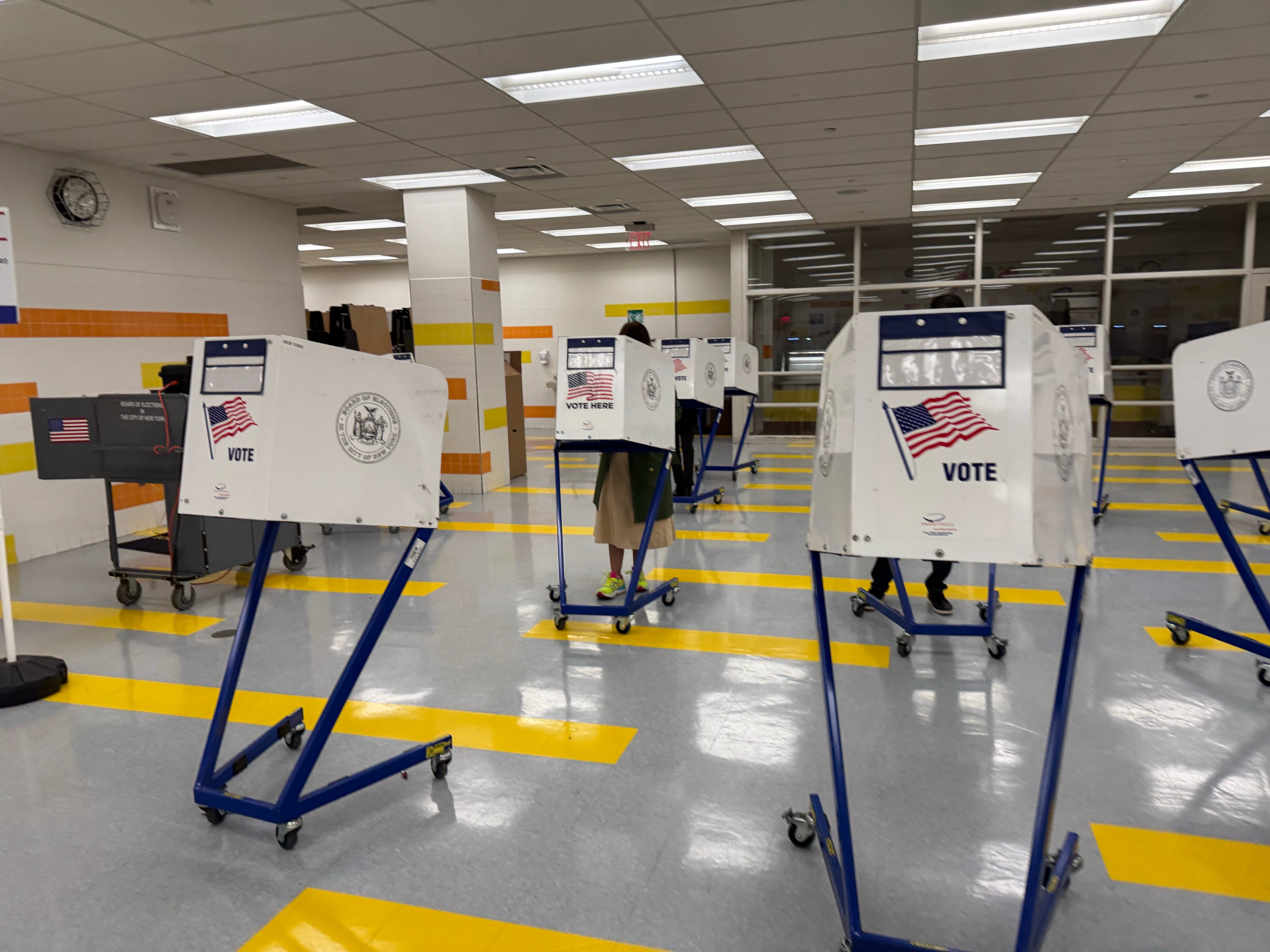
On Tuesday, I spent the afternoon handing out literature for Ryder’s campaign outside a polling place on 13th Street. Many of the passersby I spoke with were completely unaware that competitive primaries were taking place, and actual voters trickled by intermittently; indeed, after twelve hours of the poll site being open, only 550 people had voted.
Across the street, hundreds of New Yorkers waited in a line that snaked around the corner, as they approached the food bank to fill their bags up with groceries. The juxtaposition stuck with me all day. New Yorkers are struggling—but overwhelmingly disconnected from the political processes that shape whether they can afford to live here.
Amid low faith in democracy, an ascendant leftist movement in the Democratic Socialists of America has been able to give its members hope—and move the needle in low-turnout races. Some of our candidates were part of this left-leaning wave, and we’re excited to see them fuse progressivism and abundance as they take higher office. Others were defeated by it, and we’re disappointed that their voices won’t represent us. Still others were bogged down by the political machinery in their district and unable to break through to increase turnout.
Here’s a round-up of where we won and lost, our take on the results, and where we go from here.
Overall, Abundance-endorsed candidates won in 7 of 13 races—a solid rate of victory given our exclusive focus on competitive races.
🎉 Brad Lander defeated incumbent Dan Goldman in NY-10
🎉 Micah Lasher won the open NY-12 seat over a crowded field, including fellow endorsee Alex Bores
❌ Antonio Reynoso lost the open NY-07 seat to DSA-backed (and Mamdani-endorsed) Assemblymember Claire Valdez, 58 to 33 percent.
❌ Drew Warshaw lost the Comptroller primary—the first competitive race for that seat in nearly 20 years. Incumbent Tom DiNapoli won with 58% of the vote; Warshaw and Raj Goyle, another challenger, split the remainder.
🎉 Jessica González-Rojas unseated incumbent Jessica Ramos in SD-13
🎉 Grace Lee handily won her rematch in SD-27 against Yuh-Line Niou
❌ Steven Raga lost the open SD-12 seat to DSA- and Mamdani-backed candidate Aber Kawas
🎉 Diana Ayala defeated incumbent Eddie Gibbs in AD-68
🎉 Eli Northrup won the open AD-69 seat, defeating Stephanie Ruskay (who we had also identified as an abundance champion)
❌ Mike Scala lost to Pesach Osina in AD-23
❌ Tunisia Morrison lost to Gregory Meeks-backed Nathaniel Hezekiah in AD-32
❌ Ryder Kessler lost in AD-66, a race now down to roughly 60 votes between the two remaining candidates
🎉 Carl Wilson held CD-3, though by a tighter margin than expected, as candidates who dropped out after the special election were still on the ballot
As everyone else has noted, this was an astonishingly good night for the DSA. Valdez handily won an open seat, and Darializa Avila Chevalier toppled an incumbent in Congress. A wave of DSA- and Mamdani-aligned candidates won state legislative seats across the city, including in tough fights against entrenched incumbents. Lander’s win over Goldman fits the same pattern: he ran in close alliance with Mamdani’s coalition, and his win reflects this political machine on the rise, fueled by the mayor’s popularity and a muscular organizing operation.
This wave was enabled by low primary turnout. As of 6pm on Tuesday, NYC’s Board of Elections had logged roughly 420,000 voter check-ins across the entire primary, compared to over a million votes in last June’s mayoral primary. In a city of 4.6 million active registered Democrats, a few hundred thousand people decided every race on this ballot. Political machines win in exactly these conditions: it’s what’s kept many incumbents in office long after they’d lost touch with their constituents, and it’s what allowed a newer, energized machine to sweep so many races this time.
So while this was a real flex of Mamdani and the DSA’s organizing power, we hesitate to call it a broad referendum on what voters want. Mamdani made “affordability” the party’s buzzword, and we’ve been glad to see him recognize the importance of abundance policies to deliver on it. But his coalition has mostly internalized the messaging on affordability without the underlying policy agenda—several candidates ran on demonizing market-rate development, the same scarcity-minded thinking that Mamdani has powerfully rejected. We’re hopeful that some may yet adopt a more abundance-style governing agenda, as we’ve seen several newly elected mayors and governors do (though that pattern has so far shown up more among executives than legislators).
Where the DSA didn’t have a candidate in the race, the older rules of city politics still applied. While the narrative around NY-12 was defined almost entirely by that $26 million in outside AI-industry spending, the race still shook out close to how we might have predicted before that money poured in: neither the social media following of a Kennedy nor the allure of a potential AI-fluent Congressman could overcome Lasher’s institutional support. In races without a DSA candidate or the mayor’s involvement, local political machines and elected name recognition carried the day. That’s how Lee and Ayala won, and it’s also a part of why other candidates, including Kessler, lost: the downtown clubs, in particular, have become expert at turning out a more NIMBY-minded electorate in low-salience races.
We helped put abundance on the map for this election before a single vote was cast. Our widely-covered Congressional candidate forums, in NY-10 and NY-12, forced candidates to put their stances on housing, transit, energy, and good government on the record—and led them to compete on who was the “abundance candidate.” Our Voter Guide recommendations drew more than 100,000 views, and our endorsement was proudly touted by candidates up and down the ballot. While we still see abundance as a governing agenda more than a campaign platform, key messaging is breaking through: both Brad Lander and Dan Goldman proudly claimed the abundance mantle in our forum, as did four front-runners in NY-12, and even NIMBY candidates were engaging in revisionist history about their records to appeal to voters.
We are excited to work with Lasher, Lander, and other candidates that we endorsed as they prepare for the general election and beyond to help them develop policy agendas, recruit staff, and otherwise prepare to take office.
With two years until the next competitive primary, we’re also continuing to invest in leadership development to prepare a strong slate of candidates to run for office. We now have over 100 members on Community Boards and are kicking off a series of trainings to help folks maximize their impact as board members—if you’re a CB member, sign up for our kickoff in July!
Finally, the governing continues at the city and state level. Alongside our electoral work over the past few weeks, we’ve submitted testimony and publicly testified to the Commission on Government Efficiency (COGE), earning praise from the City Journal. This work has the potential to shape what voters see the next time they’re at the voting booth: a set of charter amendments focused on making government work better for New Yorkers.
The work continues, but for now, we are grateful to everyone who read our voter guide, shared it with fellow New Yorkers, volunteered for candidates, and otherwise participated in this election cycle.
No posts
Comments
Nothing yet. Say the first thing.
Sign in to join the conversation.