
Mayor Zohran Mamdani and Speaker Julie Menin shook hands Tuesday on a roughly $125 billion budget for the coming fiscal year, ahead of the July 1 deadline. We followed this budget season from the mayor’s first proposal through its ups and downs.
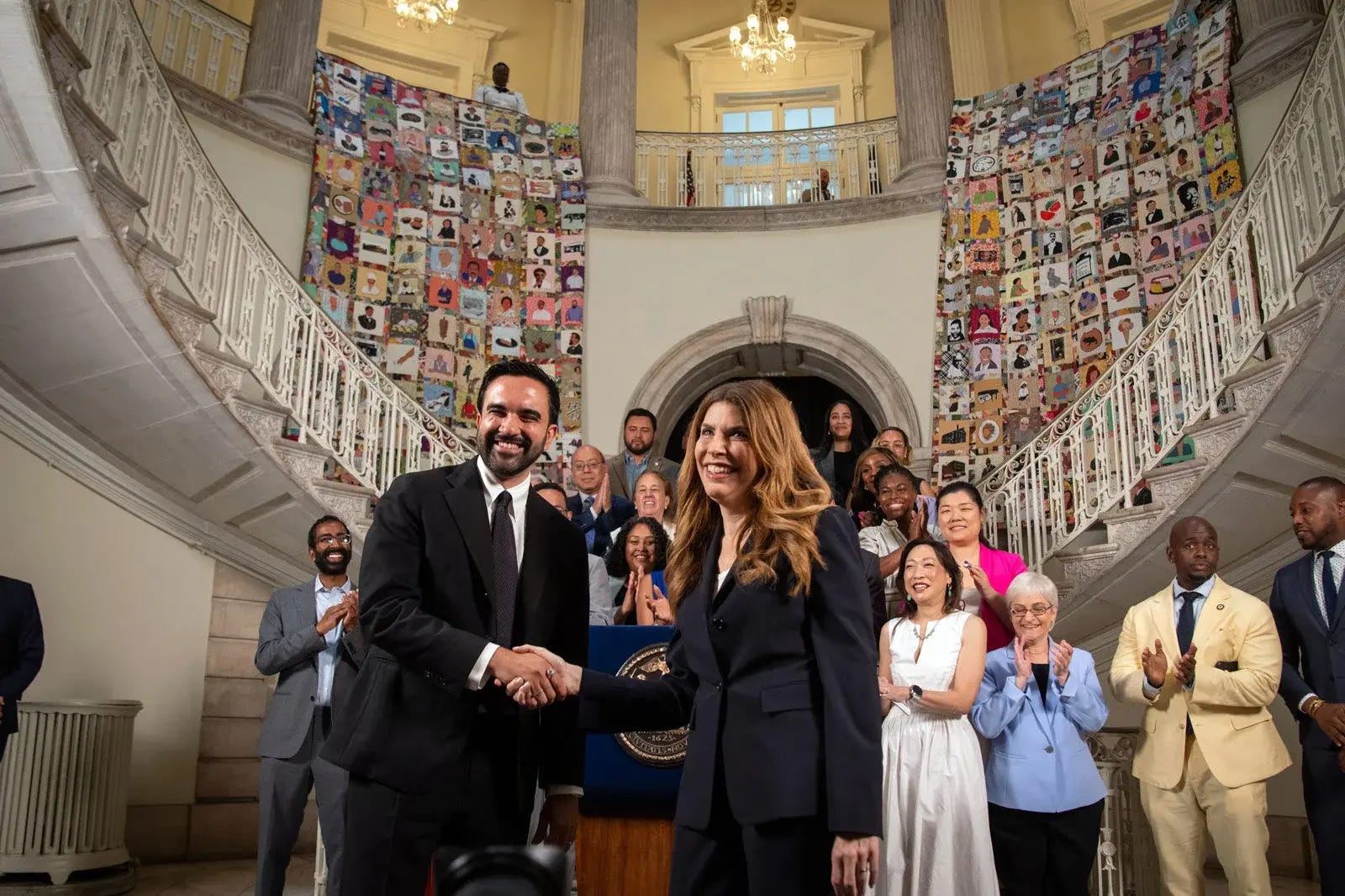
The agreement is a political success, but a fiscal punt. To close the gap (which you may recall jumped all over the place), the mayor and council leaned on one-time aid from Albany and deferred pension contributions. As we have written, the pension maneuver frees cash now in exchange for larger bills later. The deal does add an additional $350 million to reserves, reversing the mayor’s earlier push to draw them down, but New York’s economy is strong, and it should not take crisis-era tools to balance a budget in good times. Next year, the mayor could well again point to the pending fiscal crisis to demand higher taxes on businesses and high earners and the cycle will play out once more.
The adopted budget expands the City Fighting Homelessness and Eviction Prevention Supplement (CityFHEPS), the rental assistance voucher program. The council surprised many by picking this fight with the mayor, but they had leverage. It was untenable for Mamdani to be seen opposing vouchers for a few reasons—first, he supported expanding the program in his campaign; second, he had proposed increasing the police headcount despite vowing not to do so in his campaign; and finally, because the relatively moderate Council Speaker Julie Menin was pushing for the vouchers and he could not be seen as to the right of her on the issue. Vouchers should be seen as well aligned with Mamdani’s
That said, for now the voucher program is caught in a death spiral: high rents push more households into needing a voucher while raising the price of each voucher. As the city builds and rents ease, voucher costs should follow them down, but until then we cannot afford to lose neighbors to the gap.
However, more funding will not house more people absent delivery reform. Many households that qualify for a voucher to obtain or retain housing cannot get through the paperwork to claim what they are owed. We have proposed longer reapplication windows, the reuse of information residents already gave the city and state, and fewer demands at each step. The city can act now to reduce the time tax put on its poorest residents.
The budget also adds $54 million a year to Fair Fares, the discounted-transit program, and raises eligibility from 150 percent to 200 percent of the federal poverty level. The expansion is great news; paired with automatic enrollment, which would take operational work from the city, Fair Fares is an efficient way to widen transit access for low-income riders.
We are glad to see that the mayor was willing to at least temporarily compromise on his call for free buses. Free buses are an expensive way to reach a fraction of the people who need help. The MTA recently found that two-thirds of Fair Fares users’ trips are subway only, meaning free buses alone would either not help the majority of low-income New Yorkers or would cause people to move from the faster subway to the slower bus system, crowding the buses and dropping ridership and revenue from the subway system. Further, free buses would cost roughly $1 billion a year; while roughly $370 million—a bit more than double the total new fiscal year 2027 spending—could dramatically expand Fair Fares to make riding the bus or subway free for many low-income New Yorkers and much cheaper for many more. After fully funding Fair Fares, the city could put the remaining money into new subways in upzoned communities, reducing commute times and housing costs throughout the city.
Similar to vouchers, the city now needs to focus on dramatically expanding the uptake of Fair Fares. Only about 41% of eligible New Yorkers have signed up. Contrary to what some may argue, this is not the natural consequence of a means tested program. The city has the data it needs to more nimbly automatically enroll people who are eligible. SNAP, Medicaid, and the Biden-era child tax credit are or were all means tested and had double the uptake rate. The lack of a universal program is not an excuse.
Rent freeze. The Rent Guidelines Board froze stabilized rents for two years, a central Mamdani promise. For most of the roughly one million stabilized units, a freeze is survivable: in mixed buildings, where regulated apartments sit beside market-rate ones, the market units cross-subsidize the rest. A freeze for regulated units will simply mean higher increases for unregulated units. The danger lies in the older, fully stabilized stock—pre-1974 buildings concentrated in the Bronx, Upper Manhattan, and central Brooklyn—where operating costs already outrun the rents owners are allowed to collect. A two-year freeze pushes those buildings toward deferred maintenance, vacancy, and foreclosure. City Hall has started to move to reduce insurance costs for some of these owners, which is helpful, but a lot more will be needed to reduce their operating costs and prevent collapse.
Penn Station and Gateway. New York continues to tangle with the federal government over the nation’s largest transit hub. After announcing the proposed redesign of Penn Station, Amtrak, now muscularly controlled by the Trump Administration’s Department of Transportation, is looking to clarify partnerships and costs. Amtrak’s Andy Byford, formerly of the MTA, pressed MTA chair Janno Lieber to sign on as a partner, and Lieber has refused, citing the absence of a cost estimate or funding source, the protections in the MTA’s century-plus lease, and his skepticism of President Trump’s intentions. The federal government has said that it will spend $8 billion on the overhaul and has included a request for $1 billion in its more than $80 billion supplemental budget request to pay for the war with Iran. It is not clear how the Trump Administration plans to convince Congress to give $8 billion to New York, or why Amtrak would be eager for the MTA’s partnership if the federal government is picking up the tab. In better news, a federal judge
Congress passes a housing bill. Congress passed the 21st Century ROAD to Housing Act, the largest federal housing package in decades. The bill directs the Department of Housing and Urban Development to publish model zoning and land-use frameworks, streamlines federal environmental review for housing, opens a path for more jurisdictions to adopt single-stair apartment buildings up to six stories, ends the permanent-chassis rule that has held back factory-built homes, and steers grant money to localities that grow their housing stock. President Trump canceled the signing to press an unrelated voting bill, though the measure can become law without his signature. We are happy to see pro-supply reforms pass with wide margins, and to see them framed as technocratic, no-brainer affordability moves.
And with that, we would like to wish you all a happy Fourth of July. It will be extremely hot—seriously—please take care, drink lots of water, and check on people in your community. I, like many, often feel torn about celebrating the country, especially this year, but I have already channeled my Knicks joy into the World Cup and I plan to let that carry me through. I hope everyone can find something to celebrate this weekend.
No posts
Comments
Nothing yet. Say the first thing.
Sign in to join the conversation.