
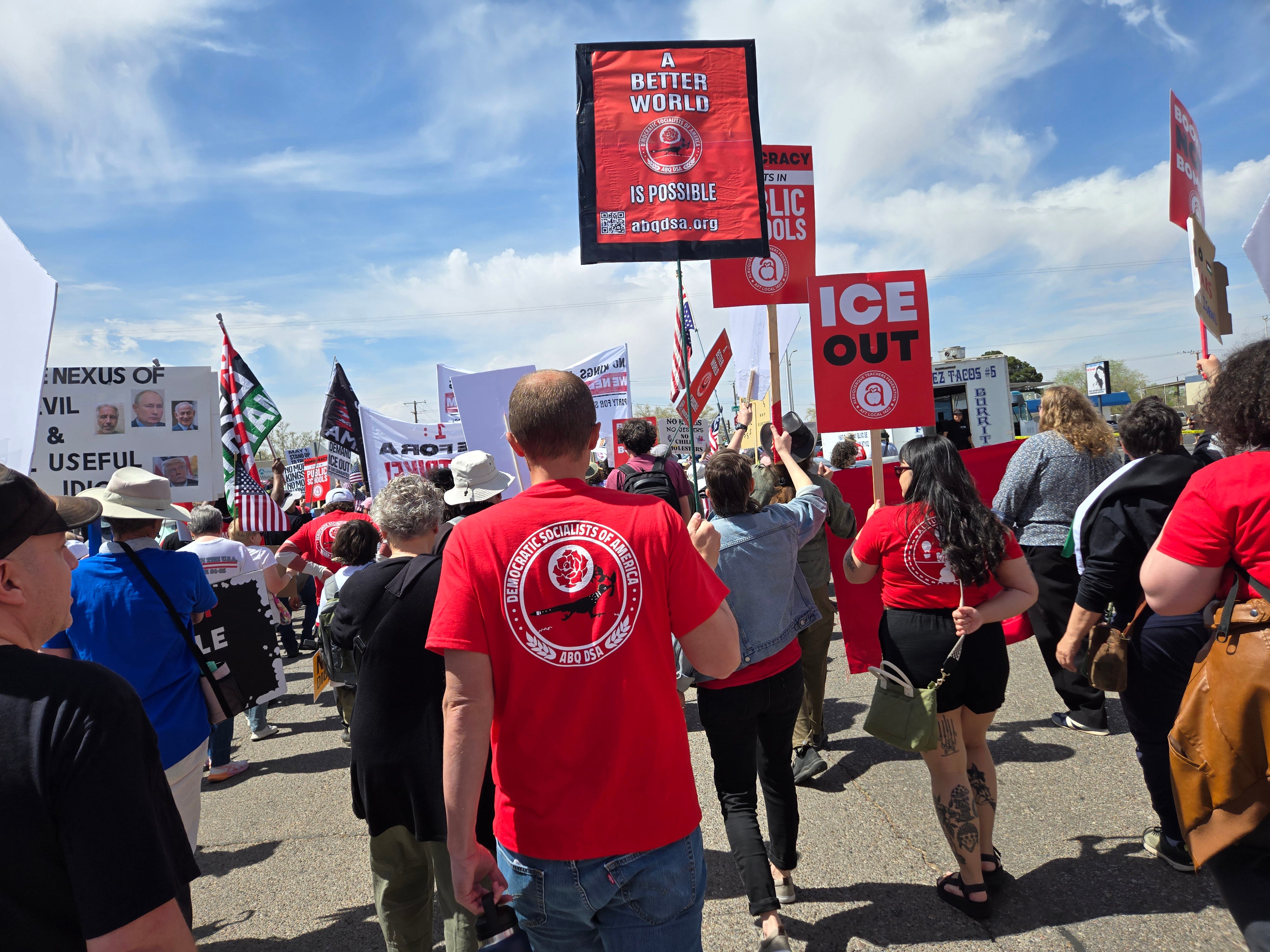
As I began closing in on Montgomery Park, riding full steam down the Paseo Del Nordeste bike path, traffic began to pile up. People of all ages were streaming in on their bikes from all directions — a trickle at the Carlisle crossing turned into a flood by the time we inched toward San Mateo. Outside of Balloon Fiesta, which draws an international audience instead of the almost entirely New Mexican audience on March 28th, no other event could have drawn so many people out by foot and by bike to fill a park in our small city.
When I arrived, passing up the free bike valet which was by then near capacity, I could not find the edge of the crowd. On both sides of the Hahn Arroyo, people had gathered in numbers that surpassed anything I had yet seen in Albuquerque. Young families, old friends, neighbors, and newcomers alike were sharing in something exuberant — the third gathering of its kind, and by far the largest — to express support for, and a willingness to fight to defend and expand, democracy.
In my conversations that morning, I kept expressing astonishment at the crowd. Even so, I never imagined the total would be what it turned out to be. Counting those who lined the three-mile march route winding down Montgomery, Louisiana, and San Mateo, all those who played music, gave out food and drinks, and offered support along the way, drone footage estimates came in close to 50,000. Yet, this march, the largest in Albuquerque history, was only one of 28 held across the state that same day.
What does a number like that mean? It helps to have a framework.
Harvard scholar Erica Chenoweth, who is also one of the researchers behind the Crowd Counting Consortium, which documents protests across the U.S. to measure the effectiveness of civil resistance, has found, across dozens of historical examples, that it takes roughly 3.5% of the population engaging in sustained nonviolent resistance to turn the tide against an authoritarian regime. Based on attendance estimates from across New Mexico, it is safe to say our state crossed that 3.5% threshold on March 28th, with upwards of 5 to 8% in the streets in several towns.
The New Mexico contingent comprised 28 of the nation’s 3300 nationwide protests totaling an estimated 8 to 9 million participants, once again breaking the record for the largest single-day protest in American history. That is not nothing. That is, by Chenoweth’s own measure, enough to demonstrate the potential to stop an authoritarian in its tracks, and enough to send a clear message to our state and local governments that New Mexico demands a people-first agenda, building on major working-class wins like universal childcare.
Stacey Abrams, who delivered the keynote address at Montgomery Park, gave us something important to hold onto as we sit with those numbers. Her biggest message was this:
We’re going to organize ourselves to show up after today because they need to know that ‘No Kings’ is not a day, it’s a dream, and it’s a truth, and it’s a reality... We’re going to show up at those community meetings, at those city council meetings, at those county commission meetings, because they’re not doing this alone in DC.
“No Kings is not a day.” That is the critical lesson.
Yes, 50,000 people turned out in our city, surpassing all expectations. But that number only shows us our potential. The real work is in the second part of what Abrams said — the turning up, the organizing, the building of a movement that outlasts any single day of protest.
Think about it this way: far more than 50,000 Burqueños support a bold transformation of our democracy. The people who couldn’t make it didn’t disappear, nor did their support. Polling consistently shows that the policy agenda on offer from the organized left — fair wages, affordable housing, healthcare, childcare, community safety, an end to needless wars — commands majority support. If 8% of Albuquerque showed up in the streets, somewhere close to 80% likely supported what we were doing out there. That gap, between the 8% who showed and the 80% who agree, is exactly where organizing lives.
Mobilizing and organizing are two different things, and both matter. Mobilizing is how we show force. It’s how we demonstrate to those in power that we exist, that we are many, that we are paying attention. March 28th was a mobilization, and a historic one. But mobilizations alone do not win contracts. They do not pass legislation. They do not transform city councils or build mutual aid networks or stop an ICE raid on a neighbor’s family.
Organizing does those things.
Organizing is the slow, relational, unglamorous work of building power from the ground up — and it is how every lasting change in this country has actually come about. It is how unions are formed and how workers win the kinds of contracts that bring real wage increases, job security, and dignity on the job. It is how our city councils and state legislature can be transformed into bodies that are drawn from the working class and act for the working class, rather than for donors and developers. It is how the fight against those who would buy our state to bleed it dry can be contested, and overcome.
And crucially, organizing is also how we build things. We saw this with universal childcare. We are seeing it in ongoing efforts to expand affordable housing in Albuquerque. Organized people, working together over time, with a vision and a plan, can win material improvements in everyday life — and those wins build the trust and momentum to win more.
The stakes right now are high and they are concrete: ICE operations tearing families apart; a war in Iran that was never put to a vote; the ongoing genocides in Gaza and Sudan that our tax dollars fund; wages that don’t cover rent; food insecurity; housing scarcity; the steady erosion of public institutions. None of these are problems that a single march — however historic — can resolve on its own. But a sustained, united movement, rooted in working-class communities and reaching across issues, can.
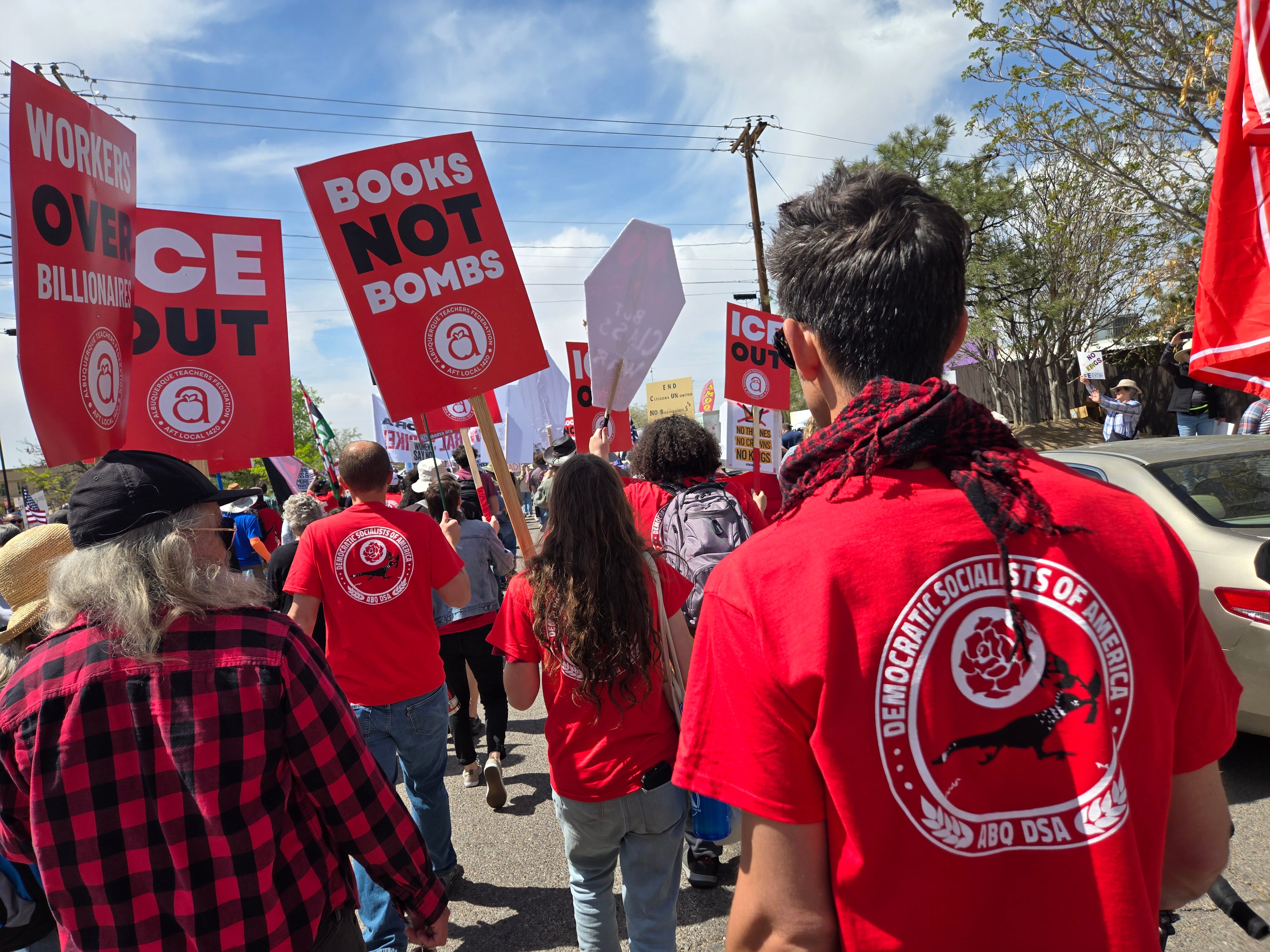
A glimpse at the front of the march in Albuquerque showed that some people already understand this. The forward column was a left united front of roughly a thousand members of DSA, PSL, Organized Power in Numbers, and three unions in our city, UE, AFT, and CWA, who represent our teachers, university faculty, staff, graduate workers, communications workers, and government workers — followed by a wave of progressive organizations. Together, these groups are calling for a renewed push toward a general strike on May Day 2026. They do far more than show up to national protests. For many of them, the march was a moment to deepen relationships, recruit new members, and invite the tens of thousands around them to take the next step.
That column was a hopeful sight. Not because it was the loudest or the biggest part of the march, but because it represented thousands of Burqueños who have been doing the work between the big days — building the capacity, the relationships, and the vision needed for all the fights and projects still ahead of us.
At the park, I had conversations with high schoolers and retirees alike who were looking to get into organizing for the first time. There was urgency in those conversations. There was clarity, and resolve — but also hope, and joy. A sense that it is we, together, who make our futures. That no one is coming to save us, and that this is not a cause for despair, but for action. We alone are responsible for our democracy. We alone can build a future of dignity, peace, and abundance for all the people of this city and state.
No Kings was not the struggle. It was a place to meet, to count ourselves, to feel in our bones that we are not alone. The struggle is what comes next: in your union, in your neighborhood association, in your DSA chapter, in your school board meeting, in the conversations you have with your coworkers about why things are the way they are and how they could be different.
The world is not made by a handful of elites for a handful of elites. The crowd that filled Montgomery Park and spilled out along three miles of Albuquerque streets on March 28th was a living refutation of that. Fifty thousand people, on a Saturday morning, saying with their bodies: we know our power, and we’re not done yet.
The horizon is further than one march, and we are moving toward it together.
The views expressed in this piece are those of the author alone and not necessarily those of The Red Rose, its Editorial Board, Albuquerque DSA, or the Democratic Socialists of America.
No posts
Comments
Nothing yet. Say the first thing.
Sign in to join the conversation.