
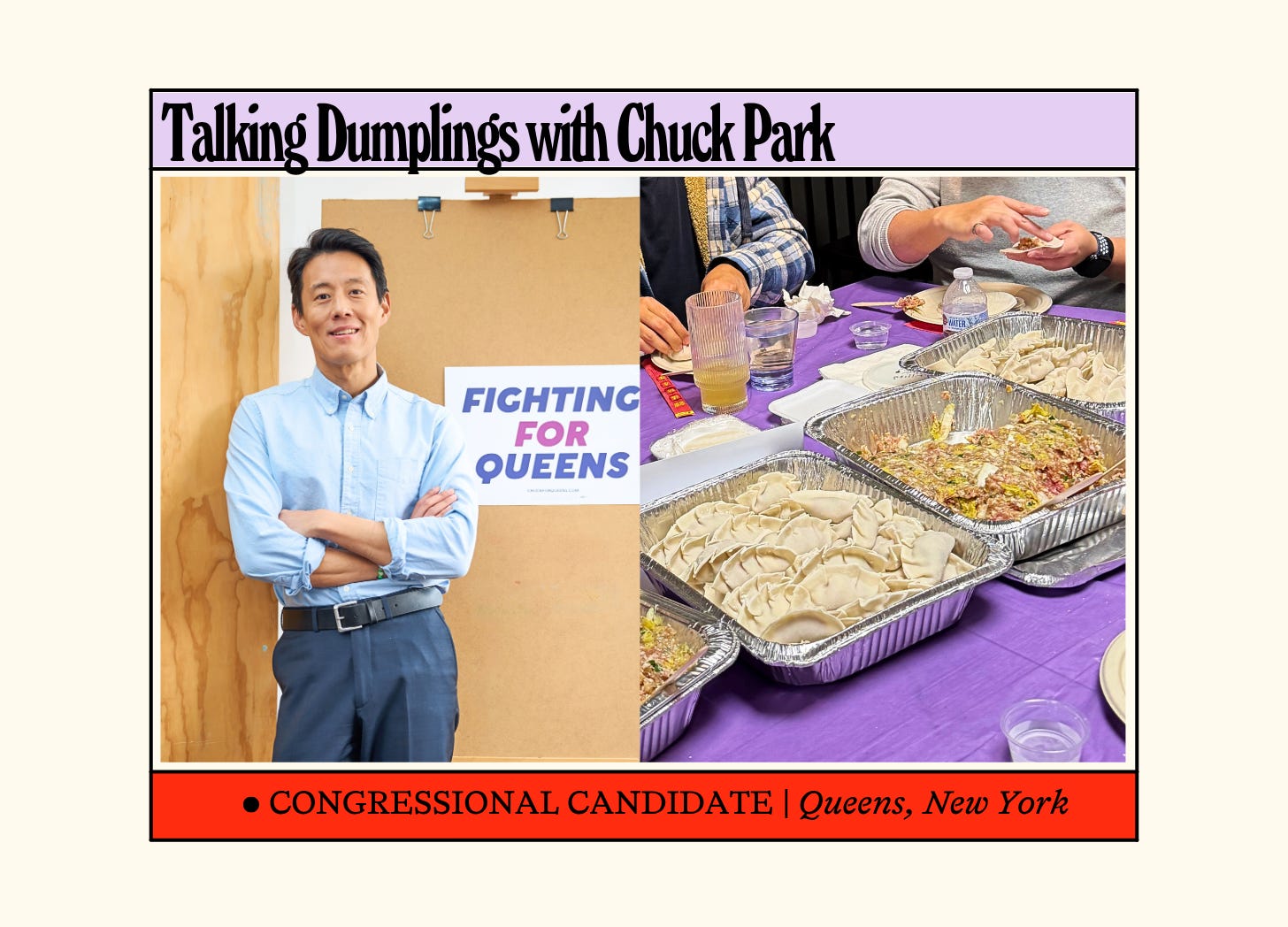
Dumplings are a big part of the culinary tapestry of Queens, New York. (In fact, food journalist Caroline Shin wrote a piece in Issue 2 of Above the Fold about the “Dumpling Capital of America.”) Nicknamed “The World’s Borough,” Queens is where you’ll find the best Nepalese momos, Colombian empanadas, Korean mandu, and so much more. And all credit is due to the immigrants who have decided to call this place home.
Alongside the restaurants lining Roosevelt Avenue or Flushing’s Main Street are dumpling-making traditions taking place in immigrant homes, where families get together to assemble beautiful and delicious dough parcels for dinner.
“I have a lot of memories of my aunts, my mom, and my grandma just sitting around in our living room for hours laying out tons of the wrappers, with huge metal mixing bowls of the filling,” recalls Chuck Park, the son of Korean immigrants who landed in Queens back in the ‘80s. “They were sitting, chatting and gossiping, and, methodically just making trays and trays and trays and trays of mandu while my cousins and I were running around.”
It’s this feeling of warmth alongside informational exchange and storytelling that Park fondly associates with dumpling-making. And it’s a feeling that he hopes to extend beyond the confines of family homes, and outward to the borough of Queens at large. Community is at the center of Park’s mission and goals as he—a grassroots organizer and former diplomat during the Obama administration—runs for office as a Democrat in New York’s 6th Congressional District (which covers neighborhoods such as Forest Hills, Jamaica, and his birthplace, Flushing).
In February 2026, Park launched an event series on his campaign trail called “Dumplings & Dialogue,” where New York residents—from Queens or otherwise—can gather, make, and eat dumplings, sharing stories and experiences with one another in the process.
“Queens is one of the most diverse communities in the world. It’s the beating heart of immigrant America,” Park says. “We built these communities ourselves around living rooms, making dumplings together. And so the dumplings are kind of the gateway into just talking about our shared broader immigrant experience in Queens.”
In a conversation with Above the Fold, Park talks about his personal connection to Queens, plans for future Dumplings & Dialogue events, and what he hopes the community takes away from the shared activity of dumpling-making (and eating).
Jasmine Ting: Can you tell us about your personal relationship to Queens?
Chuck Park: Many of our origin stories as immigrant Americans, especially immigrant New Yorkers, start in Queens. My parents, they came from Korea in the ‘80s. They landed in Woodside, and their first job was street peddling. So they’d wake up at the crack of dawn, leave their apartment, and go to the original H Mart in Woodside. They’d buy coffee and cigarettes, hop on the subway, and then go to Canal Street, where they’d spend 12-13, hours a day selling T-shirts, jackets, and jeans to tourists. Through street peddling, they were later able to open a small business. They bought a house, and they raised five kids. And this one son of immigrant street vendors grew up to become a US diplomat under President Obama, representing the richest, most powerful country in the world.
To me, that’s the promise of Queens. That’s what makes this place so magical. You can land here, work your butt off, and this place will give you a home and a future.
What made you want to run for Congress?
I’m running for office because I think that promise is under attack. I think we need leaders who will defend that promise—and not only defend it, but expand it.
More than anything, I’m fighting to defend our story, but I also want to make sure that the story of Queens is also told to the rest of the world. It really is a miraculous, magical place where people with so many differences come together in unity, usually around food. And I think dumplings are the perfect delivery vehicle for bringing us together.
How did the idea for Dumpling & Dialogue come about?
I wanted to authentically connect to our communities in Queens, whether it’s my Korean community or the Chinese community, the Filipino community, the Polish community with pierogis, Italian immigrants in Queens who still make ravioli. Every culture has their dumpling, right?
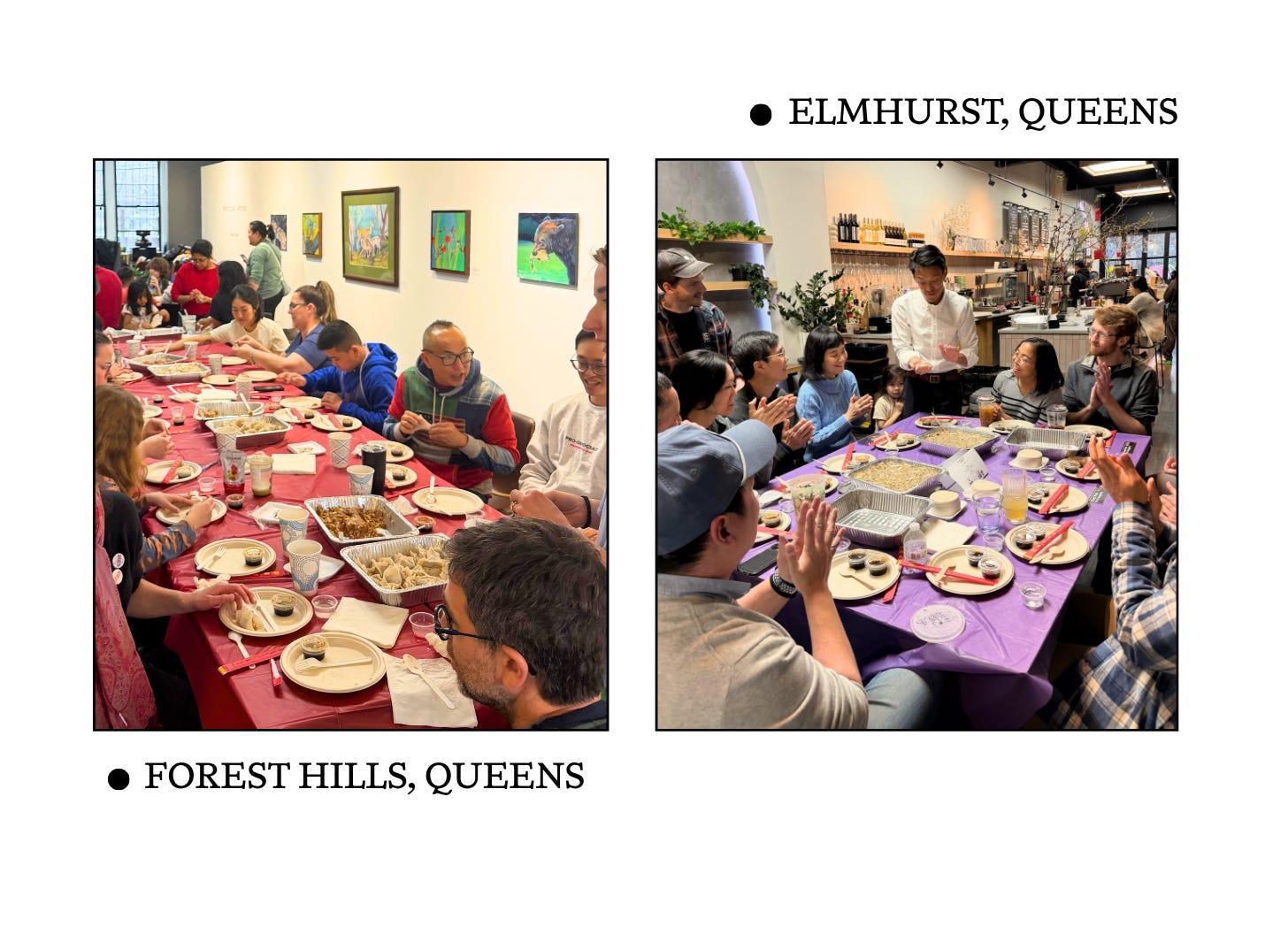
We started off with Korean mandu and Chinese jiaozi. We did that twice: one in Forest Hills, and one in Elmhurst. We did an empanada event for our core volunteers and canvassers in Corona. Next, we’re going to do a lumpia-making event in Woodside, where Little Manila is. And that’s going to be with Filipino chef Abi Balingit and Filipino author Jill Damatac. Same thing, just gathering the community. We’re going to sit around, we’re going to share a little bit about the Filipino community in Queens. We’re going to make food together. We’re going to eat food together and build community.
I think future iterations will include empanadas, ravioli, and pierogis for the Polish community.
How do you think dumplings facilitate community dialogue in a way that might otherwise not be possible?
It is tough to talk about, let’s say, public safety and immigration enforcement, because if you start with the public policy issue, people come in immediately with where they stand. Maybe they’re against illegal immigration, or maybe they’re super in favor of open borders and give everyone citizenship now. To be clear, I’m in favor of a pathway to citizenship for undocumented people. But if you lead with the big political issue, that will immediately lead to polarization, separation, and division. And so the whole goal of these Dumpling & Dialogue was to start with points of commonality.
I mean, obviously dumplings are a common thing among Italian Americans, Polish Americans, Korean Americans, or Venezuelan Americans. But, really, the commonality is the immigrant experience. We all came at some point in our histories from somewhere else. We were all treated like crap here. We came with nothing, and we started with that nothing, and we built these communities ourselves.
Were there any moments during past Dumpling & Dialogue events that stood out to you? Or perhaps that excited or inspired you for the future one?
I think just to know that I was able to recreate that feeling of a living room in this community space called the YANT Art Space. Most of the attendees were strangers. There were around 40 people, maybe ten or a dozen kids. No one knew each other. We weren’t all Koreans. We weren’t from the same family. And so I wasn’t sure if the food alone—if the act of making dumplings, sharing, and eating them together—could build community. But it did.
People sat down next to people they didn’t know before, and they did the same thing that my mom, my aunts, and my grandma did. They made dumplings together, talked, and ate together. And the kids were running circles around the room, breaking stuff. It felt so warm and so close to what I experienced as a kid growing up.
I think everyone left the event feeling like, “Wow, this is a new community that I’m part of.” And that’s what surprised me, that it actually works. I guess it’s not some magical formula. It’s something that people have been doing forever that unified us.

As you keep hosting Dumpling & Dialogue events, what do you hope more people take away from them? Aside from learning how to make dumplings, of course.
There’s so much commonality among all of us, despite what you might feel reading headlines about national division. In fact, if you sit next to somebody in Queens, there’s a good chance that you’d have a lot in common with each other.
The dumpling dialogues bring some positivity, definitely some joy, and all built around good food during a time where it feels like our differences are more stark than ever at the national level. It’s a good reminder that if you just go out and walk on the streets of Queens—walk on the streets of Woodside, or Flushing, or Elmhurst, or Bayside—you just experience the miracle of what is already happening in these neighborhoods. People who are drastically different from all places in the world practicing all religions—whether you’re Jewish, Muslim, Catholic, Sikh, Hindu…There are so many people who, anywhere else in the world, maybe wouldn’t be getting along and on a daily basis in Queens we are going to school together. We’re working together. We’re marrying each other. We’re playing baseball or cricket or soccer together. This is the miracle that happens every single day in Queens, and that’s the story I want to tell. We have really something special going on here that we should be proud of.
This interview has been condensed and edited.
No posts
Comments
Nothing yet. Say the first thing.
Sign in to join the conversation.