
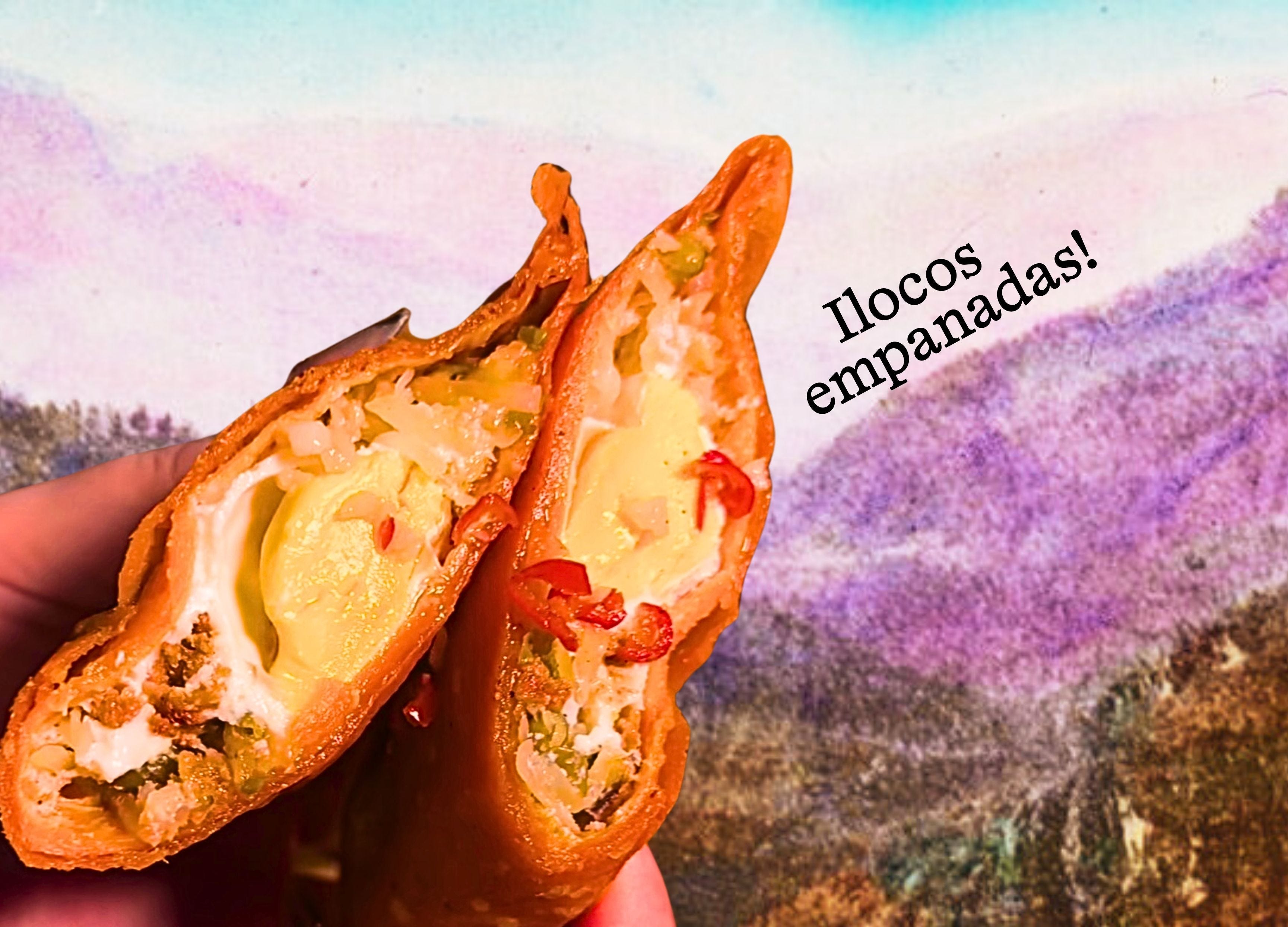
Please join me in welcoming Jasmine Ting, a food and culture writer who’s been working with me on the Above the Fold Instagram account (if you’ve noticed we’ve been posting a whole lot more lately, well, now you know why! If you haven’t, go check it out and give us some love!). You’ll be seeing more of Jasmine’s thoughtful research, reporting, and writing in future installments of the newsletter—including today’s, where she goes deep on the Filipino Ilocos empanada, and chats with the maker responsible for it blowing up in Brooklyn. —Leah
Since the dawn of Instagram in the 2010s, the vibrant purple hue of ube has been the defining color of Filipino cuisine—at least, as it is known to people especially in the Western mainstream. But most recently, a new striking hue has become the face of Filipino food virality: orange. Specifically, Ilocos empanada orange.
An Ilocos empanada is a popular Filipino street food that originates from the northern region of Ilocos (which is divided into Ilocos Norte and Ilocos Sur), where the influence of Spanish colonization is deeply felt and seen. I remember my first trip to the city of Vigan, Ilocos Sur when I was young, mesmerized by Filipino tricycles driving on cobblestone streets that went through the corridors of the old Spanish colonial town. This hybrid blend of Spanish and Filipino cultures defines the city, and is perfectly encapsulated by the city’s most iconic snack.
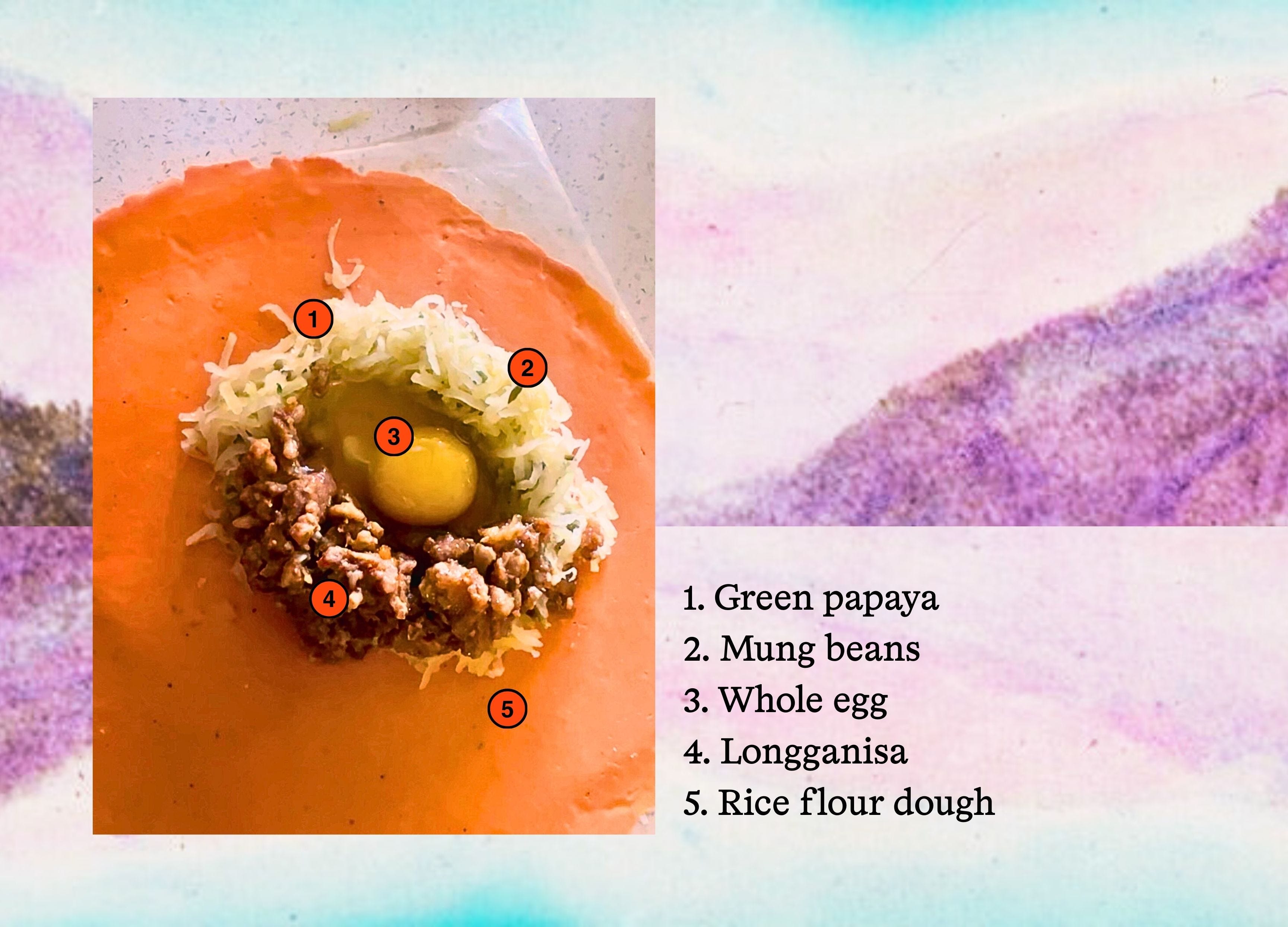
Like many Filipino dishes, the Ilocos empanada is the result of Filipinos taking a Spanish heritage dish (the empanada) and making it their own. The filling is a mixture of shredded green papaya, longganisa (savory Filipino breakfast sausage; in this case, preferably garlicky Vigan longganisa), mung beans, and a whole egg. All of this is folded into a rice flour shell, which has been dyed a bright orange color using atsuete (annatto seeds), and is deep-fried to a crisp—so crisp, in fact, that a bite into the massive, bright orange crust should elicit an audible crunch. Of course, another essential component on the side is sukang Iloko, a fermented sugarcane vinegar from Ilocos.
It amazes me that, somehow, this regional Filipino street food has become the Internet’s latest food obsession. Many food content creators drive for miles for empanada drops from the nearest home cooks-turned-empanada entrepreneurs. Quite a number have knocked on Alyssa Price’s door for this very reason. The Brooklyn-based purveyor, who goes by @ijustbecookin on Instagram, officially began selling her empanadas just over a month ago. And now, she finds herself swamped with orders.
“I have an email list,” she explains. “Last time I checked, it’s at 4,300 people, which is mind-blowing.”
Alyssa first tried Ilocos empanadas from a Filipina vendor selling them from her garage in Hawaii—she was enamored by the unique treat and wanted to recreate it on her own. She did her research online, called up family (to no avail as they were unfamiliar, tracing their roots to Metro Manila), and began testing out recipes. It took about a year of R&D to land on her signature empanadas.
“It’s been one of the most challenging recipes that I’ve developed, worked on, and learned,” Alyssa says. “But also the most rewarding, because, funny enough, this is the one food item that now I’m known for, which I feel so blessed for.”
Ahead, Alyssa speaks to Above the Fold about the challenging process of making Ilocos empanadas, how she makes them her own, and an exciting forthcoming pop-up at Titi’s Empanadas.
Jasmine Ting: What’s your personal connection with Ilocos empanadas, and what made you want to run an empanada business?
Alyssa Price: I’ve grown up feeding people my whole entire life, and the purpose is to just bring joy to those that I’m feeding, and also maybe trigger a memory in them, or maybe provide them a new experience. This dish kind of just fell in my lap, and it’s been really a big passion project—it’s a part of my heart that I’m sharing with others, and a cool way that I get to connect with my culture.
I grew up second gen Filipino in the U.S. My parents really purposely raised us not to speak Tagalog, more so for the purpose of assimilating. The only thing that we’ve had to embrace our culture is cooking Filipino food. Even though this empanada is not exactly where I’m from, it feels really cool that I get to connect to being Filipina in that way.
People often know more about Latin American empanadas, but it’s rare that Filipino empanadas ever get talked about. How did you feel, seeing Ilocos empanadas blow up on social media the way that they have?
I really appreciate that it is getting a moment of attention because there are a lot of creators out there who are taking the time to expand on educating others more about Filipino culture and more about Filipino cuisine. I think there’s something really fun about just what it looks like—it’s bright orange, and the shape is fun.
You’ve put so much thought into your empanada-making process. How else have you personalized and really made Ilocos empanadas your own?
I’ve just kept it traditional. It has the green papaya, mung bean, and, of course, the egg. I’ve made so many of these, but it’s still so satisfying every time I crack that egg, because it’s just so beautiful. Something I’ve had a lot of fun with is my spiced suka (vinegar) that I serve with it. I use a combination of a couple different vinegars, and some spices that I grew up eating with longganisa.
Something that is super challenging about the dish is the dough. It’s made of rice flour, which causes it to be extremely delicate when it’s not cooked. It’s easier to handle if you roll your Ilocos empanada a little bit thicker. But what makes it special is a thinner shell, a very crispy shell.
And when you’re cracking a whole egg in there, it just completely disrupts the whole integrity of the dough. When I first did it, I literally had to freeze them before I dropped it in the fryer, because I could not pick it up from the time I assembled it to the time when I threw it into the fryer.

I’ve always wondered how you get those empanada shells so crispy. I watched your “crunch test” video, biting into your empanadas all over Brooklyn—even in the subway! So cool that your empanadas have such a loud crunch.
It seems that a lot of other vendors or sellers keep their dough’s hydration levels a little bit higher, and I’m not too sure if that helps with their strength. I mean, they’re also pros. They’ve been doing this way longer than I have. They’re able to roll their dough super, super thin. But something I’ve noticed is that they don’t get as many bubbles as I do on my empanadas. And that’s something that was super important to me. Once I discovered the hydration level that I was really happy with, I kept it on purpose, a lot lower than what I’ve seen, because I got really gorgeous bubbles when it came to frying it. But even in that respect, although everything that I’m adding into this empanada is traditional, I do feel like that’s a bit non-traditional, how I keep the dough a little bit on the dryer side for those really great bubbles.
After I cut off the seam to my empanadas, I purposefully push the seam out a little bit and thin it out to make the biting experience a lot nicer. When I push out that seam, and I give you more of that little dumpling fold, if you will, it’s almost like you’re eating this meal and then also eating chips to accompany it.
Making Ilocos empanadas sound really labor-intensive, just like it is to make other dumplings. How do you balance it with your day job?
The first couple weeks were crazy, having to go to the market an hour before they close after work, picking up 150 pounds of papaya. And having it on a sling on my back or in a granny cart through the subway has been a trip, but, you know, it’s getting easier. I’m getting stronger, and now I can do it in the mornings, because I did take a leave of absence. I’ve just been serving food to my community, hosting a lot, and, you know, getting it out there by word of mouth. I didn’t think that putting myself out there with these empanadas would get so many eyes on me. So whenever it happened, I just knew for a fact that this is what I wanted to focus on.

The last food that we had really to go viral was ube. But you know, there’s this risk. I’ve spoken to chefs before who talked about the risk of our food just becoming social media bait.
There is a part of me, as I’m trying to expand and as I’m trying to get this to many people, that’s cautious because in the back of my mind I’m thinking, “Will this be a fad food?” I’m not sure. That’s really what’s causing me to take it one step at a time and really build my community when I am serving empanadas, and be very mindful about what my commitments are to expanding. There definitely is a fear of, like, lack of longevity. It’s really hard for me to not think about certain restaurants that I used to go to in lower Manhattan and how they’re no longer open.
But there are also novelty dishes out there that have been out there for a while, like Forsyth Fire Escape and their scallion pancake burritos. So there is hope for longevity. It’s really just how you can also connect this meal with the audience who wants to try it and see how we get them to come back.
What are you most excited for people to try at your upcoming pop-up with Titi’s Empanadas?
One flavor that we did some R&D for is a sinigang Ilocos-style empanada. We made some sinigang. We made it a little bit more powerful, reduced it, removed the meat, and then we also had some mustard greens that we mixed in there. We kept the broth on the side—we’re going to serve it with the broth as an accompaniment, almost like a birria with consommé.
We also made a sinigang spiced suka. And then another one that we did some R&D on is a sisig Ilocos empanada [with stir-fried pork belly]. They’re smaller empanadas, so instead of putting a whole egg in the center, we actually add the egg into the mixture. And we made this delicious calamansi mayo, that’s what the sisig is cooked with, and it’s also served on the side.
These all sound so delicious! And, honestly, there should be no reason for you not to be able to experiment with this format. Other Filipino chefs and bakers have done it.
It’s okay to also have your own opinion and also want to be true to a dish that you grew up with your whole life. But I do feel excited, because if there’s anywhere to do this version, this level of experimenting, it is New York City. I think it’s really fun to sit down, get creative with like-minded individuals, and see what magic we could create. Aside from Titi’s Empanadas, there’s also other collabs coming down the pike, and I’m just thrilled to see what creations I end up making with all these other chefs as well.
Now that the business has been taking off, will you be sticking to your name, “ijustbecookin”?
I’m sticking to this. This is my brand, and I think that’s what I’m known for. It’s funny, because this Instagram page was private a month ago. It was more of like a personal journal to myself, if anything. I think it’s genuinely perfect because I didn’t put my food out there to become the seller of Ilocos empanadas in New York or to have that be my one main thing. Really, I put it out there because I wanted people to try my food, and I just really love the recipe. Ilocos empanadas just happened to be the one thing that made me very confident in putting myself out there and selling. So, at the end of the day, I do just be cooking.
This interview has been condensed and edited.
No posts
Comments
Nothing yet. Say the first thing.
Sign in to join the conversation.