
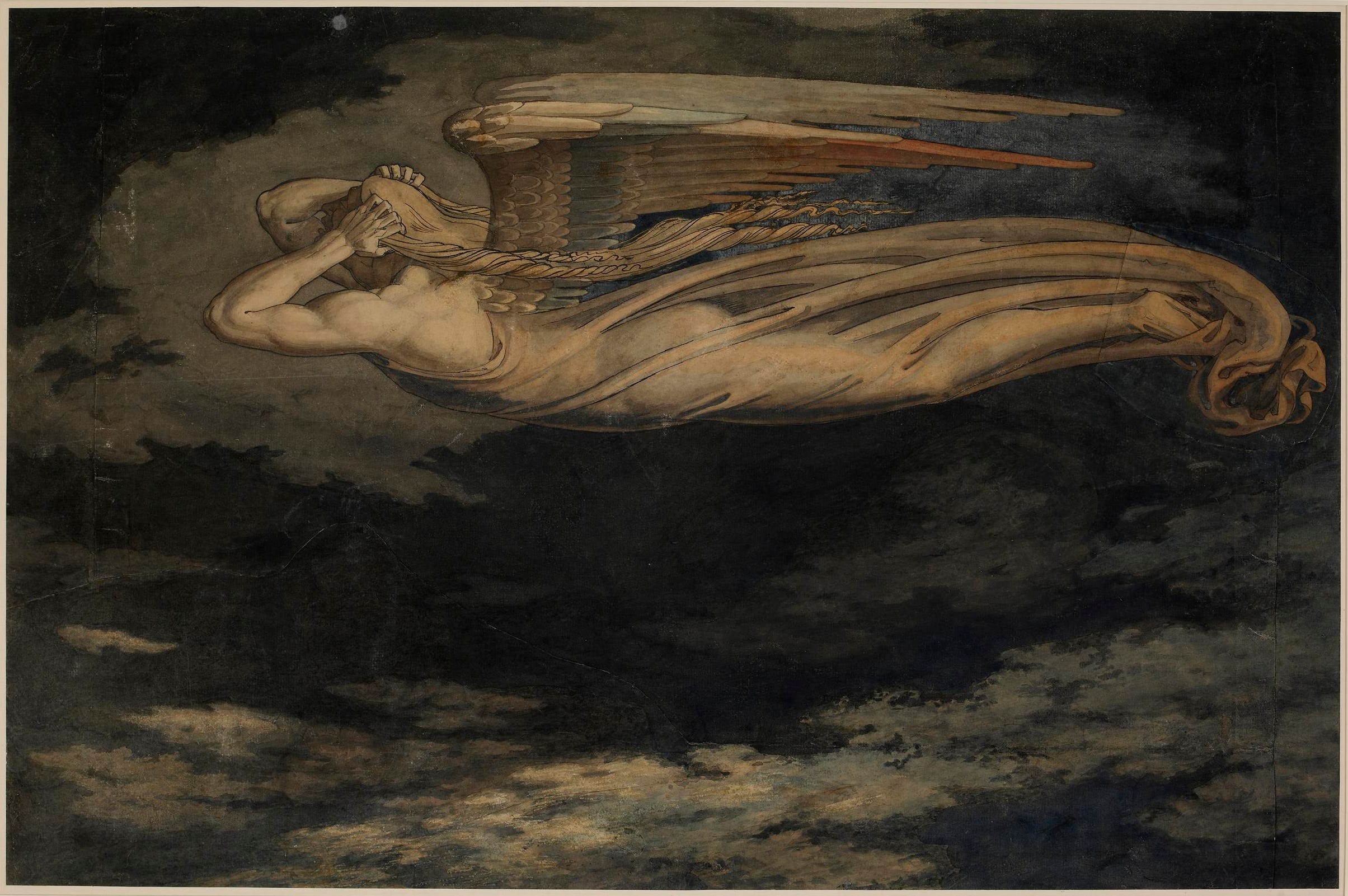
The Night-Hag, when call’d
In secret, riding through the Air she comes
Lur’d with the smell of infant blood, to dance
With Lapland Witches …Milton, Paradise Lost Book 2
If you’re travelling north up the western side of Scotland, then you’re going to come to the peaty swamps of Rannoch Moor.1
The motorway swoops through Glasgow like a concrete seagull, the poetry of its motion read off the blue signs above it: Springhill, Baillieston; Easterhouse, Barlanock. Through groves of street furniture and tarmac deserts (Garthamlock, Queenslie) – pizza boxes and empty cans blossom like wildflowers (Riddrie, Stepps) along the verge. The city’s edge is a place of prisons and sewage treatment works, undeveloped land a tangle of bindweed, hogweed and Himalayan balsam. Along the dirty banks of the Clyde, off white fronds of Russian vine dangle above the waterline – the garden plant that grows 30 metres in a year. destroying fences and garden sheds like a green-and-grey forest fire.
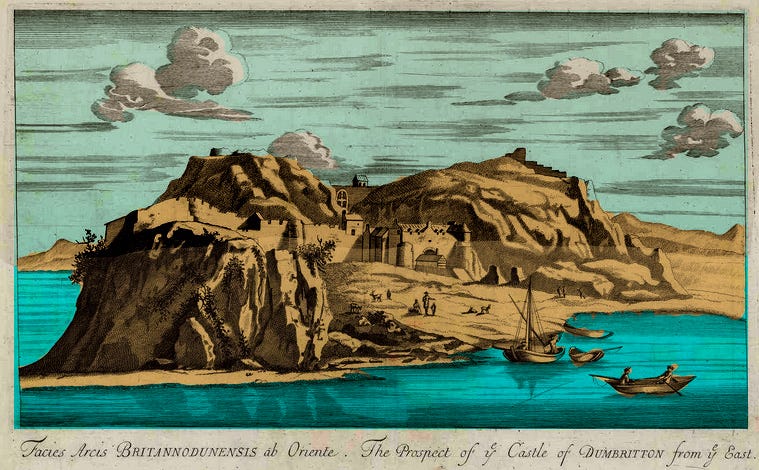
The Erskine Bridge lifts you above all this, 45 metres over the tidal river, looking upstream to the dreaming skyscrapers, downstream over Dumbarton Rock towards the open sea. So as not to distract the driver, newly placed opaque barriers on either side guard against this view. Down again on the north bank, the back of Dumbarton is cheerful with traffic lights and the fibreglass canopies of petrol stations.
To mark the entry to the Highlands, a circling flight of aluminium geese on the Balloch roundabout, twice life size, a substitute for the blocked out landscape. They were removed in 2021 as a safety hazard: even aluminium wildlife being too distracting.
After Tarbet, though, the landscape forces itself upon you. Well, not so much the landscape as the lake. Loch Lomond splashes against the steep, steep side of Ben Vorlich, squeezing the roadway into tight narrow bends. Any Citylink coach or timber lorry coming south spreads well over the white line, and if it meets a Citylink coach coming north there’ll be a two-minute gridlock.2
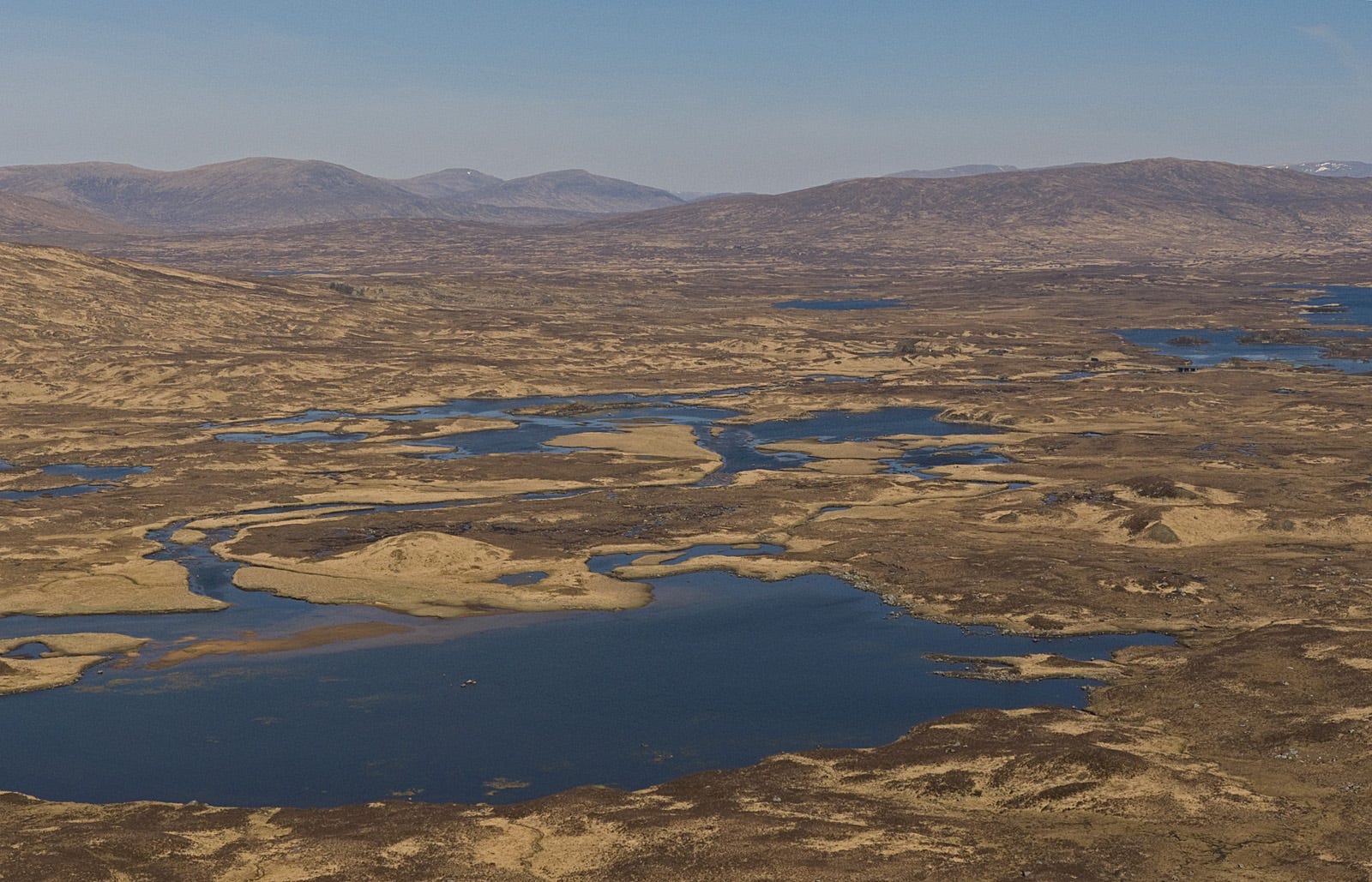
Forty minutes on, and you dive through the long concrete bridge over the Water of Tulla and up a long hairpin bend to where there’s no more roadsigns. Water, heather, black peat: they start at the scruffy verge and stretch out of sight. This is indeed one of those liminal zones, the places where you shouldn’t be, you should just be passing through. Places like pedestrian subways. Shower rooms at motorway services. Midnight railway stations. Multi-story car parks. The Moor of Rannoch.
Or as, when an underground train, in the tube, stops too long between stations
And the conversation rises and slowly fades into silence
And you see behind every face the mental emptiness deepen
Leaving only the growing terror of nothing to think about
TS Eliot ‘East Coker’
Yes, these are the liminal spaces, from the Latin word limen for the threshold stone across your doorway. To ‘eliminate’ some interloper is to kick them out of your house.
Liminal: it’s like a wasp at the picnic, the buzzword that just keeps buzzing…
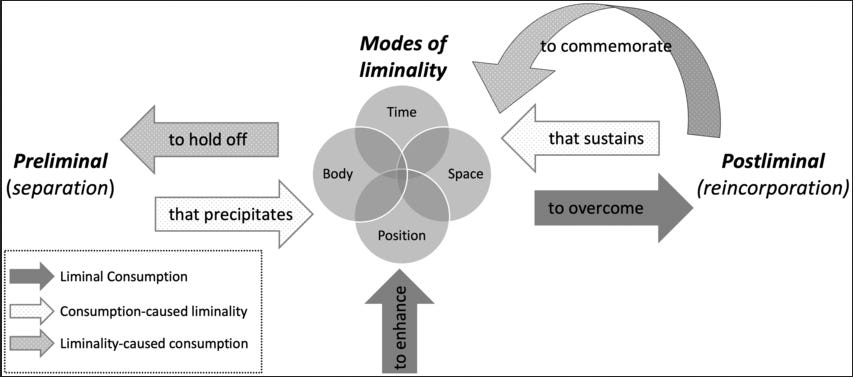
Liminal places cause unease and disquiet – but they can also be a spur to creativity. Empty, dislocated places between where you have been and where you hope, eventually, to arrive.
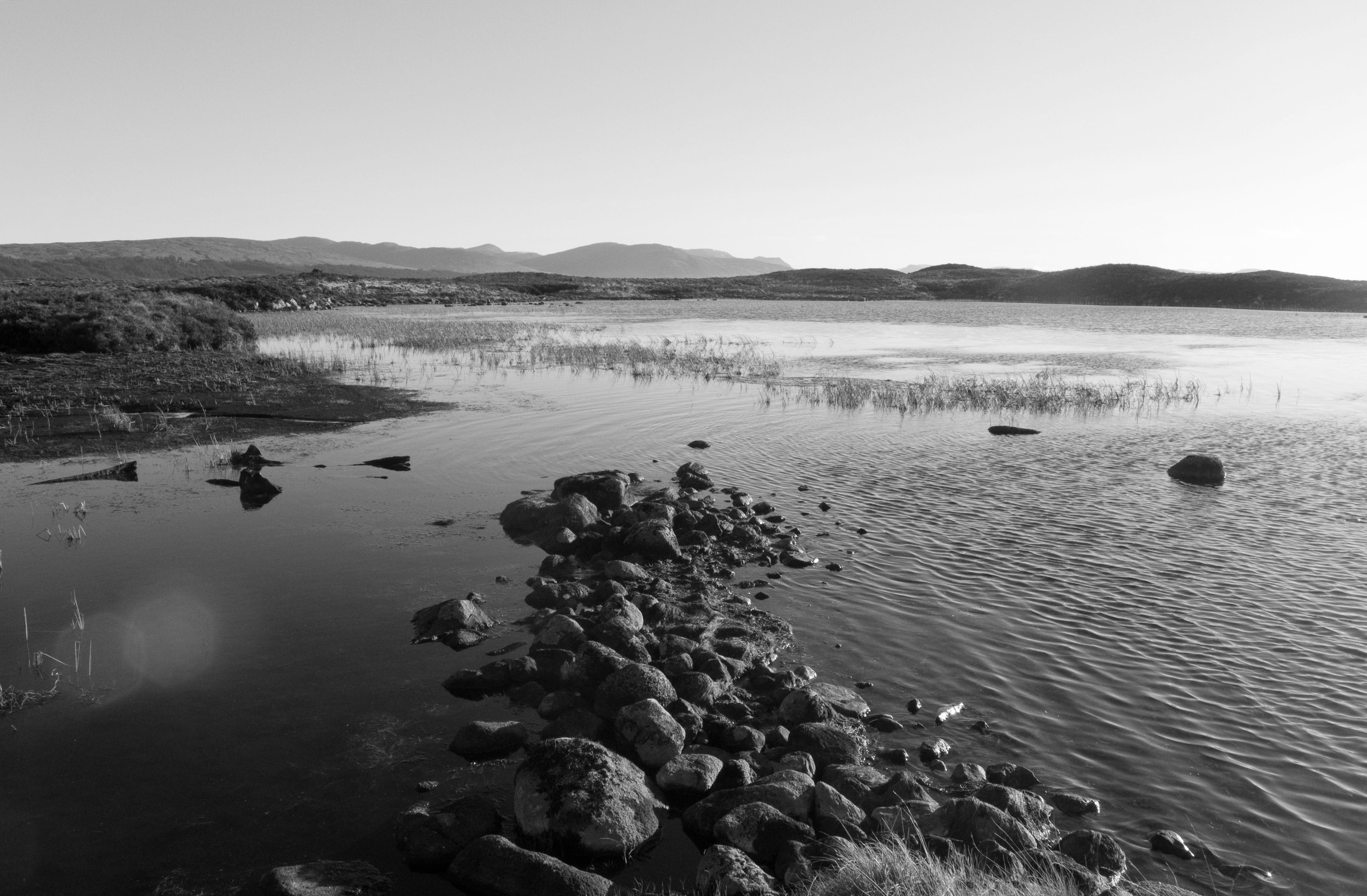
In our world of straight lines and squared off boundaries, Rannoch Moor is the opposite of all that. There are no boundaries here. Everything flows into something else. The land is half water, and the water is half land; every patch of ground has its small lake or lochan, and in each lake a scatter of small islands.
And on those islands, time too is discontinuous. Surrounded by grey water, tall pine trees grow. They are patches of memory, minimal extracts from the forest that covered this land: discs cut from ten centuries ago like the clippings from a hole-punched document scattered across the office floor.
On their trunks, and on the rocks of the shoreline, the lichens are the tartan colours of the MacDonald cattle-raiders who crossed the land in the pine trees’ early youth. Tartans dyed from natural camouflage – lichens out of the bog itself, its rocks and dead treetrunks.
If you’re a mathematician (which you aren’t, the use of that sociologists’ buzzword right in the article header has surely driven you away already…)
But if you were one, you’d understand entirely where we are now. The way the boundary between brown bog and peat-stained water, what should be the shoreline: well, there’s this thing called the Hilbert Curve. Which demonstrates, entirely rigorous and mathematical, that a line – an infinite line, we grant you, stretching without end in either direction – can pass through every point of the 30 square kilometres of Rannoch Moor.
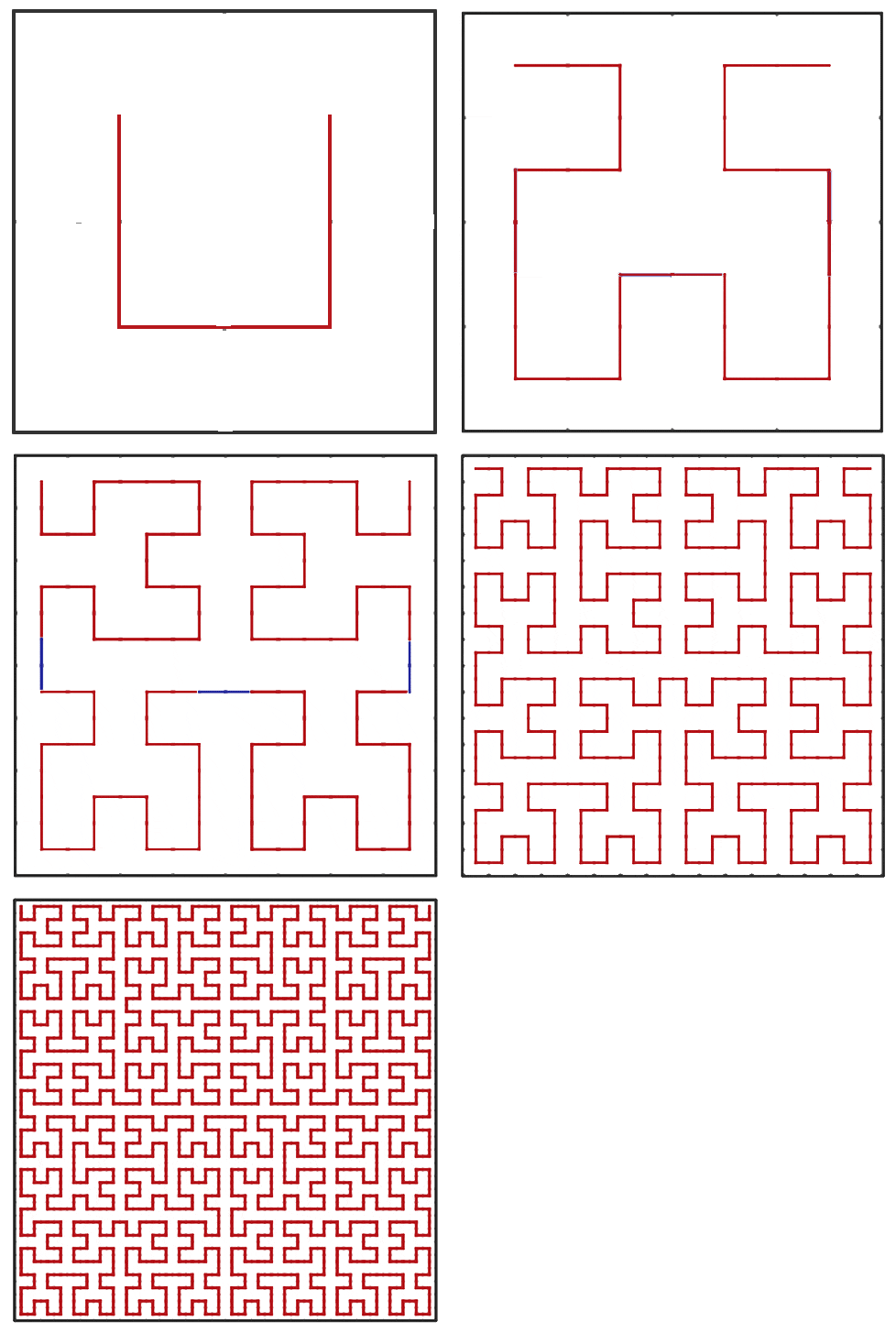
The video3 shows the first five stages. The process never ends, but the mathematical concept of a limit lets us (well, lets analytical algebraists) determine the final position that each point of the ever-wiggling line is tending towards.
Limit, from Latin Limes, 3rd declension masculine, plural limetes, a boundary, particularly the edge of the Roman Empire.
As against Liminal, from Latin Limen, 3rd declension neuter, plural limina: a doorstep or threshold.
And when it comes to Rannoch Moor, and the shoreline where its sodden ground meets its black peaty waters: the boundary – the limes – is everywhere.
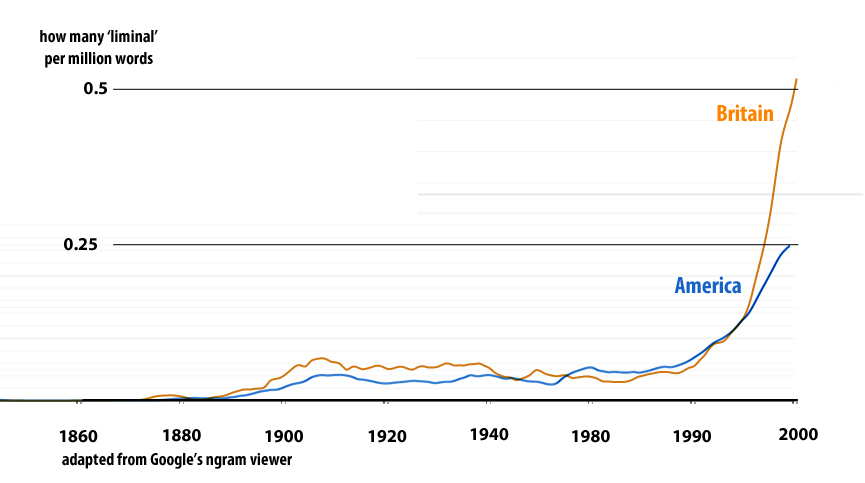
Which may explain this graph, produced by Google, showing that within the next 20 years the word ‘liminal’ will appear in every single published book; and sometime in 2055, will become every word in each of those books. We shall have to look to the somewhat less voguish US for books with some remaining other words in them.
But for now, you’re in the middle of Rannoch Moor, in that strange, and strangely trendy, in-between state, that liminal zone between green and cosy Argyll and the bright shopping streets of Fort William…
No way would you want to stutter to a stop with a nasty smell of rubber, in a snowstorm, with no signal on your phone. On the other hand this inbetween zone that’s neither here nor there also represents, at last, a straight and level bit of roadway to overtake that caravan... (Psychologists have shown that as car drivers we are even insulated from our own humanity. Inside our steel and aluminium exoskeleton we become solitary insects, every other tin box a rival for our roadspace.)
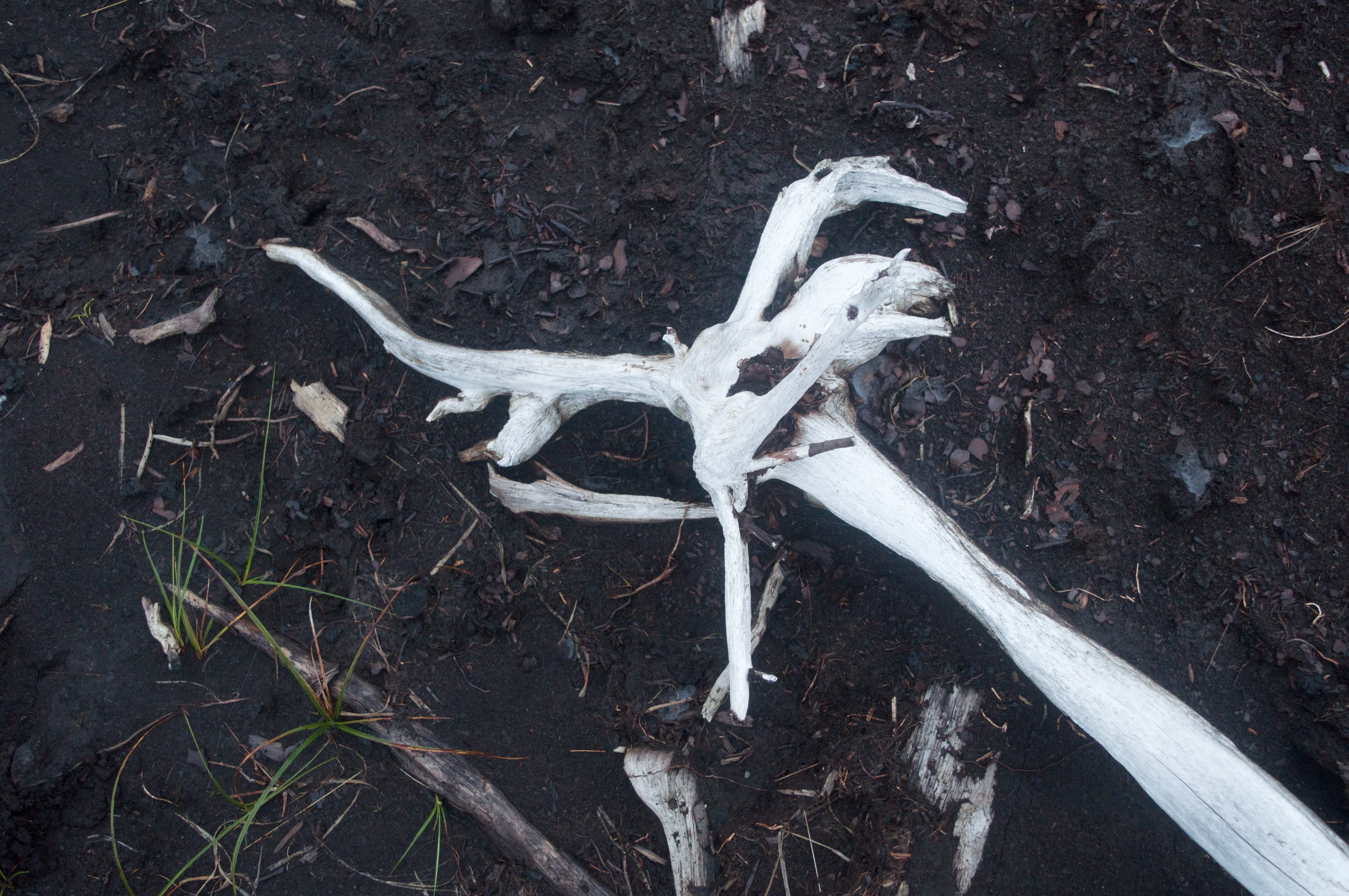
After failing to overtake the caravan, I turn off along the northern corner of the moor into the shadow of the mountain, on the single-track spur road to the White Corries. it’s just after daybreak on a May morning, towards the end of a six-week drought. A ski station, empty at the start of summer: it’s another of those uneasy liminal spots. Alone in the beaten earth of the car park, I change into my boots and haul out my rucksack.
But soon the car is out of sight. And for the next two days until tomorrow evening I’ll be in this strange, unsettling, inbetween world of Rannoch Moor.
I May, I Might, I Must
If you tell me why the fen
appears impassable, I then
will tell you why I think that I
can get across it, if I try.Marianne Moore, 1909
I’m driving this time, but the Rannoch passage is even more intense if you decide to take the train.
Many drivers avoid this stretch by heading north by Crianlarich. They’ll still end up crossing the Rannoch Moor.
Little animations on web pages: annoying, aren’t they? But at least I did build this one all by myself in Adobe Photoshop.
Comments
Nothing yet. Say the first thing.
Sign in to join the conversation.