
Large Language Models (LLMs), such as OpenAI’s GPT-4 and Google’s LaMDA, have ushered in a new era of generative AI. These models are reshaping industries—from customer engagement to creative content generation—by providing advanced natural language processing and generation capabilities. However, translating the power of LLMs into functional, real-world applications requires not just cutting-edge technology but also robust operational frameworks.
Enter LLMOps (Large Language Model Operations): a specialized discipline focused on the lifecycle management of LLMs, bridging the gap between innovative AI research and enterprise-scale implementation. LLMOps encompasses everything from data preparation and model customization to deployment and continuous monitoring. It ensures that LLMs are not only deployed efficiently but also remain reliable, scalable, and aligned with business objectives.
Key components of LLMOps include:
Data Management: Creating high-quality, diverse datasets for fine-tuning and maintenance.
Model Optimization: Tailoring pre-trained models to specific domains and tasks.
Deployment Strategies: Leveraging containerization, serverless computing, and API integrations.
Monitoring and Evaluation: Continuously tracking performance, bias, and fairness.
Security and Compliance: Mitigating vulnerabilities and adhering to regulatory standards.
With rapid advancements in generative AI, LLMOps practitioners must stay ahead by mastering trends like federated learning, multimodal capabilities, and explainable AI. This chapter explores the principles, challenges, and tools integral to LLMOps, equipping organizations with the knowledge to transform LLM potential into practical, scalable solutions that deliver measurable value.
LLMOps refers to the tools, practices, and techniques used to operationalize LLMs effectively across their lifecycle. It is the generative AI equivalent of MLOps but adapted to address the unique demands of LLMs, such as massive datasets, iterative customization, and complex monitoring.
LLMOps brings together data scientists, ML engineers, and IT professionals, enabling them to deploy, monitor, and scale LLMs for consistent and high-quality performance
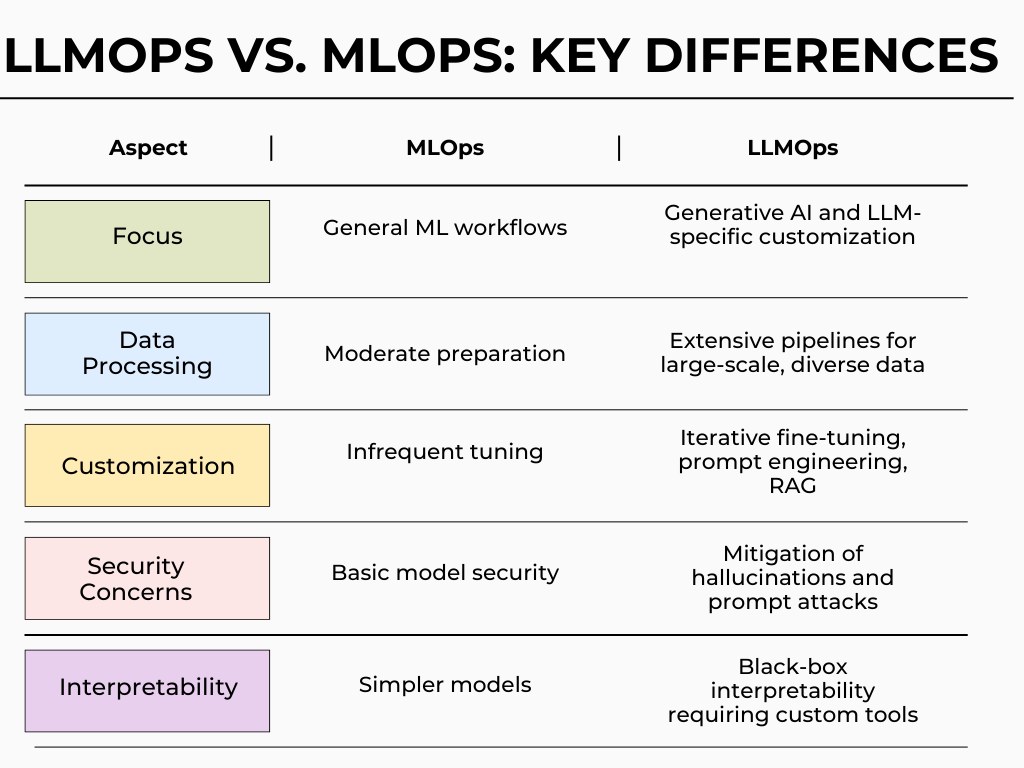
While LLMOps builds on MLOps principles, it diverges significantly to meet the specific needs of generative AI. Traditional MLOps workflows often fall short when applied to LLMs, necessitating tailored approaches in areas like:
LLM Customization
Fine-tuning, prompt engineering, and retrieval-augmented generation (RAG) are iterative and resource-intensive processes, unique to LLM workflows.
Data Complexity
LLMs require vast, diverse datasets, which necessitate advanced pipelines for ingestion, transformation, and vector database integration.
Performance Monitoring
Metrics for LLMs extend beyond accuracy to include fairness, bias, and safety, requiring sophisticated monitoring tools.
Security Challenges
Unique vulnerabilities like prompt-based attacks and data poisoning necessitate advanced security measures.
To operationalize LLMs successfully, LLMOps introduces a structured lifecycle encompassing exploratory data analysis, customization, deployment, and monitoring. Below is a detailed breakdown:
1. Exploratory Data Analysis (EDA)
Data Understanding: Analyze the characteristics of the dataset, identifying patterns, outliers, or gaps.
Data Collection: Gather information from diverse sources aligned with the LLM’s intended use case.
Data Cleaning: Eliminate errors, inconsistencies and duplicates to prepare a high-quality dataset.
2. Model Selection and Customization
Model Selection: Choose an LLM architecture (e.g., GPT, BERT) based on the task requirements and available resources.
Customization Methods:
Fine-Tuning: Adjust model parameters with domain-specific data for specialized tasks.
Prompt Tuning: Use optimized prompt templates to guide model outputs without altering its weights.
Retrieval-Augmented Generation (RAG): Leverage external databases to enrich responses with contextual information.
3. Model Deployment
Prepare the customized LLM for serving in a production environment, ensuring efficient infrastructure setup.
Deploy incrementally, starting with quality assurance (QA) environments, before moving to production.
4. Ongoing Monitoring
Monitor critical metrics, including latency, accuracy, cost, and fairness, to detect performance degradation/drifts.
Implement real-time alerts for issues such as data drift or output quality changes.
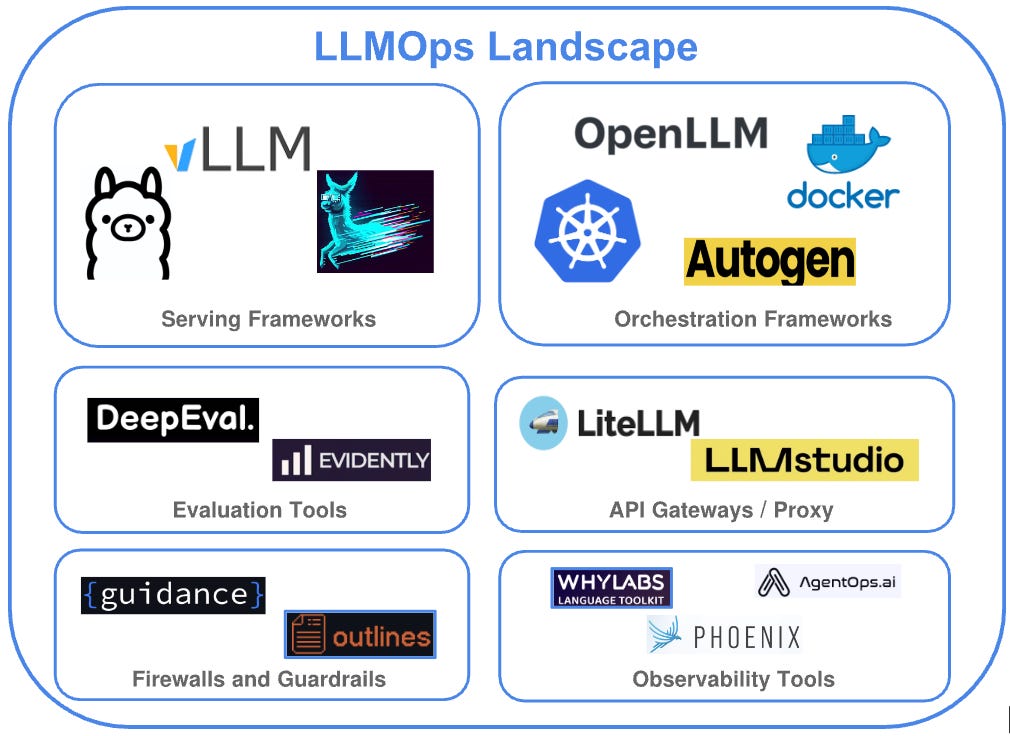
A wide array of tools is available to support LLMOps across its lifecycle. Some popular options include:
Data engineering forms the backbone of any LLMOps workflow, ensuring that the model is powered by high-quality, relevant data. This involves data ingestion, transformation, and integration with advanced storage and retrieval systems.
LLMOps requires robust databases for storing, managing, and retrieving large-scale datasets and embeddings. Popular options include:
Pinecone: A vector database optimized for retrieval-augmented generation (RAG), allowing efficient similarity searches for embeddings.
Weaviate: An open-source vector database with integrated machine learning capabilities for seamless data storage and retrieval.
FAISS (Facebook AI Similarity Search): A library that enables fast and scalable similarity searches across embeddings.
Milvus: A highly scalable vector database that supports real-time embedding management and queries.
ElasticSearch: A versatile search engine that supports text and vector-based queries, commonly used in LLMOps for hybrid search capabilities.
PostgreSQL: A robust relational database often extended with vector search plugins like pgvector for hybrid storage needs.
Vector Search with Pinecone
import llama_index
from llama_index.vector_stores.pinecone import PineconeVectorStore
from llama_index.core import StorageContext, SimpleDirectoryReader
# Initialize Pinecone
pinecone.init(api_key="api_key", environment="your_environment")
# Create a new index
index_name = "example-index"
pinecone.create_index(index_name, dimension=128)
# Construct vector store
vector_store = PineconeVectorStore(pinecone_index=pinecone.Index(index_name))
# Create storage context
storage_context = StorageContext.from_defaults(vector_store=vector_store)
# Load documents
documents = SimpleDirectoryReader("../data").load_data()
# Build index
index = llama_index.VectorStoreIndex.from_documents(
documents,
storage_context=storage_context,
)
# Query the index
query_engine = index.as_query_engine()
response = query_engine.query("Your search query here")
print(response)
Vector Search with Faiss
import numpy as np
from llama_index.vector_stores.faiss import FaissVectorStore
from llama_index.core import StorageContext, SimpleDirectoryReader
# Create FAISS index
dimension = 128
faiss_index = faiss.IndexFlatL2(dimension)
# Construct vector store
faiss_vector_store = FaissVectorStore(faiss_index)
# Create storage context
storage_context = StorageContext.from_defaults(vector_store=faiss_vector_store)
# Load documents
documents = SimpleDirectoryReader("../data").load_data()
# Build index
index = llama_index.VectorStoreIndex.from_documents(
documents,
storage_context=storage_context,
)
# Perform similarity search
query_vector = np.random.random((1, dimension)).astype("float32")
D, I = index.storage_context.vector_store.search(query_vector, k=3)
print("Distances:", D)
print("Indices:", I)
Efficient data collection often involves using crawlers to gather information from diverse sources. Leading tools include:
Scrapy: A Python-based web scraping framework designed for scalability and flexibility in crawling structured and unstructured data.
BeautifulSoup: A library for extracting data from HTML and XML files, ideal for quick, small-scale crawling tasks.
Apache Nutch: An open-source web crawler that integrates seamlessly with big data tools like Hadoop.
Octoparse: A no-code web scraping tool that simplifies data extraction for users with limited programming knowledge.
Diffbot: A powerful API-based data extraction tool that can scrape web pages and transform content into structured formats.
Colly: A fast, scalable, and elegant crawler written in Go, known for its simplicity and high performance.
import scrapy
from llama_index.core.data_loader import DataLoader
from llama_index.core.schema import Node
class CustomDataLoader(DataLoader):
def __init__(self, spider_class):
self.spider = spider_class()
def load_data(self, batch_size=100):
for i in range(0, len(self.spider.start_urls), batch_size):
urls = self.spider.start_urls[i:i+batch_size]
items = []
for url in urls:
item = self.spider.parse(url)
items.append(item)
yield items
# Define your Scrapy Spider class here
class QuotesSpider(scrapy.Spider):
name = "quotes"
def start_requests(self):
urls = ["http://quotes.toscrape.com"]
for url in urls:
yield scrapy.Request(url=url, callback=self.parse)
def parse(self, response):
for quote in response.css("div.quote"):
yield {
"text": quote.css("span.text::text").get(),
"author": quote.css("span small.author::text").get(),
}
# Use the custom data loader with LlamaIndex
custom_loader = CustomDataLoader(QuotesSpider)
documents = custom_loader.load_data()
index = llama_index.VectorStoreIndex.from_documents(documents)LangChain: Provides building blocks for LLM-powered applications, including tools for prompt optimization, version control, and deployment.
Haystack: Facilitates semantic search, question-answering, and LLM agent design.
LangGraph: Framework for developing AI agents using graph-based representations.
LangServe: Library for deploying LangChain applications via REST API.
LlamaIndex: Comprehensive toolkit for building LLM applications, including vector stores and retrieval.
LangSmith: Offers robust observability features, including token counting and performance monitoring, to optimize LLM deployments.
Langfuse: Open-source observability platform for LLM applications, providing detailed traces and evaluation metrics.
TensorFlow Extended (TFX): Machine learning lifecycle management platform.
MLflow: Open-source platform for the machine learning lifecycle, including experiment tracking and model versioning.
Great Expectations: Library for data validation and testing.
DVC (Data Version Control): Tool for version controlling machine learning projects.
Delta Lake: Framework for managing data lakes.
Apache Airflow: Platform for orchestrating complex computational workflows.
HashiCorp Vault: Secrets management solution.
AWS Key Management Service (KMS) / Azure Key Vault / Google Cloud KMS: Encryption key management services.
Hugging Face Model Hub: Repository of pre-trained models and benchmarking tools.
LlamaIndex: Framework for benchmarking and comparing models across various tasks.
MLPerf: Industry standard benchmark suite for AI systems.
Deepchecks: Comprehensive model evaluation platform.
Git: Distributed version control system.
Docker: Containerization platform for deploying applications.
Kubernetes: Container orchestration system.
Flask / Django / FastAPI: Frameworks for building RESTful APIs.
Data Management and Security
Adopt rigorous pipelines for data preprocessing and encryption.
Use tools like Apache Airflow, DVC, and Delta Lake.
Model Customization and Selection
Choose models based on task-specific needs using benchmarking tools like Hugging Face and LlamaIndex.
Scalable Deployment
Implement containerized solutions with tools like Kubernetes.
Opt for serverless deployments using AWS Lambda or Google Cloud Functions.
Continuous Monitoring
Employ real-time observability platforms like LangSmith and Langfuse.
Regularly retrain models to maintain relevance
Key trends shaping the future of LLMOps include:
Responsible AI: Enhanced focus on ethical practices and transparency.
Hybrid Approaches: Combining LLMs with other AI paradigms.
Democratization of AI: Expanding access to LLM capabilities.
Sustainability: Addressing the environmental impact of large-scale AI systems.
By embracing these trends, LLMOps practitioners can turn the transformative potential of generative AI into tangible, responsible business outcomes. LLMOps isn’t just about operationalizing technology—it’s about shaping the future of AI deployment.
If you have any inquiries, feel free to reach out via message or email.
Connect with me on Linkedin
Find me on Github
Visit my technical channel on Youtube
No posts
Comments
Nothing yet. Say the first thing.
Sign in to join the conversation.