
This Gospel is part of the very long discourse set at John’s version of the Last Supper. At the outset of the meal (“before the Feast of the Passover”), Jesus washed the disciples’ feet, then foretold his betrayal and denial. Between those two devastating predictions, he has warned clearly for the first time of his departure, then immediately given the great Love Commandment—not, then, as some timeless ethical norm, but specifically as a response to this foreseen loss. His absence will be caused by betrayal, yet fulfilled, as well as healed or mitigated, by love. And this passage we now read, the beginning of the long farewell discourse, expands on this but turns out to be not so much about his absence—although Thomas in particular thinks of it as such—but about his presence.
The section we are reading arguably starts back at 13:36, with the first of a series of uncomprehending questions from the disciples: each of Peter (13:36), then Thomas (14:5), then Philip (14:8), and then (after we finish reading this week) Jude (14:22) acts as a foil for Jesus’ teaching. The fact that each disciple seems to misunderstand what Jesus is saying is at least somewhat familiar from John’s stories of Jesus’ “signs.” His words here, like the earlier signs, are not understood by those in the story, but invite the reader—like the characters who ask— to deepen their comprehension. The reader might be at an advantage relative to characters however, since we are assumed to have the benefit of the Advocate or Paraclete whose presence and work is promised later in the chapter.
The passage we read falls into two parts: the first, with Thomas’ question at the center, concerns Jesus’ absence as a paradoxical preparation for the future life of the disciples; the second, proceeding from Philip’s question, concerns the relationship between Jesus and the Father but returns to Jesus’ absence and its consequences. The opening becomes clearer if we remember what my colleague Teresa Morgan has pointed out, that the words we find in the NT referring to “faith” or “belief” are often somewhat closer to “trust.”1 We do have a vestige of that idea when we say “have faith”; we know it means more than agreeing with certain ideas. How much more sense Jesus’ assurance makes as a response to fear and uncertainty, if we read “trust (or “have faith”) in God; trust also in me.”
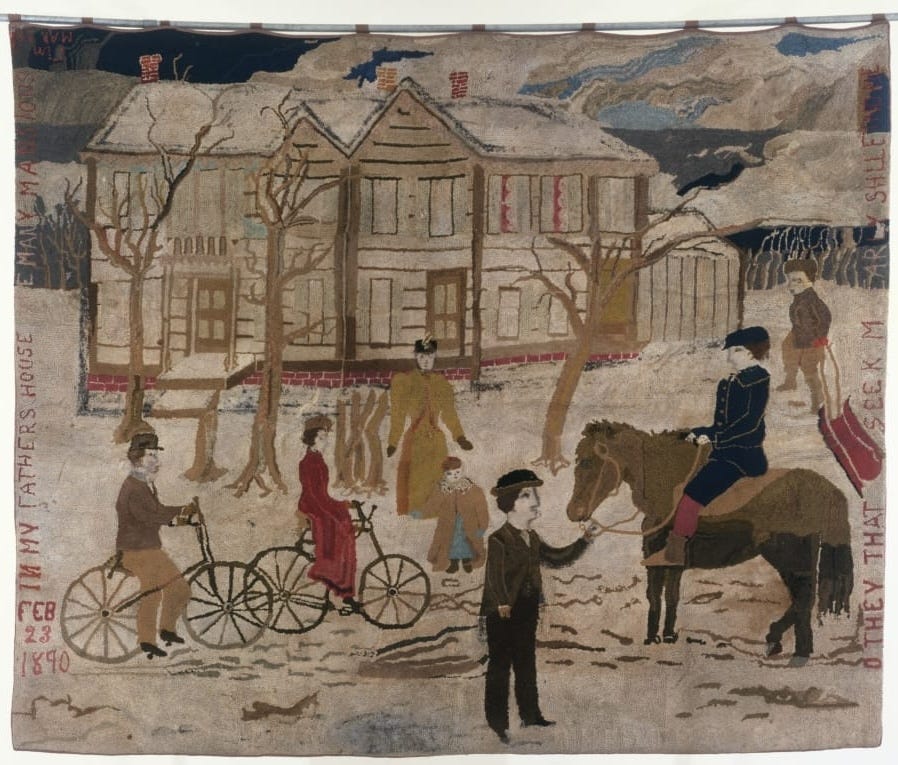
The first part of the passage includes words famously used in funerals and otherwise for the promise of life after death.2 “In my Father’s house there are many dwelling places” (v.2) is evocative, but curious. What are “dwelling places”? Some will remember the phrase as translated in KJV, “many mansions.” There were medieval interpretations of the “many” that imagined a hugely differentiated heavenly real estate portfolio, where degrees of virtue earned the departed better digs. The real idea however is conveyed well in the spiritual, “Plenty Good Room!” The promise is not varied grandeur but lots of space, or rather spaces.
Jerome’s Vulgate had used the Latin “mansiones”, and it seems to have stuck with the KJV translators. Mansio in Latin and “mansion” in older English too meant something like “quarters” or “place to stay,”3 and so (more importantly) does the original Greek monē—the word still used by Eastern Orthodox for monasteries. The idea is not a house with a title but a place in the home of another, somewhere to rest and receive hospitality. There is space for all, but in the Father‘s house all remain guests; the “dwelling places” phrase perhaps misses this. I’m offering “places to stay” as a better translation here.
Many will think first when reading this, and perhaps the following statement about Jesus as the way to the Father, of a trajectory from earth to heaven, concerning death and the afterlife. If that is not wrong, it is not quite right either. The passage contains references both to movement to the Father’s house and also to a movement from the heavenly realm to the earthly; so Jesus says “I go and prepare a place for you, I will come again and will take you to myself, so that where I am, there you may be also” (14:3). Philip’s question and Jesus’ assurance that they have seen the Father if they have seen him has some similar force; God has already come to the believers.
The same language of “coming to stay” recurs through the chapter with this equal and opposite dynamic, from heaven to earth, although choices by translators make it less clear. In verses 10 and 17 (the latter verse read only after our Sunday passage has ended) we find the same “stay” language (strictly speaking, the related verb). First the Father “stays” with or in Jesus and then the Spirit “stays” (you may see “dwell” and “abide” respectively in your Bibles, but these are all the same word). So the “stay” that is being organized is not just a post-mortem event for the believers, but somehow includes the Father and the Spirit coming to stay now.
Even more clearly though, the “mansion”—monē —appears again too, when Jesus says (in v. 23, also after our extract finishes) that “Those who love me will keep my word, and my Father will love them, and we will come to them and make a place to stay (monē) with them.” NSRV translation notwithstanding, this is not a “home,” but exactly the same kind of “dwelling place” referred to in v. 2., quarters or digs. It is a place where love creates room for a guest to stay.
These two journeys, the human pilgrimage to the Father’s house where there are many places to stay, and the pilgrimage of the Father and the Son to stay with those who love Jesus and keep his word, are the same thing. The repeated “staying” language (“abiding” is another familiar term for this) is also a clue that this is not really two things, but one. What believers perceive as their own spiritual journey is in reality the journey of the Son and the Father to them. And the love which characterizes the believers is also the reality of Jesus’ presence.
So “my Father’s house” is better understood not as heaven, but as the bond of love and trust that binds the believers with Jesus and one another, so that even death itself is no obstacle to their “staying” in and with him, and he with them. They need not be afraid, because they trust they are staying with Jesus and he is with them. Neither his death nor theirs can break that bond. And yes, doubting Thomas, you do already know the way, because you know Jesus.
All this also helps us think about Jesus’ famous and evocative “the way, the truth, the life” (v. 6) statement. These three things are not really parallel ideas, but this may be the point. We recently saw, in John’s recasting of the very traditional shepherd metaphor, Jesus moving—confusingly to some extent—between places or roles in that world and its imagery, both as door and as shepherd. Here too Jesus is not readily placed neatly in a particular image, whether of life and death or of the faith of the community. Rather he is present in the whole process of faith, as its energy as well as its object.
As “way,” he is not merely the place to which we are going (although he is) nor just a companion already present (he is), but the journey itself, the link between the Father and the world. As “truth” also however, and “life,” he is more than the way between the Father and the world; he is the whole of the reality in which we think and act about our relationship to the Father and the world. These statements then take us close to the Gospel Prologue (John 1), where Jesus is depicted not merely as saviour or teacher but as the Word, the world’s meaning and origin. The assurance that he is the only way is not about religious tribalism but about understanding that our life and the world itself depend on him whether we know the anwers to Thomas’ and Philip’s questions or not. So this assurance that we will stay with him in the Father’s house—or rather that we already are doing so, and that he and the Father are staying with us too—bridges life and death. It is reassurance beyond the grave, and also that the God whom we seek is with us now.
Morgan, Teresa. Roman Faith and Christian Faith: Pistis and Fides in the Early Roman Empire and Early Churches. Oxford University Press, 2015.
Liturgical use of the text by Anglicans only dates back to 1928, in that both the TEC book approved that year and the unsuccessful English revision included the text for the first time.
The English use of “mansion” as something palatial seems to have evolved from “Mansion House,” meaning a place with plentiful dwellings.
Comments
Nothing yet. Say the first thing.
Sign in to join the conversation.