
The Gospel readings from John 14 last week and this, from the “farewell discourse,” have Jesus instructing and assuring the disciples about his (apparent) departure. They are “Easter” readings, insofar as they address the new reality created by the resurrection of Jesus. Yet they necessarily focus on life without him, in the familiar sense at least.
Even the narratives of Jesus’ Easter appearances themselves mix themes of absence, misrecognition, and elusiveness, with the joy of his return. Although he is alive, Jesus’ return is very unlike his former presence. So now there is need for instruction about his simultaneous absence and presence, his going away but then coming and dwelling or abiding (or “coming to stay,” as I have suggested, discussing the earlier verses).
Two themes are evident in this section: first, the command to love (already foreshadowed at 13:34) which frames these verses (see vv. 15 and 21) and then second and in between, the gift of the “Paraclete.” To love Jesus and believe in him is to keep his commandments (14:15), and this means love; then Jesus will ask the Father who will “send another Paraclete” (14:16). Whatever a paraclete is, Jesus was one first.
There may be some awkwardness at the idea of a “command” to love, or the conditional phrasing of this invitation and challenge,1 but Jesus (and John) do not balk at this. They are not concerned with later conceptions of faith or grace versus works, as though the follower of Jesus can only love because of an inner spiritual gift. Love me, Jesus says, and obey. This love that is commanded however is a gift, in that Jesus has evoked it by his own love. Remember too that the floor of the room we are imagining is still wet from the foot-washing (13:1ff.), which has set the scene at this whole supper event as loving service, and Jesus’ own love in particular. To love and obey him means to have experienced his love.
First delivered in the form of a condition, this love is expanded on at the end of our passage at v. 21 in more descriptive or predictive terms that connect us with the “dwelling” (etc.) language that suffuses the whole farewell discourse. Love will then be more than something commanded, it will be a state of being. The love between the believers and Jesus will also mean love from the Father, and Jesus being “manifest” to them.
That Jesus will “manifest” himself to them indicates again how these instructions concern his ongoing presence. Love among the community will be the love of God, and Jesus will then be seen among them, not as one person among others as before, but in this new way, as the presence of love. The command to love and the promise of the Paraclete are thus both ways of assuring the disciples again (as in vv. 14) that he will be with them.
The framing of the promise of the Paraclete with these two references to love suggests that this abiding love of God in the believers is at the heart of what this so-far mysterious helper will do. John is the only Gospel author to use the word “paraclete,” which appears here for the first time and then three more times in the farewell discourse, and nowhere else. It also appears in the First Letter of John (2:1), in reference to Jesus himself—in keeping with how our passage describes this new figure as “another” Paraclete. Jesus himself is the first Paraclete, and so provides the basis for understanding who and what this other one is.
“Paraclete” means someone called to another’s side, hence loosely an associate or colleague, with an implication of support. In the ancient world it typically meant a legal representative—hence the rendering “advocate” is quite reasonable, if not definitive. It is only later in John 16 that the legal sense is used to full potential, with an extended word picture of the Spirit taking the world to court.
Yet there are other nuances to the term, reflected in the lack of consensus among translators. Depending on the version you have, you may find Counselor, Helper, or Comforter instead. Older English translations from Wycliffe through to the King James’ Bible used “Comforter” for all the occurrences in John’s Gospel, but then “advocate” in 1 John 2:1, which breaks the connection. “Comforter” is lovely,2 but the older English sense of the word was to “strengthen” rather than to soothe, and perhaps worked better in the 16th and 17th centuries to render the sense of someone called in to help as an ally.
The 4th-5th century scholar Jerome transliterated the Greek word rather than rendering it with something “clearer” to his readers; he simply used paracletus in his Latin version, the Vulgate. This maintains the curiosity of it all, and perhaps thereby helps us to place ourselves in the position that John’s narrative places the disciples, who are clearly struggling with what they are being told. This is not something expected; it is new, and strange.
While it seems clear we are to understand the Paraclete as the same figure referred to elsewhere, even in this Gospel (see 20:22), as the Holy Spirit, there is a danger that preconceptions we bring from reading Luke and Acts in particular might stop us from seeing clearly just what John wants us to understand about this new figure.
The effectiveness and truth of the Paraclete’s presence is not, for John, supernatural signs such as Acts depicts, but the authenticity of love among Jesus’ followers— harder to find in the Church, we might note, than speaking in tongues— which shows how the community is caught up in the love of God, including the love of the Father, as well as of Jesus himself. This Gospel tells us that the believers truly experience God in the power of divine love in their midst. Above all the Paraclete is and does, will be and will do, what Jesus has been and has done. The Paraclete is the presence of Jesus.
Surely never better rendered than in Tallis’ musical version:
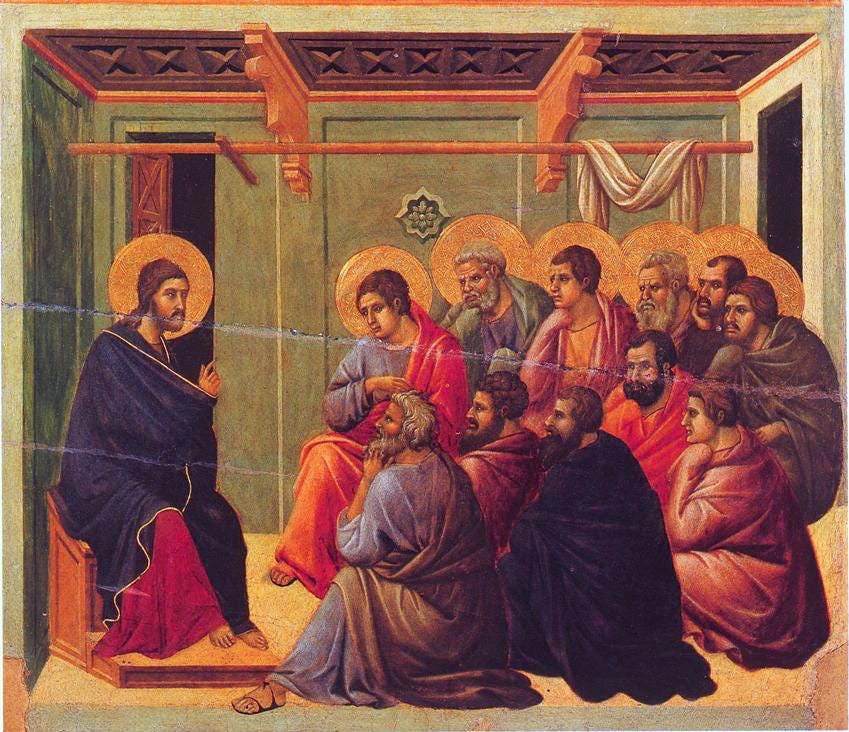
I think of Bianco da Siena’s line in his hymn “Come down, O Love Divine”: “vienne, consolatore, Nel mio cuor veramente” (in Littledale’s translation “O Comforter, draw near…”). Bianco would have known Duccio’s great altarpience the Maestà, of which the image above was a part, painted for the Cathedral in his home city.
No posts
Comments
Nothing yet. Say the first thing.
Sign in to join the conversation.