
Able Zine Issue 2
'Cultivating Community' with Tash King
Dear Readers,
As we readying to publish Issue 2 we hope to continue highlighting individuals from Able Zine's community that can help us reflect on our theme of Environment.
We are excited to introduce you to our second contributor in our 'Cultivating Community' series. Bed Zine founder Tash King, a 28-year-old from Canada, tells Able Zine about their experience collecting and archiving sites of rest from fellow chronically ill and disabled contributors. Recognising that beds function as more than just a place for sleep Tash invites people to share about their relationships with their bedroom environments through art and writing. By gathering submissions and cultivating an online network, Tash focuses the audience to pay attention to how and where we lay our heads.
We really hope you enjoy it,
Team Able Zine
*Please note: All of our previous newsletters are available to read on our website.
For enquiries and submissions for future newsletters please contact Noni Benus noni@ablezine.com
Introducing Bed Zine and Tash King
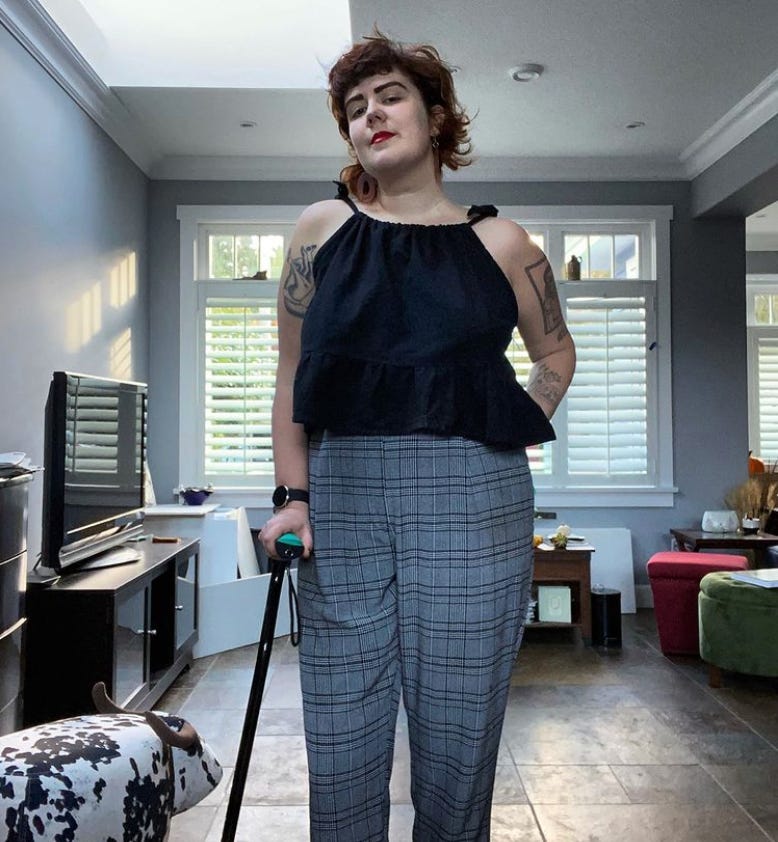
Tash King (she/her) is a chronically ill writer, artist and educator living with me/cfs & POTS. Her background in sociology informs her interest in exploring the ways that chronically ill bodies exist and resist within neoliberal capitalism. In her spare time, she reads and reviews books at @tashisreading
Tash's review of Rebekah Taussig's Sitting Pretty will be featured in the upcoming Able Zine Issue 2.
Q&A
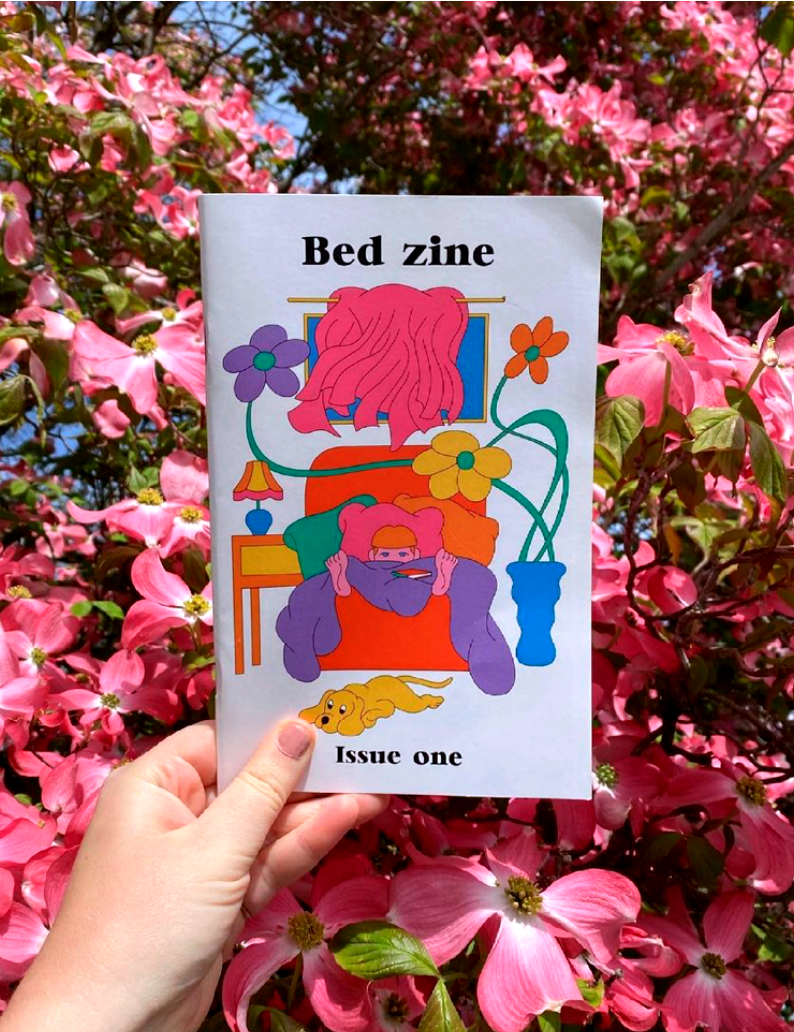
How was the idea and theme for Bed Zine born?
Last fall, lying in bed with a migraine, I started thinking about something I’d wanted to do for a while: curate some kind of disability-focused zine. During the hours I had spent in bed that day, my mind had wandered off in many different directions, but another thing I had been thinking about was that I wanted to see what other disabled people’s beds looked like.
Getting a glimpse into other disabled folk’s lives and home set-ups has been very important to me since I became chronically ill a few years ago, and this urge blossomed into the idea for Bed Zine. I decided to create a zine that would give fellow disabled people a space to represent their complicated thoughts and feelings about their beds. It would be an opportunity for people to feel validated and represented in their shared experiences, and also a platform for disabled people to work through their relationships with their beds through art and writing.
In this first issue I specifically asked that all contributions include both an image AND text, even if it’s just a few words, because I wanted people to contextualize their visual representations of bed. I was and am especially interested in the contradiction that underpins many of our feelings about bed: that bed is a comfortable and safe space for us to rest, while also a space that can feel miserable and confining.
What are your favourite features in the zine?
I love all the submissions so much, but I think my favorites are the ones that elicited the most intense immediate emotional responses from me. The visual poem “Sickbed” by Olivia Muenz is a great example of this. Her visual poem uses words to form the shape of a bed and pillows out of the words “no” and “not now”. It took my breath away. I think that the ability to condense a galaxy of feelings into a few concise words is truly impressive.
Another piece that really floored me is the painting “Rest” by Ashley Bravin. When I opened submissions for the zine I was pretty nervous about it being my first zine, and I worried that I might not get many submissions. “Rest” was one of the very first submissions that arrived in my inbox, and it simultaneously eliminated my concerns and took my breath away. It depicts this person curled up into their bedding in the fetal position. The colours, the direction of the brushstrokes, they all serve to create this sense of tension and movement in this place we often think of as quite static. Not only did I get a submission, but I got something so beautiful and emotional that I immediately wanted it as a mural on my bedroom wall!
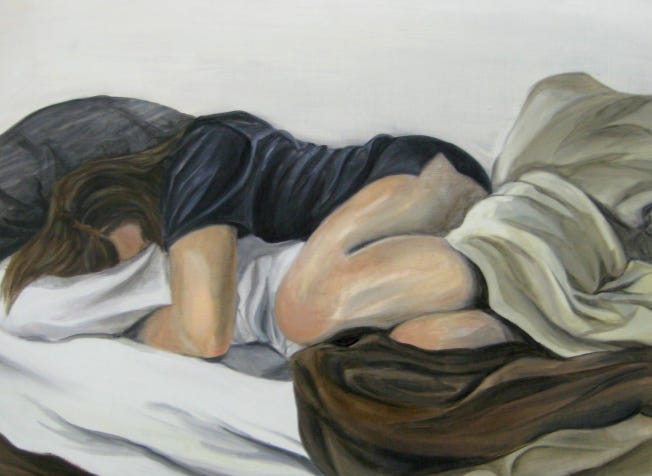
"Rest" by Ashley Bravin @ashleybravin
Often it seems hard for able-bodied people to understand the complex relationships disabled people have with everyday objects and environments. For many disabled people, our bed becomes a place of necessity, whether we want to be there or not. It can also provide sanctuary after a day of navigating public space. Did you find this balance between positive and negative experiences of the bed within your submissions? How would you suggest navigating these feelings?
I was definitely mindful of this when looking at submissions for the zine. I think that it would probably be a lot easier to fill a zine of disabled art and writing about bed with solely negative experiences, as bed is rarely just a positive place for us. It was important to me to find a variety of contributions which represented these feelings and experiences. I think part of the negative connotations of bed are due to our personal experiences as disabled people, and the fact that things like unwelcome flares will send us to our beds. On the other hand, I also suspect that part of this is due to non-disabled people’s stigma and lack of understanding when it comes to the role bed plays in our lives. In most mainstream media, a character spending time in bed is almost always shorthand for what are seen as negative characteristics: it means that they are lazy, sloppy, unmotivated, or unhappy. In daily conversations, nondisabled people often talk about spending extended periods of time in bed as an embarrassing or shameful thing. These attitudes and talking points make it hard to share a personal disabled experience in bed as anything but tragic.
With that in mind, I am very interested in representing disabled people re-negotiating their relationship to their bed, or trying to reclaim it as a space that can be joyful, warm and full of self-discovery. There is an incredible submission in the zine by Stacey Coclough called “Home of dreams”, which depicts a house that you can see inside kind of like a dollhouse, and the house, which is also a bed, is full of gorgeous and dreamy things: flowers blooming, a bird feeding its baby in a nest, the moon and stars, and a woman swimming. It’s aspirational and really taps into the transformative potential of our beds.
How has your own relationship with your bed changed alongside the development of the zine? Did you work on the zine from your own bed?
My bed has been front of mind these last few months. I actually live in a studio apartment, so I find myself looking at my bed all day long. However, because of my insomnia, I am really cautious about spending time in my bed when I’m not sleeping- despite creating a zine about bed I rarely spend time in mine!
Until I thought up the idea for the zine, I had never really reflected on my bed. I only go to my bed when I have migraines or severe fatigue, and much time spent in bed is anxious insomnia time. I’ve tried to find ways to make bed a less scary place- I recently invested in a fancy patterned new bedding set and a bunch of pillows to make it look and feel much better. Lately I’ve been trying to do more positive things in bed so it becomes a more positive place. The zine has given me a lot of space to re-think what bed means to me!

"Sickbed" by Olivia Muenz @oliviamuenz
What would your tips be to any other disabled people looking to make zines about the disabled experience?
My experience of making Bed Zine has been endlessly positive. I had a few amazing disabled publications to look up to; Able Zine, Sick Magazine, and Ache Magazine. From the very beginning, I made sure that every person collaborating on the zine was disabled, and that itself was revelatory. Everyone involved was so kind and helpful, sharing information and experiences of the process along the way. I made sure to create really flexible and extensive deadlines so everyone involved, including me, could participate in ways that were safest for our bodies. I think that creating loose deadlines was the best idea that I had, and I would suggest it for anyone else thinking of making a project like this. Without pressure, I wasn’t forced to push myself into a flare at any point, and that made the whole experience anxiety-free. It is the first project I have done since becoming relatively housebound with chronic illness three years ago, and just doing it has given me so much purpose and happiness!
What do you hope for the future of Bed Zine?
I hope that Bed Zine reaches a lot of people, disabled or nondisabled, and gives them something to think and feel about. The response so far has been really incredible, so I plan to launch a call for submissions for issue two at the end of June with the second issue coming out in the fall. I think that, despite the theme being really simple, there are so many thoughts and experiences and feelings to explore and represent and I can’t wait to continue compiling them!
Where can we get hold of a copy of Bed Zine?
You can buy Bed Zine Issue One at bedzine.bigcartel.com, or in person in Vancouver, Canada at the Paperhound Bookstore.
Instagram
Website
Comments
Nothing yet. Say the first thing.
Sign in to join the conversation.