
Hello! If you didn’t know already, it’s May, and therefore my made-up freelancer maternity leave is technically over. Don’t get too excited on my behalf—almost all of my freelance contracts ended unexpectedly while I was gone, so I’ve been quite stressed and on the job hunt for all of my leave. But, trying to ignore that part, I come to you with an essay I’ve been writing off and on for the past few months, trying to take in everything that’s happened while dealing with the explosion that is my life. Enjoy! I’m sure trying to.
Almost any time I’ve told a mother their child is adorable, I watch the mother’s face. It’s always the same, complicated reaction. They usually look at their child, smiling slightly, eyes in some distant place. Often they say nothing in response. I’ve turned this reaction over and over in my mind, considering the complexity of the brief inner dialogue I can see in their expression. Exhaustion, yes. Love, yes. Frustration, possibly. Awe, most likely. Now that I’m on the other side of it, I’m still having trouble articulating the thousand emotions I feel when people comment on my daughter’s appearance or personality.
She is several different babies to me. Sometimes I look at her and recognize her fully. And sometimes I look at her and see only a small, vulnerable creature. She is a hangry little raccoon, a chunky little frog, a curious little monkey, a smiley little human baby. People say she is alert, and clocking in early on things like smiling socially, giggling, and head and neck control. She’s gaining so much weight her arms are starting to rival the Michelin man. Her tummy looks like a pear when she’s full, heavy at the bottom, tapered up to her chest. I kiss it so much, and she’s surprised every time.
Every general cliché about parenthood is true, and everything I’m “supposed” to feel hasn’t actually occurred. When she was born, the nurses held her over me, and a bright light behind her made her body a silhouette. The seconds it took for her to cry felt like hours, but then she screamed and my husband said that as he looked at her, he couldn’t stop hearing the line “Rage, rage against the dying of the light” from the poem “Do Not Go Gentle into That Good Night” by Dylan Thomas. I didn’t hold her right away because I was in a full haze, getting stitched up immediately, and I wanted to be able to fully take in the moment. I’ve wondered if that was a mistake ever since. Instead, she nestled into my husband’s arms, wrapping her tiny hand around his index finger. I wanted to eat them both.
The doctor thought my daughter had the umbilical cord wrapped around her neck. Or maybe wrapped around an arm. She wanted me to get a C-section. Or, she finally relented, I could try pushing and she would use a vacuum assist to speed up the process. We tried the latter. The nurses put me in several positions, whispering to each other after every push, staring at the screen that scribbled out both me and my daughter’s heartbeats. How was that one? I kept asking. I really wanted to scream at them, Talk to me.
I looked above my bed to see a large light that wasn’t turned on, so it ended up reflecting my image back at me. In between contractions, I could see my curled form as I laid on my side, I could see all the gore, I could see all the nurse and doctor and husband hands reaching towards me. I watched myself like a movie, this human animal bearing down like a cow in a barn, like a cat in some hidden crevice, like a woman trillions of times over. I was me and I wasn’t. I closed my eyes during every push.
After only an hour, my daughter’s head crowned. The doctor pulled out the vacuum—this strange, small, suctioning circle—and said, One big push. And I felt my daughter emerge twice; the head and the body. The cord was wrapped around her leg. When she was finally placed on my chest, I felt nothing.
But how to explain that “nothing” here is not negative? I couldn’t put words to what I felt, couldn’t explain it to anyone. It was a blankness; not disinterest, but an empty page of newness. It felt like nothing because it was something I’d never truly experienced. I knew her and I didn’t. I kept waiting to feel the way other people had explained their experiences: overwhelming love, animalistic protectiveness. I looked up at the light mirror and saw my little family gathered around the bed. It was us and it was also some other people living our life in another universe.
A lot of pregnancy and birth and motherhood has just felt like things happening to me. I have almost no control, and I have to rely on some buried instincts to decide how to move forward. Sometimes her cries sound distinct and I know exactly what she needs. Other times, I’m confused and afraid that I’ll never be able to help her in the way she requires. Almost every experience has felt like two sides of the same coin. Sometimes she screams when I’m trying to nurse her, and it’s because she has gas or is too full to keep eating. And sometimes she screams when I’m trying to nurse her because she’s so hungry she can’t stand it. Her body wriggles and writhes in my arms, and I hold her up to look into her deep blue newborn eyes, and her screaming stops, and we stare at each other wondering who we are.
Nursing: my white whale. It was perfect at first, and then she wouldn’t latch at all, and then it was perfect again, and then she screamed every time we tried, and then she latched again but it was so painful I clenched my toes and forced my mind into some other plane of existence to make it through. I cried to my husband daily about how I failed her, about how I wished I was her comfort, about how I never thought I’d care this much about breastfeeding ever. I laid in bed feeling useless for many, many days. The doctors told me to seek therapy. In a haze of sleeplessness one day, I held her in my room, alone while my husband was at work. She cried in my arms as we tried to nurse, her eyebrows red with exhaustion. I cried and held her close and whispered, I love you I love you I love you loud enough that the words would break through to my own mind as well.
I wake up every night in a hot sweat, searching for her body that I’ve dreamed is buried somewhere in the blankets. She’s never buried in the blankets. I dreamed that my sisters came to my apartment and replaced all of my books with teddy bears. I dream that I lose my daughter in various ways—in one, she floats away down a river. In another, she’s lost in some weeds that blow silver in the wind.
Welcome to motherhood, people say to me. Is that motherhood? The base instinct of it all, is that motherhood? The feeding, the sleeping, the holding, the crying. I would classify these experiences as parenthood, something existing on an administrative level. Whereas motherhood, to me, feels more nebulous, more relational. I think, in some ways, motherhood comes later.
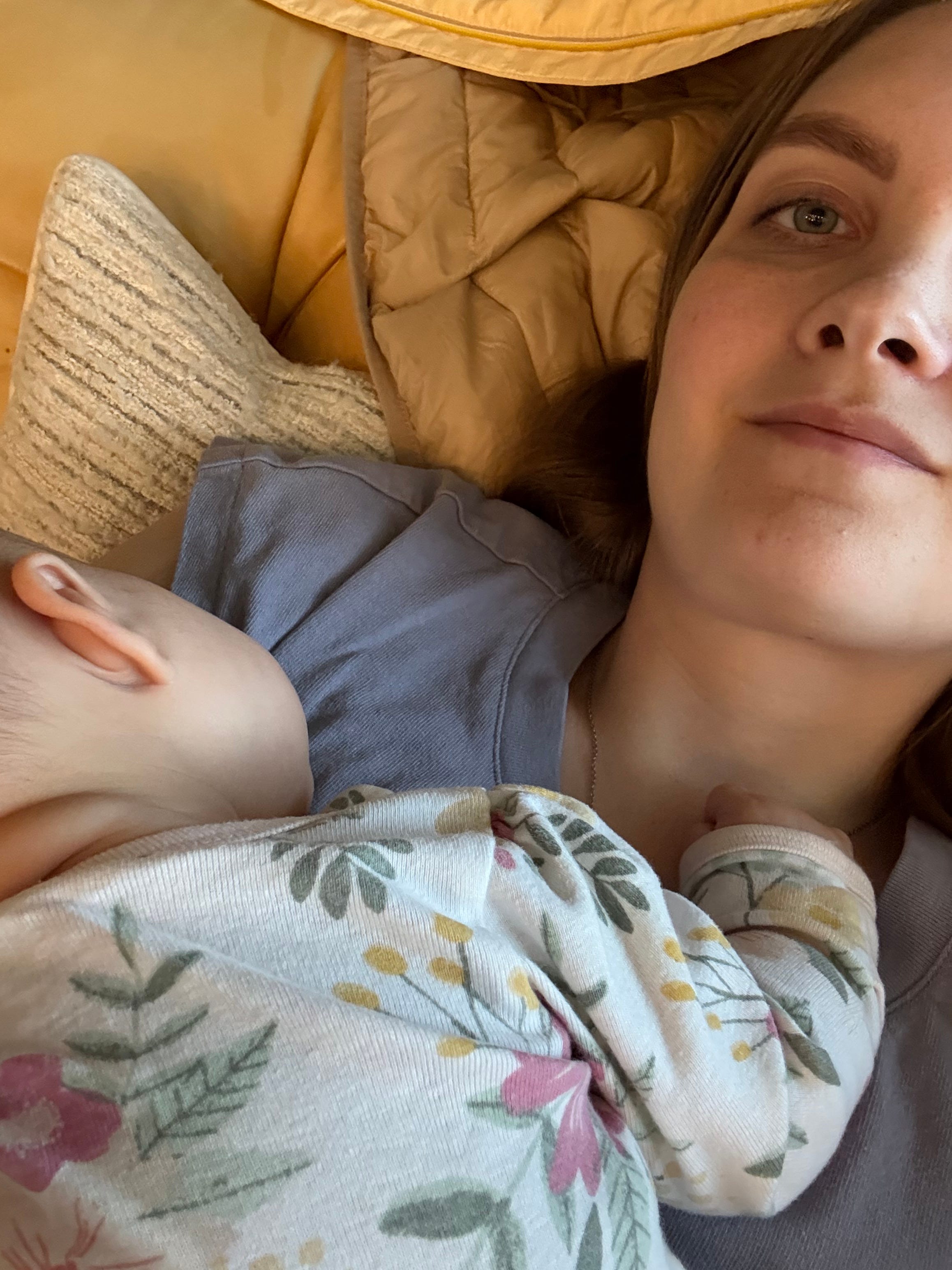
I picture motherhood in the space where we move from animal back to human, even though I also push back against the idea that we’re actually that disparate. My daughter is animal, I am animal. I sleep on the couch, my body curled around her like a comma, some instinctual pose that just felt right—my body moved into that position without me telling it to. Someday I’ll have to think more, to consider more, to answer my daughter’s pleas considering more of the human world. We’ll move together in different ways. Right now, my daughter and I work together to help her eat. But someday, we’ll do the thing author of Sapiens Yuval Noah Harari posits is the main way humans are different than animals: we’ll tell each other stories about eating, about playing, about sleeping, about living.
Right now, it’s needs instead of wants. It’s the basics of survival. It’s showing her that she’s safe and loved. It’s kissing her cheeks, right by her lips, and pulling away to see her smile that takes up half her face. It’s putting her body into a large bowl of warm water for a bath and taking in her awed expression, lips like a triangle, eyes like two dark grottoes. It’s holding her close when she wants to feed but cries instead and breathing deep together, saying out loud for me and for her: In and out. In and out.
I took her to Utah to “meet her cousin,” as if she has any idea what “meet” or “her” or “cousin” even means. It was just me and her. My husband has exceeded all my wildest dreams about parenting together, if all my hints above weren’t obvious. She loves him. He loves her. They had their routines, their walks in the morning, their ease together as my husband held her and rocked her to sleep. They held each other first in the hospital while I watched. The night before I flew to Utah, he came into the kitchen and whispered, I don’t think you should go. I was fine with it and now I’m terrified. I wondered if she would forget him; we both wondered if I could do it all alone.
In the end, I boarded the plane. Utah was a whirlwind—and even though there were several pairs of adult hands, there were also several pairs of children’s hands, cousins roaming everywhere. It was a delightfully full house. Everyone was exhausted. I cried the first few nights, holding my crying baby, while my mom came into my room and asked if I needed help. She’s just doing that thing, I whispered to my mom. Where she is too tired to eat but too hungry to sleep.
Okay, my mom said, having heard this anxious complaint before. Okay. That’s just what your baby does.
That’s just what my baby does. The sentence was like a deep breath, in and out. I released any idea of what should be happening in that exact moment. And it was like I traveled to the other universe I saw in the overhead light, to that other family curled around each other. Suddenly, I knew what my daughter needed, even before she did. We nursed as if nursing had never been an issue. She fell asleep when I rocked her, fell asleep while nursing, fell asleep with me as her comfort. When we were out around family, and she was passed from person to person, she looked for me. When I gathered her back into my arms, she’d start babbling immediately, just like her father, always ready with a story to tell. I curled around her in our bed, excited for her to wake up. I would be there, this giant face smiling at her as soon as she opened her eyes. And she would smile back.
We’re home now, and my husband told me he can tell something has changed, that we’ve bonded, that she looks for me, that we have our own secret language, just like they do. We cuddle on the bed, on the couch, both of our bodies wrapped around our daughter’s, taking turns trying to earn her ever-so-slight hiccupy giggles. There’s a calm to our house I hoped for in my darkest nights of yearning.
Almost three months ago, I laid on my side in a hospital bed, watching myself give birth in my reflection on the ceiling. Now, I lie on my side and hold my daughter close to me, checking her breathing, patting her back, watching her cheeks grow deliciously more puffy every day. I don’t wake up anxiously searching for her. I know where she is.
I knew I would simultaneously savor these moments and also wish them away. That blankness I felt when she was born has a face now, and it’s changing fast. I think I look at her like every mother looks at their child. I think I understand.
No posts
Comments
Nothing yet. Say the first thing.
Sign in to join the conversation.