
The first time my daughter could not be consoled was after my husband sneezed just a little too loud. She was utterly betrayed by his audacity. I was in the kitchen when I heard her frightened cry—this sweet melody that went from deep shaky breath to high-pitched squeal—and I ran to her, some animal instinct taking over. My husband said, I didn’t mean to— and I cut him off to say, I’m not mad at you; just give her to me.
I took her and retreated to our bedroom and held her by the window. I tried everything to calm her little six-week-old body—swaying and rocking and telling stories. When none of that worked, I racked my exhausted brain for music. Her cries seemed almost physical, taking up the room in a way that left no space for anything else. The only song I could think of was the Mormon primary song “I am a Child of God.” I mentally swiped that idea away, begging myself for any other option, please, I wasn’t ready to introduce any part of Mormonism to her, even though I knew it would be a part of her life, and I knew she would not understand the song’s context. Still, I felt frantic, trying to calm her, trying to calm myself, trying to reach for something that would soothe us both.
But the moment demanded that I forget my petty grievances. I closed my eyes and started singing, I am a child of God, and he has sent me here… It was one of the first songs I ever memorized. I’d sung it so many times throughout my life, it didn’t matter that I hadn’t sung it in the past seven years since leaving the Mormon church. The song was etched inside of me. My daughter whimpered and took shallow breaths, and at some point her crying noises started to sound like a choice, like she was just interested in how her voice sounded rather than in being scared. She eventually settled, and fell asleep on top of me—me, still in my clothes from the day, makeup on, teeth not brushed, contacts in. It was late enough that I knew I would remain in this state for as long as she slept for the first stretch of the night.
In the twilight, I felt our bodies breathe together and settled into the this new situation. I had grown used to lying with her on top of me in my bed, staring at the walls of my bedroom for hours at a time while she napped. Even though I’d done the same thing over and over, I still felt a kind of dumb awe as I realized, again, that my daughter was real and that this was my life now.
It felt like a lifetime ago, but it was just a couple months before this moment that my friend Caely and I painted my bedroom. When I first moved into this apartment, I hated the color on the bedroom walls—it was this weird blue that looked turquoise in the daytime and muted in the night. On top of the color, the room never felt complete. We had no headboard, the rug was too small, and all the art felt misplaced. I kept picturing all the time I’d spend in that room with a new baby and feeling this specific dread. I wanted it to be a place of refuge and peace instead of an unfinished, slightly ugly project. And so, nine months pregnant, I visited Ace Hardware multiple times to find the perfect shade of mauve. I borrowed my neighbor’s ladder and promised I wouldn’t be the one to climb on it. I pushed all the furniture to the middle of the room. In the dead of January, Caely and I opened the windows to keep the air as clear as possible.
We painted for hours, listening to Lady Gaga and Lily Allen and The Shins. We kept messing up paint lines and overcorrecting. It’s like when you mess up your eyeliner, Caely said, and you just keep adding more to get the line you want. I crawled around the floor, lining the baseboards with paint, acutely aware of all the ways my huge pregnant belly limited my range of motion. The whole project took us many more hours than we pictured, and in the daytime, I spent even more hours touching up sections of the wall that had looked finished the night before in the dim evening light.
The project continued with my friend Caroline helping reupholster a fabric headboard I bought, and then helping us install sconces over the bedside tables. After getting a new rocking chair and adjusting all the art in the room, it finally felt like a place I wanted to spend time. But day after day, I’d still catch patches here and there—only perceptible to me—where tiny dots of blue showed through the mauve paint. The walls were old plaster, bumpy with age and difficult to fully cover. I had rotating paint brushes at the ready every time I found a new spot—one brush drying in the sink, another one ready to dip into the paint can. As I laid in my bed with my daughter the night of her first meltdown, I could still see little dots that I’d missed.
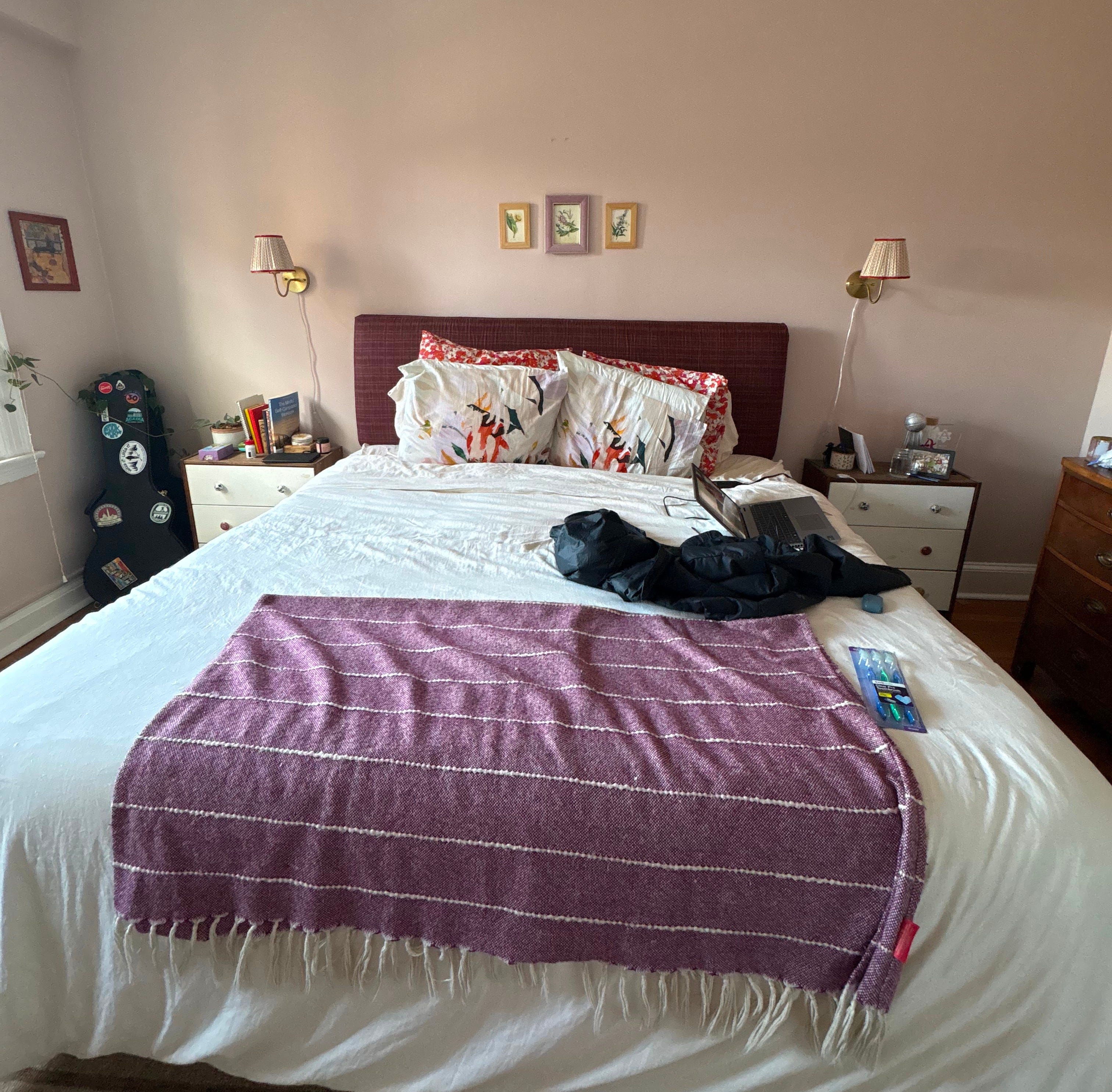
When we brought our daughter home, she basically lived in the bedroom, sleeping on us, or sleeping in her little bed on her own. I curled around her when she wasn’t on top of me, always wishing to be closer to her, feeling a strange untethering when I hadn’t touched her in mere minutes. Every time she woke up in the dead of night, my husband and I felt insane; for some reason she was always up longer than we hoped, as we learned the new rhythms of changing and feeding and soothing. Still, we could never recall why wakeups were so long as we stared at each other with tired eyes in the mornings. It was so dark outside that month, a cloudy and rainy winter. It was dark inside our apartment, too. I remember those early days as lamplit and dizzy.
In that lamplight, or the twilight, or the daylight, I walk my baby in a U-shape around the bed to put her to sleep. Though I can so clearly remember listening to Lady Gaga and Lily Allen and The Shins with Caely as we painted, the lyrics don’t come to me as easily in this new phase of life. Even past the night I soothed my daughter to sleep after her scare, the only songs I can sing fully are the ones I actually wouldn’t mind forgetting: the Mormon hymns and primary songs I sang as a child.
I left the Mormon church in 2019, and by “left” I mean I woke up one morning, saw the light shining through my curtains, and decided I was done. My untangling had been a long process full of unanswered questions, a lot of rationalization, a few broken promises to family members, and many mornings spent crying in the shower while debating whether being true to myself was worth the pain I knew I’d cause others. It was the loneliest I’d ever felt. Until I became a mother.
These versions of loneliness are not so dissimilar. In both situations—leaving the church and becoming a mother—I had to accept that no one would fully understand my experience, and then have the confidence to still believe that my experience is real. Walking around in circles every day, multiple times a day, with no witness, starts to undo that confidence. It’s like the old adage: if a mother is mothering in a tiny, mauve apartment and no one is there to hear her, is she still singing? And if she’s singing Mormon songs to an audience of one baby who can barely conceptualize sound, is there any reason to worry that the song is breaching her identity as an ex-Mormon mother?
I don’t have much time to consider these existential questions now. I’ve just had to give in, to a certain extent, to sing what comes to me, even though I can feel two versions of me playing tug-of-war as I do. Though I can sometimes recall lyrics to songs I love, it feels like a painful truth that Lily Allen’s newest album doesn’t quite have the right cadence to lull a child to sleep. Instead, I sing “The Happy Song” by Imogen Heap, and “Popcorn Popping on the Apricot Tree,” “‘Give,’ Said the Little Stream,” and “A Child’s Prayer” from my Mormon primary days. My daughter has come to expect them all before nap time, and won’t settle until I’ve sung the whole round.
I’ve rationalized this balance by analyzing the song’s meanings. “Popcorn Popping” and “‘Give,’ Said the Little Stream” are innocent enough; the first is about blossoms looking like popcorn, the second about how water nourishes the earth. “A Child’s Prayer” was always one of my favorites—it has two parts, one faster and one slower, both sung at the same time for the third verse. A polyphony, I believe. I settled on “A Child’s Prayer” because the lyrics feel more up to interpretation to me than “I am a Child of God.” Whereas “I am a Child of God” tells children what they are, “A Child’s Prayer” asks in the first verse if God is real, and if he is listening.
I have to think about these small differences, because soon enough my daughter will, too. One day, she’s going to ask where we came from, or who made the trees she loves to look at, or who made the wind she braces for while smiling. Or at least, someday she’ll ask me why other people talk about someone named God who created it all. Perhaps, she’ll ask why I’m singing about God, too.
I don’t know won’t cut it, even though that’s an answer that feels satisfactory to me. When we visit family, she’ll be exposed to Mormon culture, and she’ll maybe even attend some church meetings. I’ll have to tell her I used to believe it and now I don’t. I’ll have to explain that I still love aspects of Mormonism, but not the whole thing. I miss built-in community and I miss singing with them. I miss the way “A Child’s Prayer” sounds when there’s multiple people to sing all the different parts together, instead of just me, circling my bedroom and singing them separately. I want someone to join in, to provide the answer to the question the first verse asks: Heavenly Father, are you really there?
I’ve built this world around my daughter so far, painted the walls mauve to cover up what once was. But the blue peeks through. It always will. Mormonism will always be a part of her life, no matter how I paint the room.
It’s her family culture, it’s a language she’ll learn to speak. Mormonism’s history is intense and lovely and horrific and confusing. But Mormonism is not necessarily a villain—it’s not that simple. Nothing really is. I carry cherished memories of experiences with the youth in my congregation rafting the Green River, sitting around the fire discussing the cosmos, and, of course, singing hymns under the stars, my chest swelling with communion. There is just as much to hold close as there is to let go.
I hope to take the best parts and give them to her, to focus most on the ethos of “Popcorn Popping” and “‘Give,’ Said the Little Stream,” to look at the natural world in wonder and appreciate the way the earth gives and gives and gives to us. Those were some of the best lessons Mormonism taught me. The more complicated issues about human’s place on that earth can come later, after she understands the fundamentals. The first thing I’ll teach her sounds almost saccharine, though it’s just a basic truth: the earth provides regardless of whether we are worthy.
I don’t look at my walls and see the drips and uneven lines and blue spots with disdain. I see an attempt to make my room feel like a place I want to spend time. I think the same sentiment can be applied to Mormonism—it was a thing that once was everything I needed it to be, even though I had to leave it. I’ll leave my mauve walls, too, whether for a quick walk in our neighborhood or eventually, to move somewhere else completely. There’s so much out there to discover with my daughter when we’re all ready. When we close the door behind us, I wonder which song she’ll have stuck in her head.
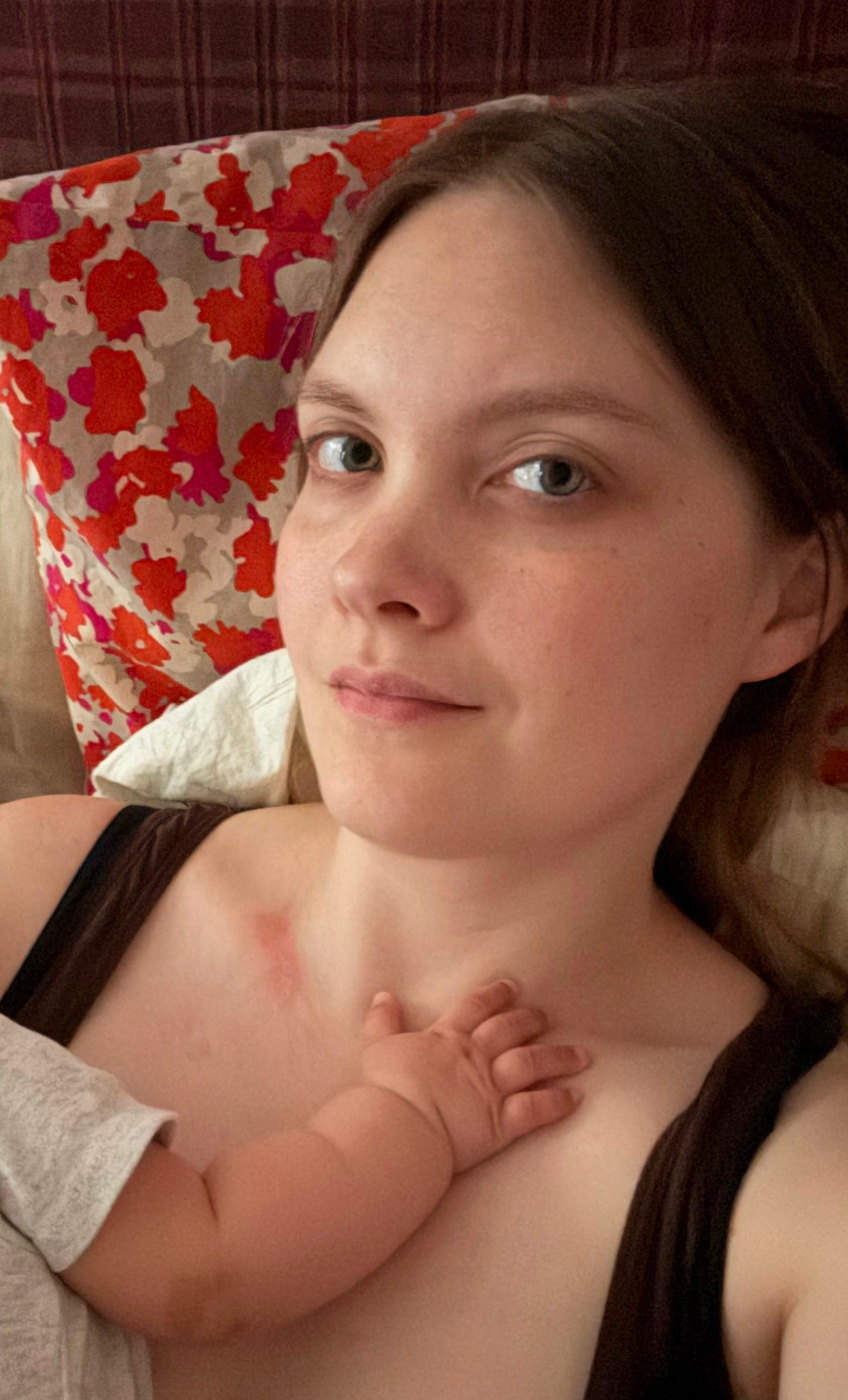
If you want to support my work (and the chubby hand pictured above), consider becoming a paid subscriber! I was reading an article the other day about how women don’t get paid for their labor (shocker), and you know, I think we could change that.
Comments
Nothing yet. Say the first thing.
Sign in to join the conversation.