

If you’re someone who pays attention, it might be easy to feel punished for doing so these days. Headlines will tell you there’s an apathy crisis, a loneliness crisis, a literacy crisis. We are simultaneously more connected and more isolated than ever.
When I feel lost, I’m a fan of finding myself in time. I go to art museums; I read old books; I trace ideas back through years. These activities remind me that many of our contemporary feelings and fears aren’t new. History is one big cycle. Everything is a response; everything is temporary; there have always been people who persevered.
As a genre, the manifesto feels like the opposite of apathy. Entire movements were born from one person or group speaking up. Studying the manifesto as a genre helps me readjust my perspective and place myself in a larger cultural context. And if one thing remains true, it is that human creativity will continue to evolve.
Art reminds me every day that there is reason for optimism. I’ve found the more I look for these reminders, the more I find them everywhere.
Here are 31 from my July, for your August.
1. Manifesto as spark. Sunday Zine Club’s July prompt is SPARK, so I’ve decided to take a stab at writing my own creative manifesto. The way I see it, the manifesto can spark a movement, or a person can be sparked to write a manifesto!
2. Manifestos for process and preservation. I ask the Sunday Zine Club community for recommendations and somebody suggests Itch.io’s recent Manifesto Jam. I love the host’s description of the manifesto as “awkward, clunky, impractical, confronting, uncompromising, defiant: all qualifiers undesirable in an increasingly professionalised, corporatised game making ecosystem.” In fact, “These traits are what makes the manifesto beautiful.”
A few of my favorites:
“The Artist’s Intent Is to Enjoy It,” a meditation on enjoying the process.
“I Will Not Delete My Games,” a promise to preserve creative work as “proof that i made something.”
3. Manifesto as Wikipedia rabbit hole. The 2026 Manifesto Jam links to the Wikipedia page for art manifestos. Apparently the manifesto genre really only gained traction with artists in the 1900s, which means the list includes lots of offerings from the last century. You get author names, associated movements, and in some cases short blurbs, essentially functioning as a menu for what might interest you if you’d like to dive deeper. Wikipedia at its finest!
4. Manifesto as invitation to time travel. I go looking for the actual text of a few of these manifestos and stumble across Obelisk, an interactive art history website whose creator refers to as an “invitation” rather than a “platform.” Surrealism, Dadaism, Futurism, Cubism, even a letter from Van Gogh — I like the way the site’s format uses hyperlinked quotations to pull you into the full text.
5. A manifesto muse? I remember that I own a copy of McSweeney’s #73, a giant collection of 20th-century manifestos. There are some I recognize — Valerie Solanas’ “S.C.U.M. Manifesto,” André Breton’s “Manifesto of Surrealism” — and there are others that are new to me, like Clare Dolan’s “The First Manifesto of the Museum of Everyday Life” (“We dream of ourselves, and reimagine our own lives by glorifying, exploring, and celebrating the detritus of our struggle to exist and thrive!”).
But best of all is John Cage’s “Manifesto” appearing before me in the table of contents after I wrote about him last month — the very same manifesto I quoted in Clue Log after randomly opening up a library copy of Silence. I wonder if he put this theme in my head without my even realizing it?
6. Manifestos for museums. I go looking for more info about Dolan’s Museum of Everyday Life and discover their glorious website. Turns out the Museum is a physical place and still operating today, and they wrote a second manifesto to follow the first:
The Museum of Everyday Life lives inside each of us, a vast and echoing cabinet of curiosities, every minute of every day filling our endless drawers and cases with new additions to the permanent collection.
7. A fill-in-the-blank manifesto. Returning to the Wikipedia list, I’m immediately intrigued by Michael Betancourt’s “The ____________ Manifesto.” I recently wrote a Mad Lib essay myself and I’m always excited to discover others who’ve played with the fill-in-the-blank form before me.
My favorite part:
The medium is as __________ as the artist. Essential only
is the forming, and because the medium is __________,
any __________ whatsoever will __________.
__________ is the name for such art.
__________ stands for freedom. __________
changes meaning with the change in the insight of those who view
it. Every artist must be allowed to mold a picture out of
__________. The __________ of natural
elements is __________ to a work of art. Instead, it is the
artist who __________ to produce __________,
in order to make a better art.
8. The return of Werner Herzog (via manifesto). Tracking down Betancourt’s manifesto leads me to the homepage of designmanifestos.org, where I find none other than Werner Herzog’s manifesto, “The Minnesota Declaration.”
I’ve previously identified Herzog as a personal creative guide, so I’m not terribly surprised to see him pop up here, too. (In that Microfascination I wrote, “I think it’s important to identify those creatives who are like flashlights for you, illuminating possibilities in the path ahead. These people help you figure out what you think — about art, about the world, about the search for meaning.”)
You can even watch Herzog read this manifesto, introduced by Roger Ebert!
9. Manifesto for an art department. I’ve seen this manifesto circulating uncredited on the internet before, so it’s nice to see designmanifestos.org name Sister Corita Kent as the author (and with another John Cage cameo to boot).
HELPFUL HINTS: ALWAYS BE AROUND. COME OR GO TO EVERYTHING. ALWAYS GO TO CLASSES. READ ANYTHING YOU CAN GET YOUR HANDS ON. LOOK AT MOVIES CAREFULLY, OFTEN. SAVE EVERYTHING - IT MIGHT COME IN HANDY LATER.
THERE SHOULD BE NEW RULES NEXT WEEK.
10. Manifesto as creative complaint. Retracing my steps to the McSweeney’s book, I notice they also include the Guerrilla Girls’ manifesto — an artist activist group I’ve always meant to learn more about. I pop their name into YouTube and discover a video about them on one of my favorite channels, The Art Assignment. I love the prompt they offer to viewers:
1. Think of something you really want to complain about
2. Communicate your message in a unique, creative way
11. Manifesto as object. Guerrilla Girls remind me of Keri Smith’s book, Guerilla Art Guide. Manifestos are often self-published as pages, pamphlets, zines — but what else could a manifesto look like? A paper airplane? A fortune-teller? Where could you leave it behind?
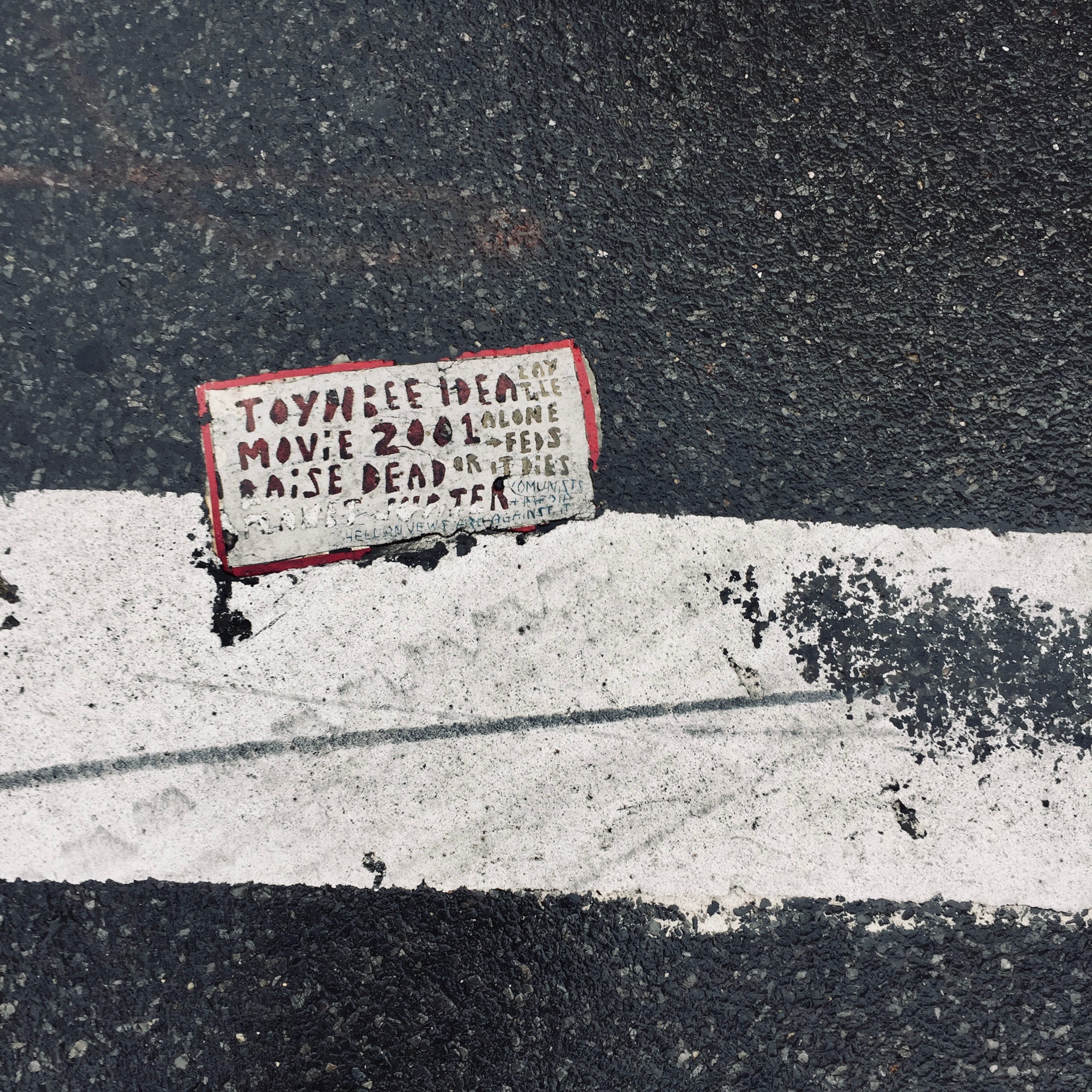
12. Manifesto as mystery tile. What other forms could a manifesto take? I start scrolling through my photo roll and come across a Toynbee tile I spotted in New York a while back. Now, the Toynbee tiles could probably be a Microfascination all on their own (and I super recommend the documentary Resurrect Dead if you’re curious), but the gist is that these mysterious tiles first started appearing in the roads of cities across the US and South America back in the ’80s. The tiles’ message is not exactly straightforward and has lent itself to different interpretations over the years, but I think my favorite takeaway is listed right there on the Wikipedia page:
Another possible interpretation is that the Toynbee reference comes from the science fiction writer Ray Bradbury’s short story “The Toynbee Convector”, which alludes to Toynbee’s idea that to survive, humankind must always rush to meet the future and believe in a better world, and must always aim far beyond what is practically possible, to achieve something barely within reach.
13. Manifesto as found text. I kinda like the idea that “writer’s block” is just a gentle signal to look outside of our own heads for the next sentence — almost as if your environment is a book waiting to be read. I don’t feel like the sole author of anything I write, really — I’m co-writing with my surroundings, my inspirations, my world. I’ve been collecting text I come across for years via photography as a wellspring of inspiration I can turn to whenever I feel stuck. This comes in handy when thinking through ideas for my own manifesto!
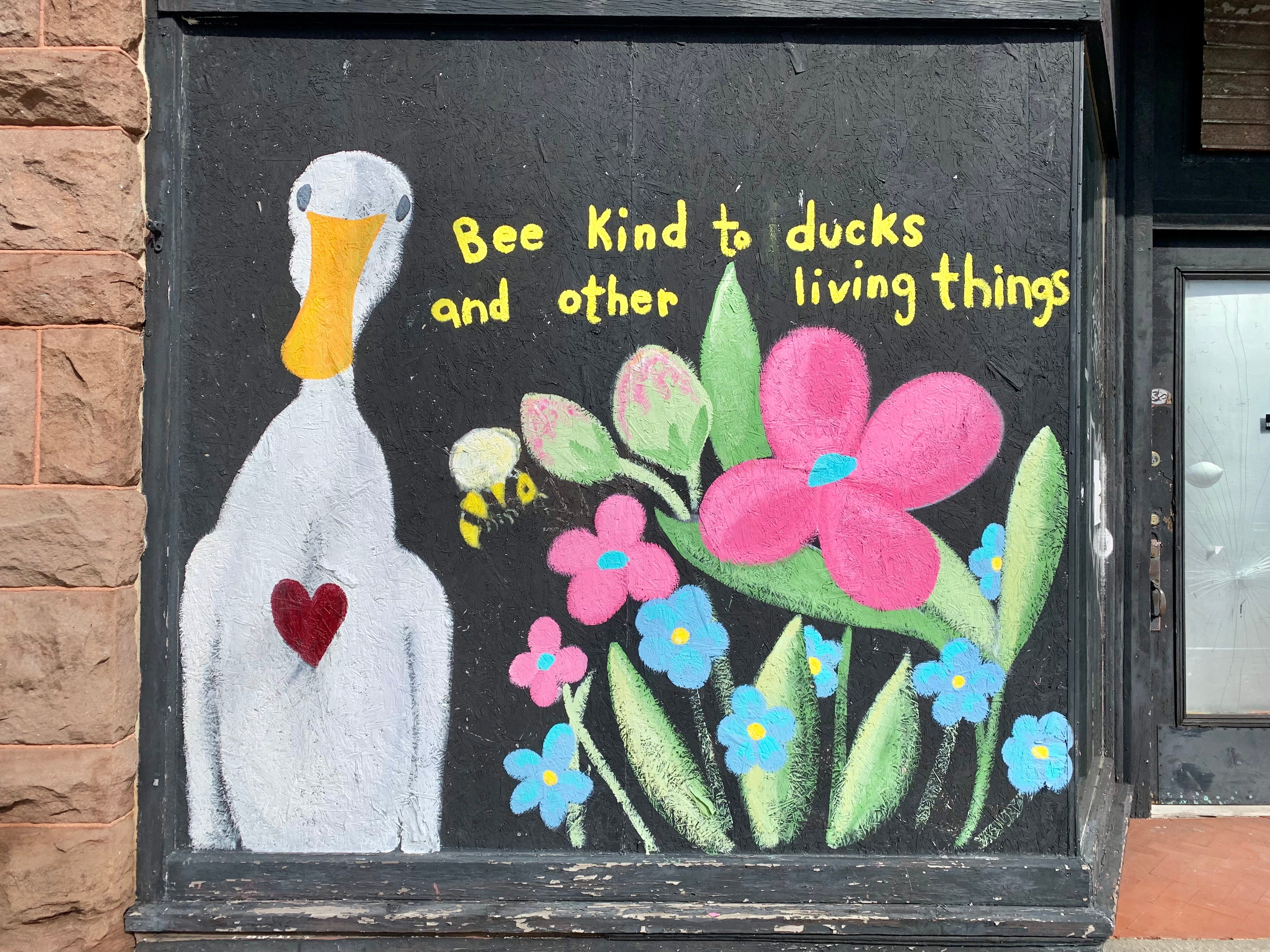
14. A manifesto appears in the mailbox! After participating in Creative Quests’ Release Day back in May, I ordered a copy of their zine, The Quest Life: 12 Principles for Staying Wildly Curious and Creatively Alive. I needed to read the words “Playfulness is an act of resistance” this month.
15. Manifesto as zine. Speaking of zines, it feels appropriate to be deep-diving manifestos during International Zine Month. Some of Stolen Sharpie Revolution’s 2026 IZM prompts could be repurposed as frameworks for a manifesto, too. (A one-page manifesto, a twenty-four-hour manifesto, a manifesto playlist…)
16. Manifestos for music. Now I’m curious about the role of the manifesto in music history. A little internet searching leads me to this blog post on “The Lost Art of Music Manifestos.” I love learning about them all (shoutout to perennial fave Brian Eno, who published his manifesto in his album’s liner notes), but the section about Ferruccio Busoni’s “Sketch of a New Aesthetic of Music” really lifts my sprits:
During Busoni’s time, many people thought that music composition was in sharp decline. They lamented that the greatest music ever made was of the past – think Bach, Mozart and Beethoven.
We all know today that it’s not true – this bummed out attitude usually comes from fear and close-mindedness. Busoni’s manifesto had a fresher perspective: he wrote that the best of music was still to come – and that music would continue to get better for several thousand years.
Busoni couldn’t see the future, but he chose to believe in it.
17. A manifesto to be read in Willie Nelson’s voice. I go looking for more music-world manifestos; Willie Nelson shared 10 rules for life and creativity as part of WePresent’s Manifesto series!
18. A manifesto in questions. Turns out the WePresent series is a gold mine. Another I enjoy is author Sheila Heti’s 10 questions for a novel (“How can you change the author’s life while you are being written?”). I love the idea that a manifesto can be composed of questions rather than concrete statements.
19. A manifesto for love. Another from the WePresent treasure trove: author Roxane Gay’s 10 rules for loving and being loved well. “The nemesis of your beloved is your nemesis too.”
20. The reader’s manifesto. The Atlantic published an article this month that had some dire things to say about the state of reading. If you also read that piece and felt a little discouraged, Book of the Month’s manifesto is a nice antidote to anxiety around the current state of literacy. (I get a kick out of their interactive “brief timeline of fiction’s exaggerated demise.”)
21. The Manifesto movie. As always, I search my topic of interest in the library catalog to see what results come up, which leads me to Julian Rosefeldt’s Manifesto. The film was originally an art installation that got remixed into a movie, where Cate Blanchett plays 13 characters who recite a number of different manifestos (including some I’ve mentioned here). After reading so many, it’s pretty cool to see and hear them performed!
22. A manifesto worth getting fired over? Are there other movies that center around manifestos? What pops into my head immediately is Jerry Maguire, in which Tom Cruise writes a mission statement titled “The Things We Think and Do Not Say,” which ultimately gets him fired. I’m always curious about texts as plot points — we hear part of it in the film, but does a full version exist anywhere? Well, since it’s a Cameron Crowe movie, of course it does.
23. The Disney guy who inspired the Jerry Maguire manifesto. Back in 1991, Disney executive Jeffrey Katzenberg wrote and circulated a memo called “The World Is Changing: Some Thoughts on Our Business.” Katzenberg urged his colleagues to shift their focus from obsessing over the blockbuster and remember to honor the importance of creative story development in future projects:
It seems that, like lemmings, we are all racing faster and faster into the sea, each of us trying to outrun and outspend and out-earn the other in a mad sprint toward the mirage of making the next blockbuster…
Magic is the key. Regardless of the recession, people will still leave their VCR’s to go to the movie theater… if they are convinced that the experience that awaits them there will be magical enough.
In the dizzying world of moviemaking, we must not be distracted from one fundamental concept: the idea is king. Stars, directors, writers, hardware, special effects, new sound systems… all of these can have a role to play in the success of a film, but they must all serve as humble subjects to the supremacy of the idea.
If a movie begins with a great, original idea, chances are good it will be successful, even if it is executed only marginally well… People don’t want to see what they’ve already seen. So, we need to be bold enough to stretch bounds, push the envelope of creativity and follow our hearts along with our heads. When we fail, let it be because we tried to innovate, not emulate. And, by so doing, I am convinced that we will continue to reap success.
The memo makes for fascinating reading 35 years later because of how much of it rings true in our current climate. In Katzenberg’s own words, “Make no mistake about it, ours is a cyclical business and we are once again repeating the cycle.” Remember what I said at the beginning about history being a cycle?!
Katzenberg quit Disney three years later in order to found a little company called DreamWorks with Steven Spielberg and David Geffen. Maybe writing a manifesto can help us find our people, our future collaborators.
24. Has anyone on my bookshelf written a manifesto? Austin Kleon’s books about creativity have a manifesto-like quality to them, each title a different instruction: Steal Like an Artist. Show Your Work. Keep Going. Don’t Call It Art. I’m a big fan of his blog and newsletter, so I google to see if he has something to say on manifestos directly. He sure does: “Write the book you want to read.” But my favorite part of this post is actually the timestamp — in 2008, Kleon had yet to publish his first book. He really did take his own advice (and became a bestselling author in the process).
25. What if there’s no wrong way to write a manifesto? Near Kleon on my shelf is Marin Kosut, an author I interviewed a few years back. Kosut wrote a genre-bending book called Art Monster that I described as “a shape-shifting hybrid of a scholarly text, conversation, manifesto, and love letter.” I like this bit she had to say when we discussed manifestos:
They can take any form. Nobody is gonna sit and tell you, well, wait, that’s not the right way to write a manifesto. So there’s this openness.
26. Manifesto as an annual creative practice. So okay, there are no rules, but what about suggestions? I poke around online looking for more manifesto inspiration and turn up a few different articles on Liminal Magick. Dorian gives basic pointers (and incorporates collage and found text!) here, and also suggests writing a manifesto as an alternative to making New Year’s resolutions.
27. Manifestos can just be for YOU. Still more excellent manifesto advice in this excerpt from Charlotte Burgess-Auburn’s You Need a Manifesto via Creative Mornings:
Free yourself from any sense of obligation — you don’t owe anyone anything. Trust your intuition. There’s only one person your manifesto can and needs to be totally true for, and that is you, right now.
There’s a tendency to look back over history and think a manifesto needs to be tied to a Major Movement or herald some Great Revolution. And don’t get me wrong, those are pretty cool. But also, you can start by just writing a manifesto for yourself. Share it if you like, or don’t. Like Burgess-Auburn says, “There’s only one person your manifesto can and needs to be totally true for.”
28. Manifestos can also unite communities. Clicking around on the Creative Mornings website I learn that the organization has its own manifesto. Short and sweet and excellent inspiration (and you can even listen to it being read). Kinda makes me think that every community should have one — even if it’s just a few people in creaky chairs sitting around an old wooden table, trying to make something together.
29. The accidental manifesto. Most of the manifestos I’ve read were written on purpose — folks with something to say who enter the writing process with the intention of adding to the genre. But I think sometimes people put pen to paper without any particular intention and only realize at the end what it is they’ve written. (Another cool side effect of using writing as a tool to work out what you think.)
This has definitely happened to me with Microfascination! As an example, I started “Searching for Meaning on the IMDb Message Boards” thinking I was just exploring the glory days of a retired Internet forum, but by the end I’d written:
Maybe the search can be a commitment, a creative practice. From now on, when I open a browser or pick up my phone, I want to begin by asking myself one question:
What am I looking for?
Which ended up being something of a motto for me going forward.
30. The claimed manifesto. Going back to the idea of found text as a basis for manifesto, I like the idea of claiming meaningful quotes written by others as a manifesto to live by. Making a manifesto zine of these collected quotes could be another fun project.
My personal top pick for “claimed manifesto” would be this C.S. Lewis quote from “On Living in the Atomic Age,” which has been a great comfort these last few years:
If we are all going to be destroyed by an atomic bomb, let that bomb when it comes find us doing sensible and human things—praying, working, teaching, reading, listening to music, bathing the children, playing tennis, chatting to our friends over a pint and a game of darts—not huddled together like frightened sheep and thinking about bombs. They may break our bodies (a microbe can do that) but they need not dominate our minds.
31. Finally: my very own manifesto! The Project Is Your Life synthesizes a whole bunch of ideas I’ve been turning over the last few years, and I’m excited to share it with y’all. Also includes a list of inspirations and recommendations for further research. Here’s a little taste:
Your life is art.
If your life is art, then everything is a medium.
If your life is art, then everyone is your audience.
If your life is art, there is no culmination; there is only accumulation.
The project is your life.
The process is the point.

As always, Connecticut folks are invited to join us at Wesleyan RJ Julia Bookstore on August 17 for our monthly Write-in! Maybe this month you’ll write a manifesto of your own?
See y’all in August!
No posts
Comments
Nothing yet. Say the first thing.
Sign in to join the conversation.