
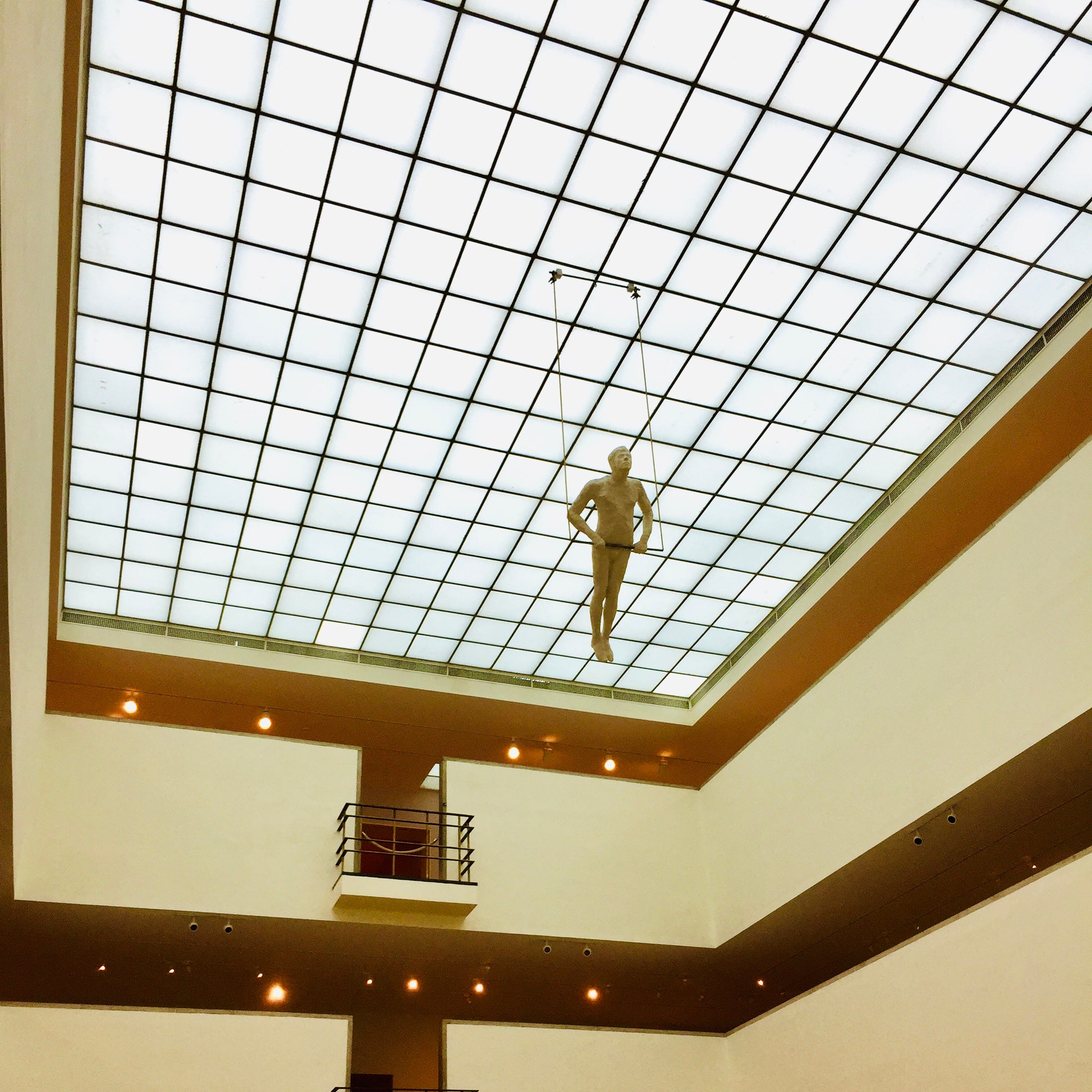
What you need won’t appear until you need it.
It happens to me frequently that I’ll realise, with a lurch of the stomach, that while the section of the book I’m working on right now is going fine, I’m about to run into trouble, because I don’t have everything I need (the right arguments, good enough material, whatever) for the bit that’s coming next.
This bothers me less than it used to, though, because again and again, the missing insight, anecdote, or angle arrives just in time. I’ll open a book at random, or hear something on a podcast, or a friend will make a comment, or I’ll notice something on a walk, and it’ll be exactly what I need for everything to fall into place. It never seems to arrive until the moment it’s required, though, so that’s more way it’s being constantly hammered home to me that trusting yourself/reality/the process is the whole game here.
I think I could muster a down-to-earth, non-magical explanation for this phenomenon, to do with the way one’s attention is primed to notice what matters most at any given moment. But it feels pretty magical whenever it happens.
I should’ve known what I was in for when my Scrabble tiles spelled out LISTEN at the start of the month.
I’ve been thinking a lot this year about influence — why artists are the way they are, and who inspires them, and how connected we all turn out to be. Even if you don’t recognize a name, it’s possible that their work has already trickled down to you through the impact they’ve had on other artists you admire. What happens when we begin to seek out and identify those influences, building a sort of inspirational family tree?
Austin Kleon writes about the importance of establishing your own artistic genealogy; I’ve found various ways of doing this over the years. I had an idea I called “Epigraph Tag,” where you open up a favorite book, make a note of the source material for its epigraph, find and read that book, then get your next assignment from that book’s epigraph, and so on. I taught myself about music by tracking Bob Dylan cover songs across decades, genres, and movements. If you subscribe to a lot of newsletters, you could even search a newly discovered name in your own inbox to see what other writers you like have to say about them.
Interviews remain a goldmine of recommendations in this vein; I always liked to end my own interviews by asking the author what books they were reading. As I continued to learn about creative influence, I noticed that certain names appeared over and over in the orbit of creators I admire.
As an example, who popped up again in that very Kleon post?

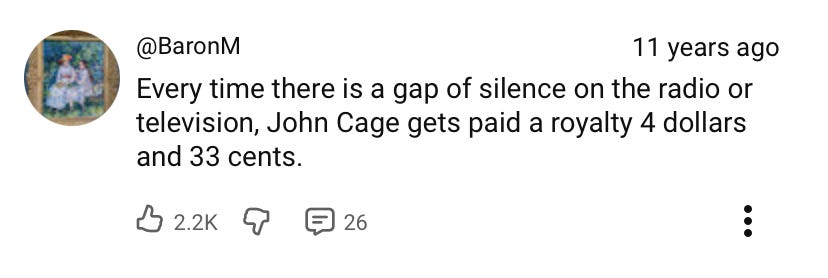
There are so many different Microfascinations I could write about experimental composer John Cage. Obsessions made his life richer. (Literally — an amateur mycologist, he was able to partially fund his creative pursuits by answering a bunch of questions about mushrooms on an Italian gameshow.) But he’s perhaps most well known for a controversial composition called 4’33”. The performer sits with their instrument, unmoving, for the titular four minutes and thirty-three seconds. Whatever sounds fill the space — the quiet rustling, an errant cough, every single inhale and exhale — this is music. It is different every time.
4’33” challenged the very definition of music when it premiered in 1952, as it required listeners, critics, and musicians to ask questions that weren’t easily answered. What is music? What happens when an audience becomes part of the performance? Is there really any such thing as true silence? And who is the arbiter of the answers to these questions, anyway?
Cage once said, “I can’t understand why people are frightened of new ideas. I’m frightened of the old ones.” Sometimes a new thing comes along in art to push the boundaries of what we thought we knew, and this can be unsettling. But these challenges often give us opportunities to deepen our understanding of art, and of each other.
By listening to 4’33”, you become a part of the piece. Any sound you make is an addition to the composition. That’s what makes it different every time. Without fail, the human element introduces a kind of unpredictable magic. Cage wrote about “a view of the arts which does not separate them from the rest of life, but rather confuses the difference between Art and Life.”
In 4’33”, they are the same.
At some point I added 4’33” to my never-ending diary playlist — an accumulation of songs with personal significance that’s now swelled beyond 500 entries since I started it. A few weeks ago, it came on shuffle while I was driving (because of course it did). At the time I wanted music, noise, distraction, but given that I was writing about Cage this month, it didn’t feel right to skip.
I thought about my Scrabble tiles and then I rolled the window down so I could hear everything around me: the road, the birds, the wind. And I thought about how a listener can pick out a single sound, and really focus on that — the sweet chirping or the rush of the highway air. Or, you could absorb all of those sounds as one, in a kind of improvisational symphony.
At first, I’d assumed I’d be sitting in pure silence simply because there was no music playing — but it isn’t quite that simple, is it? Cage believed that “there is no such thing as an empty space or an empty time. There is always something to see, something to hear. In fact, try as we may to make a silence, we cannot.”
In closing, a question of my own:
What if, as a creative exercise, everyone composed a biographical statement that was not a list of degrees, achievements, and awards, but rather a reflection of the art that has impacted them in their lifetime?
Here’s just one possibility:
Abigail Oswald was once given a book that invited her to destroy it, and this changed her life. Some years later, she listened to silence for four minutes and thirty-three seconds and discovered that silence was something quite different than what she’d believed it to be. It wasn’t empty at all.
Two books: I’ve been making my way through John Cage’s Silence this month, as well as Pauline Oliveros’ Deep Listening. Oliveros is definitely also a member of my artistic genealogy, and her writing on focal vs. global attention influenced my thinking here.
Wikipedia rabbit hole of the month: The John Cage page is a great launchpoint if you’re interested in the role of chance in the creation of art. (See indeterminacy and aleatoric music!)
John Cage & mycology: Cage once said that “much can be learned about music by devoting oneself to the mushroom.” His obsessions weren’t secondary to his creation; everything was connected. I went looking to see if any footage remained of his run on the Italian gameshow talking about mushrooms. What I found instead was this delightful website specifically devoted to Cage’s time in Italy. Feels reminiscent of an earlier era of the Internet — one I miss very much.
The Bureau for Listening: And speaking of delightful websites that remind me of the old internet: I also stumbled across something called The Bureau for Listening. I know nothing about them but their website is fun and weird and brimming with experiments and surprises. Reminds me of an online art installation!
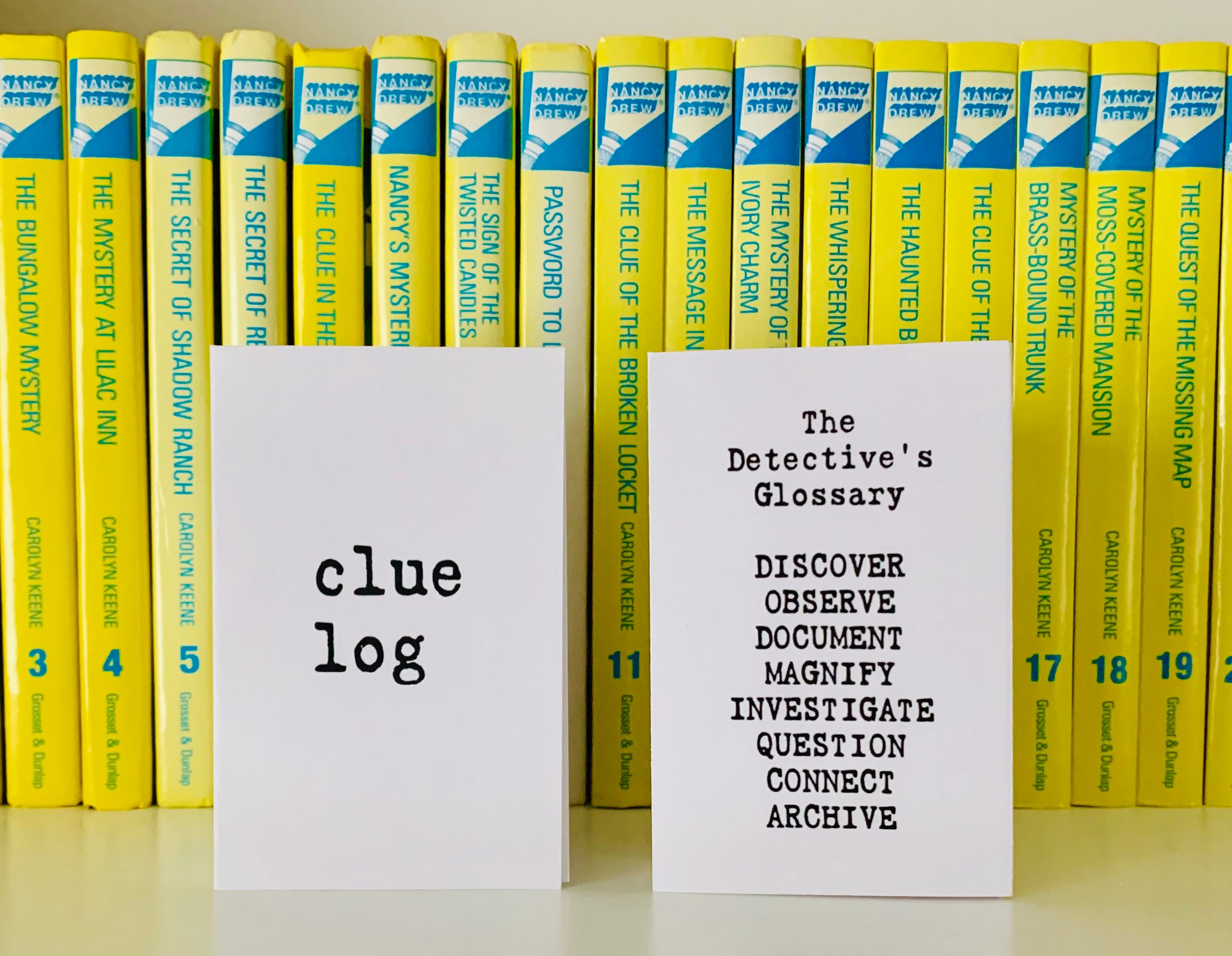
After having so much fun creating my zine in community with other Release Day participants last month, I went looking for similar groups formed around communal creative deadlines and found Sunday Zine Club. Participants have four weeks to create and submit a zine around a particular theme. June’s was FOUND, which gave me the idea to create a companion zine for Follow the Clues!
Clue Log is a zine for curious people who like to play detective in everyday life, pulling inspiration from Emily Dickinson, Journey, Carl Jung, Scrabble, various books about creativity, and John Cage (bet you didn’t see that coming). And you can make one, too! The listing includes two downloads: a zine that collects a sampling of my own clues from June, and a DIY version with the same cover and empty interior pages (so you can fill it with clues of your own).
An update from the land of Lost/Found! Back in August, I shared that I’m now the editor of Split/Lip Press’ Lost/Found imprint, which gives out-of-print books a new home. This month we announced our latest acquisition: James Gapinski’s Edge of the Known Bus Line. Reading this eerie and surreal story of survival made me feel a little stronger and more stubborn in my own life; I hope it does the same for you. Forthcoming September 2027!
Our next Wesleyan RJ Julia Bookstore Write-in is scheduled for July 20! As always, Connecticut folks are invited to hang out, write, and meet other creative people.
All right y’all, take care and I’ll see you again next month!
No posts
Comments
Nothing yet. Say the first thing.
Sign in to join the conversation.