
On April 8, just hours after the United States and Iran signed a ceasefire on stopping the hostilities — mediated by Pakistan — Israel launched one of its biggest waves of strikes on Lebanon since the start of the war. This was highly unexpected, because the Pakistani Prime Minister had assured that Lebanon was a part of the ceasefire. But Israel thought otherwise.
To understand more about the war, read this article.
This was later backed by the White House, affirming that Lebanon was a “separate skirmish”, and Tel Aviv said it would continue to attack Hezbollah. The Israeli strikes were devastating, resulting in over 200 civilians deaths.
Fearing increasing tensions, Shehbaz Sharif, the Prime Minister of Pakistan, invited delegations from the United States and Iran to Islamabad for negotiating peace on April 12.
The U.S. delegation was led by the country’s Vice President, JD Vance, special envoy Steve Witkoff and Jared Kushner, who is also Trump’s son-in-law. On the other side of the table, the Iranian delegation was led by Foreign Minister Abbas Araghchi and parliamentary speaker Mohammad Bagher Ghalibaf.
Inside closed doors, the debate went on for 21 long hours. One of the primary demands from the United States was for Iran to affirm that they won’t seek nuclear weapons. In a news conference, JD Vance said they failed to receive such a promise. Further, he asserted that no deal would be possible without a promise from Iran on nuclear weapons.
Building up on the nuclear issue, ultimately, the talks ended without any breakthrough in peace. The two delegations did not reach an agreement on six key issues:
❌ | Key disagreements during the Islamabad talks, as sourced from Al Jazeera
Ending all uranium enrichment
Dismantling major enrichment facilities
Removing Iran’s stockpile of highly enriched uranium;
Accepting a broader regional security framework involving US allies;
Ending funding for groups Washington designates as “terrorist” organisations, including Hamas, Hezbollah and the Houthis
Complete reopening of the Strait of Hormuz without tolls.
As evident, the central reason for failure of talks is nuclear weapons. What Tehran sees as security, Washington and Tel Aviv see as a threat. The nuclear pursuit for Iran, like many countries, has so far been one for regional deterrence. Essentially, if a country has a nuclear weapon, it can use it as a defensive mechanism against attacks. The aim is not to actually use the nuclear weapon, but to make threats of using the weapon. But without Iran ending its aspirations of being a nuclear nation, the United States and Israel seemingly won’t stop.
After the talks, the Iranian delegation seemed positive about continued discussions. In fact, they were willing to stay in Islamabad to resume a second day of negotiations. Envoy Moahmmad Fathali said they are ready for another round of peace talks with the United States, provided it does not make any “unlawful” demands to Tehran’s conditions.1
Iran’s primary demands included Israel to stop the offensive in Lebanon, payment of war reparations, and control of the Strait of Hormuz. Israel has refused to stop attacks on Lebanon, and the United States is pushing for Iran to cease control of the Strait.
Following the failure of the talks, Trump, in his Truth Social platform, said:
“Effective immediately, the United States Navy, the Finest in the World, will begin the process of BLOCKADING any and all Ships trying to enter, or leave, the Strait of Hormuz… Any Iranian who fires at us, or at peaceful vessels, will be BLOWN TO HELL!… our Military will finish up the little that is left of Iran!” — an excerpt
The United States is attempting to cripple Iran’s already ailing economy by blocking its major ports. In this blockade, the U.S. has stated that it will block all ships from all nations that are trying to enter or leave Iranian ports and coastal areas, and would strike back in case of attacks.
Moreover, it is trying to prevent Iran’s selective sales. Basically, Iran’s Islamic Revolutionary Guard Corps (IRGC) has full control over the Strait of Hormuz, and is blocking it as a reply to the attack by the U.S. and Israel on Iran.
Now, Iran is selling oil and allowing nations that it “likes” to pass through the Strait — granting them an exception — and disallowing nations that it “dislikes” from getting oil.
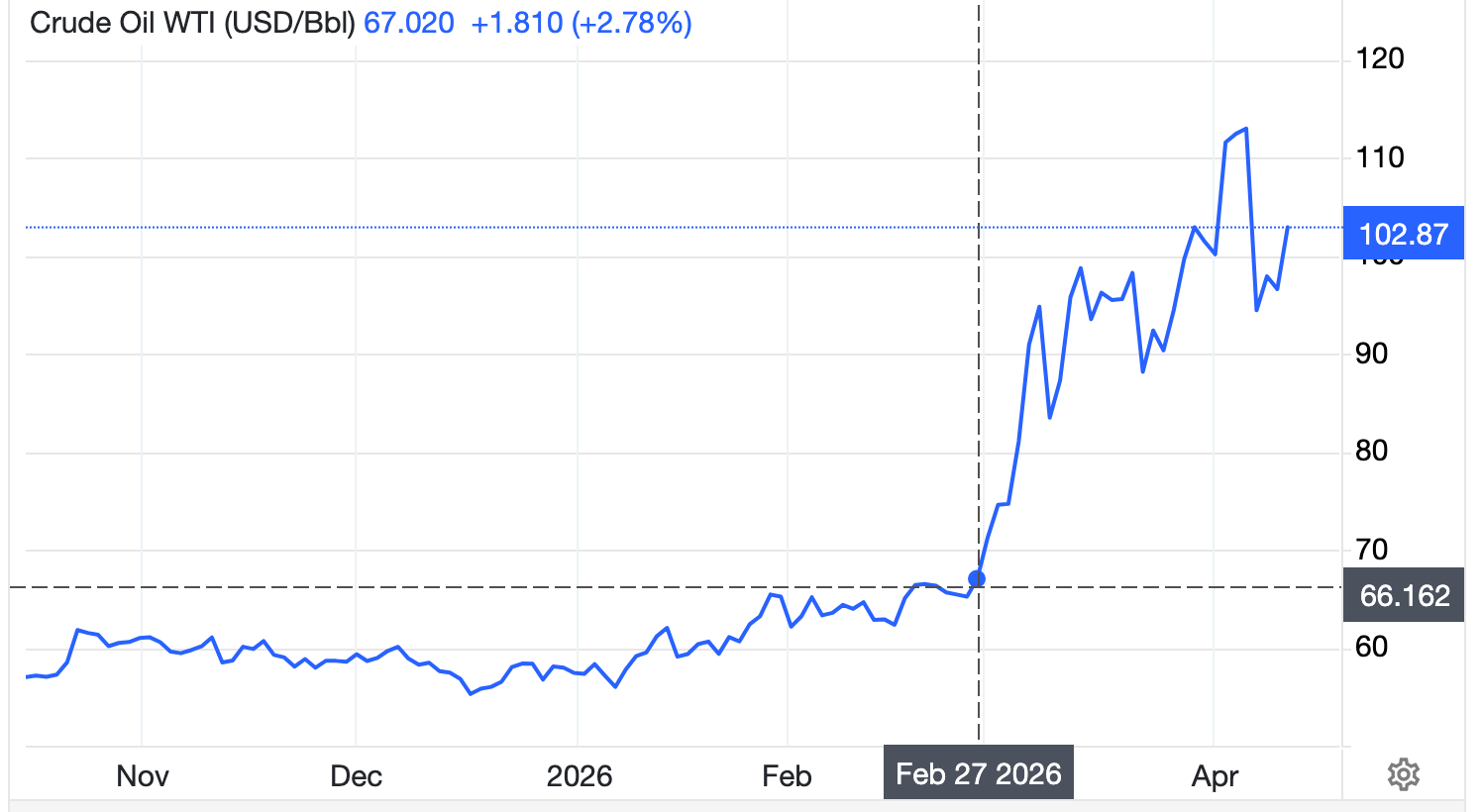
Trump sees this as a threat to the price of oil, which has been spiking consistently. But the problem with this blockade is that it risks oil price to spike even further.
Interestingly, it is to be noted that this naval blockade is legal under international law, unlike the U.S.’ prior international law violating actions such as the arrest of the President of Venezuela.
Though the blockade is legal, it is an act of war — a war declaration — which effectively could nullify the two-week ceasefire, which technically still exists.
Iran’s Foreign Ministry spokesperson Esmaeil Baghaei has criticised the U.S. blockade, writing on X: “Can an illegal ‘war of choice’ be won through a ‘revenge of choice’ against the global economy?!”2 This reflects the nature of this action — because it might very well have further repercussions for the whole world, and even for the U.S.
“Enjoy the current pump figures. With the so-called ‘blockade’, Soon you’ll be nostalgic for $4–$5 gas,” Ghalibaf wrote on X.3 The average price for one gallon of (2.8 litre) of petrol in the U.S. rose from less than $3 before the war began, to more than $4.12.4
Iran had vowed to defend its territorial waters, equating the naval siege to “piracy”.5 Iran primarily uses a strategy of using “fast-attack ships” — and Trump has warned that if these ships approach the blockade, they would be “eliminated”. He said such boats would be destroyed using "the same system of kill that we use against the drug dealers on boats at Sea. It is quick and brutal."6
We can understand that the scope for peace has almost gone back to square one — talks in Islamabad proved fruitless, and now, the U.S. is actively taking military action in Iranian waters.
Such is the situation in West Asia as of now — the war is still going strong, with de-escalation efforts being pursued by Pakistan. Trump and Netanyahu will not step back, and Tehran won’t, either.
https://www.thehindu.com/news/international/iran-israel-us-war-west-asia-conflict-live-updates-on-april-13-2026/article70856044.ece
https://aje.news/czjcze?update=4489046
Comments
Nothing yet. Say the first thing.
Sign in to join the conversation.