
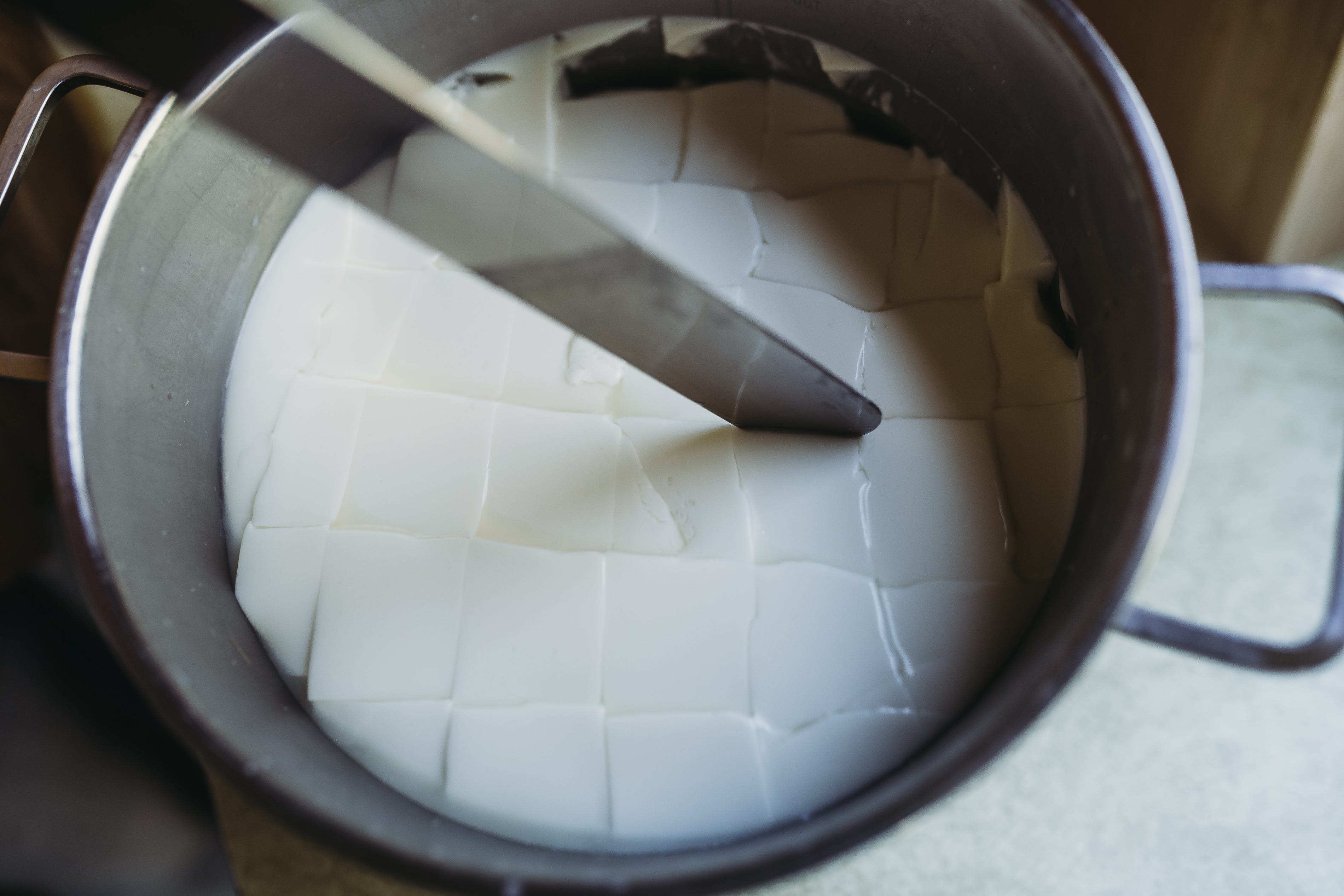
If you have access to high quality, fresh, raw milk, I recommend skipping the vinegar in the following recipe and begin by warming the milk. When using unprocessed (raw) milk, you can utilize the “stretch test” to determine when the curds are at the perfect acidity for stretching. Do this by removing a small piece of curd from the pot (a few hours after cutting the curd) and putting it in a cup of boiling water for two minutes. When you pull out the curd, it should stretch into a very long, gooey string if it is ready for the next step. If it is not ready, wait about half an hour and try the test again. Pasteurized milk will not achieve the same degree of stretch, but the test can still be utilized, just know that the curd won’t get as stretchy. For pasteurized milk, the best stretch is achieved about 3-5 hour after cutting the curd, but raw milk curds usually take 6-8 hours. The warmth of your kitchen will influence fermentation, so you can adjust your timing accordingly. Lightly pasteurized milk will make a delicious mozzarella but the “slow” method made with raw milk will result in mozzarella with superior stretch.
If you are using pasteurized milk, make sure it is only lightly pasteurized and therefore not heated above145 degrees Fahrenheit. Please don’t use ultra pasteurized or even regularly pasteurized milk. Also look for non-homogenized milk and choose full-fat.
INGREDIENTS
• 1 gallon cold non-homogenized full-fat milk, only gently pasteurized
• ¼ cup white vinegar, diluted in 1 cup of cold water
• ¼ cup sea salt
• ¼ cup yogurt (this is your natural culture)
• Rennet, enough to coagulate 1 gallon of milk (follow package instructions)
METHOD
In a large pot, add the cold milk and stir in the diluted vinegar. Over
medium heat, warm the milk to 105 degrees Fahrenheit (40.6 degrees Celsius). Turn off the heat.
Next, while stirring, add the yogurt and the rennet. Remove the pot from the
stove and keep the pot warm for about 45 minutes by covering it with a
blanket or jacket.
Check for a clean break, meaning the curd has set. Next, cut the curd into
walnut-sized pieces, cutting first one way, then the other, and then as horizontally
as possible, as you tip the pot to the side slightly. Gently stir the curd, cutting any pieces you missed. Stir the curds three to five times over the course of about fifteen minutes.
Leave the curds in the pot to settle beneath the whey, keeping the pot in a warm spot. After 3 hours, boil 1 gallon of water in a large pot and use the stretch test to check your curds.
When the test shows the curds have some good stretch, pour the whey off the curds, reserving about half a gallon of whey to make the brine. This is best made in
a gallon jar, stirring in ¼ cup of sea salt and stirring well. Set aside. Also fill a large bowl with
very cold water.
Use your hands to break the curds apart slightly. Take the boiling water off the heat and allow the water to cool for a minute or two. Ideally it will be 194 degrees Fahrenheit
(90 degrees Celsius). Slowly ladle the water into your pot of mozzarella, stirring
continuously. Continue to add the hot water, a little at a time, until the mozzarella
is gooey, like melted cheese.
Once the cheese is very malleable, use your hands to lift a few inches of
cheese out of the water. Roll it in on itself and then press it like a bubble
between your thumb and index finger before breaking off the ball of mozzarella. If this is challenging, ripping off a piece and squeezing it into a ball will also work well.
Put this ball into the bowl of cold water to cool and then transfer it to
the jar of brine. Continue until all the mozzarella has been shaped into balls
and submerged in the brine.
Before using the mozzarella, it is a good idea to leave it in the brine for about five hours. Pour off the brine and store the mozzarella in a covered dish in the fridge for up to a couple of weeks.
My book Radical Farm: Animals, Food and Our Future has many more recipes for cheese and other real foods made with wholesome ingredients. Learn more at www.radicalfarmbook.com
Comments
Nothing yet. Say the first thing.
Sign in to join the conversation.