
Understanding Human Desire in a Dopaminergic Age
We live in a time when the human soul is constantly being hijacked by stimulation. The world around us has been engineered to maximize dopamine, the brain’s “reward” chemical. This is being done deliberately, and for sinister reasons, by Shayṭān and his soldiers, as Allah says:
{ وَٱسۡتَفۡزِزۡ مَنِ ٱسۡتَطَعۡتَ مِنۡهُم بِصَوۡتِكَ وَأَجۡلِبۡ عَلَیۡهِم بِخَیۡلِكَ وَرَجِلِكَ وَشَارِكۡهُمۡ فِی ٱلۡأَمۡوَ ٰلِ وَٱلۡأَوۡلَـٰدِ وَعِدۡهُمۡۚ وَمَا یَعِدُهُمُ ٱلشَّیۡطَـٰنُ إِلَّا غُرُورًا }
“And incite whoever you can among them with your voice, mobilize against them your cavalry and infantry, share with them in wealth and children, and make promises to them.” But Shayṭān promises them nothing except delusion.
[Surah Al-Isrāʾ: 64]
Now more than ever, Muslims must return to the works of our classical scholars, such as Ibn al-Qayyim and Ibn al-Jawzī,who wrote extensively about the diseases and cures of the soul, and about protecting the heart through the Qur’an, Sunnah, and the teachings of the early generations.
Thanks for reading! Subscribe for free to receive new posts and support my work.
The Dopaminergic Society
Modern society has perfected the art of capturing human attention and monetizing desire. Every scroll, swipe, and purchase is part of an intricate system designed to keep us wanting more while feeling less satisfied.
Industries now profit from human weakness: alcohol, tobacco, gambling, pornography, and opioids are not merely vices—they are multi-billion-dollar markets built upon the exploitation of the soul’s vulnerabilities.
As Abū al-Ḥasan ʿAlī al-Nadwī once wrote:
“Godless states are, in fact, trade societies or cartels whose real job is to extort, not to confer, benefits. They have no spiritual roots, no ethical ideals, and they are supremely unconcerned with the inner selves of their peoples and the welfare of humanity at large. Their attention is focused only on material gain. Whenever there is a clash between morality and economic gain, these states will always give preference to the latter… Prostitution is, for example, a legal trade; usury is practiced by governments; gambling flourishes under respectable names; alcohol is freely available and the industry is extolled as a source of national wealth. Radio, cinema and television function solely as instruments of entertainment. Instead of educating the masses and refining them morally, they pervert their tastes and make them frivolous.”
(Islam and the World, 48/41)
His words, written decades ago, now read like a prophecy fulfilled. We inhabit a dopamine economy, one that rewards distraction, overstimulation, and moral numbness.
The Inner Jihad
In Islamic psychology, desire (shahwah) is not evil in itself. As Ibn al-Jawzī explains in both al-Ṭibb al-Rūḥānī and Dhamm al-Hawā, desires are the soul’s natural inclinations toward what it loves, food, drink, sleep, and reproduction. These were placed within us for survival. If men did not desire the opposite sex, for example, there would be no continuation of humanity.
The problem arises when one does not limit these natural inclinations to what Allah has legislated:
{ یَـٰبَنِیۤ ءَادَمَ خُذُوا۟ زِینَتَكُمۡ عِندَ كُلِّ مَسۡجِدࣲ وَكُلُوا۟ وَٱشۡرَبُوا۟ وَلَا تُسۡرِفُوۤا۟ۚ إِنَّهُۥ لَا یُحِبُّ ٱلۡمُسۡرِفِینَ }
“O children of Adam, take your adornment at every masjid, and eat and drink, but do not be excessive. Indeed, He does not like those who commit excess.”
[Surah Al-Aʿrāf: 31]{ وَأَمَّا مَنۡ خَافَ مَقَامَ رَبِّهِۦ وَنَهَى ٱلنَّفۡسَ عَنِ ٱلۡهَوَىٰ }
“But as for the one who feared standing before his Lord and restrained himself from (his) desires—”
[Surah An-Nāziʿāt: 40]{ فَإِنَّ ٱلۡجَنَّةَ هِیَ ٱلۡمَأۡوَىٰ }
“Then indeed, Paradise will be his refuge.”
[Surah An-Nāziʿāt: 41]
Thus, the goal is not to suppress desire completely, as the Christians failed to do by monasticism,but to redirect this energy toward what is permissible. Otherwise, we fall into addiction: the endless chase for pleasure that only brings pain. Ibn al-Jawzī wrote:
قال ابن الجوزي في الطب الروحاني:
“فلا جرم أن جميع ما يرومه ينعكس عليه، فإنه يتأذى من حيث قدر النفع و يحزن من حيث أراد الفرح.”
“Inevitably, everything he seeks will turn against him; he will be harmed where he expected benefit and saddened where he sought joy.”
For this reason, the soul must be tamed, much like a wild animal. Al-Ājurī quotes repeatedly in Adab al-Nufūs:
النفس كنفوس الدواب و الإيمان قائد و العمل سائق
“The soul is like an untamed beast; faith is its guide, and righteous action is its driver.”
Our Prophet ﷺ summarized this reality beautifully:
والمجاهدُ من جاهدَ نفسَهُ في طاعةِ اللَّهِ
“The true mujahid is the one who strives against his own soul in obedience to Allah.”
(Tirmidhi)
Hence, scholars like Ibn al-Qayyim classified jihad into four types, the greatest of which is the struggle against the self.
Ethical Regulation of Desire
Islam does not suppress desire; it regulates and elevates it. Every prohibition comes with a lawful alternative, a divinely balanced channel for our impulses:
Usury ——→ Trade
Gambling ——> Healthy competition
Illicit pleasure ——> Lawful marriage
The Sharīʿah is not a list of restrictions, it is a moral architecture designed to protect the soul from self-destruction.
The True Knight
The Prophet ﷺ taught that true strength is not physical domination, but mastery over oneself:
“The strong man is not the one who can overpower others, but the one who controls himself when angry.”
(Bukhari & Muslim)
The early sages understood this inner struggle as futuwwa, a spiritual chivalry rooted in courage, restraint, and nobility of character.
قال الحسن بن علي المطوعي:
“صنم كل إنسان هواه، فمن كسره بالمخالفة استحق اسم الفتوة.”
al-Ḥasan b. ʿAlī al-Muṭawwiʿī (d. 371 AH) said: “Every person fashions an idol from his desires. Whoever breaks it through resistance deserves to be called a true knight (of futuwwa).”
In this light, every believer is a knight, and every moment of temptation is a battlefield. The heart is the kingdom under siege.
Why?
Someone might ask: what is the possible wisdom behind Allah decreeing this internal jihad?
The reality is that we were created to single out Allah in worship—to give Him our complete love, submission, and devotion. Yet, one of the greatest obstacles to this lofty purpose is our own desires. Ibn al-Qayyim beautifully explains this in al-Fawāʾid:
الأربعون أن التوحيد واتباع الهوى متضادان فإن الهوى صنم ولكل عبد صنم في قلبه بحسب هواه وإنما بعث الله رسله بكسر الأصنام وعبادته وحده لا شريك له وليس مراد الله سبحانه كسر الأصنام المجسدة وترك الأصنام التي في القلب بل المراد كسرها من القلب أولا
“Tawḥīd (pure monotheism) and the following of desires are opposites. Desire is an idol, and every servant has an idol in his heart according to his desire. Allah sent His messengers to break these idols and to call to His worship alone, without partner. Allah’s intent was not merely to destroy the physical idols while leaving the idols of the heart intact, but rather to destroy the idols of the heart first.”
Ibn al-Qayyim notes that these external idols resemble the internal idols that the heart clings to and worships besides Allah, whether they be lust, wealth, status, or ego.
As Allah says:
{ أَرَءَیۡتَ مَنِ ٱتَّخَذَ إِلَـٰهَهُۥ هَوَىٰهُ أَفَأَنتَ تَكُونُ عَلَیۡهِ وَكِیلًا أَمۡ تَحۡسَبُ أَنَّ أَكۡثَرَهُمۡ یَسۡمَعُونَ أَوۡ یَعۡقِلُونَ إِنۡ هُمۡ إِلَّا كَٱلۡأَنۡعَـٰمِ بَلۡ هُمۡ أَضَلُّ سَبِیلࣰا }
“Have you seen the one who takes his desires as his god? Will you then be a guardian over him? Do you think most of them hear or reason? They are only like cattle—rather, they are even more astray in way.”
[Surah Al-Furqān: 43–44]
Thus, the inner jihad is not merely about controlling the self,it is about restoring the throne of the heart to its rightful King. To worship Allah alone, one must destroy the idols within before confronting the idols without.
The Battleground Within
Ibn al-Qayyim paints this battle vividly in Rawḍat al-Muḥibbīn:
*“He should know that Allah has made the heart the king of the body. It is the center for knowing, loving, and worshiping Allah. Allah tests the heart with two rulers, two armies, two sets of allies, and two armories.
Truth (ḥaqq), conscience (rushd), and guidance (hudā) form one ruler. Its allies are the angels, and its army consists of truthfulness (ṣidq), sincerity (ikhlāṣ), and resistance to desire.
Falsehood (bāṭil) forms the other ruler, with devils as allies and desires as weapons. The nafs stands between these two armies. When the army of falsehood finds openings in the heart, it enters, conquers, and humiliates it.”*
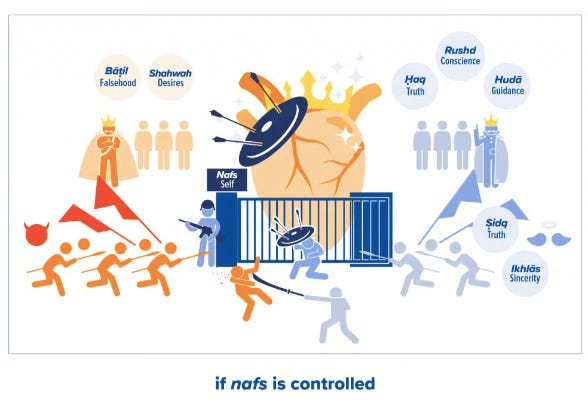
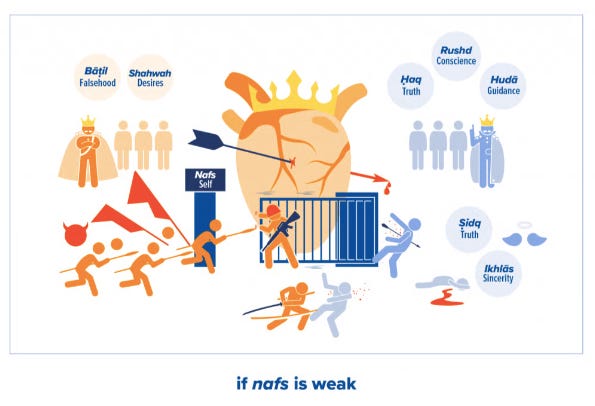
This is the essence of the inner jihad — a lifelong war for sovereignty over the heart. These illustration is taken Yaqeen insitute article by Dr. Zohair Abdul-Rahman that I highly recommened
Conclusion: Redirecting Desire
Our task is not to extinguish desire, but to sanctify it—to reclaim our inner architecture from the dopamine merchants and realign it with divine purpose.
Here are a few tools inspired by the story of Prophet Yūsuf (عليه السلام):
1. Duʿāʾ:
{ قَالَ رَبِّ ٱلسِّجۡنُ أَحَبُّ إِلَیَّ مِمَّا یَدۡعُونَنِیۤ إِلَیۡهِۖ وَإِلَّا تَصۡرِفۡ عَنِّی كَیۡدَهُنَّ أَصۡبُ إِلَیۡهِنَّ وَأَكُن مِّنَ ٱلۡجَـٰهِلِینَ }
“He said, ‘My Lord, prison is dearer to me than what they invite me to. And if You do not turn away their plot from me, I might incline toward them and become of the ignorant.’”
[Surah Yūsuf: 33]
2. Ikhlāṣ (Sincerity): That you make your intention behind our actions one thing: Pleasing Allah
{ وَلَقَدۡ هَمَّتۡ بِهِۦۖ وَهَمَّ بِهَا لَوۡلَاۤ أَن رَّءَا بُرۡهَـٰنَ رَبِّهِۦۚ كَذَ ٰلِكَ لِنَصۡرِفَ عَنۡهُ ٱلسُّوۤءَ وَٱلۡفَحۡشَاۤءَۚ إِنَّهُۥ مِنۡ عِبَادِنَا ٱلۡمُخۡلَصِینَ }
“She certainly desired him, and he would have desired her had he not seen the proof of his Lord. Thus did We turn away from him evil and immorality. Indeed, he was one of Our sincere servants.”
[Surah Yūsuf: 24]
3. Ṣidq (Truthfulness):
Which means in this context to make your efforts one thing. If a person is truly truthful in their intent, they will channel all effort toward that goal, preferring obedience over fleeting pleasure, as Yūsuf (عليه السلام) did when he chose imprisonment over sin.
{ قَالَ رَبِّ ٱلسِّجۡنُ أَحَبُّ إِلَیَّ مِمَّا یَدۡعُونَنِیۤ إِلَیۡهِ }
“My Lord, prison is dearer to me than what they invite me to.”
[Surah Yūsuf: 33]
4. Change the Environment:
Yūsuf (عليه السلام) did not stay; he ran toward the door.
{ وَٱسۡتَبَقَا ٱلۡبَابَ وَقَدَّتۡ قَمِیصَهُۥ مِن دُبُرࣲ وَأَلۡفَیَا سَیِّدَهَا لَدَا ٱلۡبَابِۚ قَالَتۡ مَا جَزَاۤءُ مَنۡ أَرَادَ بِأَهۡلِكَ سُوۤءًا إِلَّاۤ أَن یُسۡجَنَ أَوۡ عَذَابٌ أَلِیمࣱ }
“And they both raced to the door, and she tore his shirt from the back. They found her husband at the door. She said, ‘What is the recompense for one who intended evil for your wife except imprisonment or a painful punishment?’”
[Surah Yūsuf: 25]
Thanks for reading! Subscribe for free to receive new posts and support my work.
Comments
Nothing yet. Say the first thing.
Sign in to join the conversation.