
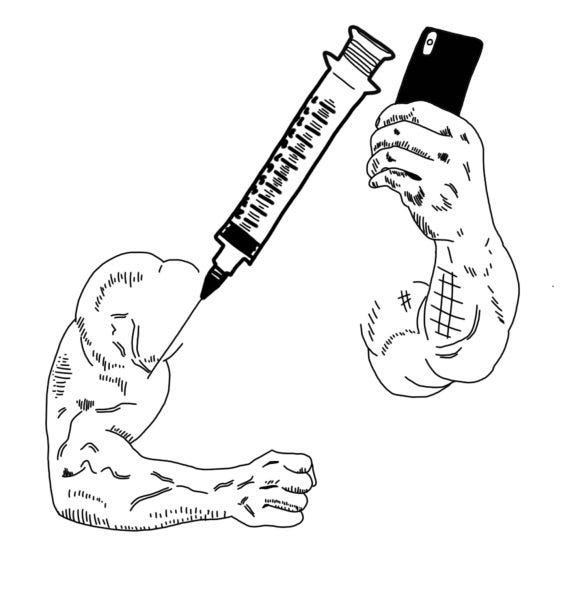
In today’s world, we’re witnessing an aggressive trend: building muscle at any cost.
Steroid use is becoming normalized under sanitized terms like “testosterone therapy”, and masculinity is increasingly being reduced to two external markers: money and muscles. This is a direct result of the narcissistic, image-obsessed Instagram culture we live in, where your worth is tied to how you appear. As a result, masculinity is increasingly measured by how much money you make and how physically shredded you look.
Unfortunately, this trend has seeped into the Muslim community as well. Sometimes it appears in its unfiltered form, with brothers openly abusing steroids and promoting a toxic, hyper-masculine image. Other times, it comes in a more subtle form, wrapped in religious language, such as “Your body is an amanah” or “The strong believer is better and more beloved to Allah than the weak one.”
These sayings are 100% true, and I firmly believe that most Muslim fitness coaches encouraging brothers to get active are sincere and doing much-needed work. After all, there is a real and growing need for Muslims, especially men, to take care of their physical health and be more active.
But here’s the concern: without balance, this message can become damaging. We need to ask ourselves, What do we mean by strength? Because muscle does not always equal strength.
The Prophet ﷺ said:
“The strong man is not the one who can wrestle well, but the one who can control himself when he is angry.”
(Sahih al-Bukhari, 6114; Sahih Muslim, 2609)
This hadith clearly redefines our common understanding of strength. It’s not about who can bench more or has the most defined physique. Strength in the eyes of Allah is the ability to regulate your nafs, especially during moments of anger and provocation.
So if our fitness culture is creating short-tempered, arrogant, or ego-driven men, then it’s missed the mark, no matter how physically strong those men are.
Scientific research confirms this. True strength comes primarily from your nervous system, not just the size of your muscles. When someone begins strength training, their body doesn’t get stronger just because the muscles grow. Rather, the nervous system learns to activate the muscles more efficiently.
This includes better coordination between muscles, faster signaling, and the ability to recruit more muscle fibers when lifting. Studies show that most early strength gains come from these neurological improvements (Sale, 1988; Enoka, 1997), not from muscle growth.
This is why Olympic weightlifters—who are often lean and compact—can lift far more than much larger bodybuilders. Bodybuilders may have more muscle, but they train for size, not for how well their nervous system controls that muscle.
In short: real strength is about how well your brain controls your muscles, not just how big they are.
Historically, “strong men” didn’t look like bodybuilders or Instagram models with 6-packs and vein-popping arms.
Strongmen lifted awkward, heavy objects like stones, logs, and animals. They trained in functional, labor-based movements. Their bodies were built for utility, not aesthetics. Defined abs and symmetrical physiques are modern ideals, shaped by commercial gym culture, photo filters, and sometimes performance-enhancing drugs.
Moreover, not every body type is designed to look like a Greek statue. Some brothers may be incredibly strong, yet carry extra body fat or have unconventional builds. That does not make them any less capable or healthy.
Another important thing to understand is that the modern ideal physique—the kind sculpted through counting protein, carbs, fats, and tracking macros—is built on a foundation of food surplus, precision, and leisure. For most of human history, people didn’t have the time, means, or luxury to micromanage their diet.
Even when we look at the Prophet ﷺ and the Sahabah, they often lived off whatever they could find, sometimes going days with very little. The Prophet’s ﷺ diet was simple and minimal:
“The family of Muhammad ﷺ never ate their fill of barley bread for two consecutive days until he passed away.”
(Agreed upon: Bukhari and Muslim)
“Since the Prophet ﷺ came to Madinah, the family of Muhammad never ate their fill of wheat bread for three consecutive nights until he passed away.”
(Agreed upon)
A’isha (رضي الله عنها) said:
“O my nephew, we would see the crescent, then the crescent, then the crescent—three new moons in two months—and no fire would be lit in any of the houses of the Messenger of Allah ﷺ.”
He asked, “Then how did you survive?”
She replied, “On the two black things: dates and water. Though the Messenger of Allah ﷺ had neighbors from the Ansar who had milch animals, and they would send some of their milk to the Messenger of Allah ﷺ and he would give us to drink.”
(Agreed upon)
This was not a man living on six high-protein meals a day. And yet, he ﷺ was the strongest of men in resolve, in patience, and in physical endurance. It’s hard to imagine the Sahaba, during a military expedition, sitting around the campfire calculating their macros:
“Akhi, I need 150 grams of protein today—pass the grilled chicken leg.”
The Prophet ﷺ was not described as a bodybuilder. The companions described him as:
“He was neither very tall nor very short, had large joints, large head, and thick palms and feet. When he walked, he leaned forward slightly as if descending a slope. I never saw anyone like him before or after him.”
(Reported by Ali ibn Abi Talib; Hasan Sahih – Tirmidhi)
This was a man of strength, but not a man obsessed with sculpted aesthetics. His build was functional, natural, and in harmony with the demands of his mission.
I’m not saying the brothers promoting fitness in our community are wrong or misguided. In fact, I commend their efforts. But we do need to broaden and balance our definition of strength:
Strength begins with iman and emotional regulation, not aesthetics
True physical strength is about real-world capability, not isolated gym workouts
Strength is more about neural efficiency than about having large muscles
The Prophetic model of strength includes self-restraint, resilience, usefulness, and dignity, not image-based vanity
We must remember that in Islam, intentions, character, and usefulness to others carry more weight than appearances. So let’s continue to encourage fitness in our communities, but let’s also make sure that our definition of strength is grounded in the Prophet’s ﷺ example, not the algorithm
No posts
Comments
Nothing yet. Say the first thing.
Sign in to join the conversation.