
Clay Chapman is a master mason, designer, and builder based in Carlton Landing whose work is at the forefront of a contemporary structural masonry revival. He’s the founder of the Hope for Architecture initiative, a grassroots effort to reestablish load-bearing brick construction as a durable, low-carbon alternative to conventional building practices. Trained in the fine arts (with a background in sculpting and painting) Chapman approaches building as both craft and expression. His work reflects a deep commitment to beauty, material honesty, and permanence, drawing from centuries-old construction methods while integrating modern performance standards. Through hands-on apprenticeship programs and built work, Chapman is not only creating enduring places, but also training a new generation of builders to carry forward the craft of structural masonry. His work demonstrates how traditional building techniques, rooted in artistry and discipline, can offer practical solutions to contemporary challenges in housing, sustainability, and design.
You should probably know that I love brick.
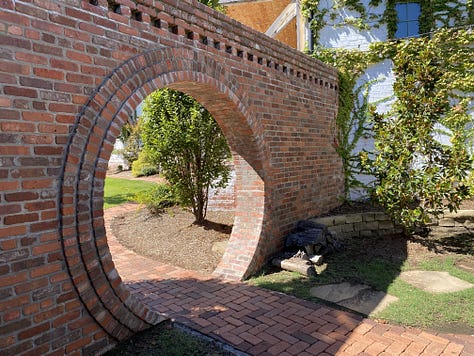
I’ve spent a lot of time (not always successfully) practicing ceramics. I love clay. I love texture. I love things made from the earth. Brick buildings, to me, feel like super ceramics... So when I saw Clay’s work for the first time, it resonated instantly. I first became aware of Clay through a presentation he gave at the Congress for the New Urbanism (I believe it was in Oklahoma City). His work stood out to me, probably because I’ve always been drawn to the materiality of building.
But I didn’t actually meet him until 2023.
At the time, I had just become widowed at the age of 29. I was in a place in my life where I felt completely alone and ungrounded. There’s very little advice out there for someone in that position, and it was very isolating. A few days after the funeral, something in me shifted. I had this sudden, undeniable urge to leave… to go somewhere, to do something. It felt like a voice cutting through the fog: stop dwelling, go have Abby’s adventure.
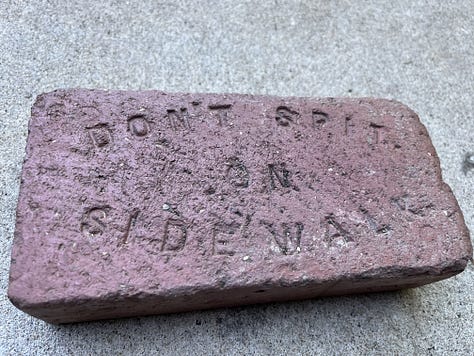
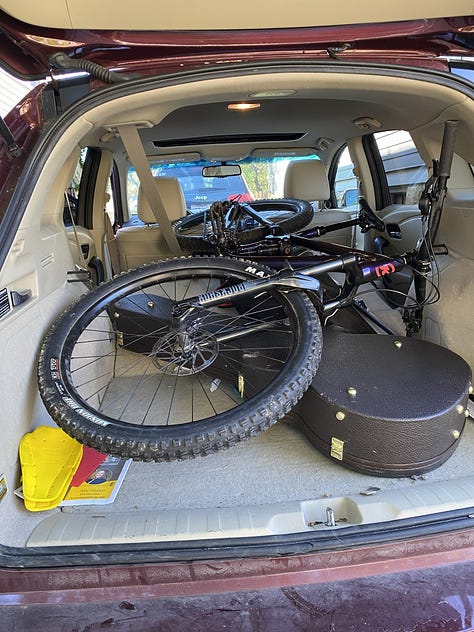
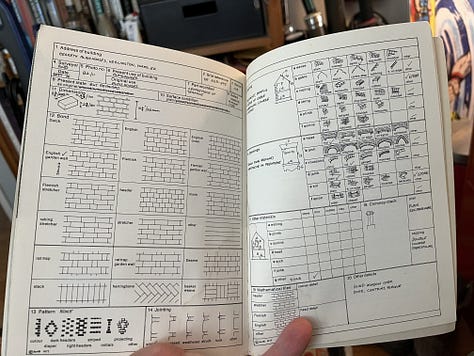
So I did. I found a dog sitter, packed up my car, and started driving. My first stop was Carlton Landing.
I reached out to a mutual connection, Kevin Klinkenberg, who connected me with Clay. We spoke on the phone, and without hesitation, he invited me to come visit and see the work for myself. When he asked where I was staying, I told him I could just camp. Instead, he offered to put me up in a house with members of his crew, a construction lead and a documentarian, who turned out to be incredible hosts (and people I’ll likely talk to on the podcast someday).
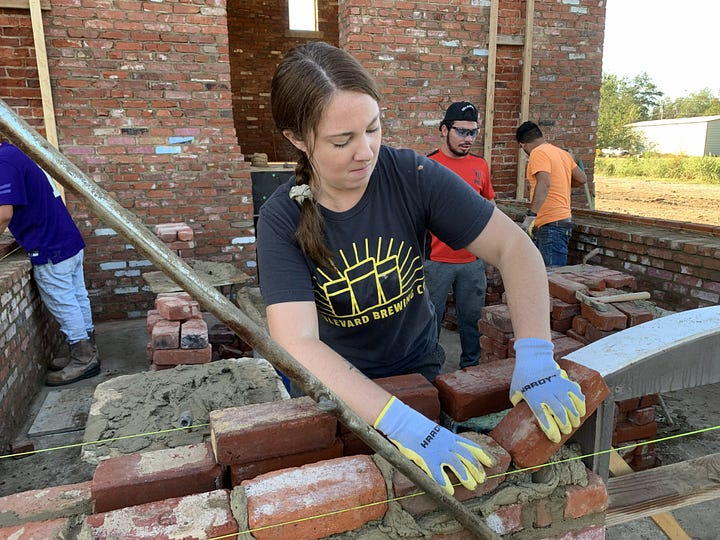
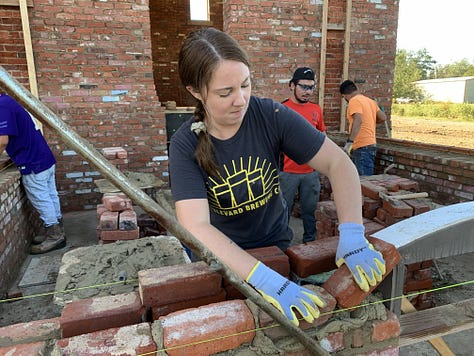
This experience was very impactful for me because I didn’t just observe, I got to participate. I spent time on-site learning how to mix mortar and lay brick. It was much harder than I expected. The mortar alone was a workout. Those bags are not designed for someone with my upper body strength. But still, I laid a few bricks.
That house is finished now, there’s something deeply meaningful about knowing I had a hand (however small) in creating something that will last.
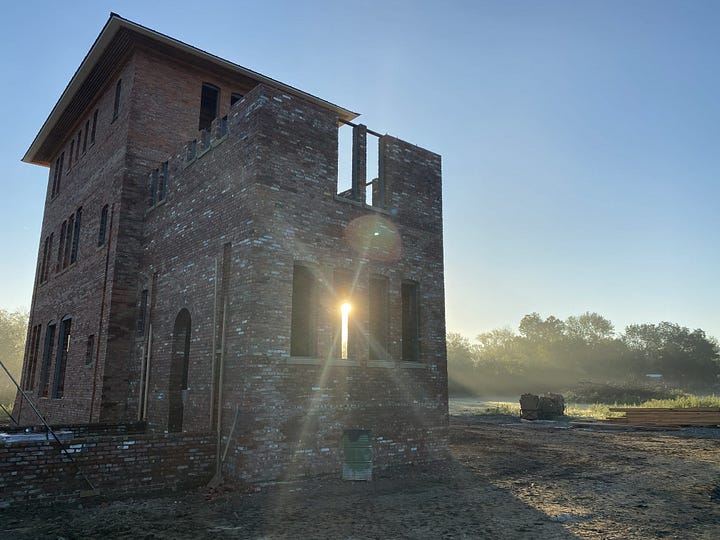
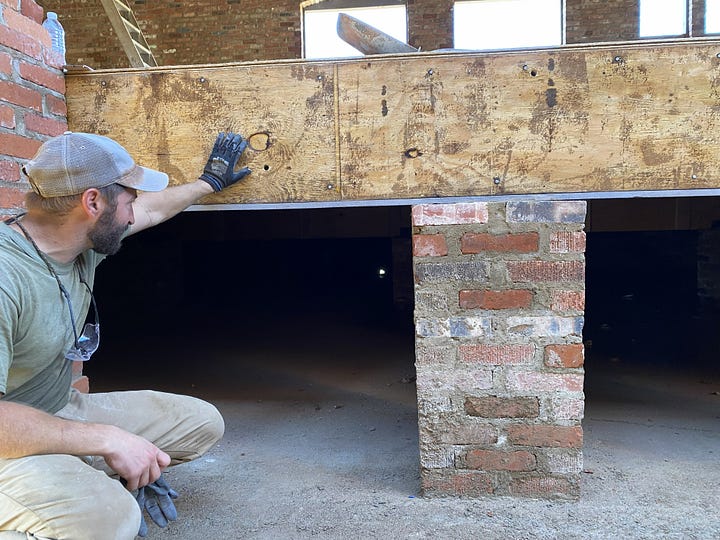
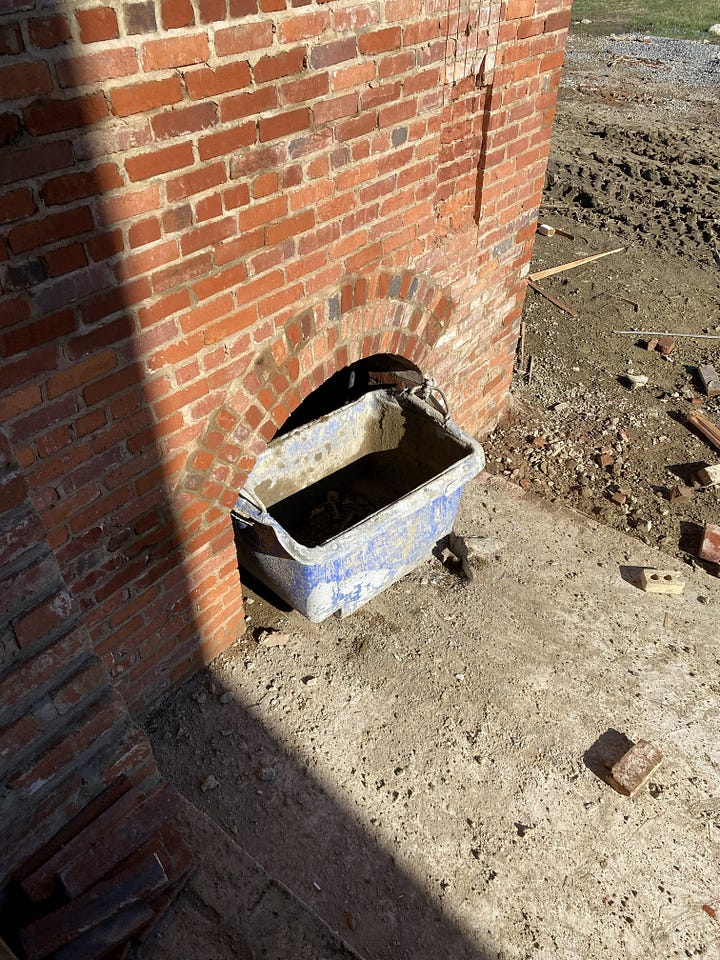
And then there was Carlton Landing itself.
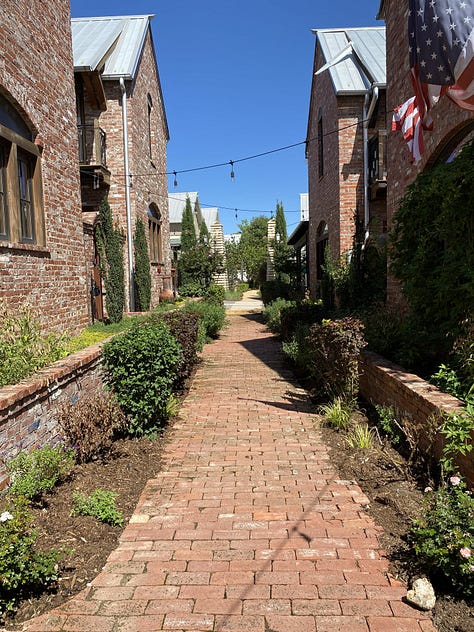
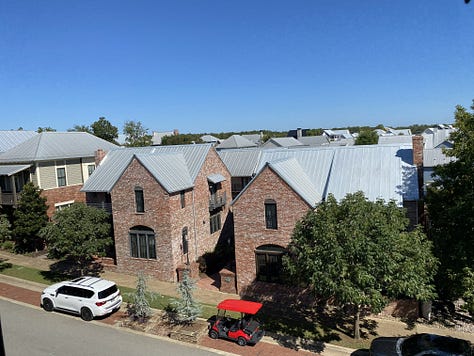
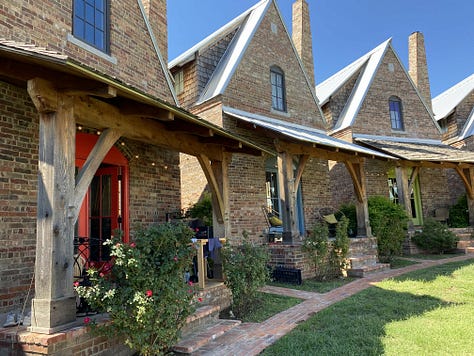
It’s hard to describe if you haven’t been, but it felt less like a development and more like a living work of art. A demonstration of what’s possible when you choose to build differently; when you prioritize beauty, durability, and human experience over speed and convenience.
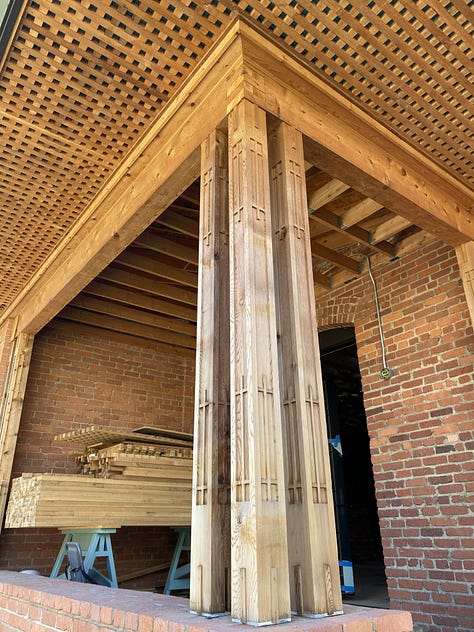
Clay Chapman has lived in Carlton Landing for over a decade with his wife and three children. When I visited, he was in the middle of building his family home; a rare opportunity to see the work not as a finished product, but as a process. There’s something revealing about seeing a place mid-construction. The decisions, the adjustments… You begin to understand not just what these homes are, but how they come together.
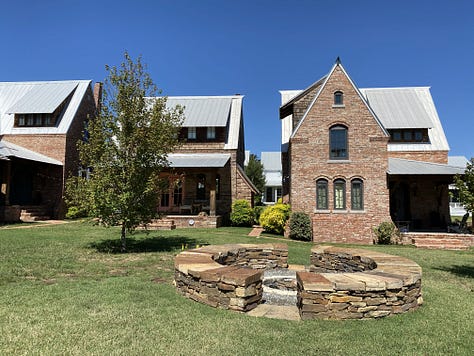
Clay had so much to share. I had so many questions. One moment from that build has stayed with me. Partway through construction on his home, they ran out of brick. Instead of waiting or sourcing more of the same, Clay made a shift. He began incorporating stone quarried directly from the surrounding area. It was experimental, a response to circumstance, but also informed by his travels in France, where buildings often reflect layers of time through a mix of materials and methods.
The result wasn’t compromised. The house tells a story. What could have been a disruption became something very beautiful. Authentic.
There’s also a fascinating convergence happening in Carlton Landing between the structural masonry revival, New Urbanism, and regenerative land practices. You can feel it not just in individual buildings, but in the fabric of the neighborhood itself. It’s walkable, intimate, and distinctly human-scaled. There’s a sense of harmony that’s hard to pin down but easy to feel.
Not every home is built of brick, but there is still a shared sense of permanence and an understanding that these buildings are meant to last and belong. The landscape plays an equally important role. In some areas, sidewalks lift into boardwalks, allowing water to move naturally through the site rather than being forced into pipes. It’s a subtle but powerful gesture that works with the land instead of against it.
There are chickens, gardens, and small moments of cultivation woven throughout, and signs of life that go beyond aesthetics. The density is softened by thoughtfully placed open spaces that create enclosure without confinement. And then there’s the setting itself with the forest and the lake.
It really feels like a demonstration of how things could be different.
During this road trip, I kept returning to the idea of “planning”... the core of my profession. It started to feel fundamentally misaligned with reality. Life is unpredictable. It shifts suddenly, without warning. I certainly could have never planned for the circumstance I was in at the time. So what does it really mean to plan? What does it mean to be actually sustainable? I began to think of my work not as planning, but as pattern-making.
What actually shapes outcomes over time are patterns: repeated behaviors, relationships, and ways of inhabiting space. At a personal level and a community level, patterns determine direction far more than any static plan. That idea has stayed with me: if we want different outcomes, we have to ask, what patterns are we reinforcing, and which ones need to change?
Looking back, my stop at Carlton Landing felt like an exploratory journey I didn’t fully plan, but deeply needed. Carlton Landing, along with Clay’s generosity and willingness to share his work, was the beginning of that.
So this conversation means a lot to me.
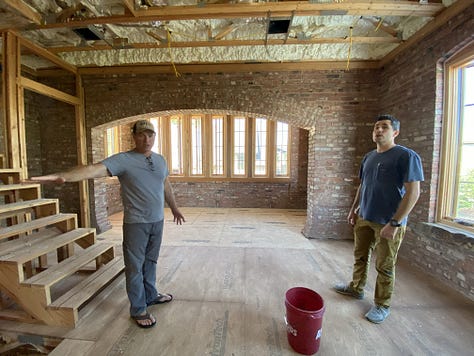
No posts
Comments
Nothing yet. Say the first thing.
Sign in to join the conversation.