
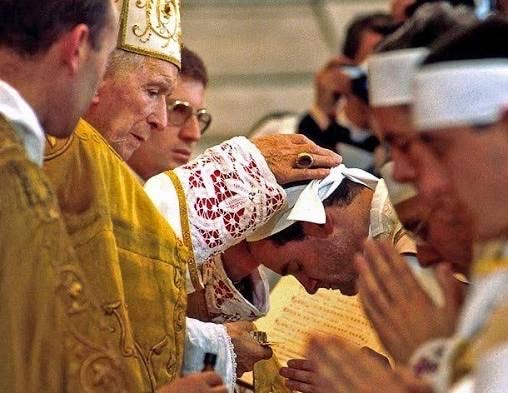
In light of the SSPX’s announcement that they will be consecrating new bishops soon, let’s review what the Church actually teaches about Obedience to the Pope by relying on the authority on the subject, Bellarmine.
St. Robert Bellarmine, the Doctor of the Church whose “De Romano Pontifice” stands as the definitive manual on papal authority, provides a nuanced understanding of the limits of power that is often overlooked in modern discourse. He famously argues that while the Pope is the supreme judge of the faithful and cannot be judged by any earthly superior, he is not a despot with absolute power to do as he pleases.
Bellarmine makes a crucial distinction in Book II, Chapter 29, regarding the necessity of resistance:
“Just as it is lawful to resist the Pontiff who attacks the body, so also is it lawful to resist him who attacks souls or destroys the civil order or above all, tries to destroy the Church. I say that it is lawful to resist him by not doing what he orders and by impeding the execution of his will; it is not lawful, however, to judge, punish, or depose him, since these are acts proper to a superior.”
He clarifies that this resistance is not an act of judging the Pope, which would be a violation of the hierarchy, but a legitimate act of self-defense. By "impeding the execution of his will" when that will is directed toward the harm of the Mystical Body, the faithful are actually exercising a higher form of obedience to the perennial Magisterium.
This principle of resistance is inextricably linked to Bellarmine’s "Notes of the Church," specifically the notes of Antiquity and Uninterrupted Duration. For Bellarmine, the true Church is identified by its adherence to what has been handed down from the beginning:
“The second note is Antiquity, for the true Church is older than the false. As God existed before the devil, so the true religion existed before the false... Therefore, we must follow that which has been handed down from the beginning.”
If a contemporary command or policy contradicts the constant, ancient teaching of the Church, it lacks the "note" of Antiquity and thus loses its binding force in the conscience of the believer. This is precisely the theological ground upon which the Society of St. Pius X has historically stood.
They argue that when the preservation of the Traditional Mass and the clarity of Catholic dogma are at stake, the duty to "follow that which has been handed down" overrides a specific administrative command to the contrary. From this perspective, the act of consecrating bishops without a mandate is not an act of schismatic rebellion, but a necessary step to ensure the survival of the traditional priesthood and the transmission of the Faith.
The legal dimension of this theological stance is found in the 1983 Code of Canon Law, specifically Canon 1323. This canon explicitly states that no one is liable to a penalty, such as excommunication, if they acted out of a "state of necessity." Specifically, Canon 1323, §4 states that no one is subject to a penalty who:
“…acted under the pressure of grave fear, even if only relatively grave, or by reason of necessity or grave inconvenience unless the act is intrinsically evil or tends to the harm of souls.”
Crucially, the law also protects those who perceive a crisis even if the authorities disagree, as §7 exempts one who:
“…thought through culpable error that one of the circumstances mentioned in nn. 4 or 5 was present.”
When applied to the SSPX, the argument follows that if the bishops truly believed, based on Bellarmine’s criteria, that the Church was in a state of spiritual emergency, the "automatic" excommunications often cited by the Vatican are canonically void from the start.
Because excommunication requires "contumacy" or a willful spirit of rebellion, a bishop acting to save souls and preserve Antiquity lacks the necessary intent for the law to take effect. Therefore, in the light of Bellarmine’s ecclesiology, these consecrations can be seen not as a break from the Pope, but as a preservation of the Papacy and the Church’s own historical identity against the winds of novelty.
No posts
Comments
Nothing yet. Say the first thing.
Sign in to join the conversation.