
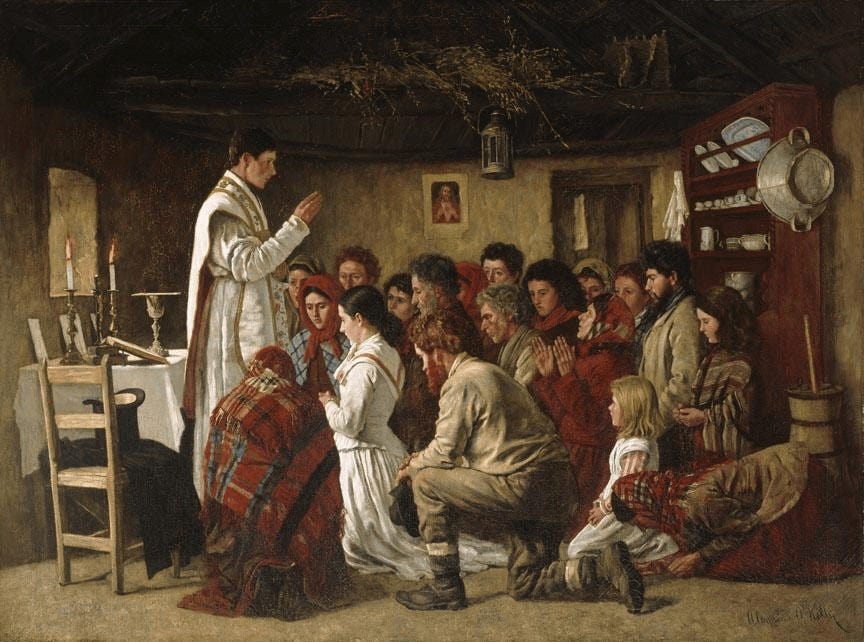
As traditional Catholics look toward the future, the question of "reconciliation" between the Society of St. Pius X and the Roman hierarchy frequently takes center stage. To understand why a formal canonical agreement remains elusive, one must look past modern diplomatic expectations and examine the fundamental principles laid down by Archbishop Marcel Lefebvre. The impasse is not a matter of administrative protocol or petty stubbornness; it is a profound disagreement on the very direction of the Catholic Church, a reality that shifts the timeline for true unity far into the future.
Archbishop Lefebvre made the Society’s position explicitly clear during the height of the post-conciliar crisis. He insisted that the SSPX could not enter into a practical accord with Rome until Rome herself returned to the fullness of Catholic Tradition. In his view, signing a document that merely granted the Society a legal corner to exist while the rest of the Church continued on a path of doctrinal and liturgical experimentation would be a compromise of the Faith. The Archbishop’s "demands" were not for concessions, privileges, or personal recognition, but for a wholesale restoration. He maintained that until the Roman authorities once again embraced the pre-conciliar Magisterium, condemned the errors of modernism, and restored the ancient Roman Rite to every altar, any administrative "deal" would be a trap. Consequently, the SSPX’s stance remains unchanged: they will not make a deal with Rome until Rome behaves like Rome again.
Because both sides are operating on entirely different theological wavelengths, the faithful should not expect to see a formal reconciliation within this generation. The current ecclesiastical landscape is dominated by a hierarchy formed in the spirit of the post-Conciliar era, making a sudden, top-down restoration highly unlikely. However, this does not mean the cause of Tradition is defeated. Instead, the strategy relies on a completely different metric of victory: the slow, steady, and supernatural reality of demographic trends.
While mainstream dioceses face closed parishes, aging congregations, and a catastrophic collapse in priestly vocations, traditional chapels tell an entirely different story. The future of the Church is being born in the large, faithful families who fill traditional pews every Sunday. These families are producing the next generation of Catholics, and more importantly, the next generation of priests. Young men entering traditional seminaries are not burdened by the theological ambiguities of the mid-20th century; they are grounded in the clarity of the timeless Magisterium. As these young families grow and these younger, traditional priests multiply, the balance of numbers will inevitably begin to shift.
This is the true essence of playing the long game for Tradition. It is a multi-generational war of attrition where patience is a necessity. When we look at the current trajectory, we are looking at a seismic shift in the behavior and identity of Rome that will likely take a century to fully manifest. In about one hundred years, as the old guard fades and the descendants of today's traditional families come of age, the sheer reality of demographics will compel the hierarchy to look back to its roots. Until that day arrives, the duty of the faithful is not to pine for an artificial, compromised peace treaty, but to keep the flame of the Faith burning brightly, maintaining the fort until Rome is finally guided back in line with Tradition.
No posts
Comments
Nothing yet. Say the first thing.
Sign in to join the conversation.