
The modern landscape of Church history is often dominated by scholars who approach the early centuries of the Faith with a profound modern bias against the very concept of religion, a bias that neither the Apostles nor Christ Himself shared.
These Modernists frequently operate under the assumption that Christ came to dismantle the structures of organized religion, when in reality, the function of religion has always been the placating of God through sacrifice, within a sacred space, at an altar, and via the mediation of a priest.
Christ did not come to destroy this fundamental reality; rather, He came to be the perfect offering and the High Priest truly worthy of placating the Father. This was the truth clearly communicated to the early Christians of the first century through the Apostles.
The Sacrifice of the Eucharist was never a casual communal meal, but a sacred rite offered only by priests in a long, elaborate ritual that likely took hours. To anyone initiated into the mysteries, this was clearly distinct from the Agape meal.
Because of the Discipline of Silence maintained by the initiated, this ritual was protected from being inspected under the microscope of those who would later seek to deconstruct it. The Early Church did not commit these rites to an official written form in a way accessible to outsiders until the time of Gregory the Great.
This mystery from silence remains a barrier that cannot be interpreted any which way at the pleasure of speculative academic Modernists. Their bias is so severe that their theories ultimately sound like impious nonsense to those who are truly initiated into the life of the Faith.
To attempt to go back in time and reimagine how the early Church celebrated these Sacred Mysteries, guided by scholars who possess no concept of what religion actually is, remains a fool’s errand.
Such an endeavor is rightly condemned as the heresy of antiquarianism. It belies a severe lack of Faith in the integrity of the Church to hand down the deposit of faith received from the Apostles.
The modern attachment to a "new way" of doing things within the Church acts as a corrosive virus that eats at the soul and destroys the Faith from within. When we recognize that the liturgical life of the Church is not a subject for academic reimagining but a sacred inheritance, it becomes clear that the departure from this tradition represents a grave error.
If we are to preserve the integrity of the deposit of faith, it is time to recognize the damage caused by these modern innovations and condemn the New Mass and all its implications in favor of the timeless religious reality established by Christ.
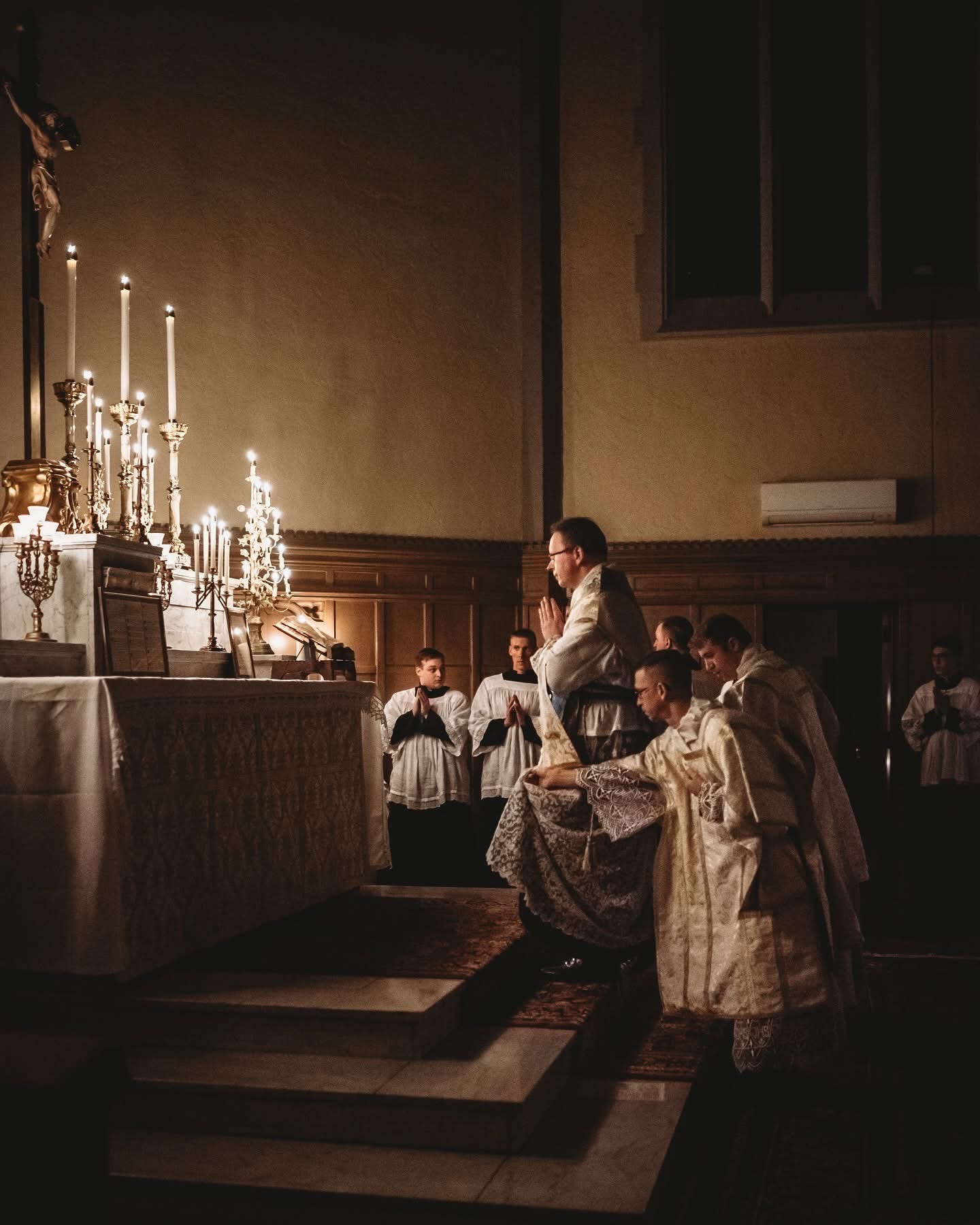
Image courtesy of Latin Mass Photographer
Comments
Nothing yet. Say the first thing.
Sign in to join the conversation.