
As someone who is an avid, borderline obsessive over television soaps like The Summer I Turned Pretty, anything with longing and a good soundtrack and beautiful people making terrible decisions for love, it was obvious that I was going to love Off Campus.
What’s not to love? A cast with insane chemistry, a storyline that walks the perfect line between grey and golden, and a music selection that makes you feel like your own life deserves a cinematic score. But somewhere around episode four, I noticed something. I wasn’t just watching the show. I was feeling it, deeply, almost embarrassingly so. And I like things that make me feel a lot. That’s the whole point. But yesterday, I decided to actually look at why. Why does a fictional hockey player make grown women rearrange their schedules? Why does a fake dating plotline hit like something personal? Why, neurologically and historically and culturally, does this keep working on us?
That’s when I found the science. And wow.
Here’s what nobody tells you about dopamine: it doesn’t spike when you get what you want. It spikes in anticipation of getting it.
Neuroscientist Wolfram Schultz mapped this in the 1990s, reward neurons fire hardest not at the moment of reward, but at the cue that predicts the reward is coming. The almost touch. The held eye contact. The moment where you can feel it about to happen.
Off Campus, based on Elle Kennedy’s The Deal and built around the slow burn between Hannah Wells, a quietly brilliant music major who hates hockey, and Garrett Graham, Briar University’s star center who desperately needs to pass his ethics exam, is essentially a dopamine delivery machine disguised as a streaming show. The fake-dating setup is not a lazy trope. It is a neurological trap, and a genius one. Because when you place two people in a constructed intimacy…a deal, a performance, a lie told to everyone else; you are giving the brain the prediction cue over and over again. You know they’re going to fall for each other. The brain knows. And it is losing its mind in anticipation, episode after episode, refusing to look away.
Creator Louisa Levy structured the episodes like novel chapters, each one ending on a hook just before the emotional payoff. That’s not an accident. That is someone who understands, consciously or not, that the gap between wanting and having is where we live. The show weaponizes that gap. And we hand ourselves over to it willingly.
Here’s something cool about neurons: the same neurons that fired when a macaque reached for food also fired when the macaque watched another animal reach for food. Your brain doesn’t cleanly distinguish between doing and witnessing. It rehearses both.
Applied to fiction, this is staggering. When Hannah Wells sits across from Garrett at a and feels the specific, unbearable awareness of someone looking at you like you are worth looking at, your mirror neurons are not observing that feeling from a distance. They are running the same program. You are not watching a girl fall in love with a hockey player. You are, neurologically, falling in love with a hockey player. The emotion is real. The biochemistry is real. The only thing that isn’t real is Garrett Graham.
This is why “it’s just escapism” has always been the wrong frame. Escapism implies going somewhere else, checking out, leaving. What the show actually produces is a second life running in parallel, an emotional experience with full neurological weight, at zero personal cost. You get the longing without the vulnerability. The warmth without the risk. The intimacy without having to be known.
Let’s go deeper, because the neuroscience is only half the story.
There is a version of Garrett Graham that has never existed in real life and probably never will. He is not just handsome and athletic. He is emotionally present. He notices Hannah, not her body first, but her. He shows up. He makes her feel like the smartest, most interesting person in the room, and he does this without making her shrink. He is dominant but not threatening. Confident but not arrogant enough to stop listening. He cries exactly once, in private, about his father, and it makes him more attractive, not less.
He was written by a woman, for women. And the character who emerged is not a portrait of a real man. He is a portrait of what women have been quietly, persistently asking for, sometimes in their journals, sometimes in group chats, sometimes just in the way they describe what they want and watch people’s eyes glaze over because it sounds too simple: I want someone who is here. Who is emotionally legible. Whose interest in me does not have to be decoded like ancient scripture.
This matters more when you understand the landscape a lot of women…particularly younger women, are actually navigating. Emotional unavailability dressed up as mystery. Digital intimacy that evaporates in person. Men who were never taught to articulate want, or warmth, or fear. Into that absence, Garrett Graham walks, and he is fluent. He knows what he feels. He says it eventually. He does not make Hannah guess.
For women who grew up in cultures that romanticized the chase, the hot-and-cold, the emotionally unavailable man who just needed the right girl ,Garrett is almost disorienting. He is the counter-programming. And the brain, starved of a particular kind of recognition, floods.
There is a concept in psychology called the “safe container”, a bounded space in which intense emotion can be felt without real world consequence. So is the novel. So is the show that you know, because the genre promises it, will end with the two of them together.
Off Campus stresses you out. The breakup, their separation.Your cortisol rises. Your chest gets tight. This is not a metaphor, this is a measurable physiological stress response to a fiction you are choosing to consume.
And then it resolves.YAY.
Because the HEA, the Happily Ever After, is not sentimentality. It is the genre’s contract, its iron law, the promise that makes every dark moment survivable. The resolution triggers a dopamine-serotonin cocktail that your body experiences as relief. As warmth. As something very close to joy.
What you have just done, without knowing it, is run an emotional simulation. You have practiced surviving the fear of losing someone. You have rehearsed hope following despair. Women who read and watch high volumes of romance are not retreating from emotional complexity, they are training for it. The genre is a gymnasium for the affective nervous system.
Oxytocin……. sometimes lazily called “the love hormone” is released through physical touch, yes, but also through perceived emotional intimacy. Through feeling known. Through warmth that feels directed at you. Parasocial relationships, the attachments we form to characters, to celebrities, to people who do not know we exist, trigger measurable oxytocin responses in the brain.
This is why the group chat about Off Campus does not feel embarrassing to the people in it. Neurochemically, it isn’t. Hannah and Garrett are not abstract. They have weight. The brain has processed them as real bonds, not because it has been fooled, but because it is doing something quite sophisticated: extracting emotional nutrition from a narrative the way it might extract it from a lived experience.
And the shared ritual of watching, of talking about it, of losing your mind together, that is its own oxytocin event. The show becomes social infrastructure. A shared emotional language. A low-stakes way to articulate what you actually want from love without the terrifying vulnerability of admitting it directly.
It would be incomplete to talk about all of this without acknowledging the machine behind it.
The romance industry is not a recent phenomenon. It is one of the most consistently profitable publishing and entertainment sectors in history, and its primary consumer has always been women. In the 1970s and 80s, the Harlequin romance novel created a subscription model for desire. Women received books in the mail, monthly, like a vitamin for something the rest of culture was not providing. The industry understood something that literary culture refused to: women’s inner emotional lives were an enormous and largely unserved market.
BookTok: the ecosystem through which Elle Kennedy’s Off Campus novels found their massive contemporary audience, is a direct descendant of that tradition. Women recommending books to women. Women articulating what they want in a story with a precision and passion that the mainstream has always found slightly embarrassing. Prime Video did not create the audience for Off Campus. The audience created themselves, over years, through a digital oral tradition, and Prime Video showed up with a budget.
The show hit number one worldwide within 48 hours of its release on May 13, 2026, not because of marketing, but because a community of women had already decided it mattered. The capitalism here is interesting: for once, the machine did not manufacture the desire. It simply followed the women who already had it.
We are saying: I want to feel a lot. I want a story that takes my emotional capacity seriously. I want to watch a woman who is smart and guarded and musical and a little afraid, choose, slowly, to be known, and to have that choice be met with someone who does not flinch.
We are saying: the love I have imagined deserves a narrative, a score, eight episodes structured like chapters, and an insane amount of chemistry between two people who look at each other like that.
We are saying, with every rewatch and every group chat message and every TikTok of that scene: I know this feeling. I recognize it. I have felt this, or I have wanted to…andddd it is not a small thing, and I refuse to be embarrassed by how much I care.
The science just confirms what we already knew. The brain is not being tricked by Off Campus. It is doing exactly what brains evolved to do, finding the experiences that matter, rehearsing the feelings that are worth having, and bonding, fiercely and without apology, with the stories that finally bother to show up for us.
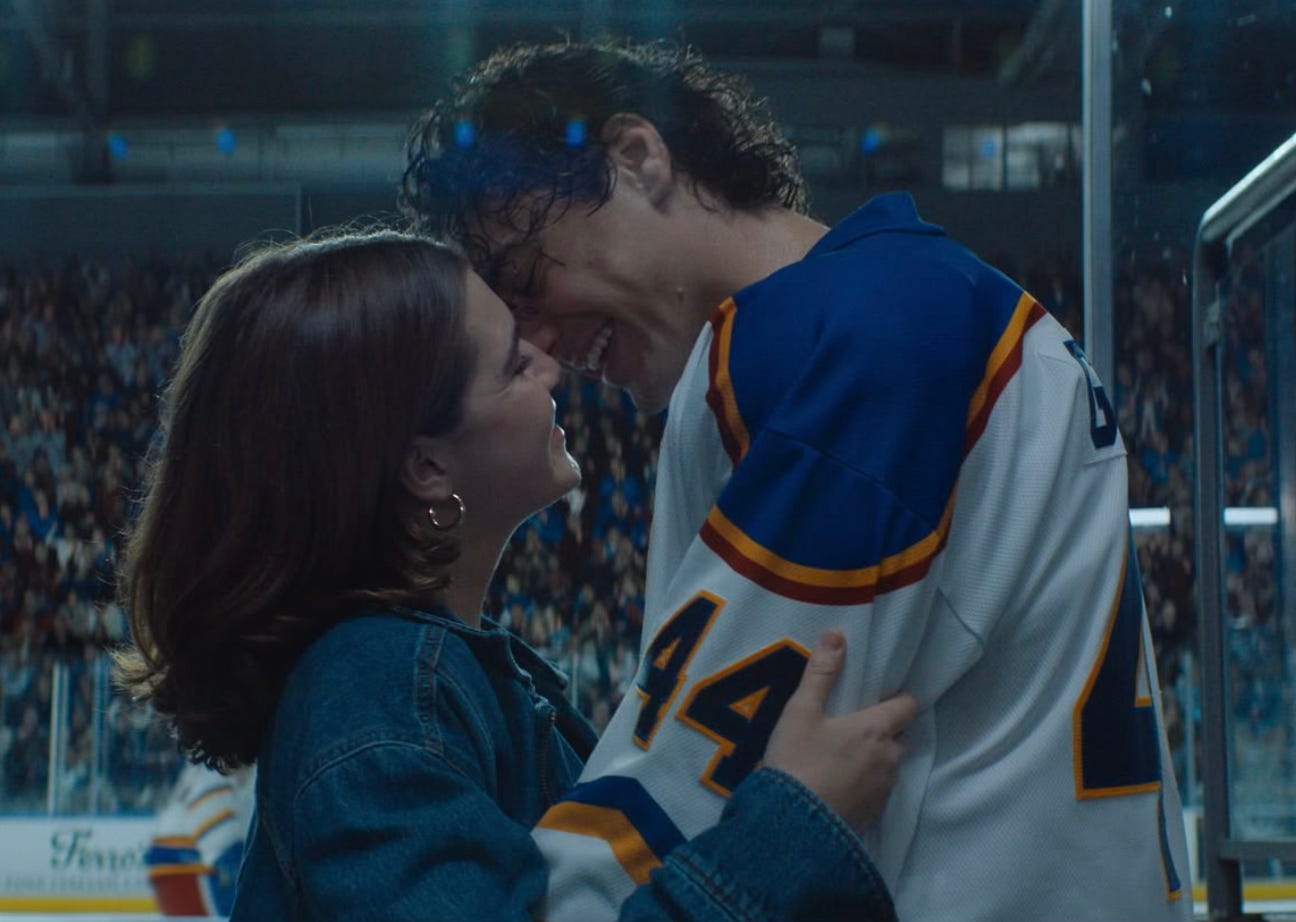
if you made it till here, here’s a picture of my favorite scene from the show

No posts
Comments
Nothing yet. Say the first thing.
Sign in to join the conversation.