

I recently read the book Cheaper, Faster, Better by Tom Steyer. What impressed me most was that it is not merely a call for climate action. It makes a compelling case that the clean-energy transition is already underway, driven by economics as much as urgency.
In this excellent book, reframes the climate conversation from sacrifice to opportunity, arguing that the future isn’t just greener — it’s cheaper, faster, and better.
If you’re unfamiliar with Tom, he’s an American investor and philanthropist who shifted from running a hedge fund to becoming a leading voice in climate advocacy. After a successful career in finance, Tom founded NextGen America to promote clean energy and greater accountability on climate change.
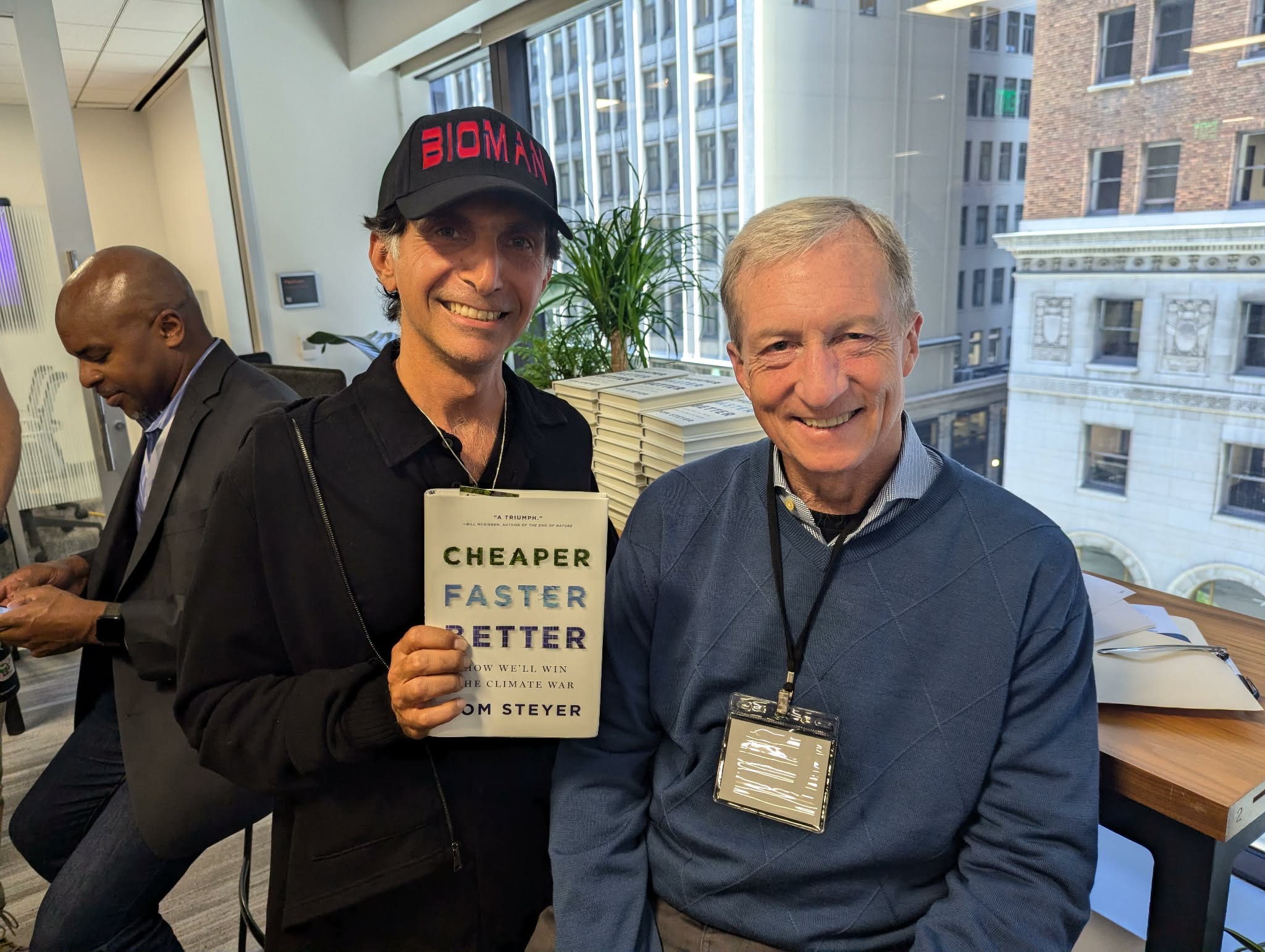
Tom’s work in this space demonstrates how policy, investment, and civic engagement can converge to accelerate the clean energy transition and other environmental initiatives.
Several of the book’s arguments have stayed with me.
The Core Argument
In Tom’s book, he states that environmental advocates have operated on the assumption that saving the planet requires sacrifice — that people and businesses will need to pay a “green premium,” choosing cleaner options even when they cost more.
But Tom thinks this framing is not just wrong but strategically catastrophic.
His alternative: clean energy and clean technology have already crossed — or are rapidly crossing — the threshold where they are simply better products on their own terms. Cheaper to build and operate. Faster to deploy. Higher-performing.
The cost of solar panels has fallen by more than 99 percent since the 1970s. That long-term decline illustrates Steyer’s central argument: new technologies can improve rapidly while becoming increasingly economical.
This isn't a moral argument. It's a market argument. And Tom believes that changes everything, because it means clean energy wins not by convincing oil executives to become environmentalists, but by making their business model economically obsolete.
The “Five Plus One” Framework
Tom identifies five sectors where emissions cuts are essential: electricity generation, transportation, manufacturing, agriculture, and buildings. The “plus one” is carbon removal and sequestration: drawing carbon dioxide from the atmosphere and storing it through approaches such as direct air capture, reforestation, and marine cultivation.
The buildings section is particularly concrete. Since roughly 80 percent of today’s buildings are expected to remain in use in 2050, focusing only on new construction isn’t enough — the real challenge is retrofitting existing structures to waste less energy, and doing it in a way that saves owners money rather than asking them to pay a premium. This is Tom’s logic throughout his book: find the climate solution that also happens to be the economically rational choice, and you don’t need to rely on anyone’s virtue.
Looking Ahead
Tom’s book highlights real-world examples of how clean technologies are already outperforming outdated systems in cost, speed, and impact. It reframes the debate: climate action isn’t just an ethical imperative, it’s a market opportunity. By showing that sustainability can go hand in hand with growth, Tom challenges businesses, policymakers, and citizens alike to rethink what’s possible.
Cheaper, Faster, Better leaves a clear message: the clean energy transition isn’t just possible — it’s happening, and it can be faster, smarter, and more profitable than most realize. For anyone curious about climate solutions that are practical, profitable, and urgently needed, this book is a must-read!
Additional Sources
Cheaper, Faster, Better | Spiegel & Grau
Economics Always Wins: Climate and Electrification in the 21st Century - A Conversation with Tom Steyer | Scripps Institution of Oceanography
A. A. Rustom's Bioverse is a reader-supported publication. To receive new posts and support my work, become a free or paid subscriber.
Comments
Nothing yet. Say the first thing.
Sign in to join the conversation.