
Good evening. Trump is quietly laying the groundwork for a national emergency declaration on elections, doctors are sounding alarms about his weight as the White House stays evasive, and infighting inside his own administration keeps spilling into public view even as the trade war with Canada turns real. Also today: a viral video of an ICE agent telling a U.S. citizen "because you're an immigrant" was reason enough to cuff him, Iran calling out new US sanctions as a sign of desperation, mystery manhole crews back under Manhattan, a fast-moving wildfire forcing 14,000 evacuations outside Reno, Zelenskyy drawing a hard line against wartime elections, and Kazakhstan wrapping up an election built to hand its president another seven years.
Some of you have also reached out about my TikTok account saying you cannot see some videos, well, I now have a strike on the account and it is one strike away from completely banning me.
This Sunday evening, I want to take a moment to speak directly to you.
Thank you for giving me the best job in the world. Thank you for subscribing, for reading, for supporting independent journalism when it has never mattered more. Because of you, I get to do this full time, with no corporate sponsor whispering in my ear, no advertisers steering the narrative, no worrying about clicks or quotas. This platform is 100% editorially independent, and every word you read here comes from a place of truth and a fierce love for this country. Your subscriptions fuel it.
Mainstream media keeps catering to the powerful and the profitable. We chose something different. We chose each other, we chose honesty, and we chose to tell the stories that need telling, no matter how uncomfortable they are for the people in power.
Here’s the news:
Election Emergency Declaration:
Trump is building the case for a national emergency declaration on elections before November, and the signs point to it happening soon. He used a primetime address in July to repeat the false claim that 2020 was stolen, and former strategist Steve Bannon predicted right after that Trump would declare a national security emergency to “protect” elections, telling followers to “block the last week of August out.” Asked point blank whether he’d declare such an emergency, Trump refused to rule it out, saying only “stranger things have happened.” Aria Branch of the Elias Law Group, who has already sued to block earlier Trump election orders, says the administration is actively “searching for” a legal basis that she argues simply doesn’t exist. Democratic lawmakers and voter groups have taken the threat seriously enough to run tabletop exercises for scenarios like ICE agents stationed at polling places.
The evidence that this is coming is the documents themselves. A White House task force pulling from the ODNI, NSA, CIA and DHS has been declassifying “election integrity” files at an accelerating pace, seemingly to build a paper trail for the emergency to come. One release recycled an intelligence assessment that actually found no evidence China altered the 2020 vote, but officials pivoted to seize on a New Jersey software error that let 6,600 noncitizens register (fewer than 400 voted) to push broader noncitizen voting fraud claims. The Census Bureau then claimed 24,000 noncitizens voted in 2020 without disclosing its methodology, a number election expert David Becker said “fails the laugh test,” and DHS separately claimed 278,000 noncitizens are registered nationally using a tool already reported to be inaccurate. Each release reads less like an investigation and more like a predicate being built for the announcement Bannon promised.
When directly asked if an emergency declaration was coming, the White House wouldn’t say no, instead pointing to the “Save America Act,” which would let DHS purge state voter rolls, restrict mail-in voting, and require proof of citizenship and photo ID to vote. Former White House attorney Ty Cobb, now a Trump critic, said ICE presence at polls is “a virtual certainty” once this happens, and raised the possibility of National Guard deployment too, calling it an echo of Trump’s failed 2020 push to seize voting machines. Branch says the constant rhetoric is already functioning as intimidation on its own, even before any formal declaration. She’s counting on the Constitution’s clear limits on executive control over elections to give her side ground to fight it in court once it comes. The pattern across all of it points the same direction: this isn’t hypothetical anymore, it’s a matter of timing.
The U.S. Postal Service published a final 95-page rule late Friday tightening mail-in voting requirements ahead of November’s midterms, timed so it can take immediate effect if courts lift the injunction currently blocking it, after U.S. District Judge Indira Talwani blocked the changes that stem from Trump’s March executive order pushing his long-standing false claims about 2020 voter fraud. The rule would require states to hand USPS lists of voters who received mailed ballots along with unique barcodes on outbound and return ballot envelopes, and USPS would refuse to deliver ballots in states that don’t comply, though it says it won’t inspect ballot contents or track party affiliation. Democratic election lawyer Marc Elias accused USPS of having “caved to Trump,” while many states and congressional Democrats argue the agency lacks the authority to make such a drastic change this close to an election. USPS says the rule “will help determine adherence to federal law and facilitate law enforcement efforts,” and it plans to formally publish the rule August 26 while taking no action to implement it unless the injunction is lifted.
Judge Indira Talwani sharply criticized the Trump administration and USPS for publishing their final rule restricting mail-in ballots late Friday night even though two separate court orders already block it from taking effect, warning that the move risks sowing confusion among states and voters this close to the midterms. She indicated the timing and publication itself, not just the underlying rule, may be grounds to enjoin USPS further, treating the late-Friday release as an end run around her existing injunction rather than the neutral contingency planning the agency claimed it was.

Trump’s health concerns:
Doctors are raising concerns about President Trump’s weight, which has climbed to about 238 pounds as of a May medical report, up from 215 pounds listed at his August 2023 Georgia booking and just 1.6 pounds shy of the “obese” classification he carried in 2019 and 2020 given his 6-foot-3 height. The administration says he gained 14 pounds between his two most recent annual checkups, and he has visibly appeared heavier in photos than during his 2023-2024 campaign. Obesity specialist Scott Kahan of George Washington University argued that “addressing obesity to protect the president’s health should be a priority similar to ensuring Secret Service protections for his life,” while former FDA commissioner David Kessler warned about visceral fat around the liver, pancreas, and heart contributing to premature death. The White House did not directly answer questions about Trump’s weight, instead pointing to his energy, cognitive fitness, and packed schedule as evidence of healthy aging, and it denied he has ever taken a GLP-1 drug despite renewed scrutiny after Stat News reported the administration helped an unnamed 79-year-old patient get expedited access to the powerful weight-loss drug retatrutide.
Trump’s weight has been a recurring storyline across his political career, from his children telling Barbara Walters in 2015 that they wished he ate healthier, to a 2016 appearance on “The Dr. Oz Show” where he weighed 236 pounds and told host Mehmet Oz, now his Medicare and Medicaid chief, that he wanted to drop 15 to 20 pounds. He grew heavier during his first term regardless, reaching 239 pounds in January 2018 and 244 pounds by June 2020 under successive White House physicians Ronny Jackson and Sean Conley, the latter of whom found him technically obese at 243 pounds in February 2019. That same year, Trump contracted a serious case of COVID-19, a disease researchers have linked to worse outcomes in obese patients, and he credited an experimental Regeneron antibody treatment with helping save his life. He appeared notably thinner when announcing his 2024 campaign, with a doctor’s note crediting “an improved diet and continued daily physical activity,” though his weight has since crept back up in his second term.
Trump has often turned his own and others’ weight into a political weapon, mocking Illinois Governor JB Pritzker and former adviser Chris Christie while insisting at last month’s White House correspondents’ dinner that he’d “never call anybody fat.” He’s defended his own diet publicly, joking that avoiding bulletproof vests keeps him from looking heavier and suggesting in the Oval Office that “maybe junk food is good and the other food is no good,” since many health-conscious people he’s known have died anyway. Outside physicians pushed back on that framing, though some cautioned against reading too much into weight alone for older patients; obesity specialist Gitanjali Srivastava said that for a patient in their 70s or 80s, “it’s less about a number, but more about what is the percent body fat” and overall function. The White House responded to the broader scrutiny by contrasting Trump’s “sharpness, unmatched energy” with what it called the prior administration’s cover-up of Joe Biden’s decline, while Trump himself has joked about not wanting to surpass William Howard Taft, the heaviest president in history at over 300 pounds, saying “I have to be careful because I don’t want to supersede his record.”
Other News:
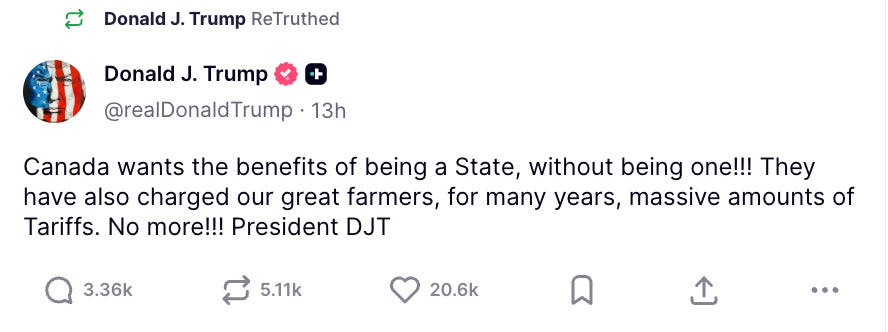
Trump lashed out at Canada for the first time since trade talks collapsed Friday, writing “Canada wants the benefits of being a State, without being one!!!” and “No more!!!” after accusing Canadian farmers of hitting the US with tariffs for years. His comments followed the US imposing 50% tariffs on $20 billion worth of Canadian goods on Saturday, covering everything from hockey sticks to tongue depressors, with Mark Carney vowing to match them “dollar for dollar.” Carney told reporters in Ottawa that Canada is “at war” over trade, saying “you’re at war when you’re attacked, and we got attacked,” and that Trump had miscalculated by escalating the fight. US trade representative Jamieson Greer countered that the US was simply responding to a year of Canadian retaliatory measures, telling Fox & Friends Weekend the goal is “protecting American workers and protecting American supply chains.” The breakdown has also thrown the future of the USMCA into question, since Trump refused to renew the deal this summer despite Canada and Mexico requesting a 16-year extension, with Carney calling the collapse “certainly not good news” for the pact.
NBC’s Kristen Welker pressed Senator Tim Scott on Meet the Press over whether Susan Collins is right that Trump’s Canada tariffs will raise costs for American families, and when Scott tried to pivot back to blaming Joe Biden, Welker cut him off, pointing out Trump has now been in office two years and inflation has actually ticked up on his watch, from 3% when Biden left to 3.4% now. Scott tried again to invoke Biden, prompting Welker to flatly tell him, “The Biden administration is over,” refusing to let him deflect from a question about current policy. The exchange captures a broader pattern of Republicans still reaching for the Biden blame two years into Trump’s term, even as reporters increasingly push back on that framing with the actual numbers.
Education Secretary Linda McMahon said children should be tracked toward trades like plumbing and electrical work as early as elementary school. The push comes as the administration touts skilled-trade demand tied to the AI data center boom, and it’s already launched Pell Grant funding for short-term vocational courses and pressured Brown University to invest $50 million in Rhode Island workforce programs as part of a discrimination settlement. Critics note the same administration has simultaneously slashed billions in education and research funding, including canceling more than 1,000 University of California research grants worth nearly $2 billion after officials admitted to searching for keywords like “diversity” and “vaccine hesitancy” to flag programs for cuts. It has also directed immigration enforcement at college campuses, targeting green card holders over political speech and pushing schools to cooperate with Homeland Security on raids. And on the practical side, the manufacturing jobs this trades push is supposedly feeding into haven’t materialized, with the US actually shedding about 75,000 manufacturing jobs since Trump took office, which some economists tie to the tariff agenda and instability from the Iran war.
Democrats and other Trump critics reacted with disbelief to a New York Times report that House Democratic leader Hakeem Jeffries met privately with Jared Kushner, the president’s son-in-law, to discuss possible areas of collaboration, a meeting that comes just months before midterms where Democrats are favored to retake the House and make Jeffries speaker. Critics point to longstanding conflict-of-interest concerns about Kushner continuing to profit off foreign nations while working on Ukraine, Iran and Gaza policy, with House Judiciary Democrats already investigating his private business raising money from Gulf states while he served as a special envoy. Tommy Vietor, a former Obama aide and Pod Save America co-host, said Kushner “has no actual government job, he just uses his family connections to get money from gulf autocrats,” and that the only appropriate Jeffries approach is “demands for documents and subpoenas.” Senator Chris Van Hollen was more measured on Meet the Press, saying he’s fine with people meeting but that “it’s another thing to see something real come out of that,” while former Republican congressman Adam Kinzinger simply posted “Make this make sense” tagging Jeffries. Jeffries himself didn’t address the meeting directly, instead issuing a statement accusing Republicans of a “my-way-or-the-highway approach” and vowing Democrats will keep fighting for “an affordable America.”
A viral video out of Lake Worth, Florida shows a Border Patrol agent approaching a U.S. citizen at a gas station, demanding his ID, and when the man asks why, the agent replies, “Because you’re an immigrant.” Before the man is even identified, agents grab his hands and cuff him while bystanders can be heard questioning how officers can arrest someone whose identity they haven’t confirmed. The incident raises a direct Fourth Amendment problem: the Supreme Court has held that roving Border Patrol agents need reasonable suspicion based on specific circumstances to stop and question someone about immigration status, and apparent ethnicity alone isn’t enough. That leaves the obvious question of what legal basis existed here beyond the agent’s own stated reasoning, since being told “because you’re an immigrant” is not a lawful basis for a stop. The episode lands as one more example of citizens being forced to prove their status to federal agents on the spot, with little clarity on what accountability follows when that goes wrong.
Iranian Foreign Minister Abbas Araghchi dismissed the threat of new US sanctions as a sign of desperation, saying Treasury Secretary Scott Bessent’s promised “toughest sanctions in history,” set to be detailed at a Monday press conference, amount to “repetitive scenarios” that show Washington has run out of ideas after nearly six months of war. Despite Iran’s economy already reeling from sanctions and repeated airstrikes since the US and Israel launched attacks on February 28th, Tehran remains defiant, having effectively blockaded the Strait of Hormuz to unauthorized oil tankers and driven up global oil prices in the process, with Araghchi insisting “all of their actions... have failed, and this new issue of theirs will fail as well.” Trump has warned of economic consequences for any country offering Iran “a lifeline,” pressuring China, which buys more than 80% of Iran’s exported oil, even as Beijing calls for diplomacy instead. Amid the standoff, Pakistan’s army chief Asim Munir is set to visit Tehran Monday as part of Islamabad’s mediation efforts, while Iranian Parliament speaker Mohammad Bagher Ghalibaf claimed Tehran has received “numerous messages” from neighboring countries about building new regional security and economic arrangements independent of US influence. Iran has yet to see Trump achieve his stated war goals, including dismantling its nuclear program (whose status remains unclear since UN inspectors were barred in 2025) or triggering an uprising against its clerical government, and while President Masoud Pezeshkian has also called for ending the war diplomatically, he framed it as negotiating from a position of strength, saying “it would be better to end the war today, when we are powerful and have dignity.”
New York police are investigating a video posted to TikTok on Friday showing three people in overalls and headlamps emerging from a manhole at 32nd Street and 7th Avenue near Penn Station and Madison Square Garden after 4 a.m. on August 18th, though no arrests have been made and the investigation remains ongoing. The city’s Department of Environmental Protection inspected the sewers in the area and found no infrastructure damage, while stressing that entering sewers is “both illegal and extremely dangerous” due to hazards like noxious gases, unstable surfaces, and flooding risks. It’s unclear whether this incident connects to a similar wave of videos that circulated in May, when groups of men, similarly dressed in protective clothing and headlamps, were seen emerging from manholes in Brooklyn, including one instance where seven men climbed out and changed clothes near active traffic, with at least three carrying shovels. A senior law enforcement official said at the time that the leading theory was the individuals were scavenging for valuables, and police said NYPD’s Emergency Services Unit searched the sewer system afterward and found nothing nefarious left behind.
Senator Chris Van Hollen of Maryland told NBC’s “Meet the Press” he’s “kicking the tires” on a potential 2028 presidential run, saying Democrats haven’t answered the call on building “an economy that really does work for everybody, especially working people,” and that his focus is “not on majority leader” of the Senate but “on what Democrats stand for going into 2028.” Pressed on whether he’s seriously considering a campaign, he noted he’s already visited early nominating states New Hampshire and Iowa, and said Democrats need to be clear “not just what we’re against, but what we’re for,” adding “I very much want to be part of that debate, and I am kicking the tires, testing the waters.” He joins a crowded and still wide-open field of potential 2028 Democratic contenders that includes Gavin Newsom, Andy Beshear, Pete Buttigieg, Alexandria Ocasio-Cortez, Cory Booker, Ruben Gallego, and Kamala Harris, none of whom has emerged as a clear frontrunner. On the party’s leftward flank, Van Hollen said democratic socialists “do” have a place in the party “as part of the debate,” pointing to recent DSA-aligned primary winners like Florida Senate candidate Angie Nixon, though he said some DSA platform planks, like replacing the president and Supreme Court with bodies subordinate to Congress or abolishing the Senate, go too far even for many candidates across the Democratic spectrum, himself included.
The fast-growing Hawk Fire spread from the Sierra foothills toward central Reno early Sunday, expanding past 10,500 acres and prompting evacuation orders for nearly 14,000 homes, with the “GO NOW” zone reaching the edge of the University of Nevada campus. Governor Joe Lombardo declared a state of emergency in Washoe County and mobilized the Nevada National Guard, deploying two helicopter crews for aerial firefighting and 60 troops to help secure evacuated neighborhoods, while roughly 400 personnel from local, state, and federal agencies are fighting the blaze on the ground and in the air. Strong, gusty winds, low humidity, and dry vegetation are driving the fire’s rapid growth, according to Truckee Meadows Fire & Rescue, and nearly 10,000 homes and businesses were without power Sunday as portions of US Route 395 were closed. Reno Mayor Hillary Schieve urged residents not to delay evacuating, warning “structures have already been burned in this fire and your life is more important than a building,” while officials are also monitoring a county detention facility near the evacuation zone in case it needs to be cleared. The fire follows an earlier wave of blazes north of Reno this month that displaced more than 13,000 residents, and while the university and Reno-Tahoe International Airport remained outside the evacuation zone as of Sunday morning, the smaller Reno-Stead Airport was closed to general aviation traffic due to the fire.
President Volodymyr Zelenskyy said holding elections during active fighting with Russia would “destroy” Ukraine by splitting the country, his first public comments on the issue since ousted former Defense Minister Mykhailo Fedorov called for a wartime poll following his surprise dismissal, which sparked protests that later cooled once demonstrators balked at Fedorov’s election demand. Zelenskyy, whose approval rating has held steady around 60%, cited an August 5th poll showing 57% of Ukrainians want elections only after fighting ends, and noted wartime elections are barred by Ukrainian law given security risks and the millions of citizens abroad, under occupation, or serving at the front. He publicly detailed his rift with Fedorov for the first time, saying he offered him four options to stay in government that Fedorov rejected, and linked the fallout partly to a failed effort to secure SpaceX’s approval for Ukraine to use Starlink over Russian territory for deep strikes, after Trump accused Zelenskyy of misleading him when Elon Musk denied having approved it. On the battlefield, Zelenskyy struck an optimistic tone, saying Ukraine has nearly retaken all of Dnipropetrovsk region and could reach territorial parity with Russia’s 2026 gains by year’s end, even as he warned of a $27 billion defense budget shortfall and a steep decline in Patriot missile deliveries, from 675 in 2023 to an expected 264 in 2026.
President Volodymyr Zelenskyy said holding elections during active fighting with Russia would “destroy” Ukraine by splitting the country, his first public comments on the issue since ousted former Defense Minister Mykhailo Fedorov called for a wartime poll following his surprise dismissal, which sparked protests that later cooled once demonstrators balked at Fedorov’s election demand. Zelenskyy, whose approval rating has held steady around 60%, cited an August 5th poll showing 57% of Ukrainians want elections only after fighting ends, and noted wartime elections are barred by Ukrainian law given security risks and the millions of citizens abroad, under occupation, or serving at the front. He publicly detailed his rift with Fedorov for the first time, saying he offered him four options to stay in government that Fedorov rejected, and linked the fallout partly to a failed effort to secure SpaceX’s approval for Ukraine to use Starlink over Russian territory for deep strikes, after Trump accused Zelenskyy of misleading him when Elon Musk denied having approved it. On the battlefield, Zelenskyy struck an optimistic tone, saying Ukraine has nearly retaken all of Dnipropetrovsk region and could reach territorial parity with Russia’s 2026 gains by year’s end, even as he warned of a $27 billion defense budget shortfall and a steep decline in Patriot missile deliveries, from 675 in 2023 to an expected 264 in 2026.
Kazakhstan held a parliamentary election Sunday that’s expected to further consolidate President Kassym-Jomart Tokayev’s power, with the pro-presidential Adilet party predicted to win an overwhelming majority in the country’s first vote for a new single-chamber parliament called the Kurultai. The election follows a March constitutional overhaul, approved by 87% of voters in a referendum, that merged the two parliamentary chambers and expanded presidential authority, including reviving the vice presidency. A Kazakh court ruled last month that the changes reset Tokayev’s term clock, clearing the way for him to seek another seven-year term. The 73-year-old Tokayev, a former Soviet official and UN diplomat who has tried to balance ties between Moscow and the West since Russia sanctions began, is tightening his grip amid economic strain, with February inflation hitting 10.2% and tax hikes fueling discontent, conditions analysts say authorities fear could reignite unrest like the deadly January 2022 fuel protests. The vote comes alongside an intensifying media crackdown, including roughly ten criminal cases against independent journalists and bloggers, among them YouTube journalist Lukpan Akhmedyarov, who faces up to seven years in prison over “disseminating false information” after publishing a list of Kazakh citizens fighting in Ukraine. Akhmedyarov said repression has sharply escalated ahead of the vote and that the outcome is “not very difficult to predict.”
See you soon.
— Aaron
Comments
Nothing yet. Say the first thing.
Sign in to join the conversation.