
Good evening. Canada and the US are now in a full-blown trade war, 50% tariffs are hitting $20 billion in Canadian goods, and Prime Minister Mark Carney says the breakdown comes down to one thing: Canada showed up united, and the US didn’t, a point he made with a pointed jab about “coordination” inside the Trump administration.
Also today: a new financial disclosure shows Trump made over 1,000 stock trades in a single month, part of a pattern of more than 21,000 trades in 2025 alone, raising fresh questions about how a sitting president is this active in the market while setting the very trade and tariff policy that moves it. Plus a CNN review finds a top Trump aide flooded Twitter with over 150 posts on January 6th, a mother is detained by ICE while recovering in the hospital from a car crash, a service member says his father was taken by ICE while he was deployed fighting in Iran, and a full rundown of everything else, from a federal court striking down Trump’s 75-country visa ban to Congo’s fight against the fastest-spreading Ebola outbreak in history.
If you find this kind of daily rundown useful, the best way to support it is by becoming a paid subscriber. This newsletter exists because readers fund it directly, not access, and not favors to any administration or network. That’s what makes it possible to report plainly on stories like the ones above without worrying about who it upsets.
Here’s the news:
Let’s get into it.
Canada Trade War:
After a last-minute breakdown in trade talks Friday night, the US imposed 50% tariffs on roughly $20 billion in Canadian goods early Saturday, prompting Prime Minister Mark Carney to vow “dollar-for-dollar” retaliatory tariffs on US steel, dairy, appliances, agricultural equipment, pulp, paper, and electronics starting September 8th. Carney said the US “asked too much, and they offered too little,” accusing Washington of proposing new terms in the final days that were “uneconomic, unfair” and undermined the deal’s reliability, despite Canada offering concessions like restoring US alcohol to store shelves. US Trade Representative Jamieson Greer countered that Canada “declined to finalize the trade deal under the terms agreed earlier this week” after the US offered “significant tariff reductions on steel, aluminum, autos, and lumber,” and said no new talks are planned as the US moves ahead with its own countermeasures. The tariffs rely on the little-used, Depression-era Section 338 law, which unlike Trump’s other tariff authorities carries no apparent time limit, meaning the duties could remain indefinitely absent a legal challenge or a future president’s reversal. Analysts estimate Canada could lose up to 90,000 jobs and 0.3% to 0.6% of GDP from the new tariffs, with Ontario, Quebec, and British Columbia expected to be hit hardest given their manufacturing, auto, and export-heavy economies.
Provincial leaders have rallied behind Carney’s hardline stance, with Ontario Premier Doug Ford pledging “full support for a strong response, tariff for tariff, dollar for dollar” and British Columbia Premier David Eby declaring “our politeness should never be mistaken for weakness.” The breakdown caps months of on-and-off negotiations in which the US sought Canadian concessions including dropping retaliatory auto tariffs, loosening dairy quotas for US cheese producers, and lifting provincial bans on American alcohol sales, the last of which the Distilled Spirits Council says cut US spirits exports to Canada by more than 70% year-over-year. Business groups on both sides warned a deal’s collapse would hurt everyone, with the Canadian Chamber of Commerce’s Candace Laing calling the new tariffs “a body blow to North American competitiveness” that leaves small exporters questioning what they can still afford. Public opinion is split on how far to push back, with an Abacus Data poll finding about 36% of Canadians support retaliation and 30% prefer continued negotiation, leaving Carney needing to convince the public that standing firm against Washington is worth the near-term economic pain. The dispute marks a serious rupture in what had been one of the world’s most deeply integrated trading relationships, with Canada sending roughly 70% of its exports to the US.
Ontario Premier Doug Ford has pushed the fight further by urging Ottawa to target retaliatory tariffs specifically at states that backed Trump, including Alabama, Arkansas, Florida, Iowa, Missouri, Montana, Texas, and Wisconsin, arguing in a letter to Carney that Canada should hit “politically significant states to the current administration’s base of support.” Alabama is a notable target given Canada is its largest export market, having received $4.3 billion in Alabama goods in 2025, representing 18% of the state’s total exports, while also ranking among Alabama’s top import sources. Ford also called for treating Canada’s electricity, energy, and critical minerals infrastructure as “Team Canada assets” to strengthen the country’s negotiating leverage, framing the broader fight bluntly: “we have to use every tool in our toolbox to make sure, as Donald Trump is trying to inflict pain on every Canadian, that we inflict pain right back.” It remains unclear whether Carney’s government will actually pursue state-targeted tariffs, which would represent a shift from Canada’s current sector-based retaliation approach, and Alabama officials have not yet responded to the proposal. The idea surfaces as both countries brace for a prolonged standoff, with Carney’s broader sector-based countermeasures already set to take effect September 8th regardless of whether the state-specific approach gains traction.
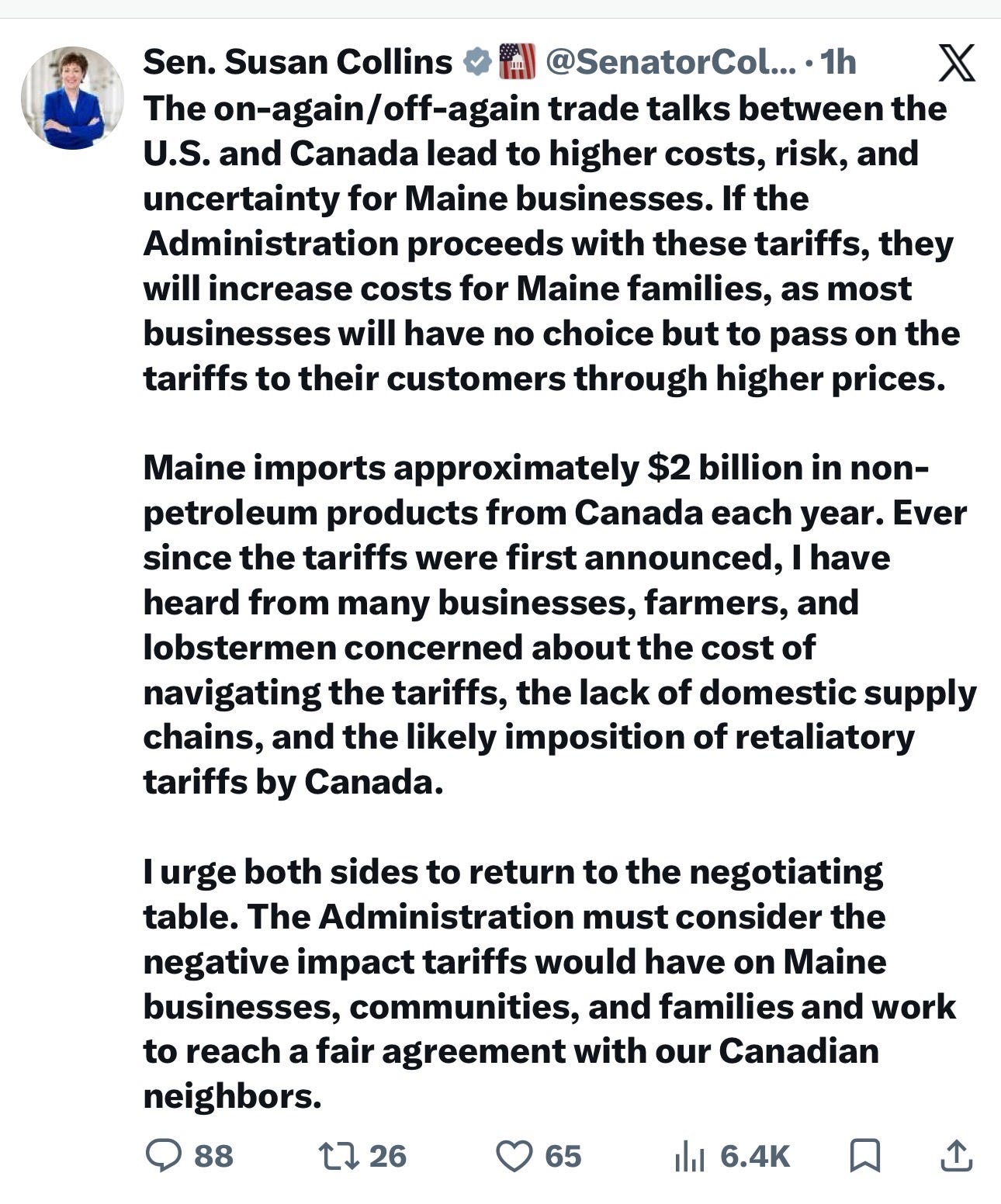
Senator Susan Collins, who is vulnerable, came out against the tariffs:
When asked whether Commerce Secretary Howard Lutnick’s involvement in the final days of trade talks was an impediment to reaching a deal, Prime Minister Mark Carney deflected the question back to the US administration but couldn’t resist a pointed jab at Washington’s internal coordination, saying the Canadian negotiating team was unified with everyone clear on the country’s objectives, then adding, “you cannot say that about the US administration,” implying that mixed signals or infighting on the American side, rather than any single official, were what ultimately sank the negotiations.
Trump’s Stock Trading:
A financial disclosure published Saturday by the US Office of Government Ethics shows President Trump made more than 1,000 securities trades in June alone, including significant purchases of Berkshire Hathaway, Visa, Mastercard, and Cintas. Because the filing only requires disclosing a value range rather than exact figures, the total value of June’s transactions falls somewhere between $78.1 million and $263.1 million. The single largest transaction was a June 22nd sale of between $5 million and $25 million in a Vanguard exchange-traded fund. The scale of this trading activity, even within just one month, is unusual for a sitting president.
June’s activity is part of a much larger pattern documented over the past year: Trump made more than 21,000 securities trades in 2025 alone, often in bursts tied to market events he himself created, with total value estimated between $600 million and $1.86 billion. Disclosures have occasionally shown him buying and selling the same security on the same day, a trading pattern more typical of an active trader than a passive investor. The sheer volume raises questions about how closely his personal financial interests intersect with the market-moving policy decisions he makes as president.
The White House maintains there is no conflict of interest because Trump’s investments are independently managed, and his son Eric, executive vice president of the Trump Organization, has said the assets are held in a blind trust. Critics note that a true blind trust typically means the office holder has no knowledge of or input into specific holdings, which is difficult to reconcile with such an active, high-volume trading pattern. Bloomberg’s report does not allege any specific instance of trades timed to policy decisions, but it lays out the scale of the activity for public scrutiny. The disclosure was reported by Bloomberg’s Hadriana Lowenkron, a White House correspondent covering the administration.
Other news:
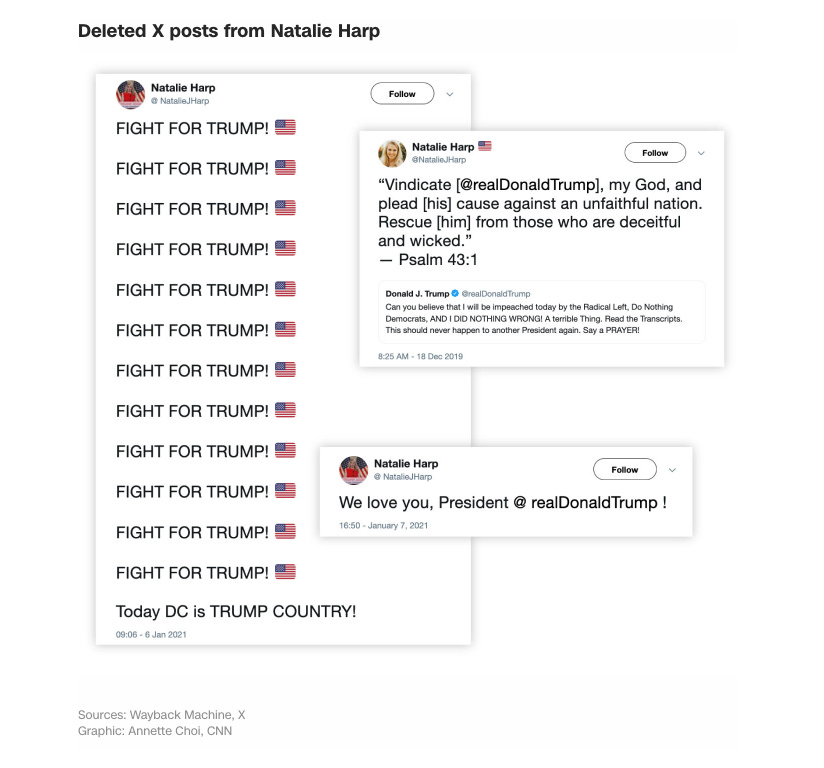
A CNN review of Natalie Harp’s now-removed Twitter account found she posted more than 150 tweets on January 6, 2021, urging Republicans to “FIGHT FOR TRUMP,” amplifying Trump’s stolen-election claims, and promoting Rudy Giuliani’s “trial by combat” call before the Capitol riot. After the Capitol was breached, Harp, then a One America News host, falsely claimed the rioters “were not Trump supporters” and spread unfounded reports that Antifa had infiltrated the mob, later praising lawmakers like Josh Hawley, Marjorie Taylor Greene, and the six senators who voted to sustain election objections as “patriots.” University of Akron political scientist David B. Cohen described her as “a totally loyal sycophantic adviser” who gives Trump the reverence he craves, and CNN’s review found her devotion dating back to 2016, including tweets defending him during his 2019 impeachment and declaring Biden’s win “A COUP.” Harp, who has served as a close Trump aide during his second term, was thrust into public attention this week after Democratic Sen. Jon Ossoff named her in a floor speech and the Daily Beast published letters she reportedly wrote pledging her loyalty to the president; neither Harp nor the White House responded to CNN’s request for comment.
Grace Stephanie Calero Cabanilla, 39, and her 19-year-old daughter Giulianna were recovering at HCA Florida Poinciana Hospital in Kissimmee after a rollover crash around August 20th when Polk County deputies, operating under a 287(g) agreement with ICE, questioned the pair’s immigration status and turned them over to federal agents, who detained the mother despite her pending asylum case and valid work permit; the daughter, who holds a visa valid through 2030, suffered a seizure after watching her mother restrained, and the family has since launched a GoFundMe as public reaction to the enforcement action remains sharply divided.
A 1-year-old baby appeared unrepresented in Arizona immigration court this week and was instructed to file an asylum application before the next hearing or face deportation, with the USCRI attorney present staying silent rather than objecting, according to court filings in an ongoing legal dispute between immigrant-rights nonprofits and the Trump administration. The incident stems from the July 31st lapse of a contract with the Acacia Center for Justice, which had distributed federal funds to nearly 100 legal providers representing over 24,000 unaccompanied migrant children, leaving many kids to face court alone despite two new HHS contracts awarded to USCRI ($20 million) and anti-trafficking group Our Rescue ($158 million). Nonprofit leaders have documented other cases of USCRI attorneys staying silent during proceedings, including an August 6th California hearing where an unrepresented minor requested voluntary departure without any objection, and the suing nonprofits argue HHS has created “a façade of compliance” that’s produced chaos rather than actual representation. An ORR spokesperson said USCRI is still assessing which children remain represented amid unclear transitions, while an ORR official told the court that attorneys have covered all hearings for 1,800 kids in the agency’s care without complications; USCRI and Our Rescue did not respond to requests for comment.
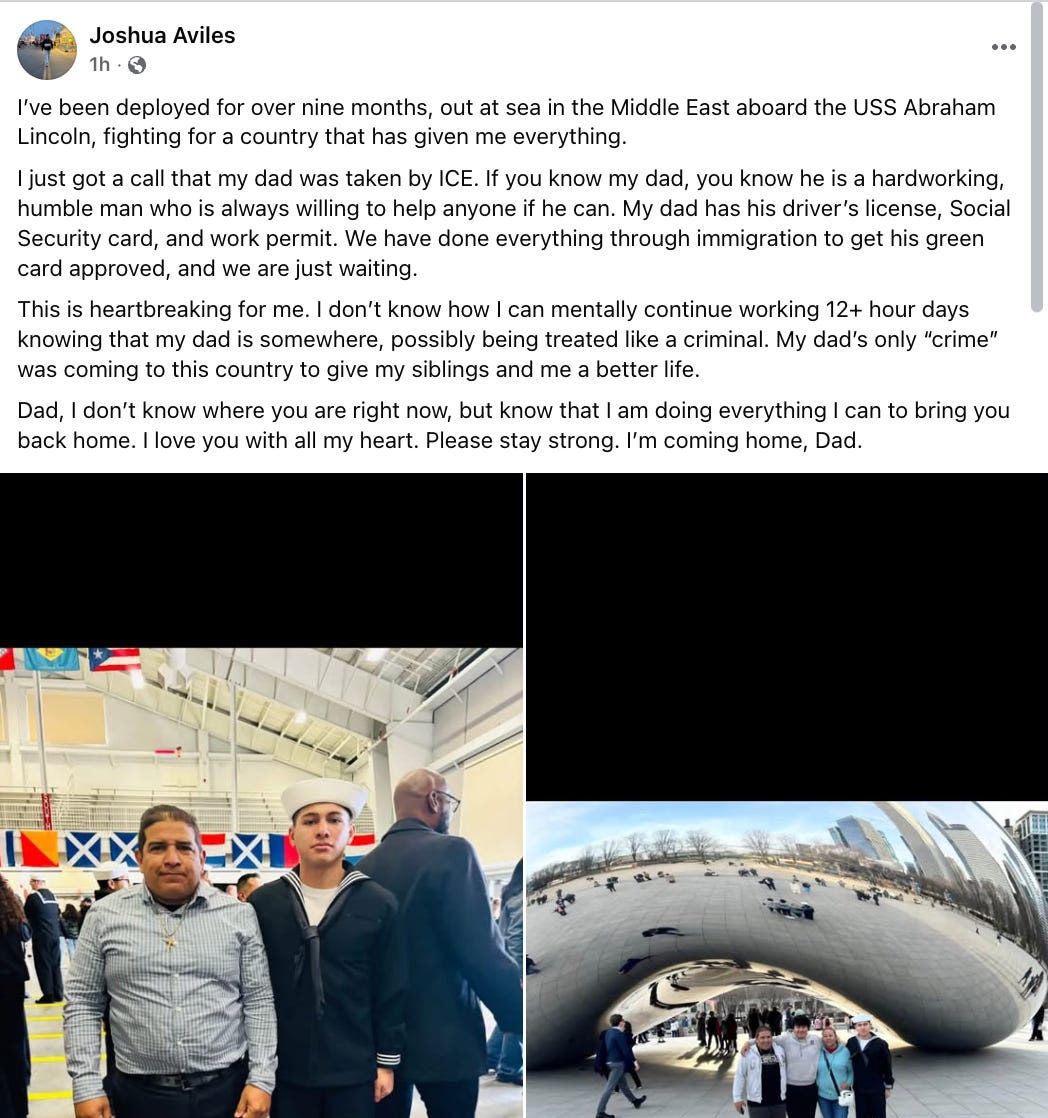
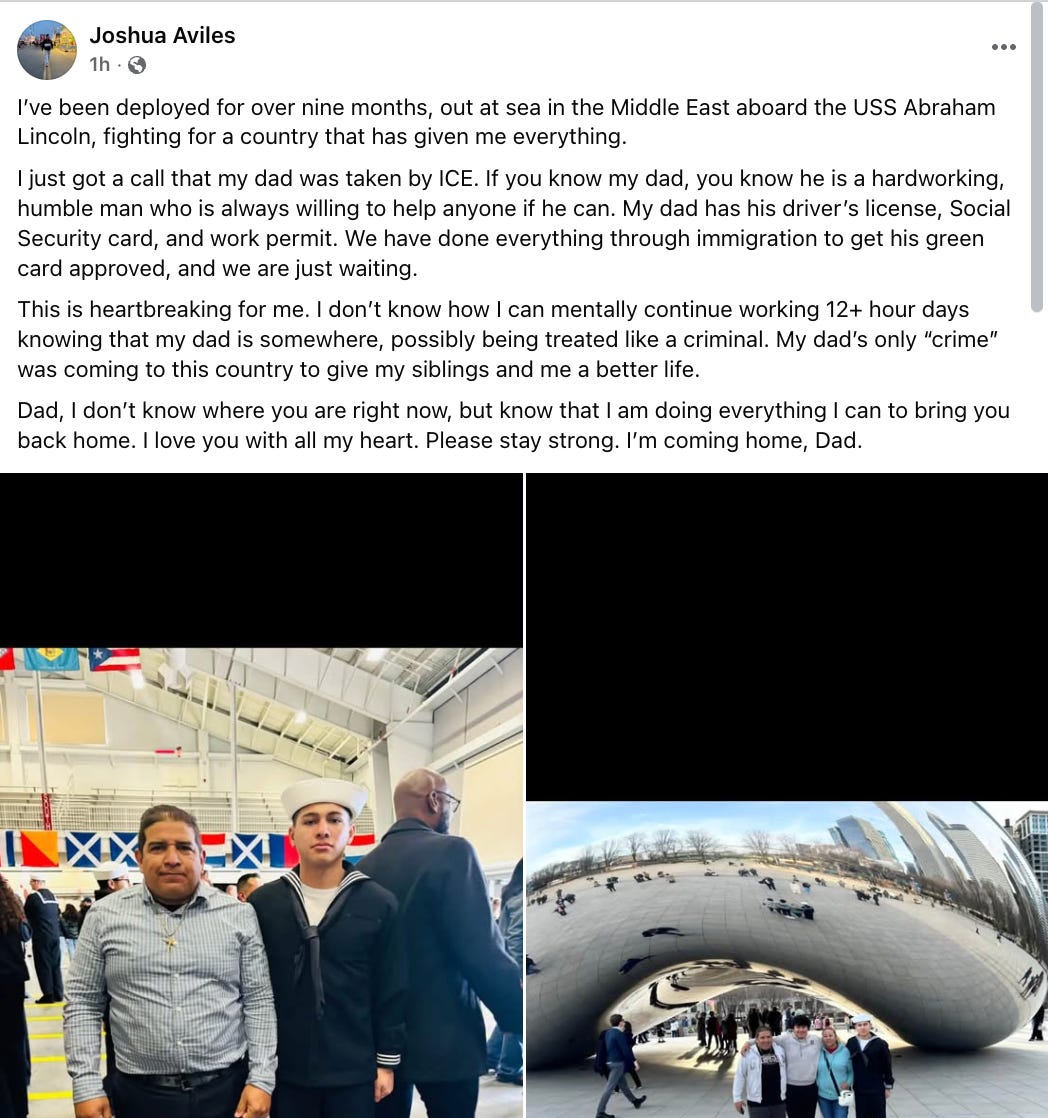
A service member says his father was taken by ICE while he was deployed aboard the USS Abraham Lincoln for over nine months fighting the war in Iran.
Per his post, his father has a driver’s license, social security card, and a work permit.
A New York federal judge, Jeannette Vargas, struck down the Trump administration’s policy suspending visa processing for citizens of 75 countries, ruling that Secretary of State Marco Rubio exceeded his statutory authority in issuing the ban. The court found the rule unlawfully bypassed consular officers, who hold statutory discretion over individual visa eligibility decisions. The lawsuit challenging the ban was brought by two nonprofit organizations along with 11 individuals directly affected by the suspensions. Immigration advocates hailed the ruling as a major win for the rule of law and for family reunification.
Congo has received more than 16,250 doses of the Ervebo Ebola vaccine, part of a planned 70,000-dose shipment from the WHO and partners, as the country battles the fastest-spreading Ebola outbreak in history. The outbreak is caused by the rare Bundibugyo virus, which has no approved treatment or vaccine of its own, though Ervebo (licensed for other Ebola strains) may offer some protection according to the WHO. The current outbreak has recorded 2,557 deaths among 5,375 confirmed cases across six provinces and is on pace to surpass the 2014-2016 West Africa outbreak that killed over 11,000 people, with Africa CDC data showing transmission hasn’t yet peaked and could triple. Containment efforts are being hampered by armed conflict between the government and rebel groups controlling key hot-spot cities, attacks on medical staff and facilities, a mobile labor population and conflict-displaced people, and a lack of basic health infrastructure. More vaccine doses are expected to arrive early next week.
Nine months after Trump promised his drug-pricing deals would expand Medicaid access to GLP-1 weight-loss drugs like Wegovy and Zepbound, only Indiana has publicly signed on, 29 state Medicaid programs have declined to participate, and access has actually shrunk, with five states (California, Massachusetts, New Hampshire, Pennsylvania, and South Carolina) ending coverage over the past year and Rhode Island set to follow in October. States cite budget fears reinforced by California’s experience, where projected GLP-1 costs were set to nearly quadruple to $800 million by 2028-29, plus looming Medicaid cuts from last year’s One Big Beautiful Bill Act; Louisiana’s Medicaid director Seth Gold said he wants coverage but won’t risk having to “contract or withdraw” it later like other states have. Under the model, states get Wegovy at $245 per monthly dose (Indiana will cover $85.16 of that per person) in exchange for adopting standardized criteria including a BMI of 35 or higher, but participation requires new budgeted spending that states like Florida and Oregon say would need fresh legislative appropriations, while New Jersey and Kentucky law outright bars Medicaid weight-loss drug coverage. Seven states are still weighing participation, and experts say most others are taking a “wait-and-see” approach, watching how Indiana’s Medicaid budget holds up over the next one to three years as federal cuts phase in before committing either way.
Federal prosecutors pursuing charges against former FBI director James Comey for allegedly threatening Trump cited passages from Comey’s novel FDR Drive to bolster their case, arguing its fictional protagonist, a federal prosecutor who targets a far-right media personality, shows Comey believes such figures should have “something... done” about them. PEN America’s legal director Mara Gassmann condemned the move as a “desperate Hail Mary” that compounds First Amendment concerns, warning that “extreme caution should be taken any time creative works are used to support criminal charges.” The underlying charges stem from a May 2025 Instagram post where Comey, vacationing in North Carolina, arranged seashells to spell “8647,” which prosecutors say is unambiguously a threat against the 47th president using “86” slang for getting rid of someone; Comey has said the connection “never occurred to me” and took the post down since he opposes violence of any kind. Prosecutors also suggested in their filing that Comey had a financial motive to stir controversy to boost book sales, though the novel has sold just 6,471 copies according to Circana BookScan. Comey’s attorneys are seeking dismissal, arguing no reasonable observer would read “86 47” as a personal threat and calling the prosecution “vindictive and selective,” rooted in what they describe as Trump’s years-long campaign to punish Comey for protected speech tied to his handling of the 2016 Russia investigation.
The Justice Department reached a $400 million settlement with TikTok and parent company ByteDance to dismiss claims that the app illegally collected data on millions of children under 13 without parental consent and failed to honor deletion requests, resolving a lawsuit the Biden administration filed in 2024, while also vacating a separate 2019 FTC privacy consent decree tied to TikTok’s predecessor Musical.ly; DOJ cited “significant changes” to TikTok’s management, ownership, and privacy practices, including its restructuring as a joint venture under US investors (with ByteDance retaining a 19.9% stake), but former Biden-era FTC public affairs director Douglas Farrar blasted the deal as “a Trump bailout for Larry Ellison,” calling the violations “the worst we saw” and the fine “a fraction of what the government should have sought.”
A Texas appeals court slashed the $50 million judgment Alex Jones owed Sandy Hook parents Neil Heslin and Scarlett Lewis down to about $6 million, with the Third Court of Appeals citing state damage caps in a unanimous ruling that left $4.1 million in compensatory damages intact but cut over $45 million in punitive damages to $1.5 million. The ruling doesn’t touch a separate $1.25 billion judgment against Jones in Connecticut, where he was also found liable for defaming Newtown families who say his followers, believing his hoax claims, subjected them to death threats, harassment, and abuse. Jones called the Texas ruling “a gigantic victory for the First Amendment” and says he’ll keep appealing to the state Supreme Court, though the court did not overturn the underlying defamation finding against him. Heslin and Lewis’s attorney Mark Bankston dismissed the ruling as “irrelevant,” noting Jones still faces over a billion dollars in total liability and that Sandy Hook families have yet to collect any money from him as he wages appeals through state and bankruptcy courts. Jones took Infowars off the air in April and now streams from new platforms, while satirical outlet The Onion’s bid to take over Infowars’ branding remains on hold amid the ongoing bankruptcy liquidation proceedings.
Russian drone and missile strikes killed at least seven people across Ukraine on Saturday, including two people killed in a ballistic missile strike on the Kyiv region and one killed when missiles hit railway infrastructure in Kyiv itself, while a Ukrainian drone strike on Russia’s Krasnodar region killed two children and wounded two adults. Zaporizhzhia was also hit hard, with a nighttime drone strike killing one person and a daytime attack killing three more and wounding 15, plus three more wounded in a strike on a minibus in the regional capital. The attacks came a day after Russian drones hit a shopping center in Zelenskyy’s hometown of Kryvyi Rih, a strike Ukrainian officials say has now killed 16 people, left nine still missing, and wounded 130 in what Zelenskyy called a deliberate “double-tap” targeting rescuers; Kryvyi Rih has been struck repeatedly through the war, including an April 2025 attack that killed 20 people. The UN says Kyiv was among the hardest-hit cities in July alone, with at least 54 civilians killed and 202 wounded, as Russia exploits Ukraine’s shortage of Patriot interceptors to intensify ballistic missile attacks on the capital. Ukraine, meanwhile, has pushed the war onto Russian soil with long-range drone strikes on oil facilities and retail warehouses, including a strike Saturday on the Novokuibyshevsk oil refinery in Russia’s Samara region, roughly 620 miles from the front line.
See you soon.
— Aaron
Comments
Nothing yet. Say the first thing.
Sign in to join the conversation.