
In general, I try to avoid having any opinions about my students’ love lives. However, because college campuses are basically the original version of Love Island, relationship drama occasionally finds its way into conversations I’m having with students, which is exactly what happened earlier this week when a couple of my students began complaining about their girlfriends.
Specifically, they were frustrated because their girlfriends didn’t think they were spending enough time with them.
Mind you, these weren’t students with lots of free time. They were student athletes, which meant early morning workouts, practices, games, team obligations, travel, and — somewhere in between all of that — trying to also be full-time college students. From their perspective, they were working their tails off just to keep everything afloat, and they didn’t have lots of extra time to give even if they wanted to.
Obviously, their girlfriends didn’t feel that way. From the perspective of their girlfriends, my students simply weren’t prioritizing them.
The Work No One Sees
Again, I try to avoid weighing in on student love lives, so I didn’t say anything directly to them. But, in my head, I found myself thinking about how their problem was basically the same issue that manifests from time to time in every relationship… romantic or otherwise. That issue is perspective.
In fact, I’m fairly convinced the vast majority of arguments and disagreements between people aren’t really about the surface-level disagreements at all. They’re about the gap between what one person experiences and what the other person can see.
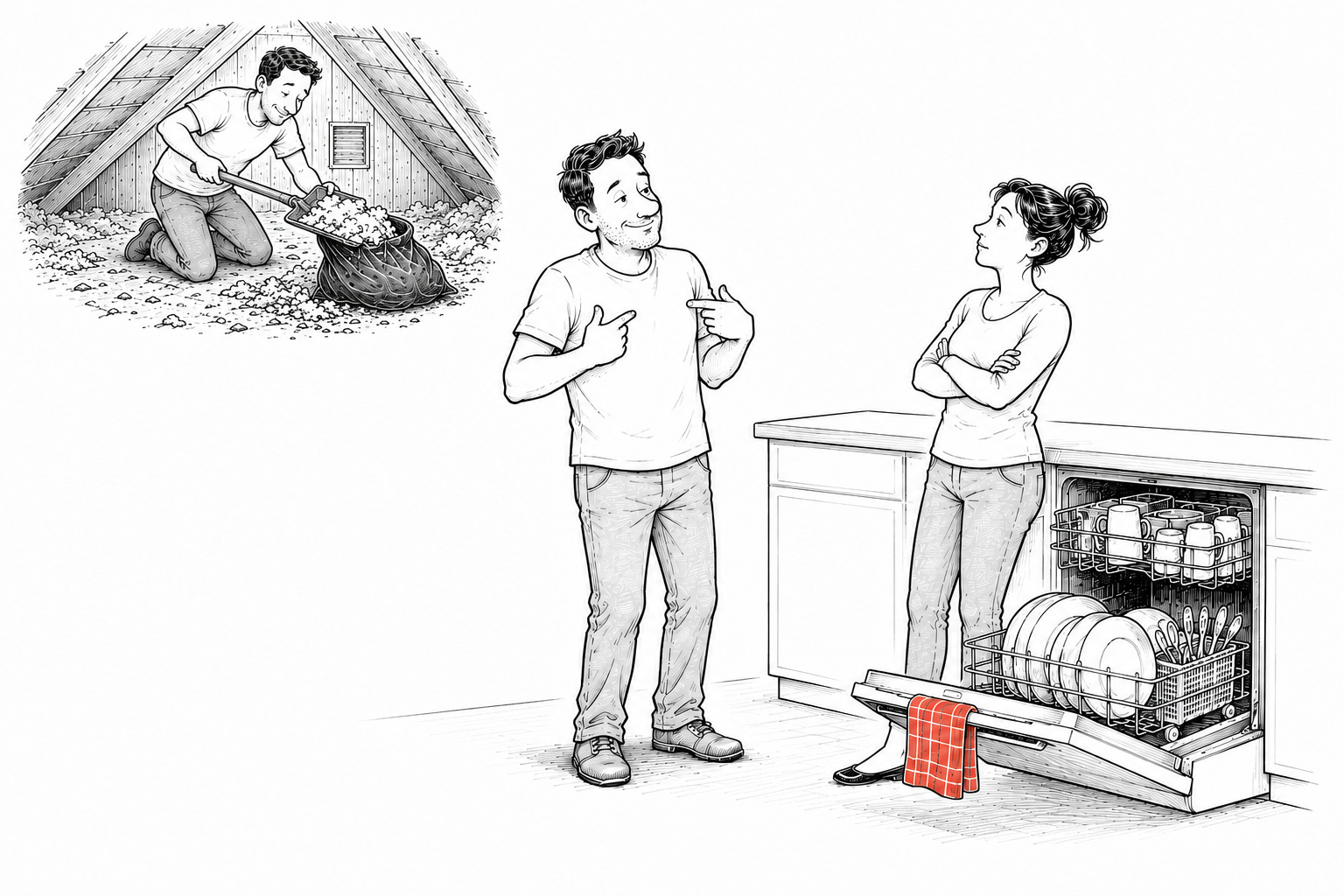
For example, as I mentioned in a previous newsletter, I recently had to get a new roof put on my house. If you’ve ever had that done, you know replacing a roof creates lots of debris in the attic. So one morning, before heading to campus, I decided to clean it up.
I figured it would take maybe 20 or 30 minutes.
It did not.
It turned into a much bigger project, and, before I knew it, I’d spent over two hours crawling around the attic, cleaning up the aftermath of the roof replacement. By the time I finished, I was running late, so I rushed to get ready and hurried out the door.
Fast forward to later that evening, and the dishwasher hadn’t been emptied.
My wife was understandably annoyed. Couldn’t I have taken a few minutes to empty it before leaving that morning?
And just as quickly, I felt myself getting annoyed in return. It wasn’t like I was sitting on the couch drinking beer and watching sports. I had spent hours doing something that needed to get done. The dishwasher wasn’t ignored out of laziness — it was simply lower on the priority list that morning.
Not that she saw any of that. From her perspective, the dishwasher was still full, which meant, just like my students and their girlfriends, we weren’t actually arguing about the dishwasher. We were operating from completely different contexts.
What We Don’t See
I’m sharing these stories because they reflect one of the most common but quietest forms of failure. In both cases, even though nobody actually failed, we perceive failure and feel failure because we mistake what we can see for what’s actually true.
We see the unemptied dishwasher. We see the lack of time spent together. We see the outcomes. But we don’t see the effort, the tradeoffs, the invisible decisions that led to those outcomes. And because we don’t see those things, we fill in the gaps with our own assumptions.
“She didn’t care enough to do it.”
“He didn’t prioritize me.”
“They could have done more.”
Those stories feel real because they’re based on the only information we have access to. But they’re also incomplete. And the trickiest part is that this isn’t just something other people do to us. It’s something we do to them, too. Just like my wife couldn’t see the two hours I spent in the attic, I couldn’t see whatever context she was operating from when she noticed the dishwasher. And just like my students’ girlfriends couldn’t feel the exhaustion of a busy student athlete’s schedule, my students couldn’t fully understand what it felt like to be on the receiving end of that limited time.
Simply put, we’re all making judgments from inside our own experiences and then reacting as if we have the full picture.
We don’t.
Learning to fail, in this case, isn’t about proving you’re right or convincing someone else they’re wrong. It’s about recognizing you’re both working with incomplete information.
And sometimes the most productive move isn’t to explain yourself more clearly. It’s to get curious. To ask what you might be missing. To invite the other person to share what you can’t see. To acknowledge that there’s probably more going on than what’s immediately in front of you.
Because more often than we’d like to admit, the issue isn’t that someone doesn’t care. It’s that we’re all trying to understand each other from inside our own heads. And that’s a much harder problem than an unemptied dishwasher.
Seeing What You Can’t See
For this week’s failure challenge, I’d like you to revisit a recent moment where you felt frustrated with someone… a partner, a coworker, a friend, or even a stranger. But instead of replaying what happened and fixating on why they were wrong — which is our natural response — I want you to focus on a different question:
What might I not be seeing?
What effort might have gone into their side that you didn’t witness? What constraints might they have been dealing with? What tradeoffs might they have been making that never showed up in your version of the story?
To be clear, you don’t have to excuse their behavior or agree with their decisions. That’s not the goal. The goal is simply to recognize that your version of the situation is incomplete.
Also, if it feels appropriate — and this is where things might get a little uncomfortable — try asking them about it.
Remember, you’re not trying to challenge them or prove a point. You’re just trying to genuinely understand.
After all, learning to fail isn’t about getting better at being right. It’s about getting better at noticing how “right” and “wrong” aren’t nearly as obvious as we like to imagine.
Comments
Nothing yet. Say the first thing.
Sign in to join the conversation.