
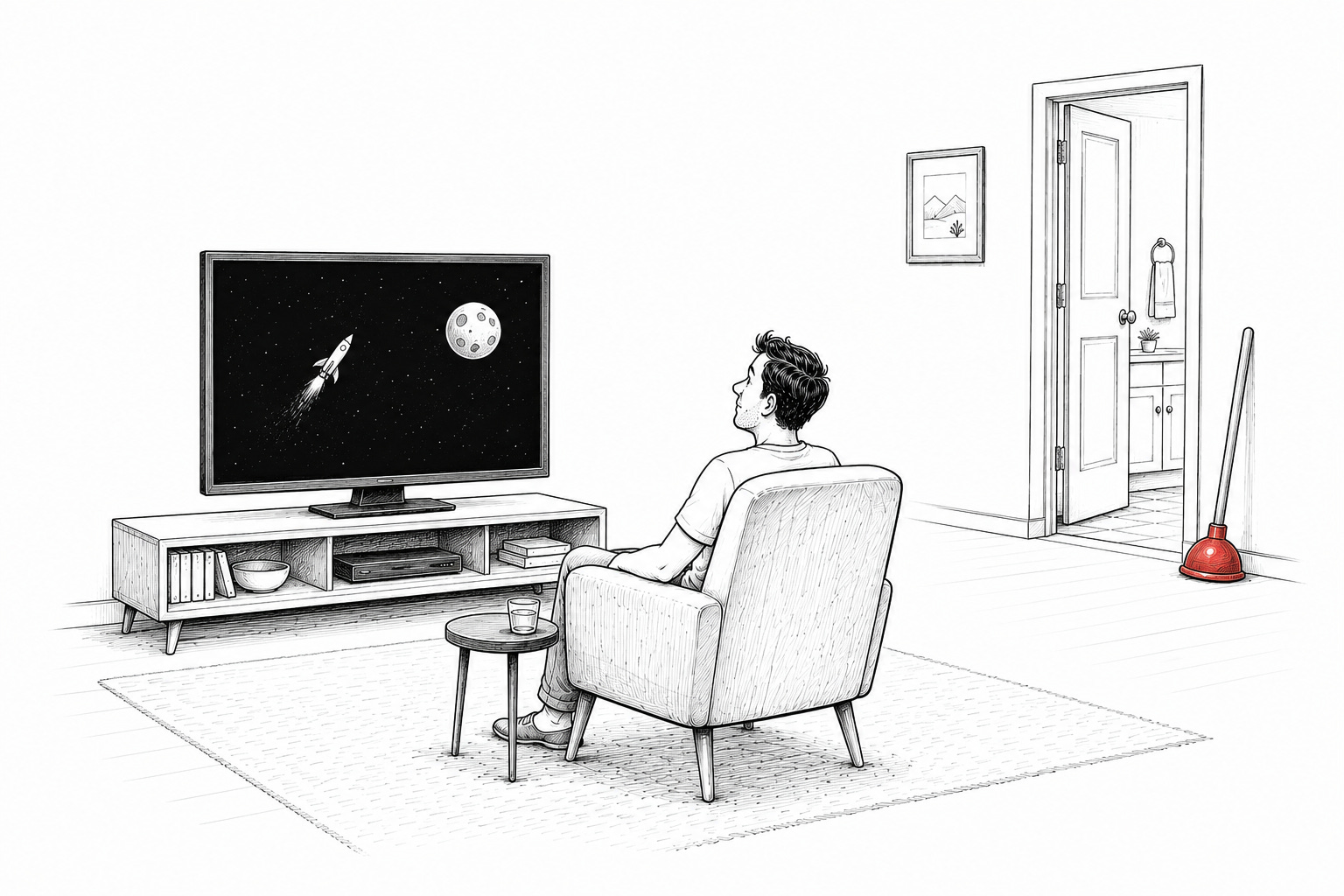
As I write this, NASA’s Artemis II mission is finishing its journey around the moon. In fact, assuming all has gone well, shortly after publishing this issue, the crew will have landed safely, and we’ll all be talking about what an amazingly successful mission it was. It showcased the immense potential of human engineering, determination, willpower, etcetera.
And yet, for those of you more passionate space nerds among us, you’ll already know that it hasn’t gone entirely according to plan. Instead, the team at NASA has spent most of the trip battling something that has nothing to do with complex orbital dynamics and advanced propulsion systems.
Nope… apparently the biggest headache has been that the toilet broke.
More specifically, the Orion spacecraft’s waste system — a highly engineered piece of equipment especially designed to handle a… ummm… messy aspect of living in zero gravity — ran into issues preventing it from pushing waste outside the spacecraft. Which, considering four people spent 10 days in there, sounds kind of like they were trapped inside a porta potty.
Anyway, I wanted to write about this issue because, honestly, isn’t it kind of ridiculous?
We tend to think the hardest parts of something like space travel are the big, impressive challenges — the engineering, the physics, the scale of the mission. And, yes, those things are incredibly difficult. But none of it works if you can’t solve for the human part.
In other words, you can build the most advanced spacecraft ever created, but if the humans inside it can’t function — if they can’t eat, sleep, stay comfortable, and, yes, go poop — the entire mission starts to break down.
On the surface, it seems like an absurd point of failure. But is it? Or is it actually the entire point of the mission
We’re not sending rockets to space for the sake of rockets. We’re sending rockets to space for the sake of humans. Which means none of this is about doing impressive things just because we want to do impressive things. The underlying purpose of the mission is to expand where human life can exist. And human life comes with needs that don’t go away when we put it in a different environment. If anything, those needs become even more important, which is why the most complex missions still depend on solving the most basic problems.
Unfortunately, in our zeal to glorify what’s impressive about the Artemis II mission, we often forget what really matters.
Solving for the needs of “being human” isn’t a job that’s unique to flying rockets to the moon. Instead, we’re constantly facing similar challenges in our own lives. We also tend to get similarly distracted.
We focus on the impressive parts of what we’re trying to do — the outcomes, the achievements, the visible markers of progress. But we forget that the parts that actually determine whether anything works are the human parts. And, just like Orion’s toilet, those are often the hardest problems to solve while also being the ones we’re most tempted to ignore.
They’re the conversations we don’t want to have. The uncertainty we can’t quite resolve. The emotional reactions that don’t fit neatly into whatever plan we’ve built for ourselves. These things feel inconvenient, so we treat them like they’re getting in the way of the real work.
But what if they’re not getting in the way of anything? What if they’re actually the most important things we’re supposed to be doing?
After all, there’s not much value in building something impressive and then forcing your humanity to squeeze into it. The real value comes from building something that actually works for your humanity — and that means accounting for the messy, inconvenient, unavoidable parts from the start. And maybe the smelly ones, too.
For this week’s failure challenge, I want you to take a close look at something in your life that should be working… but isn’t.
More specifically, I want you to identify the part of a project, goal, or situation that you’ve been quietly avoiding because it feels too small, too awkward, or too inconvenient to deal with. It might be a conversation you’ve been putting off, a decision you keep delaying, or a recurring frustration you’ve learned to work around instead of fix.
In other words, I want you to find your version of NASA’s “toilet problem.”
Once you’ve identified a problem, resist the urge to minimize it. Don’t tell yourself it’s not a big deal or that you’ll get to it later. Instead, assume the opposite: Assume this small, messy, human problem might actually be the thing determining whether everything else works.
Then do something about it.
It won’t feel impressive, and it probably won’t make for a great story on social media, but that’s exactly the point.
No posts
Comments
Nothing yet. Say the first thing.
Sign in to join the conversation.