
Last week, a federal appeals court revived more than 550 lawsuits claiming that prenatal Tylenol use caused autism and ADHD in children.
If you took acetaminophen during pregnancy and your child is neurodivergent — I know where your brain just went.
Mine did too. I’m a mom of four neurodivergent boys. And I’m a special education teacher with 20 years of experience.
So let me walk you through what actually happened, what the research says, and what this means for families like ours.
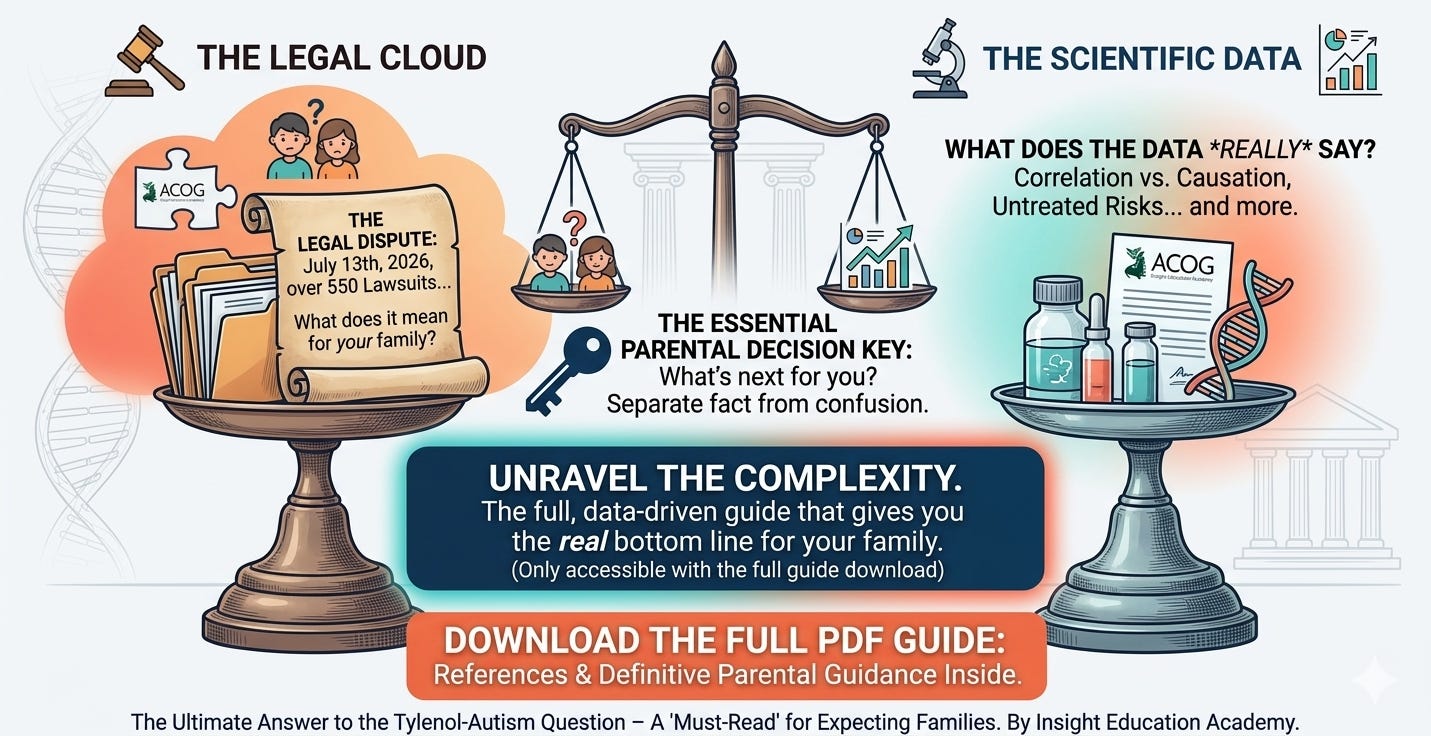
On July 13, the U.S. Court of Appeals for the Second Circuit ruled that a lower court judge made an error when she excluded expert testimony linking prenatal acetaminophen to autism and ADHD. That ruling had effectively killed over 550 private lawsuits against Kenvue, the company that makes Tylenol.
The appeals court didn’t say Tylenol causes autism. It said the experts deserved to be heard. The cases now go back to the lower court for further proceedings.
A legal ruling is not a scientific finding. Courts decide whether evidence meets a legal standard. Science decides whether something is true.
So let’s look at the science.
Over the past decade, multiple studies have found a statistical association between prenatal acetaminophen use and a slightly elevated risk of neurodevelopmental conditions like ADHD and autism. Several meta-analyses have examined this across dozens of studies:
A 2021 meta-analysis across six European cohorts found small but significant associations between prenatal acetaminophen exposure and ADHD symptoms, though the authors noted the results “should be interpreted with caution” due to methodological limitations (Bauer et al., 2021).
A 2023 systematic review and meta-analysis found an association between prenatal acetaminophen and ADHD but noted that confounding by indication — meaning the conditions requiring the medication may be the actual risk factor — could not be ruled out (Ricci et al., 2023).
A January 2026 Lancet study — one of the largest and most rigorous to date — concluded that acetaminophen use during pregnancy is not likely to raise the risk of having a child with autism, ADHD, or intellectual disability (STAT News, 2026).
A June 2026 review in Obstetrics & Gynecology Science concluded that “the previously reported modest risk elevations largely reflect confounding and methodological limitations” and that sibling comparison studies — which control for shared genetics and environment — show “no causal relationship between therapeutic acetaminophen use and neurodevelopmental disorders” (Kim et al., 2026).
Sibling studies matter. When researchers compare a child whose mother took acetaminophen during pregnancy to their sibling whose mother did not, the association largely disappears. That’s a strong signal that something else — genetics, the reason the mother needed the medication — is doing the work.
In September 2025, the American College of Obstetricians and Gynecologists issued an updated Practice Advisory and affirmed that acetaminophen remains the safest available analgesic during pregnancy. Their position:
“The current weight of evidence does not support a causal relationship between acetaminophen use in pregnancy and neurodevelopmental disorders in offspring. Judicious use at the lowest effective dose for the shortest necessary duration, in consultation with an obstetrician–gynecologist, remains consistent with best practice.” (ACOG, 2025)
ACOG also pointed out that the conditions acetaminophen treats — fever, pain, and headaches that may signal preeclampsia — pose their own serious risks when left untreated.
No alternative pain medication is considered safer during pregnancy. NSAIDs like ibuprofen carry known fetal risks. Aspirin has specific restrictions. Acetaminophen remains the standard of care.
If you’re the parent of a neurodivergent child and you took Tylenol during pregnancy, I need you to hear this:
You did not cause your child’s neurodivergence.
Neurodevelopmental conditions like ADHD and autism are driven by complex genetics, brain development, and prenatal environment. No single medication — taken at recommended doses — has been shown to cause them.
The lawsuits being revived does not mean the science changed. It means a court decided the legal process needs to continue. Those are different things.
I’d say this:
The largest, most rigorous studies do not support a causal link between Tylenol and autism or ADHD.
ACOG — the leading authority on pregnancy care — reaffirmed acetaminophen’s safety in September 2025.
Sibling studies, which are the gold standard for controlling genetics and environment, show the association disappears when you account for those factors.
The internet is about to be very loud about this. Headlines sell fear. Data tells a different story.
If you’re pregnant now: talk to your OB. Don’t stop managing fever or pain based on a lawsuit headline.
Disclaimer: Insight Education Academy is dedicated to providing support, resources, and strategies based on personal experience and educational expertise. However, no one at Insight Education Academy is a licensed doctor, psychologist, or mental health professional. The information and services provided are not intended to diagnose, treat, or replace the advice of qualified medical or mental health professionals. For specific medical or psychological concerns, we encourage you to consult a licensed healthcare provider or mental health specialist. By engaging with our services, you acknowledge and agree to this disclaimer.
References
ACOG. (2025, September). Acetaminophen use in pregnancy and neurodevelopmental outcomes [Practice Advisory]. American College of Obstetricians and Gynecologists. https://www.acog.org/clinical/clinical-guidance/practice-advisory/articles/2025/09/acetaminophen-use-in-pregnancy-and-neurodevelopmental-outcomes
Bauer, A. Z., Swan, S. H., Kriebel, D., Liew, Z., Taylor, H. S., Bornehag, C.-G., Andrade, A. M., Olsen, J., Jensen, R. H., Mitchell, R. T., Skakkebæk, N. E., Jégou, B., & Kristensen, D. M. (2021). Prenatal and postnatal exposure to acetaminophen in relation to autism spectrum and attention-deficit and hyperactivity symptoms in childhood: Meta-analysis in six European population-based cohorts. European Journal of Epidemiology, 36, 993–1004. https://doi.org/10.1007/s10654-021-00754-4
Kim, S. Y., et al. (2026). Acetaminophen use in pregnancy and autism: Separating controversy from scientific evidence. Obstetrics & Gynecology Science. https://ogscience.org/journal/view.php?number=8936
Ricci, C., Albanese, C. M., Pablo, L. A., et al. (2023). In utero acetaminophen exposure and child neurodevelopmental outcomes: Systematic review and meta-analysis. Paediatric and Perinatal Epidemiology, 37(5), 473–484. https://doi.org/10.1111/ppe.12963
Tylenol-autism lawsuits revived. (2026, July 13). The Straits Times. https://www.straitstimes.com/world/united-states/us-appeals-court-revives-hundreds-of-private-lawsuits-linking-tylenol-to-autism
This summary document outlines the current state of the discourse regarding prenatal acetaminophen (Tylenol) use and potential neurodevelopmental risks.

Want every this PDF for free?
All of the downloadable resources on this Substack — checklists, guides, cheat sheets — are available at no cost inside the Insight Parenting Community. It’s free to join, and you’ll get access to other parents who actually get it, plus live discussions, bonus content, and my courses when you’re ready. Join the community here
No posts
Comments
Nothing yet. Say the first thing.
Sign in to join the conversation.