
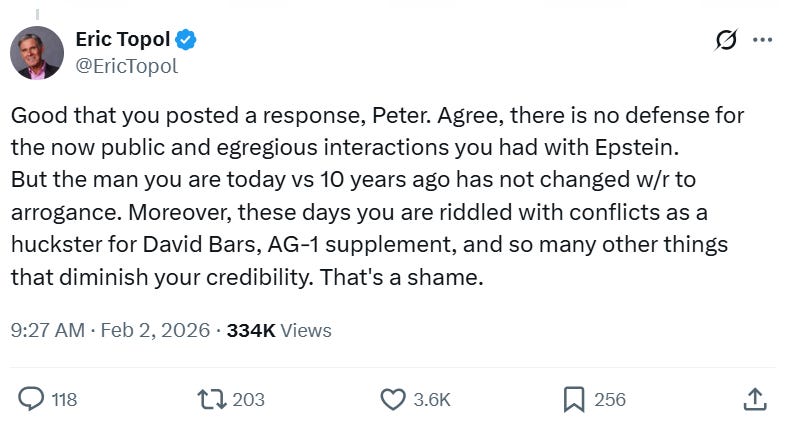
When Eric Topol lashed out at Peter Attia in a viral tweet, the broad claim—setting aside the personal material—was familiar: that longevity proponents overreach with unbridled enthusiasm, conflicts of interest, and a knack for persuasive storytelling over evidence. If you’re inclined to be skeptical of health optimization culture, it was catnip. A respected academic voice warning the public about a huckster.
But the episode is more revealing as a mirror than as a takedown. The interesting question isn’t whether Attia oversells. It’s why medicine keeps anointing a different kind of overreach—one dressed up in credentials, delivered in the language of “The Science,” and granted institutional authority that no longevity promoter could ever buy.
Medicine loves to criticize the obvious hustlers: supplement sellers, wellness influencers, celebrity doctors turned brands. Their incentives are transparent. Their claims are transactional. You can opt in, opt out, and any downside is usually personal and contained.
The more dangerous failure mode is harder to see because it sounds responsible. It’s the academic elite expert whose authority outruns the evidence while retaining the moral weight of “settled science.”
Finance has a vocabulary for this. Warren Buffett waits for durable signal inside his circle of competence. He acts rarely, but decisively. Jim Cramer performs the opposite skill: high-velocity interpretation of noise, rewarded for clarity, conviction, and airtime. Then there’s the third character: the active fund manager selling a thesis to consumers—often persuasive, sometimes thoughtful, yet historically underperforms the market.
In medicine, Peter Attia is functionally that third figure: an active manager of health. He sells a worldview and a framework to a voluntary audience. You may think the evidence is thin. You may find the confidence excessive. You may question the sincerity of his motives. But the transaction is explicit.
Not uncommonly, prominent academics operate like Cramer—rapid interpreters of incompletely vetted evidence, broadcasting conviction before certainty, while wearing the clothes of authority. That mismatch, Buffett’s prestige with Cramer’s tempo, is deeply problematic.
Eric Topol is an illustrative model of this archetype. Deeply credentialed, widely respected, routinely quoted by journalists and consulted by policymakers, Topol’s statements are rarely received as one clinician’s view. They’re received as credibility itself. Fittingly, he even names his brand accordingly—“Ground Truths.”
But look at how that credibility is manufactured. Much of it is not careful appraisal: expert reading that cuts through study design flaws, and the endless ways “statistically significant” becomes “true.” Much of it is rapid translation of what has cleared peer review, delivered with the tone of “this is what the science shows.”
The problem is not reading the literature. It’s what happens when reading becomes parroting, and parroting becomes narrative.
Because the literature—especially in hard-to-study topics like nutrition, lifestyle, and digital medicine—is often fragile. Observational studies by convenience. Unmeasured confounded by default. Key data measured poorly. Publications optimized for attention. Early signals shrink. Some are just flat out wrong. And for many others, we may truly never know the answer (is one drink of alcohol bad for you?).
Peer review in that ecosystem doesn’t certify truth. It certifies that a few people didn’t object.
And that is where danger lies: in the respectable shortcut that equates “published” with “reliable,” and “peer-reviewed” with “settled.” Treat publication as a stamp of approval instead of a starting point and you can do real damage amplifying a study’s errors at scale while appearing maximally responsible.
Topol provides an illustration. He was an early enthusiast for Theranos despite no public validation. He amplified long-COVID narratives implying common, severe multi-system injury compounds with repeat infections, claims that have proven untrue in the lived experience with rising life expectancy (a horribly misleading statistic) and labor participation. He routinely boosts observational lifestyle findings (coffee, exercise, nutrition) where healthy-user bias remains undefeated.
Most recently, with over 500,000 impressions on X, he celebrated a flashy Nature Medicine “time-of-immunotherapy” trial as “probably the best proof” of circadian biology despite glaring red flags that have since triggered immediate criticism (I’m quoted & see my post here) and editorial investigation.
This isn’t about any single miss. It’s the repeatable mechanism—take provisional papers, convert them into confident public narrative, and let prestige do the rest.
None of this requires fraud. None of it requires malice. It requires one epistemic habit: substituting peer-reviewed publication for independent appraisal, then broadcasting the result with scientific authority.
When a wellness proponent overreaches, the consumer bears the cost. When an academic elite overreaches, the system internalizes the distortion. It becomes how clinicians talk, how institutions message, how funders prioritize research, how journalists center truths, and how public digests science.
That’s the asymmetry.
This is why Topol-versus-Attia moment is revealing. Topol positions himself as the defender of evidence against hype. That critique of longevity enthusiasts is more than deserved. But the deeper issue is that the renowned academic who transmits deeply flawed studies with high conviction, is the one that turns questionable literature into authoritative narrative.
In finance, nobody mistakes Cramer’s velocity for Buffett’s discipline just because Cramer can cite earnings calls. Track record matters. Expertise matters. Humility under uncertainty matters.
Medicine needs that distinction badly. Not fewer experts—fewer Jim Cramers wearing academic robes, and more Buffets: people who wait for signal, resist narrative pressure, and speak carefully when the data are immature or wrong.
The most dangerous wolf doesn’t peddle supplements. They cite indiscriminately.
No posts
Comments
Nothing yet. Say the first thing.
Sign in to join the conversation.