
The backlash was immediate.
A&Ox2 is a reader-supported publication. To receive new posts and support my work, consider becoming a free or paid subscriber.
When reports surfaced that the FDA would not move forward with Moderna’s mRNA influenza vaccine, critics castigated the shifting regulatory standards midstream. The concern is not frivolous. If sponsors are told to compare against one standard and later judged against another, that raises legitimate questions about fairness and regulatory predictability. Regulatory goalposts should not move after pivotal trials are underway. (See my previous AAOx2 post.)
But fairness cuts both ways.
If we are going to scrutinize regulators for changing expectations, we should also scrutinize sponsors for the comparators they choose, the evidence, and for how they present their data. And we should scrutinize ourselves, and the media, for which parts of the story trigger a dopamine rush and which are either ignored or relegated to the footnotes of our mind.
The latest twist is that Moderna released a curated slide deck summarizing its Phase 3 results.
The debate, however, is not entirely about whether Moderna’s vaccine outperforms the licensed standard dose. The real question is: Is this vaccine better than the available standard of care for older adults, such as Fluzone High-Dose?
Answering that requires three things: a sober review of the findings, the counterfactual, and a recognition of how sponsor-led narratives amplified by uncritical media coverage can shape perception before full data are publicly vetted.
The Efficacy Signal: Real, but Modest
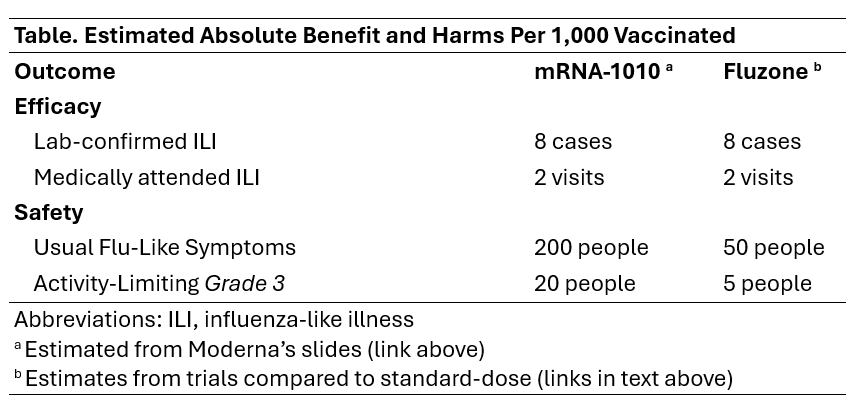
Moderna’s mRNA-1010 reduced laboratory-confirmed influenza-like illness (ILI) compared with a licensed standard-dose vaccine. Seasonal cumulative incidence fell from roughly 2.9% to 2.1%, an absolute reduction of about 0.8 percentage points, or approximately one ILI case prevented per 125 vaccinated.
Restricting to illness requiring outpatient medical care, arguably more clinically relevant, the signal shrinks further. Any healthcare encounter for ILI declined from 0.6% to 0.4% (absolute reduction 0.2%; Number Needed to Vaccinate of ~500). Emergency department visits and hospitalizations were too rare to compare
These are real effects. But they were measured against a licensed standard-dose vaccine, not against high-dose formulations that already demonstrate improved efficacy against ILI in older adults.
More Than the Usual Flu-Like Symptoms
Influenza vaccines have long been known to cause a transient immune reactions in some people consisting of fatigue, headache, muscle aches, chills, and joint pain. The pattern often resembles a much milder, shorter-lived version of the illness the vaccine is designed to prevent. In clinical trials, these reactions are graded by severity. Grade 1–2 symptoms are by far the most common, reflecting mild to moderate discomfort that does not interfere with daily activity and typically resolves within one to two days.
With mRNA-1010, these flu-like reactions were substantially more common than with other influenza vaccines. The absolute difference suggests that roughly one additional person experiences these mostly Grade 1–2 symptoms for every five vaccinated.1
While these milder reactions are uncomfortable, the more consequential distinction lies in the Grade 3 reactions. These are not life-threatening, but they prevent normal daily activity. They begin to resemble the same symptom complex used to define influenza-like illness, but without laboratory confirmation of infection.
In the Moderna slide deck, Grade 3 systemic reactions appear to occur in roughly 1–2% of recipients, compared with near-zero in the standard-dose comparator. That translates to approximately one additional activity-limiting reaction per 50 vaccinated, a rate meaningfully higher than what is typically observed with conventional influenza vaccines.
In absolute terms, the tradeoff is not subtle. The vaccine prevents a modest number of largely outpatient influenza cases, yet produces a substantially higher frequency of flu-like reactogenicity, including a measurable risk of an activity-limiting syndrome that resembles the very illness the vaccine seeks to prevent. When reactions that sideline people for a day or two occur more often than the medically attended influenza cases prevented, the risk-benefit discussion cannot rest on relative vaccine efficacy alone.
The Counterfactual
The key comparison for Moderna’s mRNA vaccine is against standard-dose influenza vaccine. But at least for adults over over 65, the relevant clinical question is not superiority over standard dose. It is whether this vaccine improves on the performance of high-dose inactivated influenza vaccines, such as Fluzone High-Dose, which are already recommended for older adults.
High-dose Fluzone has demonstrated superior efficacy to standard-dose vaccine in a large randomized trial published in 2014. The magnitude of benefit for ILI seen in that study is remarkably similar to the benefit Moderna now reports against standard dose. But the safety profile is different. High-dose Fluzone only caused a modest increase in the usual flu-like side effects, and far fewer activity-limiting reactions of the kind described in the mRNA-1010 trial (see Table below).
The debate, then, is not flu versus a few days of flu-like symptoms after vaccination. It is mRNA-1010 versus the best available alternative. And in the absence of a direct head-to-head trial, the indirect evidence points in one direction: high-dose Fluzone remains the better option.
On the ReliabILIty of ILI
There is also a structural issue inside the endpoint itself worth discussing.
“Laboratory-confirmed protocol-defined ILI” is not synonymous with a severe case of the flu. In most modern influenza vaccine trials, ILI is triggered by a protocolized symptom algorithm, often ≥1 systemic symptom plus ≥1 respiratory symptom, regardless of severity. That means even Grade 1–2 symptoms can trigger testing, and a positive RT-PCR result counts as an event.
This design appropriately maximizes event capture and statistical power. But it also means the primary endpoint includes many mild-to-moderate illnesses that may not substantially impair function. The trial is optimized to detect differences in infection-associated symptom episodes, not necessarily differences in the most severe disease.
That said, the observed reduction in outpatient health care visits for ILI indicates that the vaccine did prevent at least some clinically meaningful influenza episodes, even if the absolute magnitude remains very modest.
Nonetheless, how ILI is defined matters, especially when the vaccine’s side effect profile moves beyond routine flu-like symptoms. In a small but real minority of recipients, it produces an activity-limiting syndrome that resembles the very illness the trial is designed to prevent.
Debate by Data, Not by Public Relations
Science is not settled in slide decks or news headlines. It is adjudicated through full publication, transparent methods, and complete accounting of outcomes.
Per-protocol analyses, as shared by Moderna in their slides, can be informative, but intention-to-treat (ITT) results are the standard. ITT preserves randomization and reflects what actually happens when vaccines are used in the real world.
Likewise, reporting only influenza-attributed healthcare visits leaves an incomplete picture. A fair accounting requires total healthcare utilization. not just visits tied to laboratory-confirmed influenza. If Grade 3, activity-limiting reactions generate additional doctor or urgent care visits, those effects matter.
If we are going to debate clinical innovation, the answer is not press releases. It is transparency. Show the ITT analysis. Show total healthcare visits. Show the duration and clustering of Grade 3 reactions — are the same individuals experiencing multiple limiting symptoms, or is the 1–2% incidence spread across different people? Then let the evidence speak.
Stripped of narrative control, the picture is more straightforward: modest absolute benefit, meaningfully higher reactogenicity, but no head-to-head comparison against the best available alternative.
The conversation cannot begin and end with shifting regulatory standards, important as they are. It must also confront comparative efficacy.
We may never know. The sponsor chose not to run that trial.
But based on the data we do have, the currently recommended vaccines for older adults, like Fluzone High-Dose, remain the better choice.
If we reorient the discussion to include net clinical benefit, then the question becomes simple:
Which vaccine would you want your mother to have?
Estimates derived from sponsor-reported absolute differences in systemic reactogenicity; Grade 3 approximated from slide-level data.
Comments
Nothing yet. Say the first thing.
Sign in to join the conversation.