
The internet has been evolving for over 4 decades now (mostly for the worse), but there are 7 staple, or universal rules that govern information ecosystems, regardless of what they look like—irrespective of what social platform you’re on.
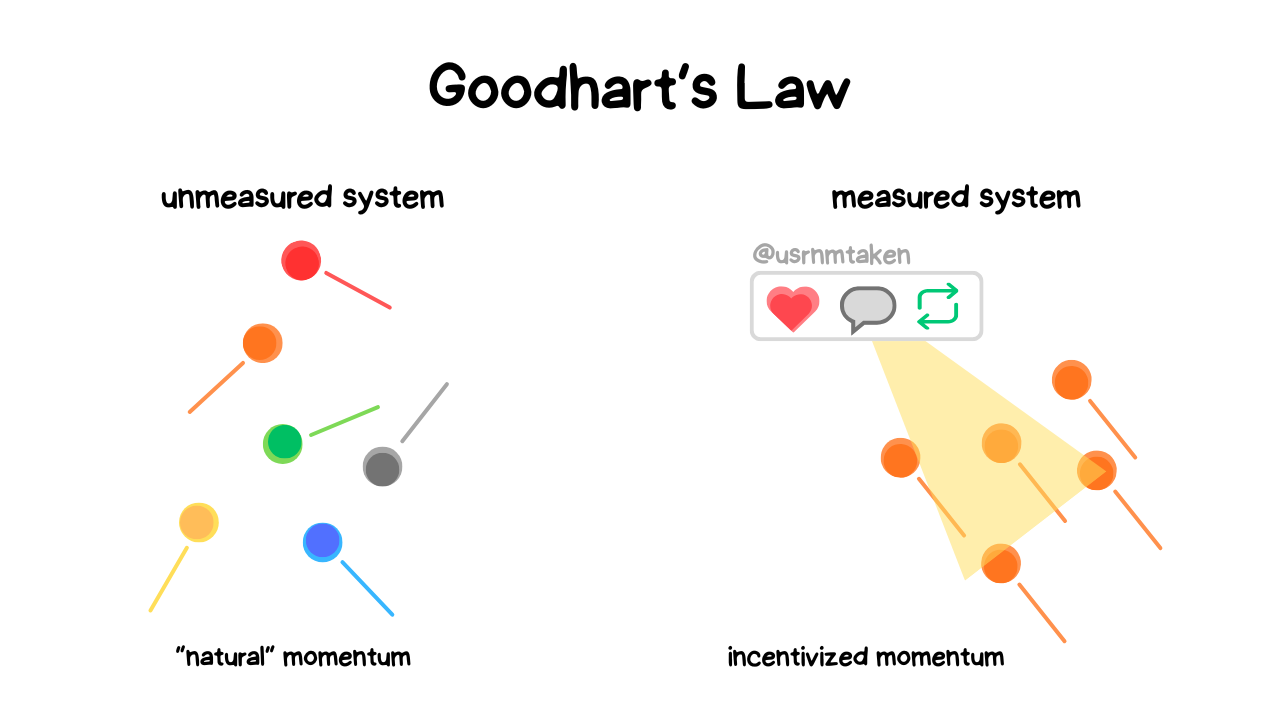
In quantum mechanics, measuring a particle’s position actively disturbs its momentum, and therefore its future positions. We can intuitively apply that to how humans interact on platforms and information ecosystems; when we measure, rank, or gauge the state of a system, we’re also actively disturbing the engagement that takes place there.
“When a measure becomes a target, it ceases to be a good measure”. The metrics by which we measure systems cannot exist without modifying the system itself; Substack users judge things by how “authentic” they are, creating a slew of performative authenticity on the platform. All users post to gain validation, no matter how “genuine” they believe themselves to be—if authenticity is the target, people adjust their behaviors to become seen as authentic; they make more spelling errors, type in lowercase, and shift the vernacular of their communities to incorporate more slang, degrading the actual platform’s ability to represent authentic, unfiltered culture. On other social media platforms, engagement is optimized to attract as many likes as possible.
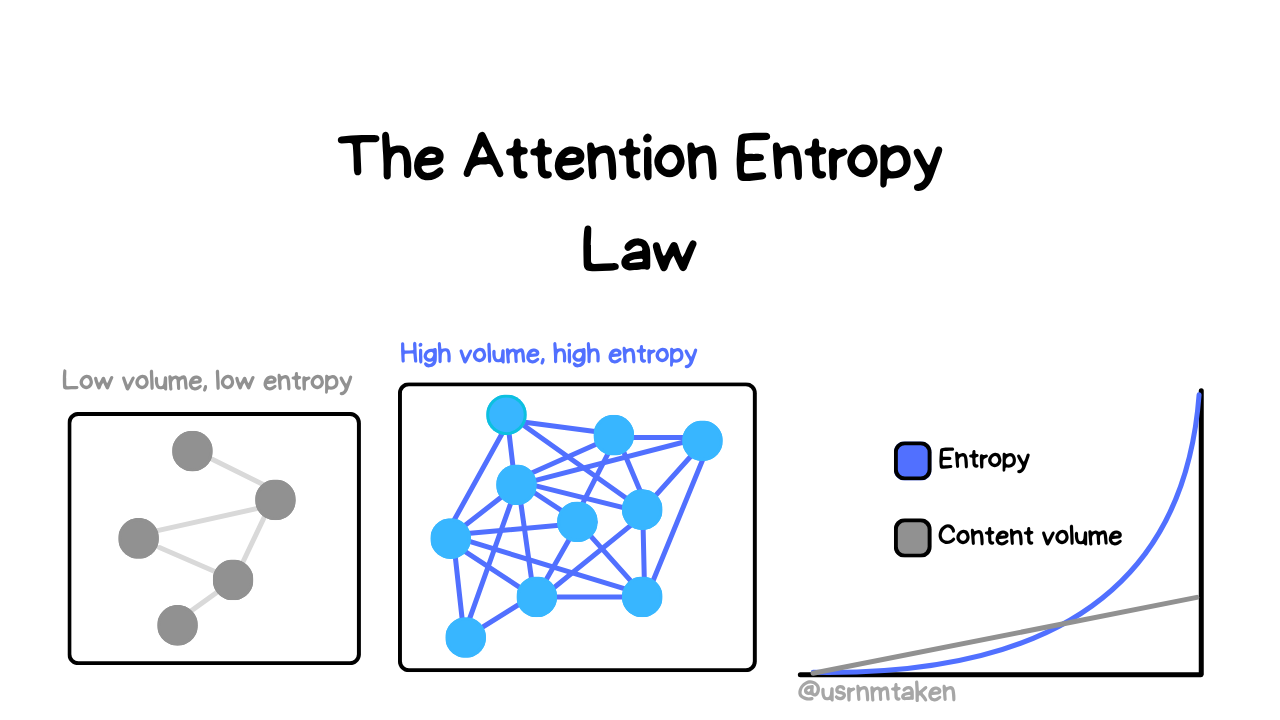
Entropy is the level of disorder within a system; something that can also be conceptually applied to information networks. In any closed system, entropy increases over time—the system’s level of disorder increases. Ludwig Boltzmann showed that a gas diffuses across a room as a result of the vastly greater number of disordered arrangements than ordered ones. Within systems involving information like social media sites, entropy scales faster than information. Having twice the content hosted would mean more than twice the entropy in the system. Connections between posts, creators, and audiences increase superlinearly. Your attention fragments at an exponential rate of acceleration, even while the amount of content increases at a linear rate of acceleration.
Social media also hosts little “micro-environments” consisting of pages, communities, specific posts, and threads—a recipe for maximum entropy; having features that all feed back into the main ecosystem. That’s why the noise within social media ecosystems is so high, while your visibility and ability to establish a grounded presence stay low. It follows that you’re only able to achieve conspicuity from contrast with your surrounding environment—a creator that’s putting out perceptive, high-quality content within a high-entropy group of environments will fail to beat a creator who’s churning out mediocre slop within a low-entropy group of environments. You can only be seen relative to the baseline of the local environment.
Simone Weil wrote that attention is “the rarest and purest form of generosity”, and, within systems of information where the quantity of potential information is orders of magnitude higher than anything we, as individuals, can manage to consume within an entire lifetime, it is costly to go against the thermodynamic patterns. The uniqueness of your content often matters more than its actual quality.
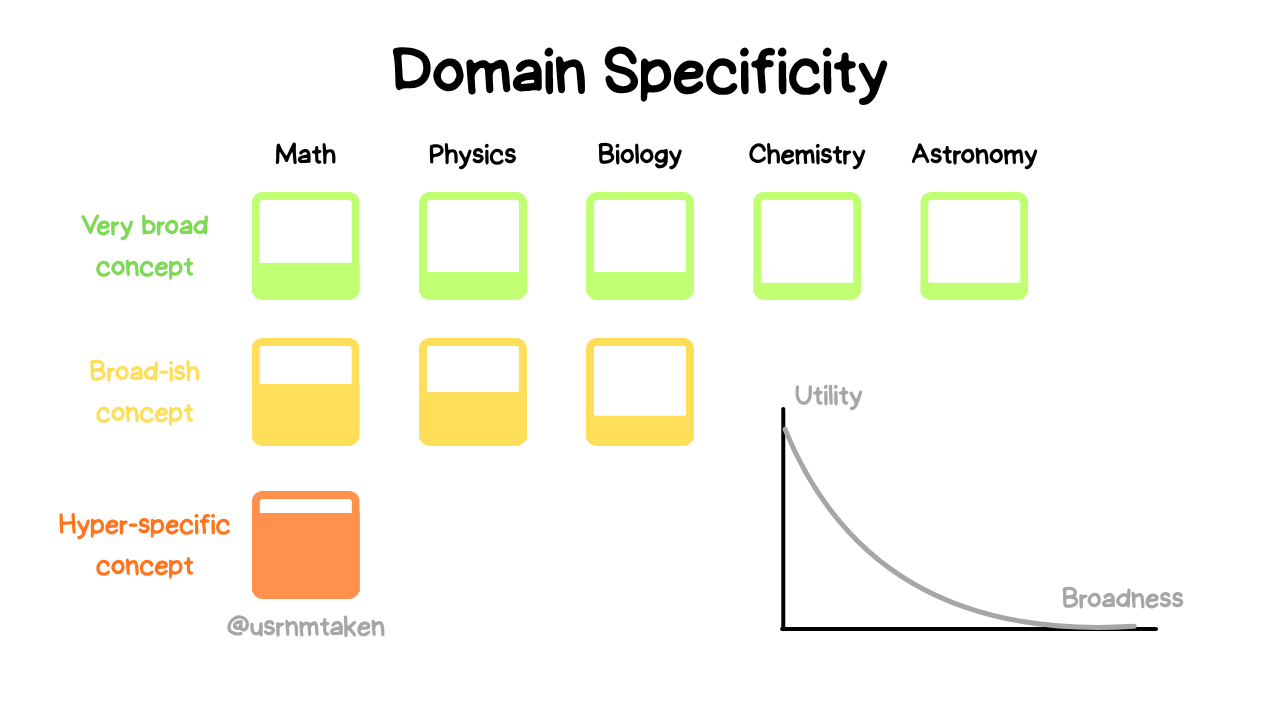
Any concept or framework that originates in a certain domain or field will have the highest effectiveness and potential to be utilized in that domain. That’s why any holistic framework that attempts to make connections from one domain and simply analogize or import them into another has its depth and utility heavily nerfed—there is a trade-off between applicability and specificity. The more universal a concept is, the less actual work it does; the less utility it can actually serve—a statement like “incentives drive behavior” is almost ubiquitously applicable and, ergo, is shallow to the point of being useless practically anywhere it’s being applied.
Concepts like these are more or less rhetorical devices, drawing upon an audience’s own lack of domain expertise and critical thought—they borrow commonplace tropes and precedent to formulate a “theory of everything”, or at least a theory that challenges basic domain knowledge in another field, usually one containing more complicated and nuanced topics. An online audience, usually craving some sort of way to fill in these epistemic gaps within their worldview, will easily buy into vague, fluffed-up theories that exempt them from actually gaining knowledge in a specific discipline. Genuine expertise will shrink the applicability of claims to sharpen its utility in that field of expertise. A person with a degree in English cannot draw from his understanding of literature and his limited understanding of science to make groundbreaking scientific discoveries that real scientists have failed to make despite their knowledge in that field.
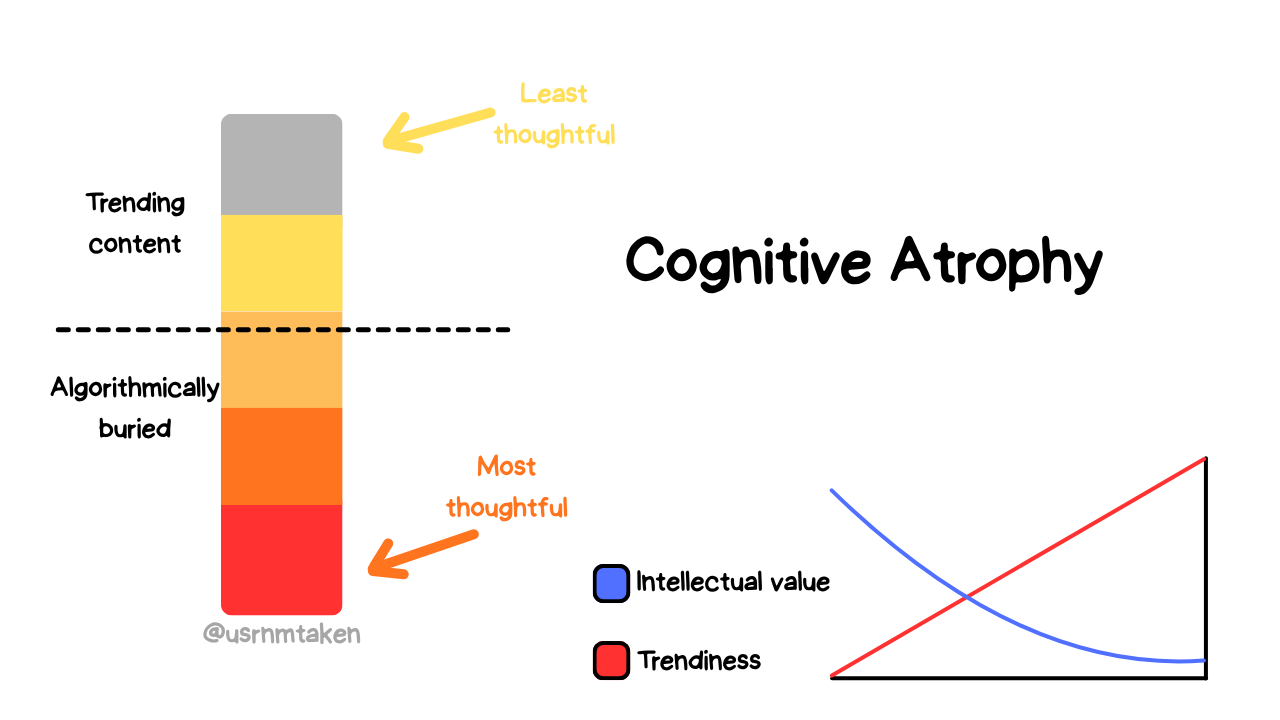
Any algorithm that rewards speed of engagement or engagement trends is suppressing critical thought. Instant or short-term engagement in the form of likes, generic comments, or shares means that the content didn’t make the recipient think critically enough before they found near instantaneous gratification from that content; the user likely didn’t gain any intellectual substance from consuming that post. Content that has delayed engagement means that the user has taken time to think critically and reflect on what they just consumed. It follows that almost all social media algorithms are designed to erode cognitive depth, instead prioritizing useless noise or slop devoid of any useful retention—even when users come to the platform for thoughtful discussion.
Unfortunately, introspective discussion is the enemy of any algorithm designed to maximize engagement. “Good” content has been buried under algorithmically optimized posts, posts that aim to trigger a reaction before the user has any time to critically consider the content they’re being exposed to. That shifts the baseline of what you consider to be a thought-provoking idea down; the actually intriguing ideas have already been filtered out—repeat this cycle over thousands of posts and daily, prolonged exposure, and you’ve cut down your ability to critically examine and think tremendously. Once you’re on social media, your ability to reason only goes down from there.
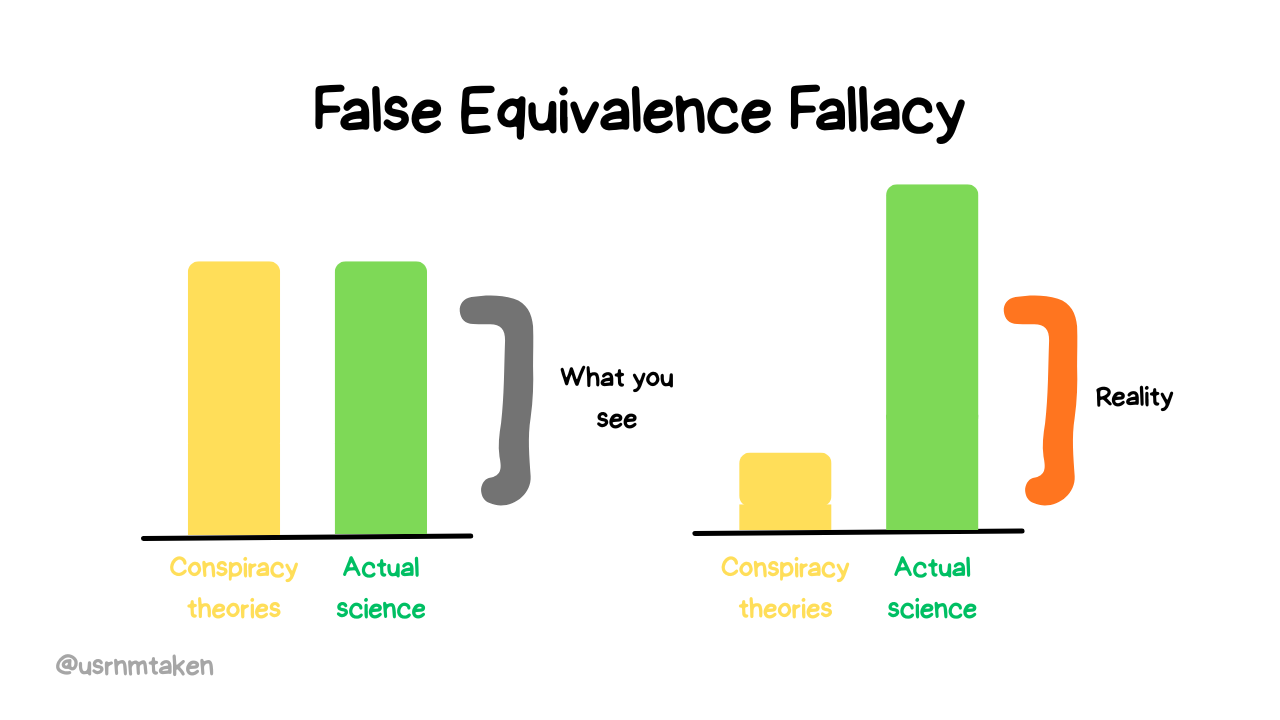
Two unequal sides are always perceived as equal due to our propensity towards detecting symmetry; content creators also like giving false equivalence to clashing worldviews because it makes for the most interesting content, even when the two sides are anything but equal—take for example Joe Rogan’s debate between Graham Hancock and Flint Dibble; that’s a debate between an amateur archeology grifter and an archeologist who has a PhD in anthropology. It is naive to believe that both opinions should be given equal breathing room and credibility, though Rogan presents the two as equals going head-on in an educated archaeology debate.
False equivalence is a propaganda engine for grifters, creating unproductive noise in a system from users who charitably give “credit” to pseudoscientific idiots. Users subconsciously detect symmetry from posts, and creators understand that—they purposefully propagate misinformation by making a 99:1 split in facts or scientific consensus look like a 50:50 debate. Next time you see any form of debate or discourse between two opposing sides, know that they’re almost never equally plausible.
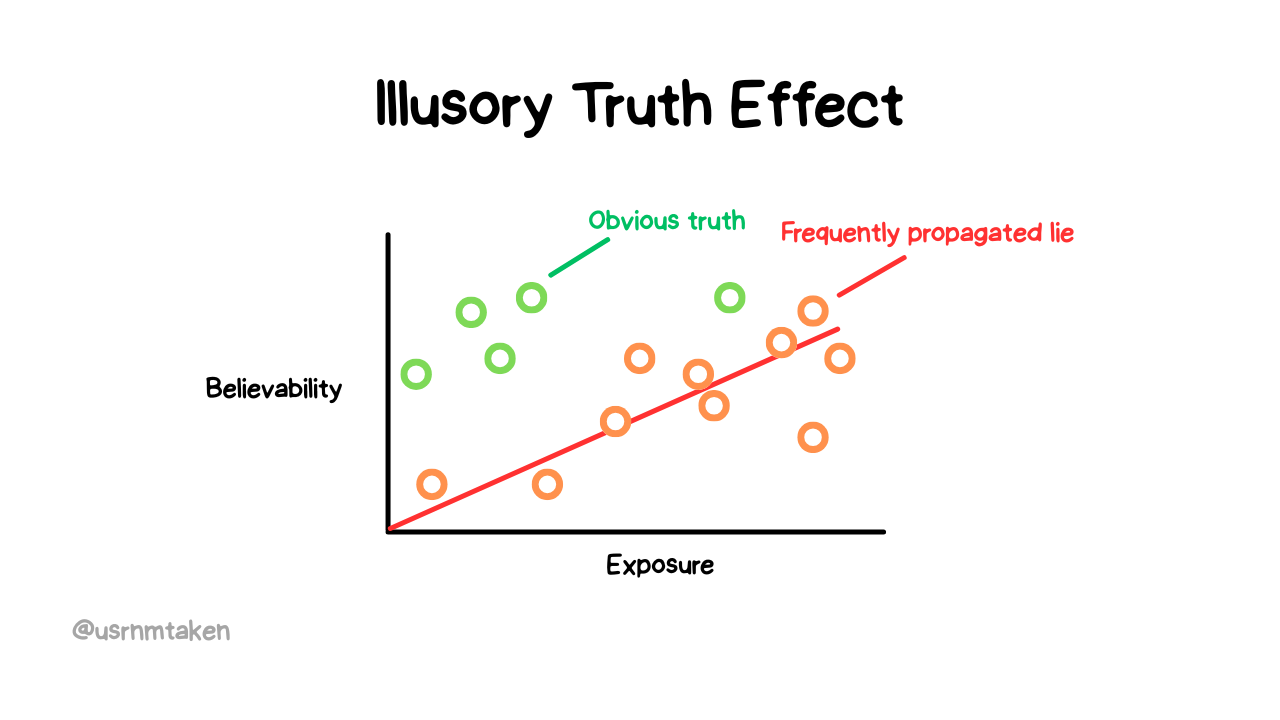
Checking pseudoscience and disinformation is hard, oftentimes debunking false claims amplifies their legitimacy and familiarity—even in the rare case that a correction travels as far as the misleading claim, repeating the misleading claim allows the recipient to grow familiarity with it. Human brains are better at remembering the central message they’re receiving than its context or nuances; repeating and introducing recipients to a noxious claim is a compulsory step in debunking it, creating situations where doing something about noxious claims may actually be worse than doing nothing and allowing that claim to be spread.
The only way to counter disinformation is to pre-emptively debunk it, or prebunk it, destroying the claim’s legitimacy before the audience is even exposed to it, allowing audiences to promptly discern between legitimate and illegitimate information when they do encounter it. Albeit prebunking is always preferable to debunking, it still fails to present a complete silver bullet to the misinformation problem, as it’s impossible to anticipate every conspiracy or lie that is going to be spread, and even harder to propagate effective prebunking claims across information ecosystems that span billions of users and pages.
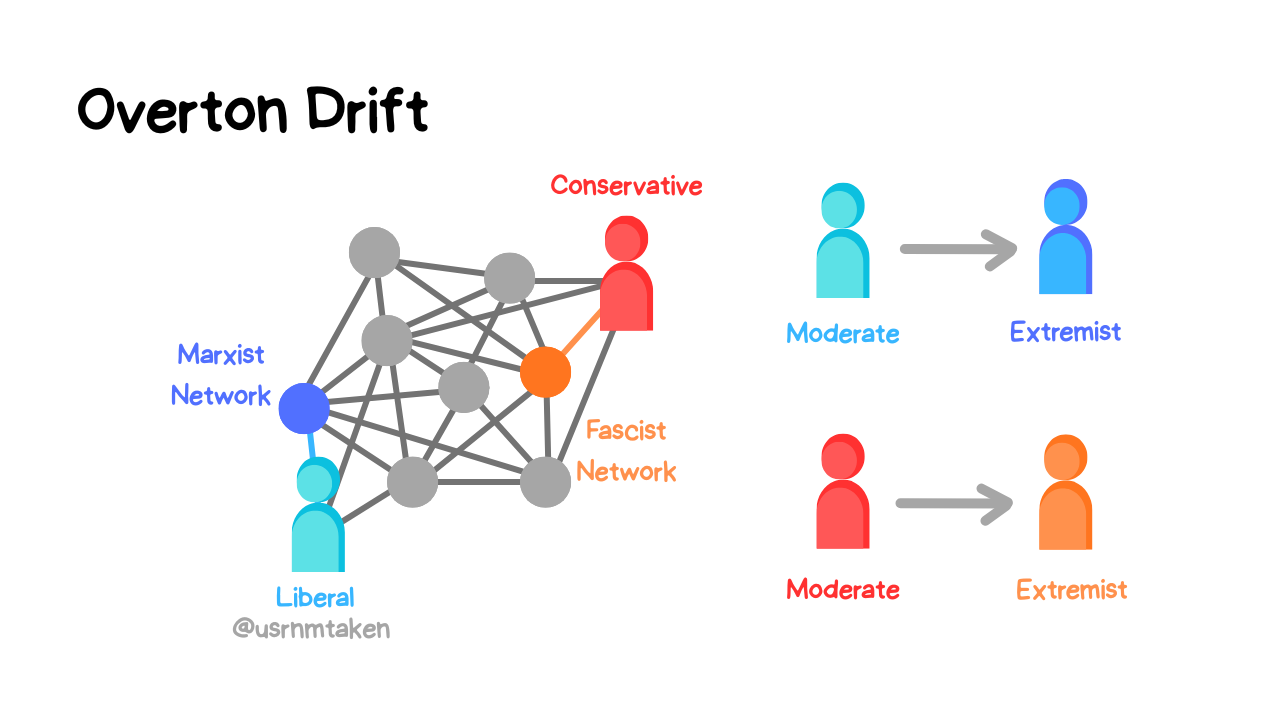
Fringe, hyperpartisan positions are frequently amplified by social media algorithms due to the outrage they incite. Instead of focusing on appeal or persuasion, extremist circles often weaponize “overton drifts” by giving audiences repeated exposure to their positions. An overton drift, or a drift in the range of ideals you find politically acceptable, is bound to occur when you’re exposed to extremist positions frequently—familiarity is a great substitute for truth; systems that optimize for trending, instantly provocative content will ease users into drifting towards clusters that promote the most provocative, partisan content.
Within most social media apps, having “no political agenda” and just a business model is a surefire way to skew the attention economy towards extremist political positions—if you’re currently a liberal, you’re going to start drifting further left towards the closest extremist cluster (e.g. Marxists, socialists), while if you’re a conservative, you’re going to start drifting further right towards the extremist sphere closest to your conscious position (e.g. nationalists, fascists). Know that most “conclusions” you’ve achieved do not belong to you; they belong to the algorithm.
While the internet becomes more AI and slop-oriented, you’ll still be able to apply these 7 laws universally to social media and networking platforms all over the internet. I can only hope that the ideas in this article find their way to the people who need them :)
Comments
Nothing yet. Say the first thing.
Sign in to join the conversation.