
We live in an algorithmically governed economy of visibility where influencer ethics meet audience media literacy. In this landscape, audiences bear increasing responsibility for discerning credible voices amid a flood of personal media content.
The ethical framework within this hybrid media ecosystem remains thin.
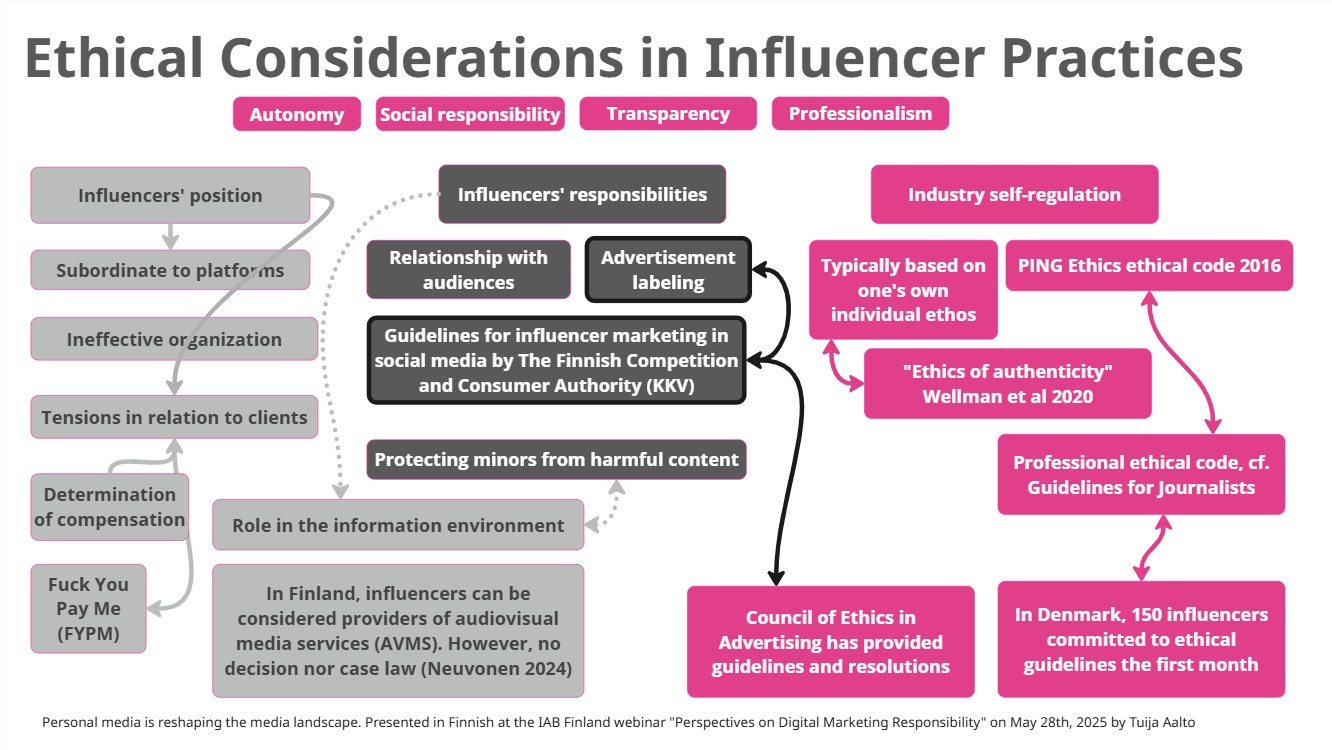
Drawing from a presentation I gave at a recent IAB Finland webinar on Digital Marketing Responsibility, this post outlines the interlinked ethical tensions that shape influencer practices today.
Have I missed a key angle?
Join the conversation in the comments—I'd love to hear your perspective.
Influencers might be portayed as autonomous actors—entrepreneurial, self-directed, and free from the constraints of traditional media institutions—but in practice, their autonomy is deeply compromised by their subordinate position within platform infrastructures. Algorithmic visibility and monetisation terms are controlled by tech companies. This platform dependency is compounded by the lack of effective collective organization—creators' unionisation efforts have yielded little impact.
Client tensions are frequent—payment terms may be opaque, and expectations vary. Peer advice and platforms like FYPM help crowdsource transparency and fairness.
Influencer autonomy is structurally constrained—dependent on aligning with platform logics to remain visible and viable, clients’ (direct or mediated by influencer agencies) demands in connection to brand deals, and audience expectations, the socio-cultural pressures originating from the followers (cf. Sundet et al 2025).
Influencers shape informational environments and public discourse. In the absence of institutionalised code of ethics, and editorial oversight, the burden of social responsibility shifts onto individual creators, highlighting the growing role of what Wellman et al. (2020) call the "ethics of authenticity".
The influencer industry in Finland is not entirely without legal regulation. The Finnish Competition and Consumer Authority (KKV) has issued guidelines on influencer marketing such as precise guidance on advertisement labeling, and the Council of Ethics in Advertising issues resolutions on reported noncompliance.
So far, influencers lack the institutionalized professionalism that anchors fields like journalism or marketing. Early efforts like the PING Ethics Code (2016) point to emerging professional ethical aspirations. Inspiringly, in Denmark, 150 influencers recently committed to ethical guidelines in one month. In Finland, influencers still operate without a unified ethical code like the Journalists’ Guidelines—or any content regulation beyond advertising rules.
While Finnish influencers could be classified as audiovisual media service providers under EU regulation, Finland’s media authority Traficom has not made such a determination (Neuvonen 2024). In contrast, Spain, France, and Italy already regulate top influencers similarly to television channels, underscoring the ongoing challenge of balancing much-needed influencer accountability with platform responsibility as outlined in the Digital Services Act (DSA).
Further reading
Borchers, N. and Enke, N. (2022). “I've never seen a client say: ‘Tell the influencer not to label this as sponsored’”: An exploration into influencer industry ethics, Public Relations Review, Volume 48, Issue 5, 2022, 102235, ISSN 0363-8111, https://doi.org/10.1016/j.pubrev.2022.102235.
The DIACOMET database encompasses ethical codes or similar guidelines for responsible communication that align with the principles of media self-regulation and transparency.
FYPM database of influencer brand deals
The International Observatory on Information and Democracy OID’s global “information climate” report “Information ecosystem and troubled democracy”
Neuvonen (2024) Finland. In European Audiovisual Observatory (2025) National Rules Applicable to Influencers
Sundet, V. S., Steen-Johnsen, K., & Andersen, M. M. T. (2025). Influencer autonomy: Navigating authenticity, agencies, and algorithms. Nordic Journal of Media Studies, 7(1), 18–36. https://doi.org/10.2478/njms-2025-000
Wellman, M. L., Stoldt, R., Tully, M., & Ekdale, B. (2020). Ethics of Authenticity: Social Media Influencers and the Production of Sponsored Content. Journal of Media Ethics, 35(2), 68–82. https://doi.org/10.1080/23736992.2020.1736078
Comments
Nothing yet. Say the first thing.
Sign in to join the conversation.