
BONUS DISC #4
Where are all the women in rock music?
The following analysis answers that question.
Contains potential spoilers for the films Almost Famous, Grace of My Heart, and 20 Feet from Stardom.
(This was originally an essay written for a class on gender in rock films: I’ve made some minor editorial changes, however much remains the same.)
If asked what one’s favorite rock band or musician is, the likelihood that one lists a woman, or a band of all women, or even a band with just one woman, is startlingly low. The feminist movement and fight for equality has lasted for decades, with major breakthroughs in many fields, but it seems the rock and roll world is lagging behind.
Though it’s often irrevocably unrecognized, women have always been involved in rock music, serving as vital pieces in the success of both the genre and specific musicians. Film has played a crucial part in the highlighting of women’s important roles and historical mistreatment.
The films Grace of My Heart (Anders 1996), 20 Feet from Stardom (Neville 2013), and Almost Famous (Crowe 2003) display women as the unsung heroes of rock, often existing in the shadows of the male superstar, however they suggest a positive future for women in the industry which is being proven increasingly true as time goes on.
In Grace of My Heart women are displayed as songwriters, with their writing fueling the industry’s best, though they receive little acclaim and there is an ever-present tension between chasing dreams and settling as unrecognized.
Edna (Illena Douglas), who changes her name to Denise with hopes it may help fuel her fame, dreams of being a singer. She leaves her hometown of Philadelphia to chase her dreams, only to end up writing music for others. Edna thrives in this role, producing major hits for male and female leads alike. She helps her close friend Doris (Jennifer Leigh Warren) rise to fame and while she’s always a champion of Doris a viewer cannot help but want more for Edna herself, who continually is pushed back behind the scenes.
Frustration for her situation continually rises as it becomes progressively more apparent that women have been societally pressured into thinking they are only good for their writing, and they cannot move beyond the initial niche they established themselves in.
The film dismantles the stereotype that women in these fields would be in competition with one another. When another songwriter, Cheryl (Patsy Kensit), enters it seems that the two women hate each other. But upon being forced to work together for a young popstar, they inadvertently form a close friendship, and Cheryl ends up being one of Edna’s biggest supporters.
Despite many trials and tribulations in Edna’s life, the film ends with her finally releasing her own album, entitled “Grace of My Heart.” She needed support from those around her, her friends, daughter, and the memory of her late partner in order to finally complete it, but she overcame her fear of rejection.
The film’s runtime primarily focuses on the struggles she faced, many of which were in the battle between industry standard and Edna’s dreams––the industry often treated women as an assembly line to function behind the scenes for male stars. When combining these struggles with the positive ending note, a reflection of the true history of women in music can clearly be seen––much time has been spent in the background, but it’s now time to step forward and shine a light on our female stars.
Not all portrayals of women in rock are fictional; 20 Feet from Stardom is a documentary that addresses the cycle of young women who want to be solo stars falling behind the curtain as backup singers, the reality of this film strengthens the conclusions we draw about women in rock on a general level.
The women of the film spent much of their careers as backup singers for male (and female) superstars, such as Mick Jagger, Bruce Springsteen, or Stevie Wonder. These big names aside, though, the real stars of the film are singers like Darlene Love, Lisa Fischer, and Merry Clayton (along with many others).
The women that spent much of their time in the industry doing backup vocals didn’t foster a sense of competition as one may expect. Instead, they worked closely together, encouraging one another and developing a strong sisterhood that has stuck with them. Any competitive atmosphere has been perpetuated by the industry and societal expectations.
Their support stems from them being in an equal situation, with a majority of them being women of color who’ve moved away from home in an attempt to make it in the industry. Their race played a critical role in the way they were often ignored by the industry. Not only were they women, but they were majority black women. For much too long a period, the voices of black women shaped the genre of rock altogether, though they got no credit for the way their gospel-inspired voices left an impact on rock.
The choice to go into backup singing wasn’t because it’s their dream, rather because it seemed like a quick way to make a name for themselves––despite their expectations, though, they were often stuck in place, with no room for advancement.
Taking Darlene Love as a primary example, the mountain in front of them was not impossible to climb. Love managed to break through and is now regarded as a celebrated, impactful voice in rock and roll. Her, and many of her contemporaries, paved way for the backup singers of today who feel the familiar immobilization of the industry. The women of today are increasingly willing to fight for their place in the spotlight. Despite the fact that it’s still a fight, the outlook for future generations of women is bright, especially thanks to the paths of previous female stars.
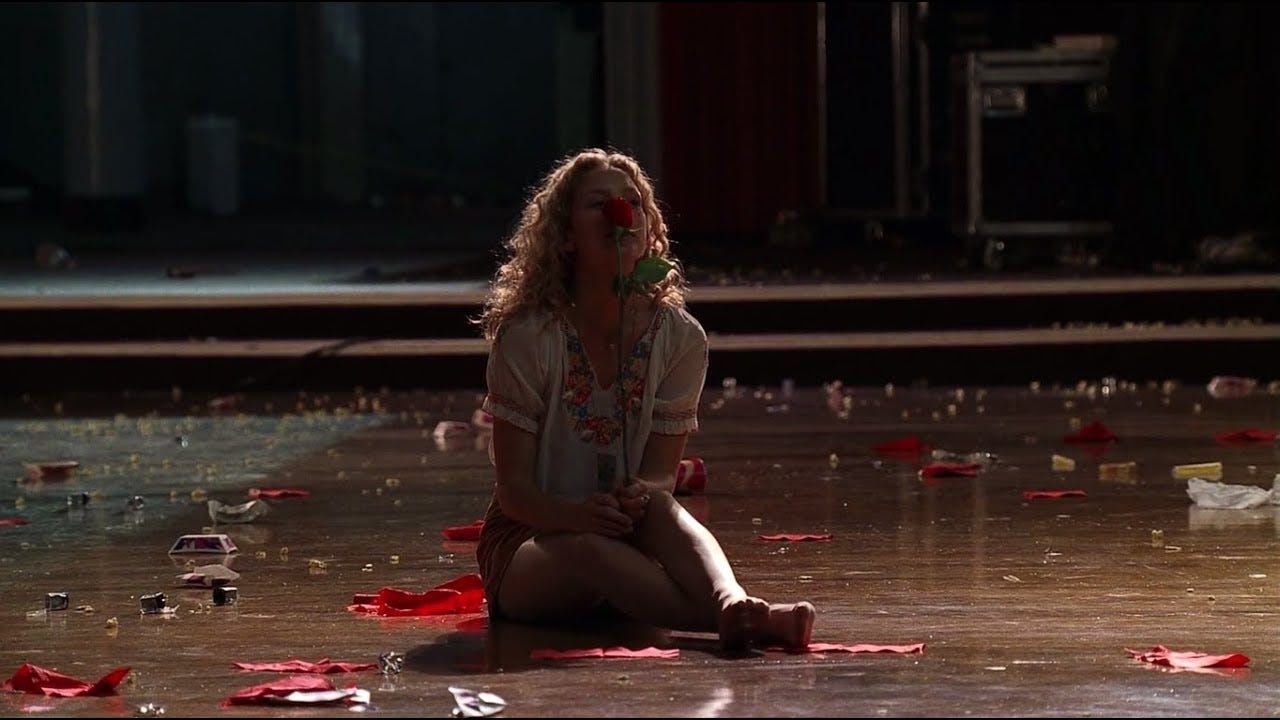
A final and especially unique case study is Almost Famous, in which the female characters aren’t aiming to work in rock music, but are nonetheless a vital part of the industry that is often twisted misogynistically. The women, and most notably Penny Lane (Kate Hudson), are referred to as “groupies” for the band that the film follows.
The band, however, never was the heart of the story.
Instead, it is the girls who Penny Lane refers to as “band-aids” that exist as the heart of the film, and of the band. The term groupie is historically misogynistic term and idea (not factoring in women who use the term to describe themselves in a positive light) based on the sexual objectification of women and the assumption that they know nothing about music, or only listen to it and attend concerts because of male stars.
Countering this is the invented term “band-aid” which signifies not only the emotional support factor the girls have on the band members, but also inherently suggests the disposable nature with which the men treat them. When one’s wound is healed, a band-aid is thrown away. The same thing happens to Penny when Russell (Billy Crudup) decides he will be okay without her.
The film paints a true and more readily generalizable picture of women in rock than many other films. It clearly highlights the mistreatment of female supporters.
Penny Lane supports Russell, lead of the fictional band “Stillwater,” but he hides her in the shadows and refuses to acknowledge how much she held him and the band together until it is too late, and he’d already mistreated her so thoroughly she wouldn’t go back.
Despite much of the music in rock being about love, and therefore women the singers have known, the music is painted as having nothing to do with women. They are often the unappreciated heart and soul of rock.
Penny’s decision to leave Russell at the end of the film shows the potential for women to regain their power, and to revoke men’s ability to treat them as worthless. Though the film suggests that Russell comes to realize how wrongfully he treated Penny, the narrative doesn’t succumb to putting them back together, therefore keeping the blame on the flawed male character.
Almost Famous opens up the avenue for women to take back independence that is often claimed as lacking, and brings hope for the future in acknowledging the vital ways with which women have contributed to rock, beyond hands-on production.
The place of women in rock is ever-expanding, and hopes can be reasonably high for women’s inclusion in music broadly, with these films that are already a bit aged serving as significant indicators of progression. While it is still a male-dominated field, doors are opening all over for women’s rights.
Grace of My Heart, 20 Feet from Stardom, and Almost Famous all point to an evolution in female agency despite their differences, suggesting that women in any field have the opportunity to become something beyond historically set limitations. This shift isn’t limited to music, it is a generational and societal shift where women are occupying previously male-controlled spaces.
Allowing other arts and professions to act as example, there are now more women in historically male positions: for example, more women are in medical school than men1, and female-written literature dominates the New York Times bestseller list with this week having ten of fifteen novels written or co-written by women2. It’s therefore safe to assume that women will be breaking through historical barriers, no longer only existing behind the scenes, but now publicly achieving greatness.
Women in music are, as a whole, growing in the understanding of their self-worth. Through this they continue paving the way for women with every step forward that’s taken, no matter what their role in the rock industry may be, whether vocalist, writer, or supporter.
Other films about women in music that everyone should watch:
Sisters with Transistors (2020)
Ladies and Gentlemen: The Fabulous Stains (1982)
Hedwig and the Angry Inch (2001)
Taylor Swift: The End of an Era (2025)
If you have relevant films that aren’t listed here, leave them in a comment!

Balch, Bridget. “U.S. Medical Schools Enroll Record Number of Students in 2025.” AAMC, 9 Dec. 2025, www.aamc.org/news/us-medical-schools-enroll-record-number-students-2025. Accessed 3 May 2026.
“Combined Print and E-Book Fiction.” The New York Times, 10 May 2026, www.nytimes.com/books/best-sellers/combined-print-and-e-book-fiction. Accessed 3 May 2026.
No posts
Comments
Nothing yet. Say the first thing.
Sign in to join the conversation.