
Web accessibility is not a checklist. Research in cognitive psychology shows that our brains have limited attention and naturally avoid unnecessary mental effort. When a website, document or email requires too much processing, people become slower, make more mistakes, lose focus or simply leave.
That’s true for everyone, but especially for people with cognitive disabilities, ADHD, dyslexia, low vision or those using assistive technologies.
That’s why I love tools that don’t just identify accessibility issues - they help us understand how people actually experience digital content.
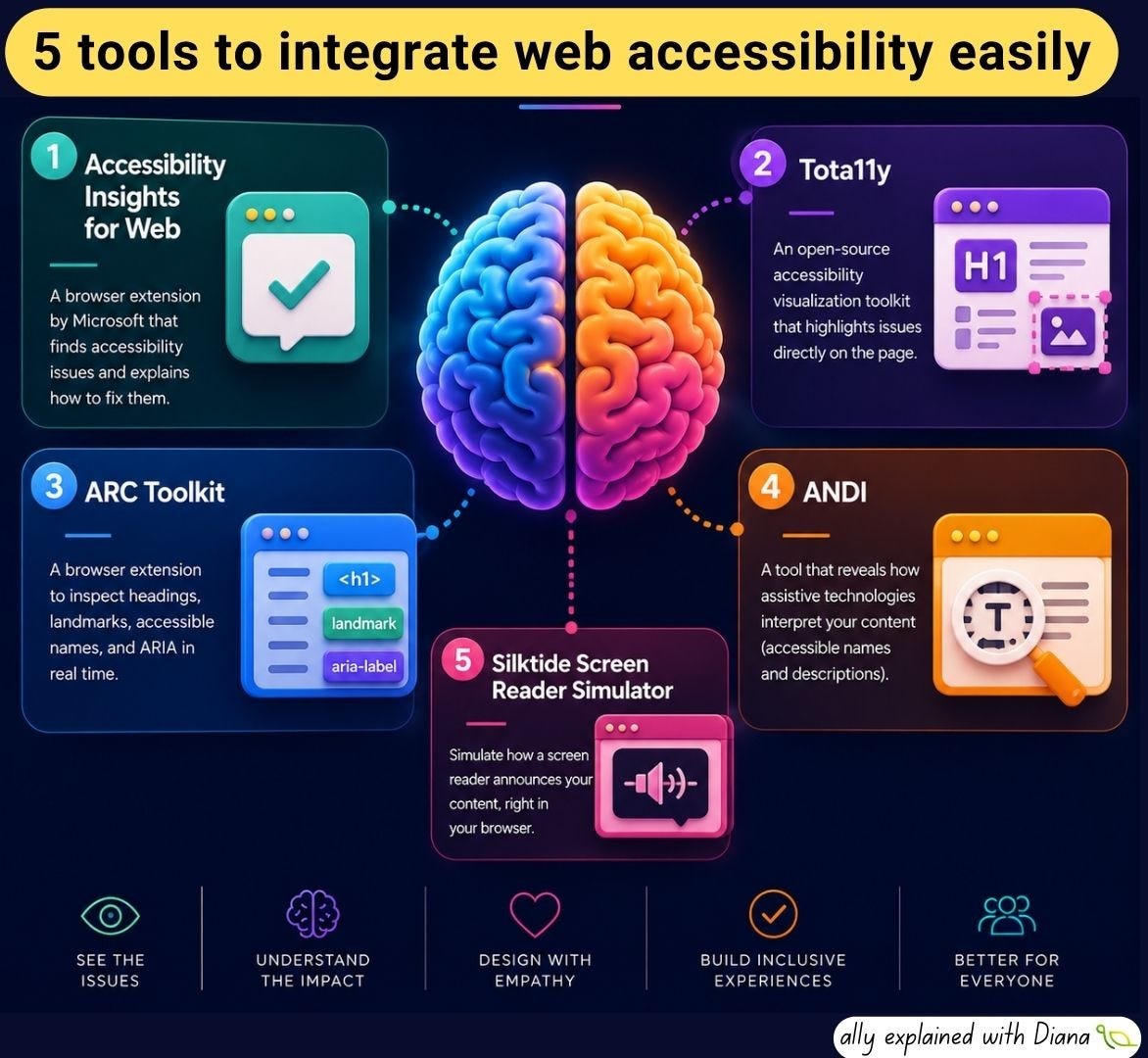
Here are 5 accessibility tools that will help your brain to integrate web accessibility in your everyday life easily:
1️⃣ Accessibility Insights for Web
Learning research consistently shows that immediate feedback is one of the fastest ways to build new habits. Accessibility Insights doesn’t just tell you what’s wrong - it explains why it matters and how to fix it. Instead of memorising WCAG, your brain gradually builds accessibility intuition.
2️⃣ Tota11y
Humans process visual information much faster than text. Tota11y overlays accessibility issues directly on the webpage, making invisible problems immediately visible. This reduces cognitive load because your brain no longer needs to imagine where the issue exists.
3️⃣ ARC Toolkit
Cognitive psychology has demonstrated for decades that recognising information requires much less mental effort than remembering it. ARC Toolkit lets you inspect headings, landmarks, accessible names and ARIA directly inside the browser, helping you recognise patterns instead of trying to remember every WCAG requirement.
4️⃣ ANDI
Many accessibility problems are invisible to sighted developers.
ANDI (Accessible Name & Description Inspector) helps you experience pages through accessibility information instead of visual design, encouraging perspective-taking - a cognitive process linked to empathy and better design decisions.
5️⃣ Silktide’s Screen Reader Simulator
Behavioral research shows that experiencing a problem creates stronger learning than simply reading about it. Instead of reading guidelines, you can immediately understand how content is announced to screen reader users. That experience is often remembered far longer than any checklist.
These tools reduce cognitive effort, provide immediate feedback and make invisible barriers visible. And that’s exactly what neuroscience tells us helps people learn and develop lasting habits.
Which accessibility tool changed the way you think and helped you the most?
Thanks for reading A11y explained with Diana! This post is public so feel free to share it.
No posts
Comments
Nothing yet. Say the first thing.
Sign in to join the conversation.