
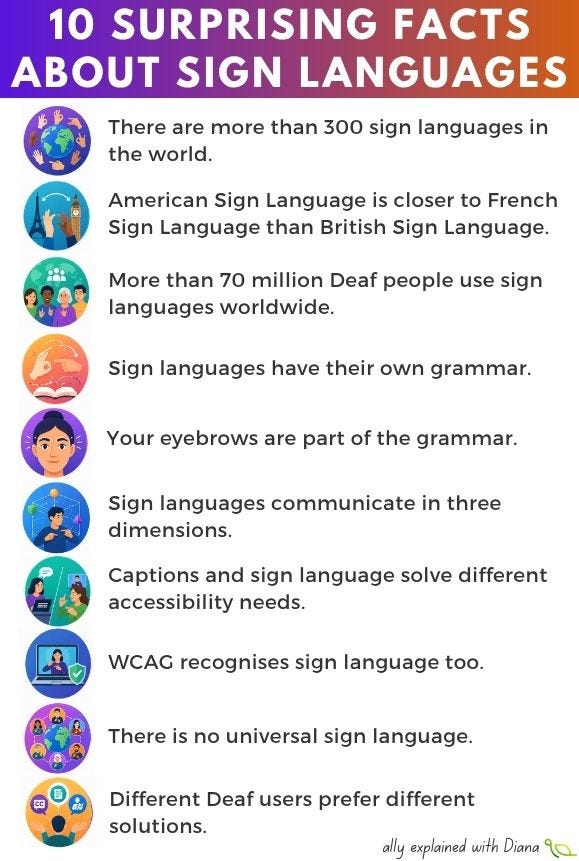
1️⃣ There are more than 300 sign languages in the world.
The World Federation of the Deaf estimates that there are more than 300 distinct sign languages used worldwide - that’s more sign languages than there are countries on Earth.
2️⃣ American Sign Language is closer to French Sign Language than British Sign Language.
Despite both countries speaking English, American Sign Language and British Sign Language are separate languages and are not mutually intelligible. Historically, American Sign Language developed from French Sign Language.
3️⃣ More than 70 million Deaf people use sign languages worldwide.
That’s approximately the population of the United Kingdom. Yet sign language support is still uncommon on many websites, even those aiming to be accessible.
4️⃣ Sign languages have their own grammar.
They’re not spoken languages expressed with hand movements. Word order, grammar and sentence structure are often completely different from the surrounding spoken language. That’s one reason why captions don’t always provide the same experience as sign language.
5️⃣ Your eyebrows are part of the grammar.
In many sign languages, facial expressions, eye gaze and body posture carry grammatical meaning. For example, facial expressions can distinguish a statement from a yes/no question or modify emphasis.
6️⃣ Sign languages communicate in three dimensions.
Spoken and written languages unfold mostly one word after another. Sign languages also use space, movement and location to express relationships between people, objects and actions. This spatial grammar is one reason why automatic translation into sign language remains such a difficult research challenge.
7️⃣ Captions and sign language solve different accessibility needs.
For many Deaf people, the national written language is a second language, while a sign language is their first. Captions are essential, but they are not a replacement for sign language for everyone.
8️⃣ WCAG recognises sign language too.
Many people don’t realise that the Web Content Accessibility Guidelines include sign language. At Level AAA, WCAG 1.2.6 Sign Language (Prerecorded) recommends providing sign language interpretation for prerecorded synchronized media.
9️⃣ There is no universal sign language.
International Sign exists and is often used at international events, but it is not the native language of Deaf communities around the world. People still use their own national or regional sign languages.
🔟 Different Deaf users prefer different solutions.
Some Deaf users prefer captions, others use transcripts or sign language. And some use all three, depending on the situation. Inclusion is about recognising that people access information in different ways.
Thanks for reading A11y explained with Diana! This post is public so feel free to share it.
No posts
Comments
Nothing yet. Say the first thing.
Sign in to join the conversation.