
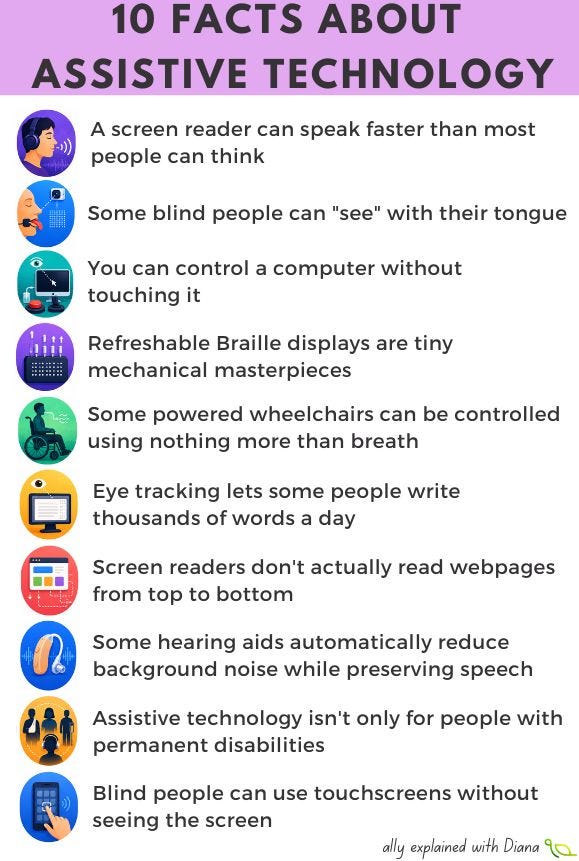
The deeper I dive into accessibility, the more I realize that assistive technologies are some of the most impressive engineering achievements ever created. Here are several interesting facts:
1️⃣ A screen reader can speak faster than most people can think.
Experienced users often listen at 500–700 words per minute, more than twice the average reading speed. To first-time listeners, it sounds like pure noise.
2️⃣ Some blind people can “see” with their tongue.
The BrainPort converts images from a camera into tiny electrical pulses delivered to the tongue. With training, users can recognize shapes, doorways and obstacles using patterns of stimulation.
3️⃣ You can control a computer without touching it.
People with severe motor disabilities use eye tracking, head pointers, sip-and-puff switches, foot switches or even a single large button to navigate websites, write documents and communicate.
4️⃣ Refreshable Braille displays are tiny mechanical masterpieces.
Every Braille dot is a physical pin that moves up and down independently. A 40-cell display contains more than 300 moving parts that constantly reconfigure themselves as the user reads.
5️⃣ Some powered wheelchairs can be controlled using nothing more than breath.
Sip-and-puff systems interpret gentle sips and puffs into commands such as moving forward, turning or stopping, giving independence to people with very limited movement.
6️⃣ Eye tracking lets some people write thousands of words a day.
For people who cannot use their hands, eye movements alone can be enough to write books, browse the web, work, study and communicate.
7️⃣ Screen readers don’t actually read webpages from top to bottom.
Experienced users navigate by headings, landmarks, lists, buttons and form fields, often reaching the information they need in just a few keystrokes.
8️⃣ Some hearing aids automatically reduce background noise while preserving speech.
Modern digital hearing aids continuously analyze incoming sound to make conversations easier to understand in noisy environments like restaurants or train stations.
9️⃣ Assistive technology isn’t only for people with permanent disabilities.
Many people use assistive technologies temporarily - after surgery, following an injury, during recovery - or situationally, like using captions in a noisy café or voice input while driving.
🔟 Blind people can use touchscreens without seeing the screen.
Modern screen readers like VoiceOver and TalkBack completely change how touchscreens work. Users explore the screen by touch, hear what’s under their finger, and activate items with gestures rather than tapping directly.
Which fact surprised you the most?
Thanks for reading A11y explained with Diana! This post is public so feel free to share it.
No posts
Comments
Nothing yet. Say the first thing.
Sign in to join the conversation.