

“It ain’t what you don’t know that gets you into trouble. It’s what you know for sure that just ain’t so.” — Mark Twain, a line Howard Marks made famous among investors
Few ideas have shaped the way we run Nine One Capital more than this one. This is the reason we remain as humble as we can, keep our opinions as moderate and polite as we can, and achieve an adequate valuation for every position we hold. We try to have a margin wide enough to make up for any errors that we might have in our judgment. We will come back to this at the end of this note.
We have an intent for writing also. This Substack is a collection of whatever we have on our minds during the week. Writing provides more clarity than thinking, and we have found that these posts allow us better the views we have refined as we posted.
Our focus over the past week has been around the new model being launched in Beijing and the subsequent steep drop in the share prices of most of the AI stocks. We have avoided most of the AI trade, but the news continues to have international impact. Changes in the world and more so questioning the market’s beliefs are the hallmarks of a conscious investor, and this will be a good learning exercise. Writing helps us digest this information.
In mid-July, as the World Artificial Intelligence Conference opened in Shanghai, a Beijing startup that most investors had never heard of released an AI model. Moonshot AI’s Kimi K3 is a 2.8-trillion-parameter open-weight model, the largest ever released in open form. On published benchmarks it matched or beat several leading American models at roughly half their cost per task, and it topped a major coding leaderboard outright, the first open model to do so.
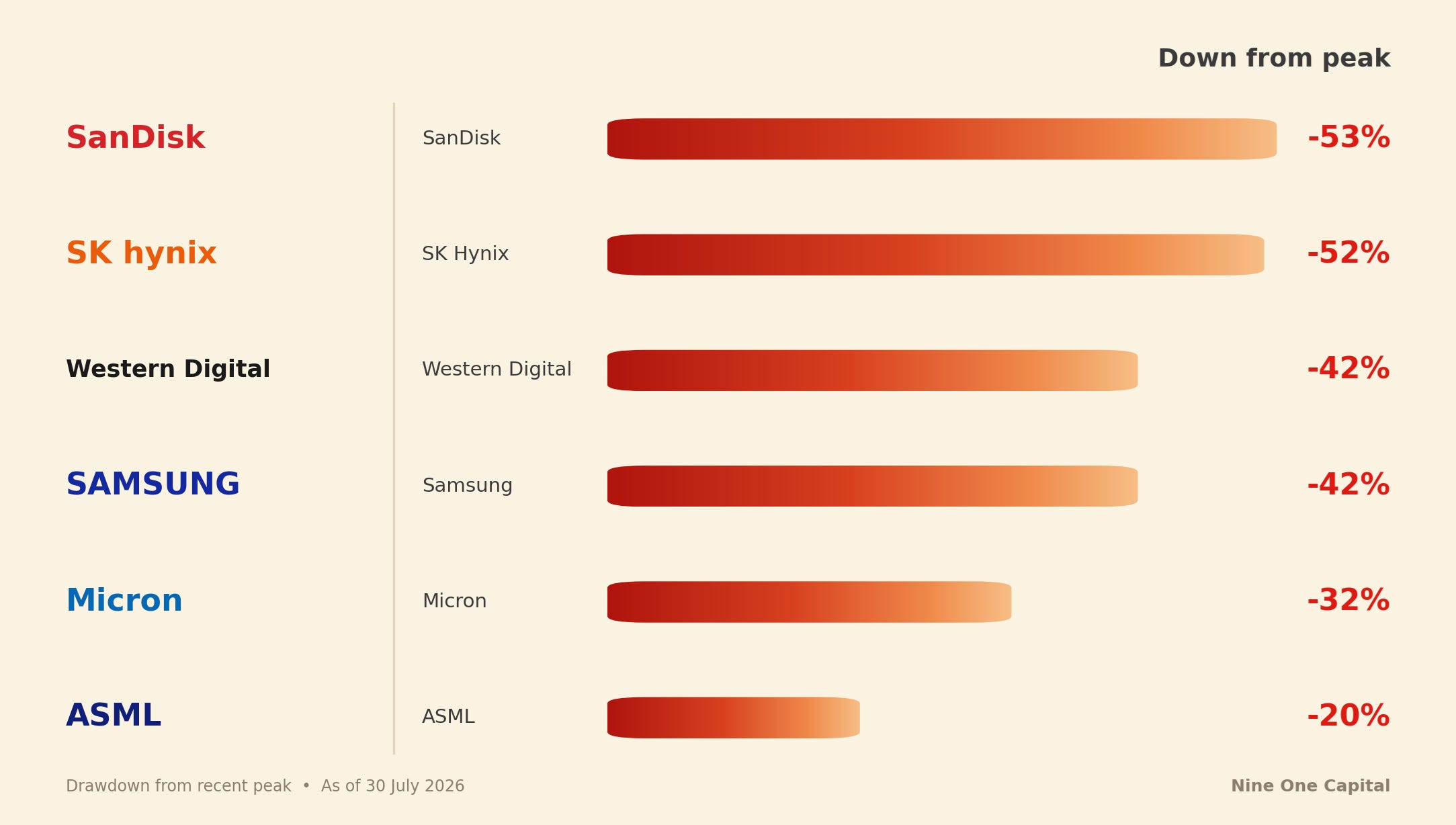
The market’s response was immediate and violent. By Bloomberg’s count, global semiconductor stocks lost roughly $3.3 trillion of market value from their late-June peak. The Philadelphia Semiconductor Index fell more than 20% from its record (by the way an index going down by 20% is what a bear market is called), in the worst week for chipmakers since the tariff shock of April 2025. Nvidia briefly ceded its position as the world’s most valuable company. The damage spread east: the Nikkei is down about 14% from its June peak, and Korean and Taiwanese chip names have fallen even harder. Nowhere is the damage clearer than in memory, the most crowded corner of the trade:
In January 2025, DeepSeek, another Chinese lab, released a model that performed near the American frontier at a fraction of the assumed cost. Roughly a trillion dollars came off global tech stocks in days. However the markets recovered within weeks, the large technology companies reaffirmed their capital expenditure plans, and the episode was filed away as a scare rather than a signal.
Eighteen months later, the same surprise worked a second time, on a larger base, at higher multiples, with heavier positioning. The semiconductor index had rallied 105% from its March low to its June peak before Kimi K3 landed. Valuations, by most accounts, had priced in something close to flawless demand for what has always been a deeply cyclical industry.
That is the detail worth sitting with. The market was not punished in July for something it did not know. It was punished for something it was sure about.
This is the Twain line from the top of this note, at a trillion-dollar scale. In Howard Marks’s words: Risk is greatest where it is perceived to be smallest. This is where the positioning is greatest, with prices leaving no margin for error. He also likes to cite Elroy Dimson. “Risk means more things can happen than will happen.”
What did everyone have set in stone in June? That frontier AI requires more and more compute. That the investment would have to occur in a few AI labs in the US and along a single Hardware supply line. That the build-out is therefore secular and not cyclical, and should be valued along those lines. Each of these individually was a reasonable assertion. Combined, and priced for perfection, and held by the majority of investors, was where the risk materialized.
There is a broader lesson here which goes beyond AI. In any emerging industry, the rate of innovation is so fast, that it outpaces the settled narrative. Kimi 3 just showed the same in a brutal way to investors who were very sure about the large compute capex led by the hyperscalers. In young industries, leads are real, but moats are provisional.
History's clearest example is the automobile. In the first two decades of the twentieth century, hundreds of car companies sprang up in the United States, more than 250 were operating in 1908 alone. Nearly every one of them was right about the technology: the automobile really did transform the world. Yet by 1929 fewer than fifty manufacturers survived, and by mid-century the industry had consolidated to essentially three. Warren Buffett has long used this example to make a point every investor in a hot sector should sit with: identifying a transformative industry and identifying its eventual winners are two entirely different problems, and early investors got the first one spectacularly right while losing fortunes on the second. AI today has its own crowded field of labs, chipmakers and infrastructure builders, all funded by capital that is certain about the destination. If the automobile is any guide, the technology will win. Most of the companies will not.
We would apply the same discipline to any emerging theme in our own market, whether it is batteries, semiconductors, defence electronics or data centres. The more settled the story sounds, the more skeptical we need to be.
Strip away the model-by-model debate and look at the inputs. Compute, at scale, is essentially two things: electricity and manufacturing. China generates roughly twice the electricity the United States does and is adding capacity faster than any country on earth. It has the deepest manufacturing base in the world. Even under export controls, it is standing up domestic accelerators, and there are already reports of trillion-parameter models trained entirely on local chips. Beijing has made open-source AI an explicit national strategy and Chinese models already account for a meaningful share of global developer usage on open routing platforms.
Given all this, it is difficult to argue that China will not offer head-on competition to the United States in AI. And if that is right, then some portion of the enormous capital expenditure being committed behind American AI labs may face headwinds on returns, at precisely the moment when valuations across the complex describe perfection.
To be fair, there is a respectable case on the other side. Cheaper intelligence may simply mean far more of it is consumed, making the compute cycle larger, not smaller, the Jevons paradox argument. This brings us to the next point.
We should be clear about who is writing this. We are a small Indian research firm. We are not AI experts, we do not sit anywhere near this supply chain, and we have no edge in predicting which lab ships the next frontier model. We read widely, we try to make sense of these developments for our own decision-making.
But that admission is not a hedge. It is the entire point of what follows. Because if a surprise of this size can blindside the most-followed, best-resourced sector in world markets, the honest conclusion is not that we should forecast better. It is that portfolios should not depend on forecasts being right.
Nobody in June had “a Beijing startup releases the world’s largest open-weight model at a Shanghai conference” written in their risk register. The trigger was unknowable. The fragility was not: crowded ownership, a 105% rally in four months, valuations that required the story to keep being true for an incremental person to become a buyer at those steep valuations.
This is what we mean when we say our strategy is designed for minimal downside in the event of negative surprises. In practice, it comes down to a few standing rules.
The first rule is to try not to lose money in any single position over its holding period. Every other rule exists in service of this one.
We size every position small. Small enough that being completely wrong in one name cannot meaningfully damage the whole. We assume that even our highest-conviction ideas can blow up.
We prefer entry prices that already assume disappointment. A stock priced for perfection converts any surprise into a loss. A stock priced for pessimism converts most surprises into information. We would rather own the second kind.
We diversify across unrelated setups, not one narrative expressed ten different ways. Twenty positions that all depend on the same macro assumption are one position.
We stay out of crowded stories, and accept the fee for doing so. In melt-ups, this discipline costs us in relative comparisons, visibly and sometimes painfully.
We judge outcomes over two to three years, not quarters. Fragile portfolios are often built by people managing to maintain short term expectations.
None of this is an abstraction for our market. Pockets of Indian equities today trade explicitly as proxies for the global AI capex narrative - data centre developers, power equipment and transformer makers, cables and conductors, cooling systems, and assorted hopefuls attached to the buildout. Some of these are genuinely good businesses. But an investor owning them at current prices is implicitly underwriting the very assumption Kimi K3 just called into question: that the capex flood is secular, uninterruptible, and immune to efficiency gains.
Meanwhile, the ignored corners of the small and micro-cap market, the unfashionable, the under-owned, the already-disappointed, carry the opposite property.
We do not know whether Kimi K3 will be remembered as DeepSeek 2.0 or as a footnote. We do not need to know. That is the freedom that comes from building portfolios for negative surprises rather than around confident narratives: the future is allowed to be surprising, and we are allowed to be wrong, without either being fatal. The danger, as ever, is not in what we don’t know. It is in what we know for sure.
If you would like to understand our research process in more depth or explore how our advisory services can support your investment journey, you can reach us at gaurav.a@nineonecapital.in or fill in the form here (link).
Important Note and Disclaimer: Nine One Capital is a SEBI Registered Investment Adviser (Registration No. INA000018814). This article is not a buy/sell recommendation. We could be wrong, and investors must do their own due diligence before taking any position. Please note that this note is shared only for the education purpose and in no way, it constitutes any buying or selling recommendation. Past performance is not indicative of future returns. Investments in the securities market are subject to market risks. Read all the related documents carefully before investing. Registration with SEBI, BASL membership and NISM certification do not guarantee performance or assure returns.
Comments
Nothing yet. Say the first thing.
Sign in to join the conversation.