
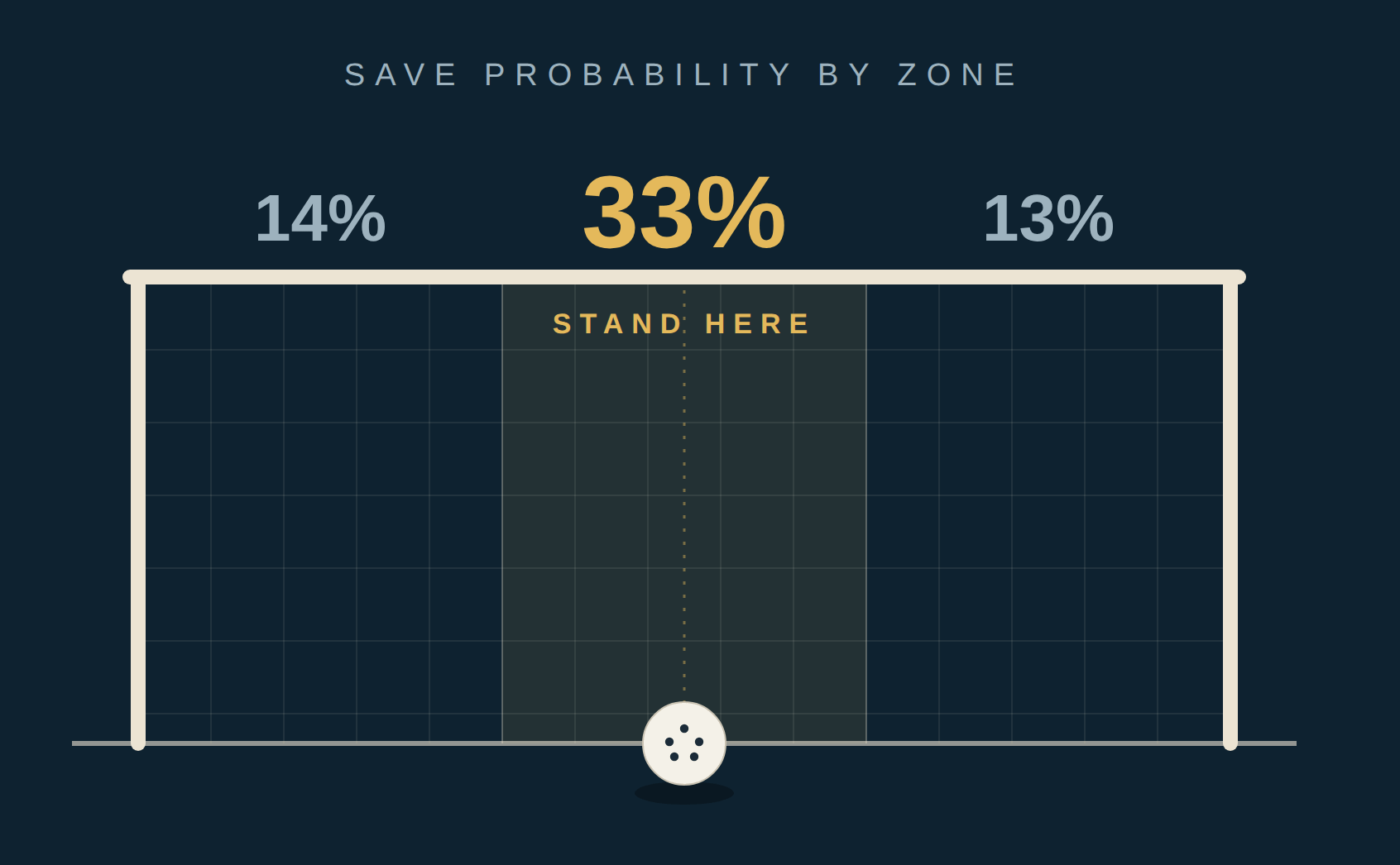
The FIFA World Cup just concluded (at the cost of many sleep-deprived nights). What better way to begin this week’s post than with a study on penalty kicks? A 2007 study by Michael Bar-Eli and colleagues analysed 286 penalty kicks in top football leagues. Staying in the centre of the goal gave keepers the highest save probability, roughly 33%, against 13–14% when diving to either side. However, during the study, goalkeepers stayed in the centre for only 6.3% of the time. The authors explain the behaviour this way: a goal conceded after diving is easier to justify, to oneself and to others, than a goal conceded while standing still. Action looks like doing the job. Inaction looks like negligence, even when it is the better decision.
This is the behaviour that we want to write about today.
A company we have owned for two years reports a reasonable quarter. Our first reaction is critical: margins could have been better, working capital has crept up again, the promoter is still not doing investor calls. The same week, we study a company we do not own and the reaction is noticeably more generous. Good business. Clean numbers. Large opportunity.
The stock we own gets judged on its weakest points. The stock we do not own gets judged on its strongest points.
This deserves attention, because the information runs the other way. The portfolio company is one we have researched for months and tracked for years. The watchlist company is often one we have known for a week. Rationally, our confidence should sit with the known business. In practice, our enthusiasm sits with the new one.
Three reasons, mainly behavioural in nature:
1. An owned stock is evaluated on actual results. A watchlist stock is evaluated on projections: The holding has reported real quarters, some of them poor. It has missed guidance at least once and has gone through a meaningful drawdown while we owned it. The new idea, at this stage, is a set of projections: an opportunity size, a margin expansion argument, an earnings model. Comparing one company’s actual track record against another company’s forecast is not a valid comparison. Projections do not miss quarters. Actual results do.
2.Attention drifts to what is new. Re-reading the same annual report for the tenth time feels unproductive. Working on a new company feels like progress. As a result, research time quietly migrates from the portfolio to the pipeline, and conviction in existing holdings goes stale. A thesis that is not refreshed weakens even when the business does not.
3. We overestimate the impact of negative events on companies we own:
Once we own a stock, every piece of bad news feels like it demands action. A weak quarter, a regulatory setback, a failed acquisition or an industry slowdown suddenly appears thesis-breaking. Yet, in reality, good businesses are remarkably resilient. Temporary setbacks often have far less impact on intrinsic value than they appear to in the moment because the long-term drivers, competitive position, management quality, return on capital and growth runway, remain intact. Extreme events often feel permanent while we are living through them, but many prove to be temporary detours rather than permanent impairments.
The urge to replace an existing holding with a new idea feels productive, but decades of evidence suggest otherwise. Ian Cassel, who has spent over two decades investing in illiquid small companies, captures this perfectly in The Art of Holding: “Many of us, seeing we have made a profit of 40% in one of our stocks, start actively looking for another company to invest the money into.” His conclusion is even more important: “One of the key requirements of staying invested in a big winner is to have (or cultivate) a high boredom threshold.”
Another study conducted on US fund managers concluded that the best managers were not consistently better at finding ideas; they were better at holding on to their winners while cutting their mistakes early. Behaviour after buying mattered more than stock selection itself.
Relevant to our universe of small/ micro caps, there are practical reasons why excessive churning is particularly expensive in small and microcaps. Every switch incurs taxes, impact costs and liquidity costs, all of which are highest precisely when markets are stressed. More importantly, a switch has to be right twice: first, that the existing holding is genuinely worse than it appears, and second, that the new idea is genuinely better than it appears.
None of the above argues for holding blindly. The same psychology also runs in reverse: investors who anchor to a holding and rationalise deteriorating fundamentals are making the opposite error, and buy-and-hold degrades into buy-and-hope. The objective is narrower, the sell decision should respond to evidence, not to boredom or to the appeal of a new idea. In our view, churn is justified in three situations as given below:
1. The thesis is broken: The specific reason for owning the business no longer holds. This is why the thesis must be written down on the day of purchase, with the conditions that would invalidate it stated in advance. If you cannot state what would break the thesis, you do not have a thesis.
2. Governance has deteriorated: Zero tolerance, especially in small and microcaps: related-party transactions growing, auditor resignations, promoter pledging, restated numbers. Governance problems rarely come alone. Sell first, debate later; no valuation compensates for a promoter who cannot be trusted.
3. A clearly superior opportunity: Opportunity cost is real and capital is finite. However for a new idea to come at the cost of existing holding, the upside has to be meaningfully higher than that of an existing holding. A new idea that is only marginally better than an existing holding, after adjusting for incomplete information and transaction costs, is not better.
A watchlist stock has not yet had the opportunity to disappoint. Every current holding was once a watchlist stock, and looked equally clean at that stage. The comparison between a holding and a new idea is a comparison between known reality and incomplete information, and should be treated as such.
When the urge to churn arrives, the useful question is: has the business changed, or has our perception changed and if yes, what has led to change in perception? Is it the stock price performance or business performance?
The exercise is certainly not as easy as it feels like but doing it is worth an effort and you will realise how many blind spots it unfolds in your investing process.
At Nine One Capital, we invest in micro and small caps through a defined framework that explicitly accounts for how liquidity, sentiment, and expectations drive valuations in this segment, not just fundamentals. If you would like to better understand our framework, you may write to us at gaurav.a@nineonecapital.in or fill in the form here (link).
Important Note and Disclaimer: Nine One Capital is a SEBI Registered Investment Adviser (Registration No. INA000018814). Please note that this note is shared only for the education purpose and in no way, it constitutes any buying or selling recommendation. Past performance is not indicative of future returns. Investments in the securities market are subject to market risks. Read all the related documents carefully before investing. Registration with SEBI, BASL membership and NISM certification do not guarantee performance or assure returns.
Comments
Nothing yet. Say the first thing.
Sign in to join the conversation.