
The faux posturing of the previous week fell away, and reality hit home big time in the opening Test at Ellis Park.
The Boks started with the power and directness which has won them two consecutive World Cups and established them firmly as the best side in the world, and while that doesn’t change because of a First Test loss, it was something of a beating on the final scoreboard - a new record for Coach Erasmus to add to his collection.
The ferocity of the tackle and ball carry in that opening 10-15 minutes was off the charts and would have had even the most optimistic of All Black supporters thinking this is going to be a very long day - or horribly early morning depending on your locale. There was intensity in this match worthy of the somewhat chintzy billing of Rugby’s Greatest Rivalry, and we can be sure that for the coming two games in the Republic this intensity is only going to go in one direction.
Add to that of course a scrum which is so well drilled in its timing that it has been unchallenged in recent years; a vehicle that generates penalties for fun, and there was an early feeling of an air of inevitability about the outcome. New Zealand were hanging onto a foothold by very narrowest of in margins. They bent, they bowed, but they didn’t break.
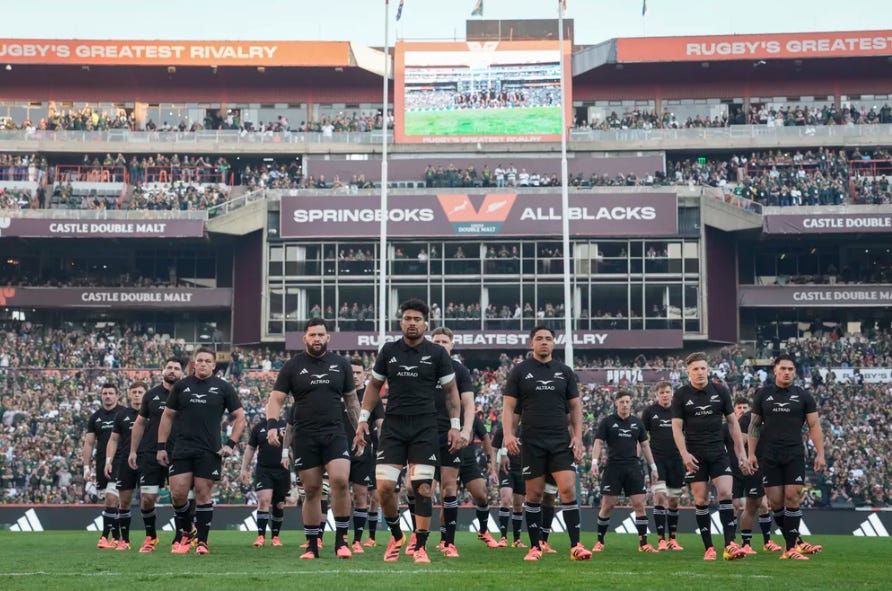
In the face of this onslaught, we saw the single biggest change Dave Rennie and Neil Barnes have brought to this All Blacks side. They displayed both a physical and mental resilience that has been absent for years.
The simple messaging of ‘get up off the ground, make just one more effort, and force your opposition into one more play’, not only trapped the Boks into a narrow mindset - for which a single try for 55 minutes of herculean effort seemed scant return - but it also translated into the opportunity for the All Blacks to go after the ball at the next tackle. And South Africa simply didn’t have the handling skills across the park to keep up the phase game.
The second enormous change in the New Zealanders in the last three months - and yes that’s all it has been so far - has been their execution on attack. Gone is the demonstrably flawed dual 10/15 playmaker, which now one can’t help but think was personnel driven rather than genuinely tactically driven.
Instead, there is a 9-10-12 combination who are proving to be an excellent set of decision makers, with the low probability plays of recent years hopefully being assigned to history’s rubbish bin.
While we saw a patient, perhaps overly cautious ball in hand and recycle game during the Nations Cup matches, in Johannesburg the rapier come out. Patient in creating chances, but ruthless when those chances appear - scoring 5 tries from 56 rucks falls firmly into the ruthless class!
A mate of mine noted afterwards that New Zealand had to make a significantly higher number of tackles in this game than South Africa, citing this as an indication of dominance. To my eye, it looked like when the All Blacks got good ball going forward, outside of that opening stanza, they were damn near unstoppable.
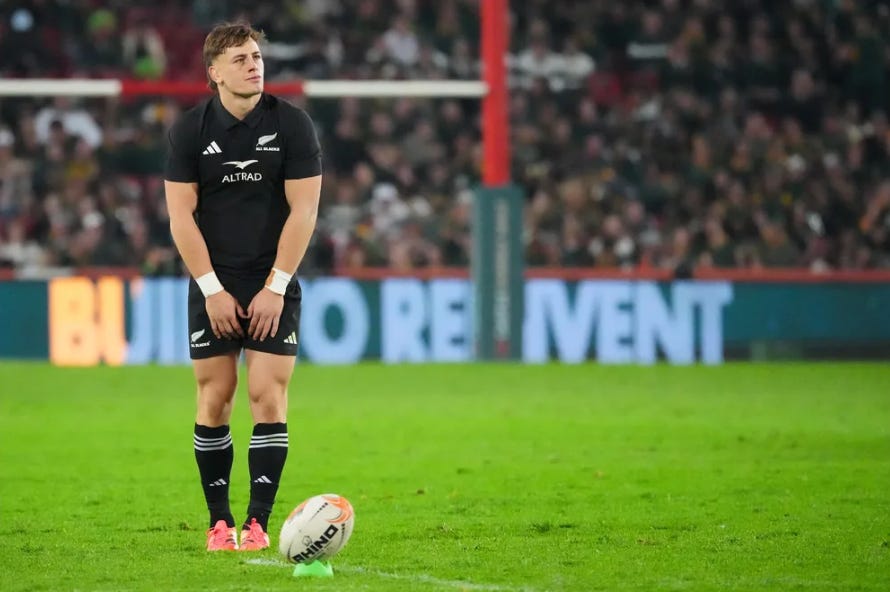
It’s worth another note of recognition for Ruben Love here. Here’s a young man who would barely have had any game time for the Hurricanes at no.10 had injury not intervened, and who now finds himself steering the All Blacks ship under a new coaching regime.
He’s faced the three highest-ranked sides already and has demonstrated the maturity to underplay his hand when every bone in his body must be screaming to drop in the flash stuff which we know is in his skill set.
It is such relief again for the All Blacks to have a number 10 who can be relied on to keep the error count low and not invite the opposition into the game, and who knows that his job is to make decisions that facilitate the attacking threats of the world class halfback and inside-centre.
And it is here where I think the balance of the match was tipped into New Zealand’s favour. South Africa went for a half back combination of Grant Williams and Sacha Feinberg-Mngomezulu who are undoubtedly skilled, but who are both prone to error.
They had little experience of starting together and Dave Rennie went after them both.
When Williams was hidden on the blindside wing, as South Africa does with its halfbacks, Tupou Vaa'i went to find him. He was harassed at the base of the ruck and, unlike Cam Roigard and Love, both Williams and Feinberg-Mngomezulu made slow decisions in positioning and distribution which allowed the New Zealand midfield defence, to get right up in the face of the ball carrier and force turnovers.
By halftime Williams had missed half of his eight tackle attempts, while Feinberg-Mngomezulu turned the ball over five times in the match. That is seriously un-South African.
Roigard and Love again demonstrated control, keeping their side probing around the edges, taking small bites into the gain line, neutering the much-vaunted Springbok line speed and getting to the edges only when the momentum had tipped in their favour and the line was compressed.
When sides assess the attacking threat of the All Blacks, Roigard’s ability to snipe, as his outstanding try scoring record confirms, is often underestimated. The All Blacks did at times look short of a forward ball runner and we can expect that to be addressed by the second Test.
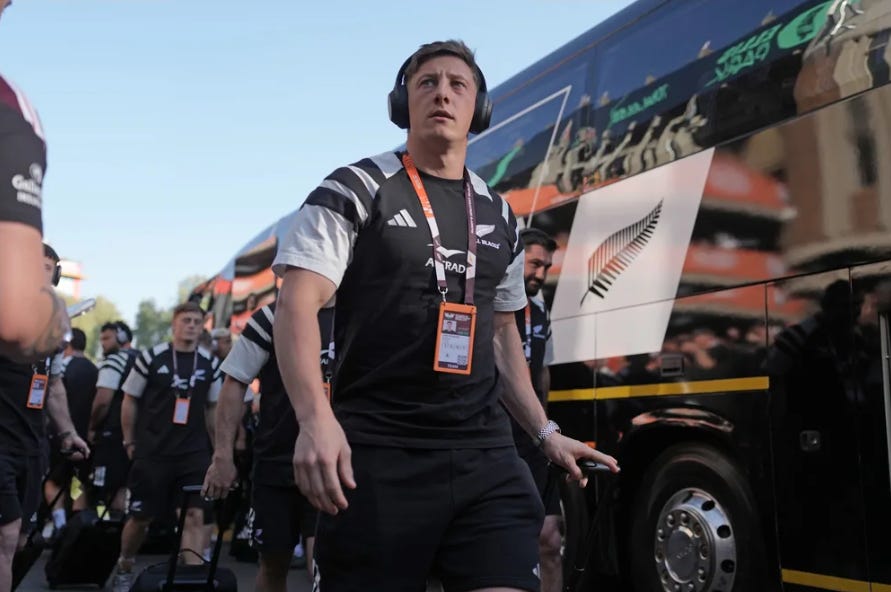
And so, to Cape Town.
What does the opening result mean for the final series? Not a lot probably, but New Zealand were the ones who couldn’t afford to go behind if they wished to win or share the four Tests.
This South African side have shown that an early loss in either a series or World Cup is far from terminal, and let’s also remember this is a territory where the All Blacks have won only one series in six attempts. The hill may have gotten a little smaller, but it’s still a hell of a climb from here.
For South Africa, the bets case scenario doesn’t change; bring the fire and brimstone and look to establish scrum domination early. But they do have to find a way to get more variety into the attack, or kick their threes when they are available, so as to bring a level of scoreboard pressure.
It cannot be regular occurrence for a South African side to only score three points in the last 50 minutes of a Test match, and once they did get a score behind, they totally lost that calm killer attitude of trusting their game to edge their way back into the match.
They also need to find a way to reduce errors and turnovers conceded, which comes back to source in the halves, which has been addressed by Erasmus in his next selection.
If there is one other area that needs immediate attention, it’s their cover/scramble defence - which has been a historic strength. In Pieter-Steph du Toit they have the best ‘safety’ defender in the world, a man who reads the game and gets to the right place on defence early, but last week he was caught for both position and speed more than once - noting he got little help from his number 8 in this regard. When the game did open up in the last quarter, the Springbok backfield fell apart with Damien Willemse being left with way too much grass to cover and the All Black kicking game took full advantage.
For New Zealand, it will be a case of making sure as many sore bodies as possible are ready to go this week. The scrum is an obvious focus, and attention to locking the scrum down rather than actively competing will be the way to go this week. Expect to hear the words, ‘walking around the loosehead’ coming out of the New Zealand camp this week.
You can’t go into South Africa flapping your gums, but this win, and the way Rennie managed the media last week has given him a legitimate platform, so expect him to drop this and few other comments about the lineout for referee Nika Aamakusheli to focus on.
Elsewhere, New Zealand didn’t do a great job kicking to a contest, so let’s hope that back down at sea level they can get that distance and hang time right, as their retention rate on their own kicks this year has been surprisingly good.
It really is astonishing the difference that Rennie and Barnes have made to this player group in only four Test matches, but whether that can be sustained in the pressure cookers to come is the real question. I really don’t like the repeated use of optimism to describe the rugby Rennie is trying to play, but there is certainly a base being built here which will stand them in better stead than the 2025 iteration.
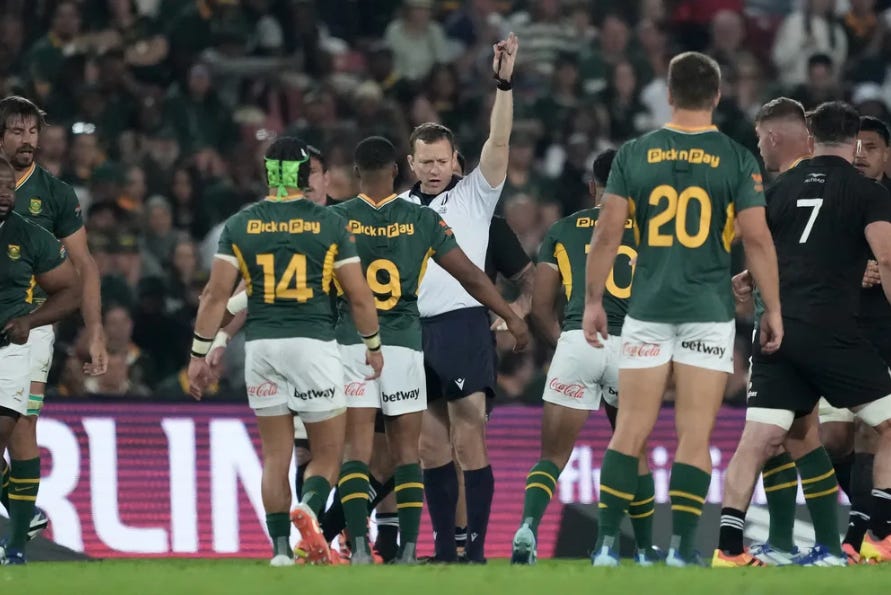
Referee Matthew Carley being appointed for the opening Test twitched a few New Zealand supporters nerves, given South Africa’s record over the All Blacks with him at the whistle was 3-0 before last week.
But for all the decisions that one might contest, how good was it for TMO to be told to take a hike twice! He also ignored his sideline assistant’s incorrect read that there were no issues with Marco van Staden’s yellow card clean out, because there was no ruck.
As for the game’s ‘big call’, it takes some cajónes to penalize an attacking South African scrum, but he got the wheeling penalty bang on. He’d awarded two penalties to the ‘Boks for the same thing earlier in the match, when that is not how the international game has been refereed in the last 18 months.
Let’s hope Nika Amashukeli shows the same strength in Cape Town that Carley showed in Johannesburg.
Finally, a word of praise for the approach Brett and Geoff have taken on 8/9 Rugby on Substack where a focus on the actual game itself is primary from both the writers and in the comments section. Worthy of a mention based on some of what I have been reading elsewhere of late.
Re-live all the fallout from the 1st Test of the Greatest Rivalry series, as Irish writer Pat McCarry joined Brett for the only* truly neutral South Africa-New Zealand Post-Mortem on all of rugby YouTube!
Comments
Nothing yet. Say the first thing.
Sign in to join the conversation.