
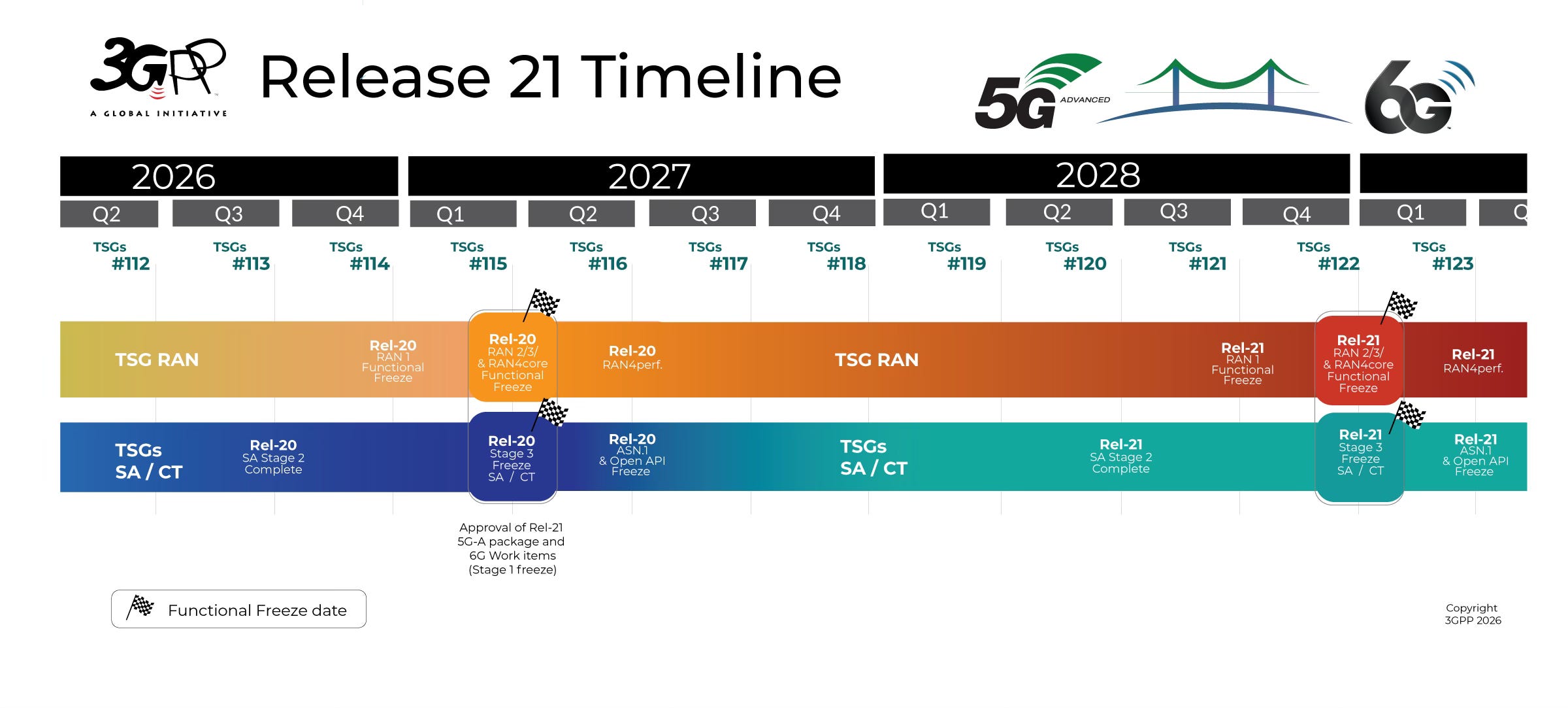
Three months ago in Fukuoka, the 3GPP community endorsed a March 2027 Stage 1 freeze for Release 21, deferring all other decisions to June. In Singapore last week, TSG RAN #112, chaired by Samsung’s Dr. Younsun Kim, approved the full Rel-21 timeline jointly proposed by the three TSG Chairs. This formally completes the first 6G study item in 3GPP and sets up a very interesting third quarter in which the working groups must settle numerous questions, including the migration architecture that operators have wanted a decision on for over a year.
RAN #112 could have been the meeting where hardware-impacting migration decisions started taking shape, but it was not to be. The Chair’s admission to the joint session with the other two TSGs (SA and CT) that “no decisions were possible” on migration options, with input now hoped for at TSG #113, was probably the most consequential comment of the week. Vodafone had warned, in a contribution superbly named “Good migration option decisions in September need hardware impacting decisions now!” that the September decision point only works if the plenary stopped deferring. You win some, you lose some.
I always like to applaud the work of the standards community; this is never easy and you can never please everyone. Well done. I hope this analysis reflects your work.
What follows is my take on the RAN #112 public proceedings, based mainly on submissions and the Chair’s draft report. I also reference previous plenaries that we have covered over the past year. Oversights, omissions and errors are all mine and I will happily make corrections if needed.
The headline outcome of the Singapore meetings is the joint agreement between all three TSGs to fix the Rel-21 schedule for both 5G-Advanced and 6G in a single, common timeline:
March 2027: 5G-A/6G package approval
March 2027: Stage 1 freeze
March 2028: Stage 2 80% checkpoint
June 2028: Stage 2 freeze (100%)
December 2028: Stage 3 freeze
March 2029: ASN.1 / OpenAPI freeze
Release 21 is the first 6G release, and the December 2028 Stage 3 freeze means the protocol work on the first 6G specifications is intended to be functionally complete in roughly 30 months. The March 2029 ASN.1/OpenAPI freeze is set (not coincidentally) just ahead of the ITU-R deadline for IMT-2030 candidate technology proposals in early 2029. It is worth recalling the earlier guardrails set by the 3GPP stakeholders, that the Rel-21 timeline had to be decided no later than June 2026, with an ASN.1/OpenAPI freeze no earlier than March 2029. The Chairs have therefore scheduled the first 6G release at the maximum aggression the rules permit: March 2029. The whole structure is reverse-engineered from the ITU calendar, as it was for IMT-2020, but with notably less slack this time around (and it felt extremely tight for 5G!).
There is a 3GPP structural oddity in the details. The March 2027 6G “package approval” is the approval of a placeholder whose RAN2/3/4 content is finalised three months later. This is deliberate concurrency, not an oversight, it’s how the 3GPP works. The normative engineering windows are equally tight: RAN1 runs Q2 2027 to Q3 2028; RAN2/3/4 run Q3 2027 to Q4 2028; six quarters each to specify a new radio generation.
There was some discussion about the dates. Some argued the ASN.1 freeze would more realistically sit in June 2029 to guarantee specification quality, and expressed concern about cramming the 5G-Advanced package approval into March 2027. Others, channelling the NGMN liaison submissions, wanted one thing above all: a stable, good-quality first 6G release without a stream of non-backward-compatible changes. That was 5G, and there is little appetite to repeat that process.
The Study on 6G Scenarios and Requirements was declared complete, with TR 38.914 approved. Launched in mid-2025, it is the first 6G study item in 3GPP to run from SID to completed TR, and it hit its June 2026 target. The wording of the final agreements tells you a lot about where 6G design pressure now rests.
The coverage assumptions debate produced one of those small-looking agreements with long-reaching implications. The baseline UE transmit power for coverage modelling was set at 23 dBm, against ZTE and Qualcomm advocacy for 26 dBm. The decisive argument came from the operators: DT did not want power increases (especially in lower bands), and BT explained that the modelling assumptions must allow a proper 5G/6G comparison: If 6G coverage claims are built on a more powerful transmitter than 5G, then every coverage gain becomes unfalsifiable marketing. A proposed 10 dB “extended coverage” figure was pushed for further discussion after Samsung warned it could drive fundamental design impacts.
The diverse-device-types sub-topic resulted in an interesting technical compromise. The proposal, which was agreed after a charged exchange, establishes the lowest-tier 6G device class with a 5 MHz maximum bandwidth option coupled, for the first time in 3GPP’s history, to a half-duplex mode.
There was a thinly veiled reference to NB-IoT and RedCap’s afterthought status in previous generations, which can be seen as standards failures - in that these were not Day-1 specifications. There was also debate about the impact on utility companies and their IoT meters and on preserving a Day-1 evolution path.
The device-tier question remains somewhat politically loaded, with its direct implications for chipset roadmaps and module pricing. As such, the Chair imposed an explicit moratorium: no working-group discussion of device types before the next September 2026 plenary.
There was a sharp vendor–operator clash over whether TR 38.914 should require an open, standardised interface between the 6G RAN and OAM systems. The proposal, that an interface from 6G RAN to the OMC shall be supported, drew support from several operators who stressed that today’s interface is proprietary and it should be standardised. An intervention from Nokia was note-worthy, claiming “we will not find an operator speaking for a single-vendor interface.”
In the end, it was formally minuted that a large number of operators wish to standardise an open interface between 6G RAN and OAM. Note that minuted wishes are not requirements, but they are place-holders that are guaranteed to resurface later in the standards process.
The September 2026 plenary (RAN #113) has long been pencilled in as the moment 6G migration options get pruned and the industry learns which architectures will be supported for the 5G-to-6G transition. Obviously that has huge implications for RAN hardware shipping today. The NGMN’s liaison efforts, especially their paper on the architecture and migration options, drew the most engaged plenary discussion. The RAN Chair opened with “I think everyone agrees we should not repeat what we did in 5G”, which is perhaps the closest 3GPP comes to an official repudiation of the NSA/SA option sprawl.
Deutsche Telekom argued the industry may need nothing more than standalone plus MRSS. T-Mobile USA wanted carrier aggregation prioritised over dual connectivity. And Apple noted, reasonably, that the 6G core’s shape won’t be known by September anyway. Vodafone made a forceful contribution: that minimising migration options requires the hardware-impacting decisions now, not in September.
A fourteen-operator architecture Technical Paper was merged into the final pCR, and a six-operator 6GR–4G interworking proposal likewise. The narrow agreements that did emerge are telling: 6G-to-4G interworking will have exactly one solution, scoped by example to IMS voice calls (the bare-minimum emergency-fallback case) and that 4G-to-6G in the other direction “makes no sense”.
But as to which migration options survive, there was no consensus on the key moderator proposals. The RAN Chair told the joint TSG session that RAN could offer no input on 5G–6G migration options until TSG #113. Meanwhile the MRSS overhead numbers that were requested at the previous plenary (the quantified evidence base) were delivered and noted without plenary conclusion.
The migration question is therefore loaded and primed for September, and there is going to be considerable pressure. The NGMN has already commited to delivering an updated version of its “6G Architecture and Migration Options — An Operator View” paper for September.
The other structural debate of the week was over whether 6G standardises a CU–DU higher layer split (HLS) and CP–UP separation, as 5G did, or treats the internal RAN architecture as an implementation matter.
The pro-split push came on two fronts. The headline paper, fronted by Verizon, was supported by sixteen stakeholders. It was reinforced by a 22-signatory discussion paper marshalled by Rakuten Mobile, which concedes the operational pain of disaggregation (multi-vendor interoperability, end-to-end observability, transport and sync dependencies) and argues these proved manageable, not fundamental. It argued that without a plenary decision, the working groups will proceed on divergent assumptions and re-litigate the functional split endlessly.
The scepticism came from a diverse coalition. They stressed that the considerations are less standards-related than industrial, AI may change the calculus, and the vendor–operator conversation needs another three to six months rather than a rushed decision.
Verizon paper’s included three proposals
Proposal 1: the 6G RAN architecture shall support HLS, to enable smooth 5G-to-6G split migration.
Proposal 2: 6G HLS shall support both CU–DU and CU-CP/CU-UP separation, with standardised open interfaces for interoperability.
Proposal 3: 5G HLS shall be the baseline, with enhancements as needed.
The plenary agreed proposals 1 and 2, so 6G will have a standardised higher layer split, with CP–UP separation and open interfaces. Proposal 3 moves to the RAN3 group to argue over a single word: reference or baseline? Welcome to the world of standards.
The non-terrestrial networks community assembled a coalition of 20 stakeholders, it’s largest yet, to add unpaired (TDD) spectrum to the 6G NTN study scope, motivated by the simple fact that TDD is currently absent from 6G NTN studies entirely. Three revisions and one “softened version” later, the proposal was not pursued. The main objection was that terrestrial TDD should be settled first before non-terrestrial implications can be assessed.
Thales registered its displeasure later in the week noting commercial interest in NTN TDD and insisting it not be excluded from 6G’s future. Expect this issue to resurface, possibly via regional regulatory pressure.
Otherwise the NTN mission was productive: the Thales-led deployment scenarios were approved after a four-revision grind; the NTN spectrum discussion split the difference on hot-spot user distribution (they settled on 4%); and NTN-based positioning was explicitly minuted as open for further discussion (GNSS-vulnerability anxiety is pulling new institutional players into 3GPP, who are now learning that the standards world plays the long game...)
The RAN #113 plenary scheduled for September 2026 is shaping up very nicely:
Migration options decision: the NGMN-endorsed decision point, with RAN having promised input to TSG #113 and SA2’s August architecture review feeding in
Constellation shaping: support it or kill it
1K/4K QAM: RAN1/RAN4 decision due
HLS: RAN3’s verdict on the reference-versus-baseline question
Device types: the framework discussion resumes at TSG level
6G–6G spectrum aggregation for non-collocated deployments: parked pending RAN2 analysis, returns in September
SSB structure and periodicities: RAN1/RAN4 time-plan due.
Worth noting also that having large coalitions to fight your cause doesn’t always work. At the last plenary, an 18-operator coalition led by Deutsche Telekom effectively wrote TR 38.914’s architecture requirements section. At this plenary, a 14-operator architecture TP was merged into the final pCR, but two equally broad operator coalitions failed outright: the 17-operator spectrum TP and the 18-operator AI-support TP were both “not pursued”. Twenty-company NTN coalitions and a 25-signatory PNT coalition fared no better.
The Scenarios and Requirements study is finished, but the political questions it deferred are not. The requirements now say what 6G must do. September begins the fight over what it will be.
Comments
Nothing yet. Say the first thing.
Sign in to join the conversation.