
6G news and analysis for the week ending Friday 12th June, 2026.
The 6G standards community now has an official deadline. At its 112th plenaries in Singapore this week, 3GPP officially approved the first timeline for early 6G specifications. Release 21 now carries a functional (Stage-3) freeze of December 2028 and an ASN.1/OpenAPI freeze of March 2029. The contested downstream dates that emerged at the April 3GPP meetings are settled, and the working groups must now match resources to fixed milestones. The TSG RAN study on 6G scenarios and requirements was also approved.
I’ll be back with a more comprehensive report on the Plenaries later this weekend, once I have sifted through the huge volumes of material... But here’s a teaser – the migration options decision has slipped into September with no consensus on the proposals.
Standards activity was not confined to 3GPP. At ITU-T Study Group 17 in Geneva, South Korea led approval of the first 6G security requirements initiated by the body. This is part of a wider Korean push that also saw ETRI formally launch its AI-RAN consortium. And Nvidia, according to a well-sourced Light Reading report, is weighing a GPU for the radio unit itself, extending AI-RAN into the last untouched part of the network. Take that report under caution though, as the company has not confirmed a product.
Elsewhere, ITRI deepened Taiwan’s 6G ties with Europe, while Finland, Sweden and Ireland launched new resilience and security programmes. The US FutureG office also opened fresh sensing-prototype funding. Four research papers round out the week, covering AI-native security, conversational network analytics, FR3 channel measurements and modular digital twins.
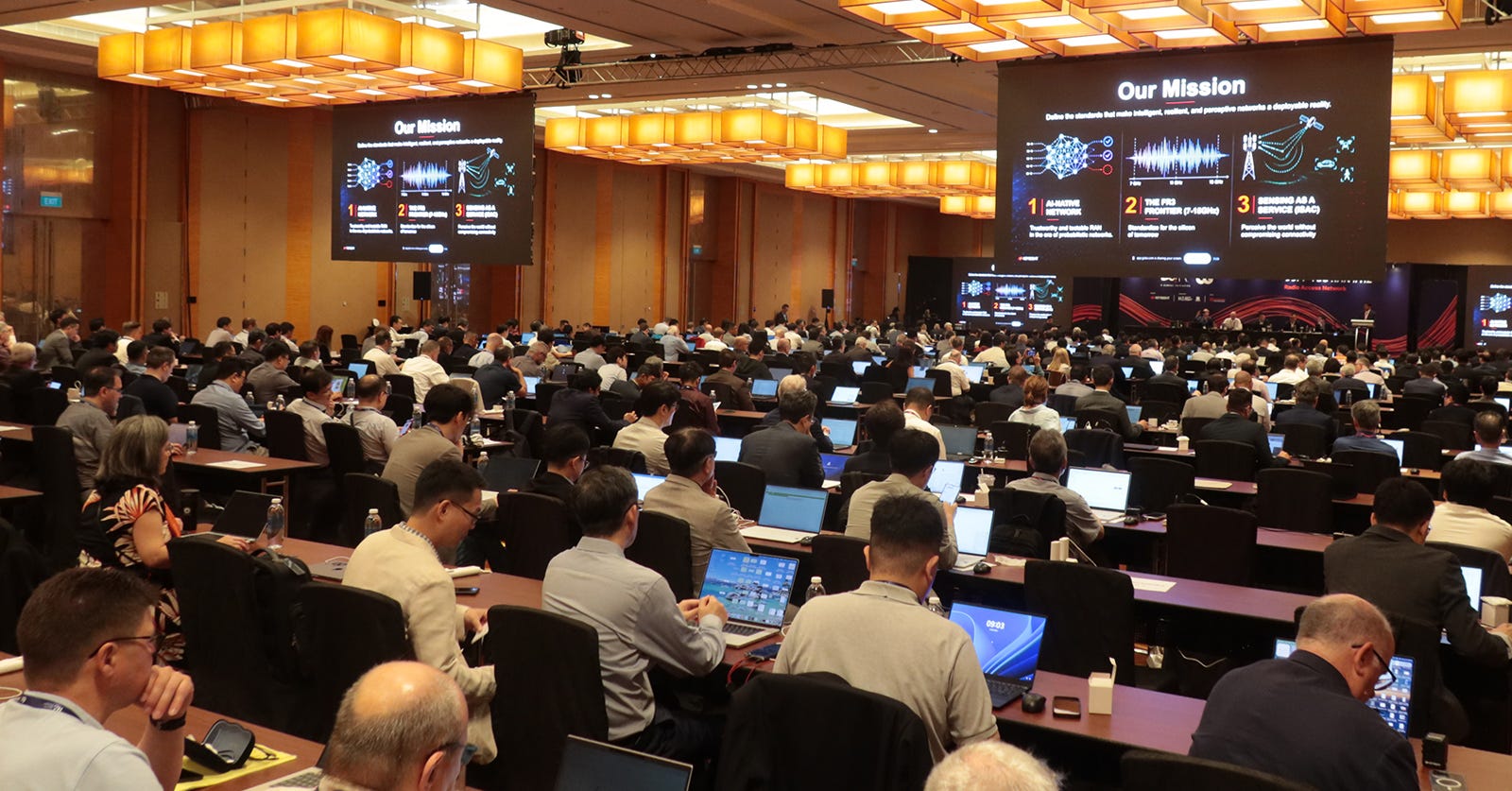
3GPP has approved the first timeline for early 6G specifications, agreed at its 112th plenaries (TSGs#112) in Singapore from 8 to 12 June. The Release 21 schedule sets package approval and a Stage-1 freeze for March 2027, a Stage-2 freeze for June 2028, a Stage-3 freeze for December 2028, and an ASN.1/OpenAPI freeze for March 2029. The same week, the groups approved the TSG RAN study on 6G scenarios and requirements (TR 38.914), a foundational document for the radio work ahead. More than 590 standards delegates attended, with 14 study items for 6G now progressing. The plenary also advanced Rel-20 deployment-driven enhancements to 5G-Advanced.
What’s new: The timeline has been stable since it was first shown at the March plenaries, but it is now formally by all three TSGs. This settles the downstream dates that 3GPP deliberately deferred in April, when only the Stage-1 freeze was agreed. The functional content of 6G is now due to freeze in December 2028, with protocol encoding fixed by March 2029.
Why this matters: This is the date that the whole community has been awaiting. Chipset vendors wanted certainty on the ASN.1 encoding deadline, operators wanted flexibility on the Stage-2 architecture freeze, and the 5G-Advanced camp wanted its own package track. The Chairs’ April paper gave each group a single agreeable Stage-1 milestone and deferred the rest. The Singapore meetings have turned two years of study-phase argument into a binding schedule. Note that these Stage-3 and ASN.1 freezes should not be confused with commercial product availability.
Implications for 6G standards: Feature prioritisation for Release 21 now runs against hard deadlines. Resource allocation across the RAN, SA and CT working groups must align to the freeze dates, which is going to sharpen decisions on which 6G features make the first release and which slip into later releases.
View source material to read more — Rel-21 timeline
View source material to read more — TSGs#112 wrap-up
South Korea led the approval of 14 new standardisation items at the ITU-T Study Group 17 (SG17) meeting in Geneva, held from 1 to 10 June, according to the Ministry of Science and ICT and reported by Asia Economy. Among them are technical requirements for IMT-2030 (the ITU’s parent programme for 6G) network security, described as the first 6G security international standards initiated by ITU-T. The meeting drew 477 experts from 60 countries, with Korea sending a 59-strong delegation. Korea also advanced a multimodal AI device security framework, a physical AI system security framework and an AI agent ID management mechanism using decentralised identifiers. A dedicated AI security research project (Q16), reflecting a Korean proposal, was newly established at the SG17 plenary in April.
What’s new: The IMT-2030 security requirements are expected to serve as core criteria in future 6G candidate-technology evaluations and standardisation. This positions Korea at the front of the treaty-level body that will run the IMT-2030 process, rather than only at 3GPP. Seven further Korean-led items, including AI system security requirements and zero-trust network guidelines, entered preliminary adoption.
Why this matters: Security-by-design is a recurring 6G theme. 3GPP SA3 has its own 6G security study underway, and European projects such as Hexa-X-II and this week’s SHIELD-6G are pushing parallel work. Establishing the first ITU-T 6G security baseline gives Korea early agenda-setting influence at the body that judges candidate technologies. The ITU-T and 3GPP tracks are distinct but feed the same IMT-2030 goal. As ever with a ministry press release, the framing of national leadership is generous, and these remain early-stage standards rather than finished specifications.
Implications for 6G standards: Early ITU-T 6G security requirements could shape the criteria against which radio interface technologies are later assessed, giving contributors who set them a structural advantage.
Separately, ETRI formally launched its AI-RAN Global Leading Project at a kickoff workshop on 4 June. This is a project we first noted in January and covered in May when HFR joined. The KRW 47 billion programme runs to 2030 and brings together SK Telecom, KT, LG Uplus, domestic vendors and four universities, developing AI-RAN software on 3GPP Releases 19 and 21 and validating it in digital-twin and live base-station environments.
View source material to read more — ITU security standards
View source material to read more — ETRI AI-RAN project
Nvidia is reported to be working on a GPU chip for the radio unit (RU), according to a detailed Light Reading report by Iain Morris. This would extend the company’s AI-RAN strategy beyond the baseband and into the radio itself. Until now, Nvidia had targeted the compute that runs in the central and distributed units (CU and DU), leaving the antenna-hosting RU untouched. The company told the publication by email that GPUs in more advanced radios will become “essential.” The rationale is scale: basic radios use four transceivers, but 5G-Advanced and 6G could reach 128, while ultra-MIMO in higher bands raises the prospect of up to 1,024, multiplying the low-PHY processing burden.
What’s new: The RU has not previously been a GPU target. Nvidia proposes replacing the custom ASICs that handle beamforming and other low-PHY functions with programmable silicon, opening that compute to the roughly six million developers familiar with its CUDA platform via its Aerial architecture. A late-May statement from Marvell chief executive Matthew Murphy indicated that Marvell will enhance its Octeon baseband processors to work directly with Nvidia GPUs, hinting at a deepening relationship after Nvidia’s $2 billion investment in Marvell in March.
Why this matters: RAN silicon economics are deteriorating. Omdia figures cited in the article put 2025 RAN spend at $35 billion, down from $45 billion in 2022, with no recovery expected. That makes bespoke ASICs, whose only buyers are telcos, harder to justify. Nvidia’s pitch is programmable platforms that evolve with standards rather than fixed designs. The scepticism is equally real. RUs account for up to 90% of mobile network energy, and GPUs carry a power-hog reputation. Nvidia counters that RU-class parts would resemble embedded automotive and robotics GPUs running below 100W, not data-centre devices.
Implications for 6G standards: GPU-based RU compute is an implementation choice, not a standards requirement. But if the leading RU silicon shifts toward programmable platforms, it could influence how 3GPP and the O-RAN Alliance treat the 7.2x fronthaul split and low-PHY functions as radios scale toward ultra-MIMO.
Be aware, the story rests on anonymous “knowledgeable sources” and whilst Nvidia described RU-based GPUs as “essential” in future they did not officially confirm that products are in development.
View source material to read more
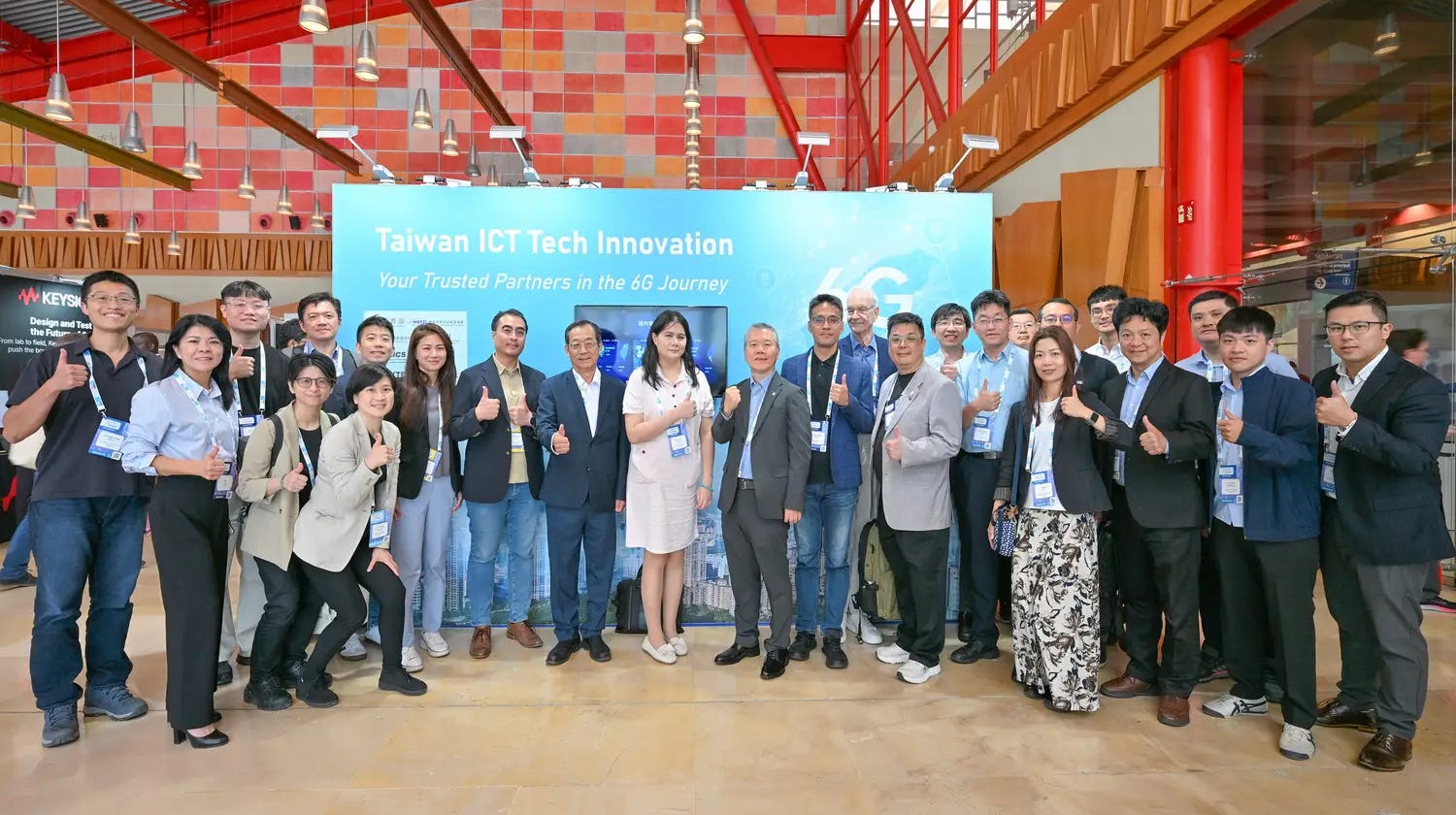
Taiwan’s Industrial Technology Research Institute (ITRI) helped broker two agreements at the EuCNC & 6G Summit in Málaga from 2 to 5 June, reported by Taiwan News and announced by ITRI. An MoU between the European 6G-IA and the Taiwan 6G Industry Forum covers technology development, international trials and standards alignment. ITRI also signed a cooperation agreement with the Netherlands’ TNO under the Future Network Services programme to work on integrated sensing and communication (ISAC), the 6G capability that lets a network detect objects and movement while carrying data. Taiwan’s Ministry of Economic Affairs said the agreements will help local firms join EU 6G research programmes, testbeds and field trials. ITRI Vice President Pang-An Ting said global 6G development is entering “a new phase driven by international validation and ecosystem collaboration.”
What’s new: ITRI showcased a self-developed 6G base station chipset combining an FR3 radio front-end with a high-density antenna architecture, which it claims delivers nearly five times the transmission capacity of current 5G base stations. It also demonstrated an ISAC system, built with European partners, for drone detection, low-altitude airspace monitoring and indoor positioning.
Why this matters: Taiwan brings semiconductor and ICT supply-chain strength, and these deals connect that base to European experimental infrastructure. This extends ITRI’s earlier EU work, including the 6G-SANDBOX toolkit deployment we covered last year. The ISAC focus matters because sensing-communication integration is one of the defining 6G capabilities and an active 3GPP study area. The 6G-IA is a 3GPP Market Representation Partner, so the MoU offers Taiwan an indirect channel toward standards discussions. The chipset capacity figure is a vendor claim awaiting independent validation, and ITRI’s own materials are promotional in tone.
Implications for 6G standards: Cross-border testbed interoperability and joint ISAC validation broaden the evidence base that flows into 3GPP and ITU IMT-2030 work. If Taiwanese results are recognised alongside European data, it strengthens the island’s contribution to early 6G standardisation.
View source material to read more — Taiwan News
View source material to read more — ITRI
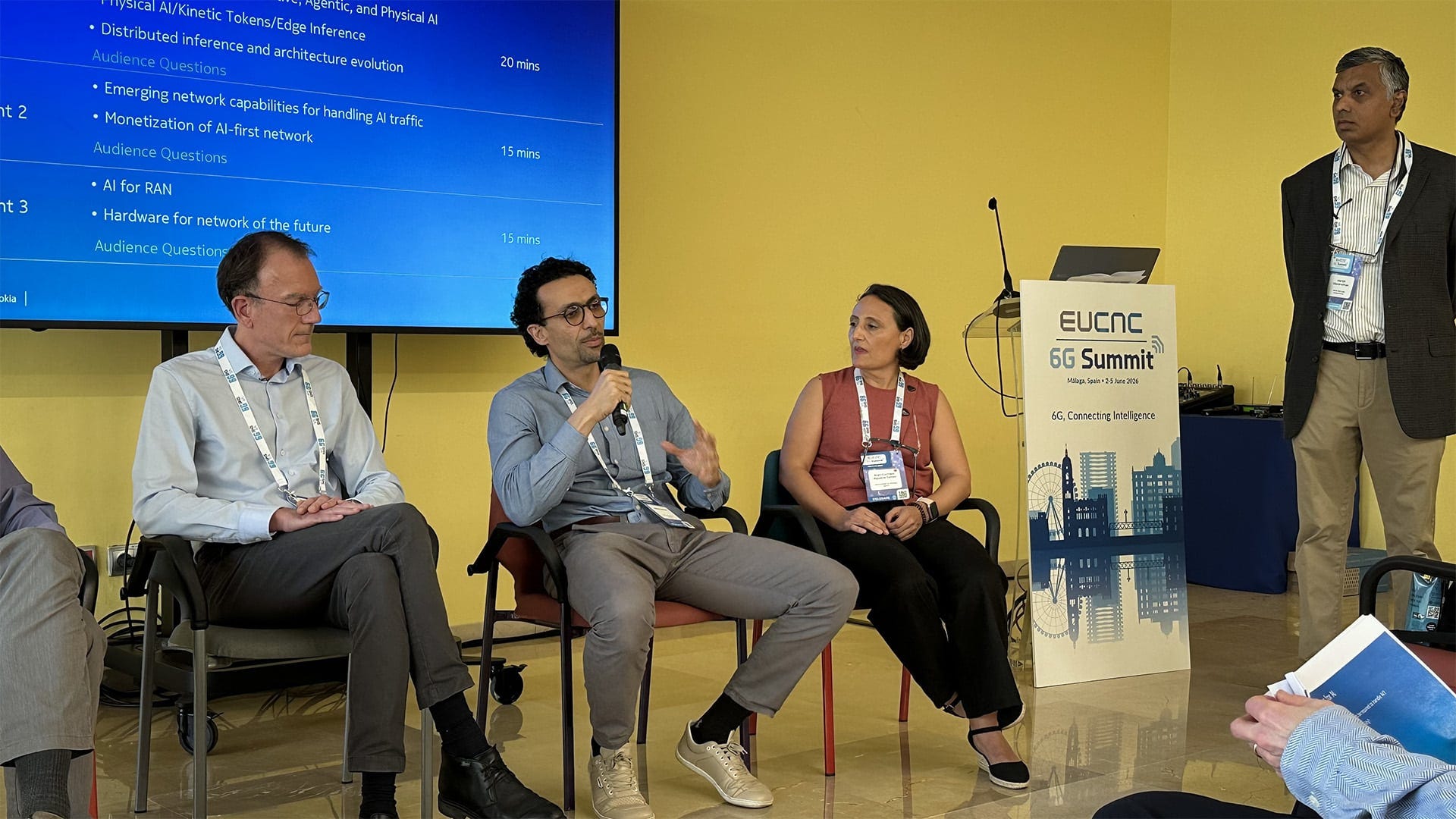
Three developments from Europe’s research week underline a shift from speed toward resilience and security. First, Finland and Sweden launched 6G-FISRE, a €4.3 million joint resilience programme led by the University of Oulu and KTH Royal Institute of Technology, with partners including Nokia, Ericsson, Saab and Bittium, to design “resilient-by-design” and dual-use 6G. In Dublin, University College Dublin (UCD) won the €8 million SHIELD-6G project, the sole awardee under a competitive Horizon Europe SNS JU call, to build an AI-native cyber threat intelligence platform with partners including Thales. And the University of Oulu’s 6G Flagship used the EuCNC & 6G Summit in Málaga to reframe the generation’s harder questions around resilience, sustainability and physical AI. Professor James Gross of KTH said resilience “can’t be bolted onto a network after it is built.”
What’s new: SHIELD-6G centres on a 6G-native cyber threat intelligence pipeline using federated learning, secure multi-party computation and differential privacy, so multi-stakeholder networks can share intelligence and self-heal without moving raw data. 6G-FISRE emphasises dual-use capabilities spanning civilian and security applications across the Nordic region. The 6G Flagship sessions and demos covered terahertz sensing, very large MIMO channel feedback and reconfigurable intelligent surfaces (RIS), the steerable panels that redirect radio waves toward users.
Why this matters: Resilience and security are moving from add-ons to design principles, a theme running through recent European work including the VTT-TNO defence MoU in May and Hexa-X-II’s security controls. The dual-use framing reflects the geopolitics, with Finland and Sweden, both now in NATO, aligning civilian 6G research with security needs. SHIELD-6G being the sole awardee in its call signals concentrated EU funding behind a single security flagship. EuCNC, which we covered last week through Telefónica and IMDEA, confirmed the wider mood, with the headline speed number no longer the selling point.
Implications for 6G standards: 3GPP does not standardise defence applications, but the technical groundwork in resilience, ISAC and zero-trust security feeds civilian standards work in SA3 and the ITU IMT-2030 process. Projects of this kind generate the architectural concepts and evidence that then flow into 3GPP and ETSI.
View source material to read more — 6G-FISRE
View source material to read more — SHIELD-6G
View source material to read more — 6G Flagship at EuCNC
The National Spectrum Consortium (NSC), with the US Department of Defense “FutureG” Office, has opened two requests for prototype proposals on integrated sensing and communication (ISAC), reported by ExecutiveGov. ISAC is viewed by many as a key 6G capability (although perhaps not in the first release), letting networks sense their surroundings while carrying data. One request, named RAPID, seeks dual-use ISAC technologies across fixed infrastructure, mobile platforms and joint AI optimisation, with multiple awards over performance periods of up to 24 months. The second seeks a multi-waveform RAN prototype built on the open-source OCUDU framework, for a single award. Proposals are due 3 July. FutureG principal director Thomas Rondeau said the open-source approach would “lower barriers to entry and accelerate industrial collaboration.”
What’s new: The prototypes must integrate or interoperate with the Open Centralized Unit Distributed Unit (OCUDU) software baseline, tying this funding directly to the DoD-backed open-source RAN stack we have tracked since October 2025. The stated aim is to converge sensing, communications and AI to give military operators more resilient capabilities in contested environments.
Why this matters: This extends a consistent US pattern of using defence funding to seed 6G-relevant open-source and sensing capability, alongside OCUDU and the AI-WIN initiative. Anchoring the prototypes to OCUDU pulls more ISAC and waveform work into a neutrally governed code base that already includes Qualcomm and several US operators. ISAC and resilient positioning featured heavily in 3GPP 6G Workshop submissions and dominated requirements debate at RAN #111. Eligibility is limited to full NSC members in good standing.
Implications for 6G standards: An open-source stack that natively supports ISAC could become a reference implementation, shaping how 3GPP-specified sensing features are deployed in early 6G networks. US defence priorities around sensing and GNSS-resilient infrastructure may also steer which technologies American firms champion in the standards process.
View source material to read more
Thanks for reading 6G Futures! This post is public so feel free to share it.
This survey reframes security for 6G cyber-physical systems, such as autonomous vehicles, smart grids, industrial robots and remote surgery, as a closed-loop, AI-native pipeline. The architecture senses at the edge, decides locally with compressed models, mitigates network-wide through SDN, NFV and O-RAN controllers, then retrains via federated learning and digital-twin replay. It organises 128 peer-reviewed studies under a formal latency contract for safety-critical slices.
Why this Matters: In 6G, ultra-reliable low-latency slices shrink the gap between a remote breach and physical harm to milliseconds, beyond what perimeter firewalls and central security operations can handle. The paper consolidates a fragmented field into one reference architecture and flags open problems in data, latency, trust, standardisation and evaluation.
View source material to read more
The authors build an open-source Network Data Analytics Function (NWDAF), compatible with the Free5GC core, and add a large language model interface for natural-language interaction. The system maps operator intents to predefined categories that trigger analytics queries or event subscriptions, abstracting away complex traditional interfaces.
Why this Matters: NWDAF underpins zero-touch automation, but open implementations remain scarce. A conversational layer lets non-expert operators manage analytics and subscriptions, a concrete step toward the AI-native network intelligence that 6G assumes. The code and datasets are released openly.
View source material to read more
The study experimentally measures outdoor urban massive MIMO channels at 8 GHz and 15 GHz in the FR3 band, extracting delay and angular spread and comparing them with the 3GPP channel model TR 38.901. It finds more directional, concentrated propagation at higher frequencies, with the 15 GHz channel slightly outperforming 8 GHz on capacity in both line-of-sight and non-line-of-sight scenarios.
Why this Matters: FR3, the upper mid-band roughly spanning 7 to 15 GHz, is the spectrum most expected to anchor early 6G, balancing coverage and capacity. Real measurement data tested against the existing 3GPP channel model gives standards work the empirical grounding it needs for multi-band MIMO design.
View source material to read more
The paper proposes a digital-twin-enabled 6G architecture that exposes network digital twin (NDT) capabilities as a service within a multi-domain orchestration framework. A DT Orchestrator composes domain-specific twin modules and simulators on demand to answer predictive and prescriptive what-if queries before any control action is deployed. It is demonstrated on a green-networking case over a 105-base-station deployment in Poznań.
Why this Matters: Monolithic end-to-end twins do not scale across the distributed, heterogeneous domains that 6G will span. The modular approach makes risk-free validation and AI-assisted optimisation practical. The case study reports a 28.5% cut in daily grid consumption through joint coverage and solar optimisation, linking digital twins directly to the sustainability goals central to 6G.
Comments
Nothing yet. Say the first thing.
Sign in to join the conversation.