
“Eat less, move more.”
That’s the common advice in fitness, right?
It’s repeated like gospel across every weight loss ad, fitness app, and influencer reel.
But for high-performing professionals already grinding in every area of life, that advice isn’t just wrong - it’s dangerous.
Because the truth is, if you’ve been eating less and training more for weeks (or months) - CONSISTENTLY - without results…
You could be fighting Metabolic Resistance.
Here’s the part the industry won’t tell you:
Your metabolism isn’t just a calorie calculator.
It’s a highly complex, hormone-regulated survival system.
And when cortisol is chronically elevated - ike it is in most execs, founders, and high achievers - it rewires that system to prioritize one thing: survival. Not fat loss.
So no, you’re not broken.
But your strategy might be.
In this article, I’m going to break down:
How your metabolism and metabolic resistance actually work (and why it’s not just about food or training)
How overstressing your system and driving excess cortisol production crushes your thyroid, sex hormones, and fat-burning capacity
Why “just push harder” backfires for people like you
And how to ‘reset’ your metabolism without burning out or gaining weight
If you're training hard, eating in a calorie deficit, and still not losing fat - or worse, gaining - it’s tempting to think your metabolism is broken.
But that’s not what’s happening.
Your body isn’t malfunctioning. It’s adapting. Metabolic adaptation (also known as metabolic compensation or resistance) is a sophisticated, built-in natural survival system that helps your body conserve energy during times of stress or scarcity.
It’s the metabolic equivalent of putting your company on a hiring freeze during an economic downturn - cut costs, streamline operations, conserve resources.
And if you’re an executive or high-achiever who lives in a high-output, high-pressure environment, your body is constantly walking the tightrope between performance and breakdown.
Metabolism isn’t just “calories in vs. calories out.” It’s the sum total of every physical and biochemical reaction happening inside your body to keep you alive:
Converting food to usable energy (ATP)
Regulating hormones
Repairing tissue
Managing inflammation
Balancing neurotransmitters
Powering your brain, heart, liver, and muscles
It’s an energy economy with limited resources, and a lot of expenses.
Your Total Daily Energy Expenditure (TDEE) is split into four categories:
1) Basal Metabolic Rate (BMR): ~60–75%
The calories your body burns just to stay alive - breathing, pumping blood, regulating temperature, etc.
2) Non-Exercise Activity Thermogenesis (NEAT): ~10–15%
Unconscious movement - fidgeting, walking to meetings, pacing on calls.
3) Thermic Effect of Food (TEF): ~10%
The energy it takes to digest and absorb nutrients.
4) Exercise Activity: ~5–10%
Actual workouts, training sessions, sports, etc.
When fat loss stalls, it’s usually because one or more of these has dropped - either through intentional dieting or chronic stress. That’s metabolic adaptation in action.
Let’s zoom in on what’s actually happening under the hood when you’re in a calorie deficit or high-stress state:
The hypothalamus - your body’s command center - detects energy imbalance and responds by:
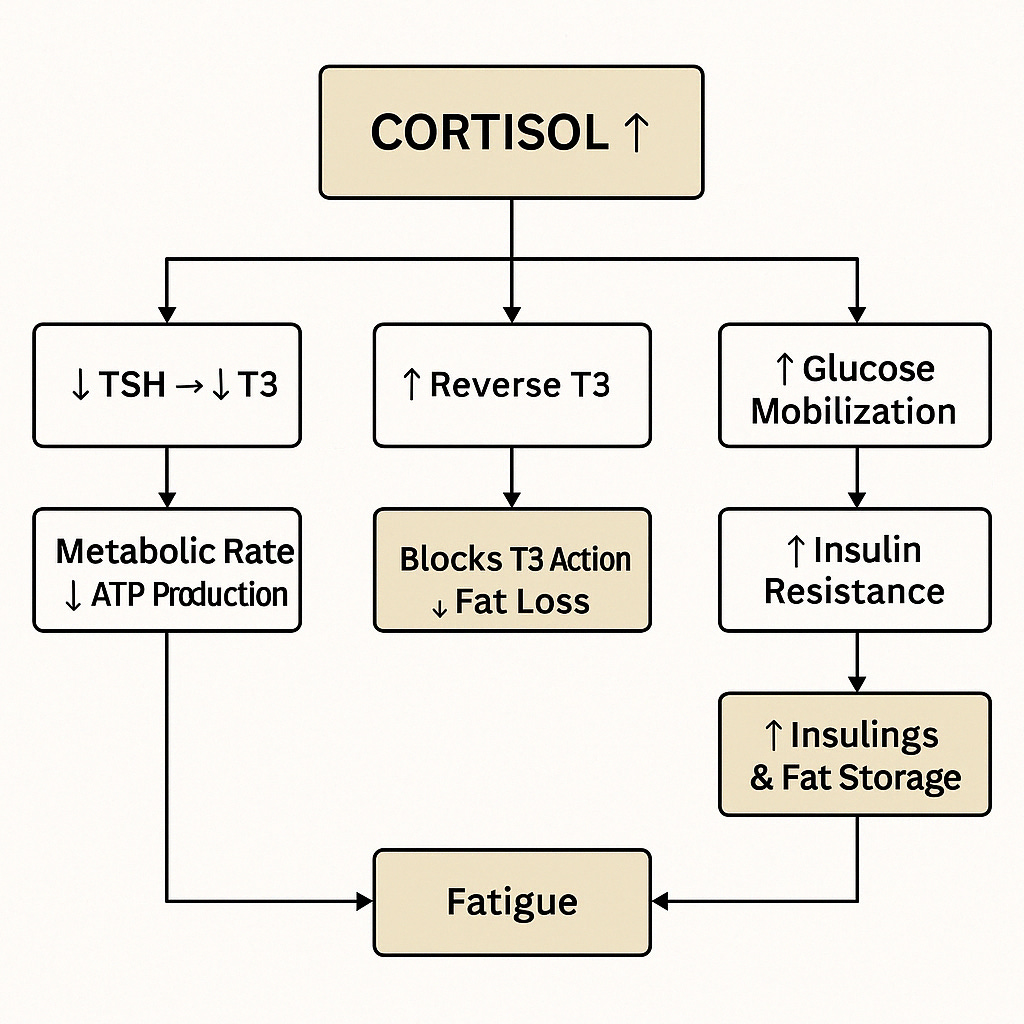
Reducing thyroid-stimulating hormone (TSH), which decreases T3/T4 output (thyroid hormones)
Suppressing gonadotropin-releasing hormone (GnRH), which decreases testosterone, estrogen, and progesterone
Increasing corticotropin-releasing hormone (CRH), which increases cortisol
T3 (triiodothyronine) is your metabolism’s throttle. It tells cells how fast to burn energy. When calories are low or stress is high, your body:
Converts less T4 → T3
Converts more T4 → reverse T3 (rT3), which blocks metabolic activity
Lowers BMR, NEAT, and energy output
Cortisol is your body's stress signal - a glucocorticoid hormone released by the adrenal glands. It's not "bad" in acute doses. In fact, it:
Mobilizes stored energy (glucose and fat)
Increases alertness and focus
Reduces inflammation (short term)
Helps drive Muscle-Protein Synthesis to help repair and build muscle.
But chronically high cortisol (common in people with busy lives and high-stress jobs) creates downstream issues:
Without realizing it, your body subconsciously moves less - fewer steps, less fidgeting, lower drive to move.
That’s your metabolism "saving energy" like a business trimming operating expenses.
The traits that make you successful - discipline, intensity, sacrifice - are the same ones that drive metabolic resistance if applied without recovery.
You:
Sleep 5–6 hours a night (but tell yourself you function fine)
Hit 6 workouts/week (with zero deloads)
Live on black coffee, protein shakes, and adrenaline
Ignore fatigue until it becomes chronic
Sound familiar?
Your metabolism isn’t broken… it’s trying to survive YOU.
You’ve been in a calorie deficit for 12+ weeks with no fat loss
Constant fatigue or brain fog despite eating clean
Plateaued lifts and poor recovery
Cold hands and feet (slowed circulation from low thyroid)
Decreased libido or irregular cycles
Poor sleep quality and elevated AM cortisol
You don’t need to train less or eat more junk. But you do need a smarter system - one that works with your physiology, not against it.
Here’s how to reverse metabolic adaptation, lower cortisol, and get fat loss moving again:
If you’ve been in a calorie deficit for 12+ weeks - or bouncing in and out of one for months or years - your body is likely compensating by lowering thyroid output, slowing metabolism, and reducing spontaneous movement (NEAT).
Before pushing harder, pause and assess:
How long have you been under-eating?
Have you ever intentionally brought calories back up?
Are you experiencing signs of low metabolism (cold extremities, fatigue, plateaued progress)?
What to do:
Spend 4–6 weeks in a “maintenance phase”—gradually increasing calories by 100–150/week until you find your true maintenance intake. Focus on whole foods, performance, and muscle retention. This primes your metabolism for more effective fat loss later.
Fat loss is not linear. The longer you're in a deficit, the more resistant your body becomes.
Inserting controlled, higher-calorie periods can reset key hormones like leptin, thyroid (T3), and even testosterone - especially for high-stress individuals.
Three proven formats:
Intermittent refeed days (e.g., 2 higher-carb days every 10–14 days)
1–2 weeks at maintenance every 6–8 weeks of cutting
Cyclical dieting: 3 weeks in a deficit, 1 week out
These aren’t “cheat days.” They’re planned physiological resets that re-sensitize your body to the fat loss process.
The application of this is going to be different for everyone. That’s why working with a coach can be so invaluable to dialing in on exactly what you need and short-cutting your progress.
Muscle isn’t just about aesthetics - it’s your metabolic engine. The more lean mass you have, the more calories you burn at rest.
But under chronic stress or in prolonged deficits, muscle breakdown accelerates and recovery tanks - unless you actively protect it.
What to do:
Strength train 3–4x/week with progressive overload
Avoid chronic cardio (especially fasted) unless it’s low-intensity walking
Get 7–9 hours of sleep and time your protein (30–40g per meal, 4x/day)
Schedule deloads every 4–6 weeks to allow CNS recovery
The longer you’re in a deficit, the deeper the adaptive hole becomes.
Most high performers push too hard for too long without realizing they’re stacking hormonal and neurological fatigue - not just physical.
Rule of thumb:
6–12 weeks in a fat loss phase → 2–6 weeks at maintenance
The longer the cut, the longer the recovery phase required
If your biofeedback (sleep, sex drive, energy, strength) is tanking, it’s time to exit the deficit - regardless of what the scale says
Think of it like a fiscal quarter. You can run lean for a while, but if you don’t reinvest in the system, your returns will dry up.
Because if your cortisol is out of control, so is your metabolism.
Again, cortisol isn’t the enemy - it’s essential for energy, alertness, and inflammation control. But when it stays elevated due to constant stress, poor sleep, under-eating, or overtraining, it begins to sabotage fat loss, hormone production, and cognitive function.
And it’s likely you can only pull so much stress out of your life - so the focus should be on your stress management and recovery systems.
Here’s how to bring cortisol back into balance:
Prioritize Deep, Consistent Sleep
Sleep is your body’s most powerful recovery tool—and the #1 regulator of your cortisol rhythm.
What to do:
Set a fixed bedtime and wake time (even on weekends)
Cut blue light exposure 1–2 hours before bed
Use magnesium glycinate (300–400 mg) or glycine (3 g) to promote deep, restorative sleep
Avoid caffeine after 2 p.m.
No supplement or diet trick matters if you’re sleeping 5 hours a night and expecting peak performance.
Promote Activation of Your Parasympathetic Nervous System
High achievers often live in fight-or-flight mode—your sympathetic nervous system (SNS) is always on.
This is fine in short bursts, but chronic SNS dominance leads to elevated cortisol, disrupted digestion, poor sleep, and hormonal dysfunction. Your body can only recover in a Parasympathetic (rest and digest) state.
What to do:
Practice box breathing (4-4-4-4) or 4-7-8 breathing for 3–5 minutes, 1–2x/day
Use guided meditations or apps like Calm/Headspace for 5–10 minutes in the afternoon
Try yoga nidra or NSDR (non-sleep deep rest) on high-output days
Recovery is not a luxury - it’s a performance multiplier.
Walk - Especially After Meals and In Natural Light
Walking is one of the most underrated cortisol regulators.
Post-meal walks improve blood sugar control, insulin sensitivity, and digestion. Sunlight exposure boosts serotonin and reinforces healthy circadian rhythm.
What to do:
Take 1–2 walks per day, 10–20 minutes
Prioritize a morning walk in natural light and a post-lunch or post-dinner walk
Use it as a midday “reset” to break up work blocks
Delay Stimulants to Support Your Natural Rhythm
Most people drink coffee as soon as they wake up, which stacks caffeine on top of already elevated morning cortisol.
What to do:
Wait 60–90 minutes after waking before your first cup of coffee
If you train early, sip half pre-workout and save the rest for later
Consider reducing to 1–2 cups/day if anxiety, poor sleep, or cravings are an issue
You don’t have to quit coffee - you just have to stop weaponizing it against your adrenals.
Fuel Your Body to Reduce Perceived Threat
Caloric restriction, especially combined with intense training and cognitive demand, is perceived by the brain as a threat.
This drives cortisol higher. But when you fuel adequately - especially with protein and carbs - you tell your body it’s safe.
What to do:
Eat every 4–5 hours with balanced macronutrients
Anchor meals with 30–40g protein and 30–60g carbs (especially around workouts)
Don’t fear carbs—they lower cortisol, support thyroid conversion, and aid sleep
Eliminate Hidden Stressors
Cortisol isn’t just triggered by obvious stress. It’s also elevated by subtle, chronic inputs you may not notice:
Examples:
Fasted HIIT or long fasts while working
Constant notifications and digital noise
Multitasking, poor boundaries, lack of time outdoors
Gut dysbiosis, inflammation, or poor digestion
Start viewing your day through the lens of your nervous system. What feels “normal” might be slowly crushing your metabolic capacity.
Bottom line?
If you're not actively managing your stress inputs and recovery outputs, you're not optimizing fat loss - you're accelerating burnout.
Now, to be clear, correcting this metabolic adaptation can take a while. The longer you’ve been dieting, overtraining, and overstressing your system, the longer it needs to recover. That means things like fat loss need to be put on hold sometimes. Because if you don’t, and you just try to ‘push through,’ you may lose the weight…
But the likelihood you regain it later is much higher when your metabolism is in an unhealthy place.
When you work with your biology instead of against it, fat loss becomes easier, not harder. You’ll notice:
✅ Higher energy and productivity
✅ Easier fat loss with fewer cravings
✅ Better sleep, libido, and mood
✅ More muscle retention during cuts
✅ Sharper mental clarity and fewer crashes
Because 6-figure health is the foundation for 6-figure wealth.
Questions about metabolism or metabolic adaptation? Drop them in the comments.
We’re giving away thousands of dollars in scholarships to our coaching program this month!
Drop a comment with the word ‘RESET’ or fill out the form below to learn how I help high performers reboot their metabolism, drop stubborn fat, and optimize for energy, strength, and success.
Fill out this form to learn more about working 1:1 w/ Coach Jorden.
Comments
Nothing yet. Say the first thing.
Sign in to join the conversation.