
By Sungchul Ji, Ph.D.
Professor Emeritus of Theoretical Cell Biology, Rutgers University
with conceptual assistance from ChatGPT
“Death is not extinguishing the light; it is only putting out the lamp because the dawn has come.”
— Rabindranath Tagore
For many years I regarded this beautiful sentence simply as poetry.
Recently, however, I began to wonder whether Tagore’s metaphor might express something much deeper—not merely about death, but about the way science itself progresses.
What if Tagore was intuitively describing a universal pattern of transformation?
What if apparent endings sometimes represent not disappearance, but our first glimpse of a larger reality?
This possibility gradually emerged during a series of conversations with ChatGPT concerning geometry, neuroscience, relativity, consciousness, and the mathematics of organization.
Surprisingly, all of these seemingly unrelated topics converged on the same underlying idea.
I have begun calling it the Tagore Transition.
1. The Lamp and the Dawn
Imagine sitting alone at night.
A single lamp illuminates your room.
Suddenly the lamp goes out.
If the room remains dark, we naturally conclude that the light has disappeared.
But suppose the lamp goes out because the sun is rising.
Then the extinction of the lamp is not the disappearance of light.
It is the arrival of a greater source of illumination.
The lamp has ended.
Light has not.
Tagore’s metaphor quietly changes the question.
Instead of asking
“Has the light disappeared?”
he asks
“Have we mistaken the lamp for the source?”
That subtle shift may have implications extending far beyond poetry.
2. A Pattern Appearing Across Science
Over the past several months I have been exploring what I call the S4→S5 transition.
It began with a simple geometric observation.
The tetrahedron is the simplest three-dimensional simplex.
The hypertetrahedron, or 5-cell, is the corresponding four-dimensional simplex.
From our three-dimensional perspective,
the 5-cell cannot be directly seen.
It can only be represented mathematically or through projections.
Between them I introduced a simplex-like structure,
the Dynamic Body-Centered Tetrahedron (Dynamic BCT),
whose fifth vertex moves continuously.
Originally I viewed the Dynamic BCT simply as a visualization.
Gradually it became something more.
It became a possible mediator between
the visible
and
the invisible.
3. A Question About Measurement
This led to an unexpected question.
Science routinely measures what can be observed.
But must everything real be directly observable?
Physics already answers “no.”
We never directly observe
the wavefunction.
We infer it.
We never directly observe
curved spacetime.
We infer it through planetary motion and gravitational waves.
We never directly observe
dark matter.
We infer it through its gravitational effects.
In science,
indirect evidence is often the most powerful evidence.
Could something similar apply to consciousness—or even to what many traditions have called spirit?
4. From Gnergons to Gnergitons
For many years I have worked on what I called the Gnergy Principle, describing living systems in terms of
Energy,
Matter,
Information.
More recently,
I proposed adding a fourth observable component:
Consciousness.
These four principles naturally define the four vertices of the Dynamic BCT.
Every living state may then be represented as a continuously changing relational point described by barycentric coordinates.
I now refer to this relational domain as Gnergonic Space.
It is a space of measurable organization.
The four coordinates summarize the changing relationships among
energy,
matter,
information,
and conscious experience.
5. A New Possibility
Suppose, however,
that Gnergonic Space itself is only a projection.
Suppose there exists a deeper organizational domain,
which I call Gnergitonic Space,
where the fifth organizing principle is
Spirit.
This does not imply that Spirit becomes directly measurable.
Rather,
Spirit would become inferable
through
its projections into
Energy,
Matter,
Information,
and Consciousness.
The relationship would resemble that between
the invisible 5-cell
and
its three-dimensional projection,
the Dynamic BCT.
We do not observe the complete 5-cell.
Yet we can study its projections.
Likewise,
perhaps we do not directly observe Spirit.
Yet we may observe its organizational consequences.
6. Can Science Test Such an Idea?
This is the question that transformed a philosophical speculation into a possible research program.
Suppose we measure
brain activity,
blood flow,
respiration,
metabolic energy,
cognitive information,
and carefully structured first-person reports of conscious experience.
My earlier work showed that the Planckian Distribution Equation (PDE) successfully describes both blackbody radiation and distributions observed in functional MRI data.
The PDE parameters are influenced by physiological energy, material conditions, informational organization, and conscious state.
These measurements could, in principle, be mapped into the Dynamic BCT using barycentric coordinates.
Each experimental observation would become a point within Gnergonic Space.
Instead of studying only the brain,
we would study
the changing organization
of the complete psychophysical system.
Notice what this does not claim.
It does not claim that fMRI measures Spirit.
Rather,
it proposes that fMRI, physiology, information, and first-person reports together may reveal the organizational signatures through which a deeper organizing principle—if it exists—becomes manifest.
Science would still be studying observable data.
The hypothesis concerns what those organizational patterns may ultimately signify.
7. A New Meaning of the Tagore Transition
At this point something unexpected became clear.
Originally,
I thought the Tagore transition meant
An ending becomes a new beginning.
Now I think that is only the visible surface of a deeper principle.
A better definition may be:
A Tagore transition occurs when an apparently self-contained observable system is recognized as the projection, manifestation, or partial realization of a more comprehensive organization previously hidden from view.
The emphasis is no longer on endings.
It is on
projection.
The lamp does not create the dawn.
It participates in it.
Likewise,
the Dynamic BCT does not create the 5-cell.
It projects it.
Perhaps consciousness does not create Spirit.
Perhaps it manifests it.
That remains a hypothesis.
But it is now a hypothesis capable of scientific investigation.
8. The Pattern Appears Again and Again
The same organizational motif seems to recur in many different fields.
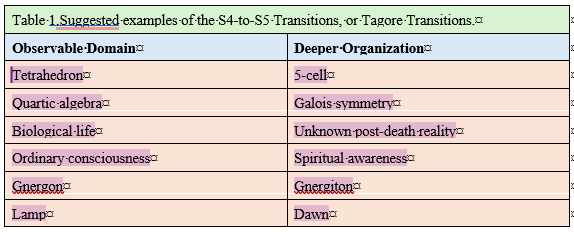
These examples are not identical.
Nor do they prove one another.
But they exhibit a remarkably similar organizational logic.
Each suggests that what appears complete from one level becomes understandable only within a larger framework.
9. Science Meets Poetry
One of the great surprises of this journey has been the convergence between mathematics and poetry.
Tagore expressed the idea through metaphor.
Geometry expressed it through higher dimensions.
Neuroscience may eventually express it through relational organization.
Physics already expresses it through indirect inference.
Perhaps these are not competing languages.
Perhaps they are complementary descriptions of the same organizational principle.
10. Beyond Reductionism
Modern science has achieved extraordinary success by analyzing systems into smaller and smaller components.
Atoms.
Particles.
Genes.
Neurons.
This reductionist strategy has transformed civilization.
Yet organization itself often cannot be found by isolating components.
Organization exists
between
the components.
The Dynamic BCT is an attempt to represent precisely those changing relationships.
If successful,
it would suggest that science requires not only a geometry of objects,
but also
a geometry of organization.
11 A Research Program Rather Than a Belief System
Nothing proposed here establishes the existence of Spirit.
Nor does it seek to replace neuroscience with metaphysics.
Quite the opposite.
It suggests a way to investigate spiritually significant human experience using the ordinary tools of science:
quantitative physiology,
mathematical modeling,
first-person phenomenology,
relational geometry,
and independent replication.
Whether the hypothesis ultimately succeeds or fails is an empirical question.
That is exactly as it should be.
12 Looking Toward the Dawn
When Tagore wrote about the lamp and the dawn, he was almost certainly not thinking about simplicial geometry, barycentric coordinates, functional MRI, or higher-dimensional projections.
Yet his poetic intuition may have anticipated something profoundly scientific.
Perhaps reality is organized in layers.
Perhaps what disappears at one level becomes visible only from another.
Perhaps the greatest scientific discoveries occur not when we find new objects,
but when we discover that familiar objects are projections of deeper patterns.
If so,
the transition from Gnergon to Gnergiton may one day become much more than a speculative biological theory.
It may become the first experimentally grounded example of what I now call the Tagore Transition:
The recognition that an observable organization is not the whole of reality, but the visible projection of a deeper and more comprehensive order.
That idea remains unproven.
But unlike a purely philosophical assertion, it invites investigation.
And perhaps that is the most beautiful feature of all.
Science and poetry, often regarded as opposites, may finally meet—not in certainty, but in a shared willingness to follow the light beyond the lamp.
Epilogue
Looking back over the past five decades of my own research, I realize that I have repeatedly been searching for the same pattern without recognizing it. Whether studying conformons, the Cell Language Theory, the Gnergy Principle, simplicial geometry, the Dynamic Body-Centered Tetrahedron, or the possible relationship between consciousness and spirit, the recurring question has always been the same:
Can the visible be understood as the projection of a deeper organization?
If the answer is ever found, it may not come from geometry alone, neuroscience alone, or poetry alone. It may emerge only when these different ways of knowing converge. In that sense, the Tagore Transition is more than a hypothesis about death or spirituality. It is a proposal for a new style of scientific inquiry—one that treats mathematics, experiment, phenomenology, and human meaning not as isolated disciplines, but as complementary windows onto the same unfolding reality.
No posts
Comments
Nothing yet. Say the first thing.
Sign in to join the conversation.