
Sungchul Ji, Ph.D.
Emeritus Professor of Theoretical Cell Biology, Rutgers University
with conceptual assistance from ChatGPT
For many years, I have used the term gnergy [1] to describe the inseparable union of information and energy in organized systems. Information directs, constrains, or controls processes, while energy makes those processes physically possible.
From this idea emerged two related terms:
Gnergon: an information–energy entity or field
Gnergiton: an information–energy–spirit entity or field
At first glance, the distinction seems simple: a gnergiton is a gnergon with spirit added.
But a recent geometrical interpretation suggests that the difference may be deeper. Metaphorically, the relationship between a gnergon and a gnergiton may resemble the relationship between a tetrahedron and a hypertetrahedron, or 5-cell [2].
Accordingly, the transition

may be interpreted as another example of the more general transition

This proposal is not yet a physical theory. It is a conceptual and geometric hypothesis intended to clarify the relationship among energy, matter, information, consciousness, and spirit.
1. What Is a Gnergon?
The word gnergon [1] was constructed from several conceptual elements:



A gnergon may therefore be understood as a unit in which information and energy are inseparably combined.
Energy alone can produce change, but it does not determine which organized change will occur. Information alone can describe or constrain a process, but without energy it cannot perform physical work.
Thus, organization requires both:

This is the central intuition behind the Gnergy Principle of Organization [3]: organized processes require energy to perform work and information to direct or control that work.
A conformon, for example, may be interpreted as a biological gnergon because it carries both conformational energy and molecular information.
2. What Is a Gnergiton?
The term gnergiton [4] adds another component:

Thus:

The addition of spirit is not intended merely as the addition of another physical variable. Spirit, in this formulation, belongs to a deeper ontological level than ordinary matter, energy, or biological consciousness.
A gnergiton would therefore be more than an information–energy unit. It would be an information–energy organization that participates in, manifests, or is completed by spirit.
This suggests a distinction between two levels:
The gnergon belongs primarily to the psychophysical world of organized matter, energy, information, and consciousness.
The gnergiton belongs to a more inclusive domain in which that psychophysical organization is related to spirit.
3. The Tetrahedron and the Hypertetrahedron
A tetrahedron is the simplest three-dimensional simplex [5]. It consists of four vertices, each connected to the other three.
The corresponding simplex in four dimensions is the 5-cell, [6] also called the 4-simplex or hypertetrahedron. It consists of five mutually connected vertices.
The geometrical transition can be represented as

where S4 denotes a four-vertex simplicial organization and S5 denotes a five-vertex simplicial organization.
The fifth vertex is not merely another point placed inside an ordinary tetrahedron. A genuine 5-cell requires an additional spatial dimension. It cannot be fully realized within three-dimensional space.
A body-centered tetrahedron, or BCT [7], contains four tetrahedral vertices and a fifth point, but it is not itself a true 5-cell. It may instead be interpreted as a three-dimensional, simplex-like projection or mediator between the tetrahedron and the higher-dimensional 5-cell.
This yields the sequence

The Dynamic BCT represents the intermediate state in which a fifth relational principle becomes partially visible without yet producing the complete four-dimensional simplex.
4. A Fourfold Gnergon
To interpret the gnergon-to-gnergiton transition as an S4 to S5 transition, the underlying fourfold structure must be made explicit.
I propose that the gnergon be associated with four fundamental domains:
Energy
Matter
Information
Consciousness
These four domains may be assigned metaphorically to the four vertices of a tetrahedron.
The gnergon can then be written schematically as
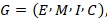
where E represents energy, M represents matter, I represents information, and C represents consciousness.
This does not mean that every individual gnergon must contain four independent substances. Rather, the tetrahedron represents a fourfold organization in which matter, energy, information, and consciousness are mutually related.
Within biological systems, these four dimensions are difficult to separate completely.
Matter provides structure.
Energy drives transformation.
Information constrains and coordinates processes.
Consciousness, at least in sufficiently complex organisms, represents the experiential or psychophysical aspect of organization.
The tetrahedron symbolizes their mutual dependence.
5. Spirit as the Fifth Principle
The gnergiton arises when Spirit is introduced as the fifth principle:

where S represents spirit.
The transition is therefore

Geometrically, this corresponds metaphorically to
The tetrahedral gnergon becomes related to the hypertetrahedral gnergiton.
Spirit should not be interpreted here as merely one additional ingredient of the same kind as energy or matter. Its role is structurally different.
Energy, matter, information, and consciousness belong to the observable or partially observable psychophysical world. Spirit is proposed as a higher-dimensional or deeper organizing principle that cannot be fully represented within that world.
Thus, the fifth vertex does not merely enlarge the tetrahedron quantitatively. It transforms the organization qualitatively.
The passage from four vertices to five represents not only addition, but dimensional completion.
6. Consciousness Is Not the Same as Spirit [8]
This interpretation also clarifies the subtle distinction between consciousness and spirit.
Consciousness is experienced dynamically. It changes with waking, sleep, dreaming, anesthesia, memory, emotion, attention, disease, and neural activity.
It is embodied and relational.
Spirit, as used in the gnergiton concept, is not simply another state of consciousness. It represents the hypothesized deeper source or dimension of which consciousness may be a partial manifestation.
In the geometric analogy:

Consciousness may be regarded as a three-dimensional projected manifestation of spirit, but projection is not identity.
A shadow preserves certain relations belonging to the object that casts it, but the shadow is not the complete object.
Similarly:

Yet consciousness and spirit need not be unrelated:

This distinction allows us to avoid two opposite errors.
The first is reducing spirit to ordinary biological consciousness.
The second is separating spirit so completely from consciousness that no meaningful relationship remains between them.
The projection metaphor preserves both difference and continuity.
7. The Dynamic BCT as Mediator
The transition from gnergon to gnergiton may be represented by a Dynamic BCT.
Its four fixed vertices correspond to:

Its mobile fifth point represents the changing relational manifestation of the higher-dimensional fifth principle.
This gives the sequence

Equivalently:

The mobile point does not have to be identified directly with spirit. A more careful interpretation is that its motion represents how the higher-dimensional organization becomes variably projected into the psychophysical world.
Its position may be expressed through barycentric coordinates:

with

These coordinates describe the relative participation of energy, matter, information, and consciousness in a particular projected state.
The Dynamic BCT may therefore represent the changing interface between the gnergon and the gnergiton.
8. A Three-Layer Interpretation
The relationship may also be expressed through the Three-Layered Reality Hypothesis [9].
Layer I: Observable organization
This includes matter, energy, biological structures, neural processes, and measurable behavior.
At this level, the gnergon appears as an information–energy unit involved in physical and biological organization.
Layer II: Relational mediation
This is represented by the Dynamic BCT.
Here, energy, matter, information, and consciousness enter changing relations. The higher-dimensional principle is only partially manifested.
Layer III: Deeper reality
This is represented by the 5-cell.
At this level, the fourfold psychophysical organization is completed by spirit, producing the gnergiton.
The full sequence becomes:




This is structurally parallel to

9. Addition or Transformation?
It is tempting to describe the gnergiton simply as a gnergon plus spirit:

This is useful as a first approximation, but the geometrical analogy suggests something more profound.
The passage from tetrahedron to 5-cell is not merely the placement of one more point inside three-dimensional space. The fifth mutually connected vertex requires a higher-dimensional geometry.
Likewise, the transition from gnergon to gnergiton may not be merely additive.
It may be transformational:

Once the fifth principle is introduced, the meanings of the original four components may also change.
Energy becomes more than physical capacity.
Information becomes more than encoded difference.
Matter becomes more than passive substance.
Consciousness becomes more than a transient neural state.
Each becomes part of a larger fivefold organization.
This is why the gnergon-to-gnergiton transition may be better described as dimensional completion than simple addition.
10. Gnergons, Gnergitons, and the Four-to-Five Transition Principle (FTFTP)
The proposed correspondence can be summarized as follows:
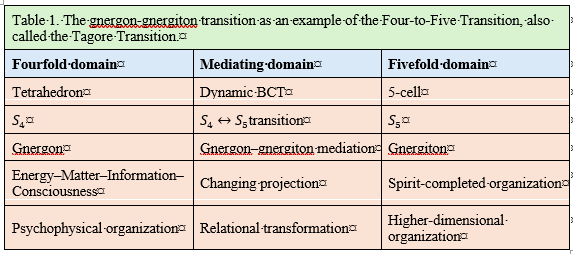
This comparison suggests that the gnergon-to-gnergiton transition may be included among the metaphorical examples of the Four-to-Five Transition Principle.
The recurring pattern is:

Such a pattern may occur in geometry, biology, consciousness studies, philosophy, and cosmology, although its meaning will differ in each field.
The recurrence of the pattern does not by itself prove that all these systems share one physical mechanism. It may instead indicate a common organizational form.
11. A Scientific Caution
The proposed relationship is presently metaphorical and conceptual.
No experimental evidence currently demonstrates that gnergitons exist as physical particles or fields, that spirit occupies a literal fourth spatial dimension, or that biological consciousness is mathematically produced by projection from a 5-cell.
The terms should therefore not be presented as established entities of particle physics.
Their immediate value is organizational and heuristic. They help distinguish:
information–energy organization from spirit-completed organization,
consciousness from spirit,
three-dimensional manifestation from higher-dimensional source,
and simple addition from dimensional transformation.
For the hypothesis to become a scientific model, several further developments would be required:
a precise mathematical definition of a gnergon,
a precise mathematical definition of a gnergiton,
an explicit projection or transformation between them,
measurable variables corresponding to the geometric coordinates,
and empirical predictions that differ from existing theories.
Until then, the geometry should be understood as a disciplined metaphor rather than as proof.
12. Conclusion: From Fourfold Organization to Fivefold Completion
The difference between a gnergon and a gnergiton may be metaphorically similar to the difference between a tetrahedron and a hypertetrahedron.
The gnergon represents a fourfold psychophysical organization:

The gnergiton represents the corresponding fivefold organization completed by spirit:

The transition
may therefore be interpreted metaphorically as
The Dynamic BCT occupies the mediating position between them. It represents the changing three-dimensional manifestation of a higher-dimensional relation that cannot be fully contained in ordinary space.
In this interpretation, the gnergiton is not merely a gnergon with one additional component.
It is the dimensionally completed form of the gnergon.
The transition from gnergon to gnergiton thus becomes part of a more general organizational pattern:
A fourfold structure enters a dynamic mediating state and becomes related to a fivefold, higher-dimensional whole.
Whether this pattern ultimately describes an objective structure of nature remains an open question. But as a conceptual bridge among geometry, biology, consciousness, and spirit, it offers a new language for an old mystery: how the visible world may be related to a deeper reality that it expresses but cannot fully contain.
References:
[1] Ji, S. (1991). A Biological Model of the Universe: The Shillongator. In: Molecular Theories of Cell Life and Death (S. Ji, ed.), Rutgers University Press, New Brunswick, N.J. Pp. 152-163, 230-237 Gnergy
[2] Ji, S. (2026). The Tagore Transition. https://622622.substack.com/p/the-tagore-transition
[3] Ji, S. (2018). The Cell Language Theory: Connecting Mind and Matter. World Scientific Publishing, New Jersey. Pp. 33-34. GPO
[4] Ji, S. (2026). From Mattergy to Gnergy to Gnergitons: An ITR-Based Account of Matter, Life, and Reality
[5] Simplex complex. https://en.wikipedia.org/wiki/Simplicial_complex
[6] 5-cell. https://en.wikipedia.org/wiki/5-cell
[7] Ji, S. (2012). Molecular Theory of the Living Cell: Concepts, Molecular Mechanisms, and Biomedical Applications. Springer, New York. P.289. BCT
[8] Ji, S. (2026). Consciousness and Spirit: A Geometric Distinction Suggested by the Dynamic BCT and the 5-Cell https://622622.substack.com/p/consciousness-and-spirit-a-geometric
[9] Ji, S. (2026). A Geometric Worldview Integrating Modern Physics, Biology, and Jungian Synchronicity https://622622.substack.com/p/a-geometric-worldview-integrating
Comments
Nothing yet. Say the first thing.
Sign in to join the conversation.