
Sungchul Ji, Ph.D.
Emeritus Professor of Theoretical Cell Biology, Rutgers University
with conceptual assistance from ChatGPT
One of the oldest problems in the science of consciousness can be expressed in a surprisingly simple question:
How can what I experience from the inside be related scientifically to what another person can measure from the outside?
A neuroscientist can record my EEG. A cardiologist can measure my heart-rate variability. A physiologist can record my breathing. An endocrinologist can measure my cortisol.
But none of these measurements tells the scientist directly what it feels like to be me at that moment.
I might report:
“My inner space feels extraordinarily peaceful, spacious, and clear.”
The scientist, meanwhile, sees electrical signals, heartbeats, respiratory waves, and hormone concentrations.
How are these two descriptions related?
This is the famous first-person/third-person problem of consciousness.
Two approaches may illuminate it from rather different directions: Rām Lakhan Pāndey Vimal’s DPV~ICRDAM and a framework that Joshua Davis and I have recently been developing with ChatGPT, which we call Simplicial Cognitive State Theory (SCST).
They are not the same theory. But their similarities are striking—and their differences may be scientifically productive.
1. Vimal’s Dual-Aspect Approach
Vimal has been developing a dual-aspect approach to consciousness for many years. An earlier version appeared in 2009 as his “Dual-Aspect-Dual-Mode” framework. More recently, the theory has developed into what he calls:
DPV~ICRDAM
where
DPV = Dvi-Pakṣādvaita Vedānta
and
ICRDAM = Inseparable-Complementary-Reflective Dual-Aspect Monism.
Vimal presents DPV as the spirituality-oriented formulation and ICRDAM as its science-oriented counterpart. His program explicitly attempts to construct a bridge between science and spirituality.
The central concept can be represented schematically as
DAS = (s, ns), where DAS means a
The crucial idea is that these are not two independent things.
Conscious experience is not simply something mysteriously produced by matter. Nor is matter merely an illusion manufactured by consciousness.
Instead, subjective and non-subjective properties are proposed to be inseparable aspects of a single underlying state.
Thus Vimal replaces the familiar picture
(Brain --> Consciousness) with something closer to
(s <--> ns) In his current formulation, “reflective” means that changes in one aspect are mirrored in the other.
This is an important conceptual move because it attempts to avoid the traditional problem of explaining how an entirely physical brain could suddenly generate subjective experience.
But it raises another question:
Can the proposed inseparability of the subjective and non-subjective aspects actually be measured?
That is where SCST may become relevant.
2. Simplicial Cognitive State Theory (SCST)
SCST begins not with an ontology but with an experimental question.
Suppose we simultaneously measure five dimensions of a person’s cognitive state:
Dominant EEG frequency characteristics
Heart-rate-variability (HRV) coherence
Respiratory power-spectrum characteristics
Stress-hormone levels
Subjective inner-space quality, reported by the participant on a scale from 0 to 10
The first four are predominantly third-person measurements.
We can write them schematically as
(ns = EEG, HRV, Respiration, Hormones). The fifth is fundamentally different.
Only the experiencing person can directly report the quality of his or her inner space:
(s = Inner Space) Thus our five-dimensional experiment already contains both sides of Vimal’s distinction:
Two Windows on the Same Cognitive State
OUTSIDE VIEW
EEG + HRV + Respiration + Stress Hormones
Objective physiological measurements
+
INSIDE VIEW
Inner-Space Quality (0–10)
Subjective first-person experience
But SCST adds something else.
It asks whether the relationship among these five quantities may itself characterize the cognitive state.
3. From Five Measurements to a 5-Cell
Five normalized quantities can be expressed as barycentric coordinates:
(b_1,b_2,b_3,b_4,b_5), subject to
(b_i\ge0)
And (b_1+b_2+b_3+b_4+b_5 = 1) Geometrically, five barycentric coordinates define a point in a
This means that a cognitive state can be represented not simply by five numbers but by a geometrical configuration.
For example, ordinary waking consciousness might occupy one region of the simplex.
Deep meditation might occupy another.
Acute stress might occupy another.
REM dreaming, slow-wave sleep, anesthesia, psychedelic states, or near-death-like states might occupy still other regions.
More importantly, transitions between cognitive states would appear as trajectories through the simplex.
Thus SCST proposes:
F(b_1,b_2,b_3,b_4,b_5) The cognitive state is not identified with any single coordinate.
It is represented by the relationship among all five.
4. Where Vimal and SCST Meet
The connection now becomes apparent.
Vimal proposes:
(s ßà ns) SCST asks:
(Can the relation between s and ns be represented geometrically?
That difference is subtle but important.
Vimal’s framework is primarily ontological. It tells us what kind of relationship consciousness and physical reality may have.
SCST is primarily operational and geometrical. It asks how first-person and third-person variables can be measured simultaneously and whether their relationships form reproducible patterns.
The comparison can be summarized as follows:
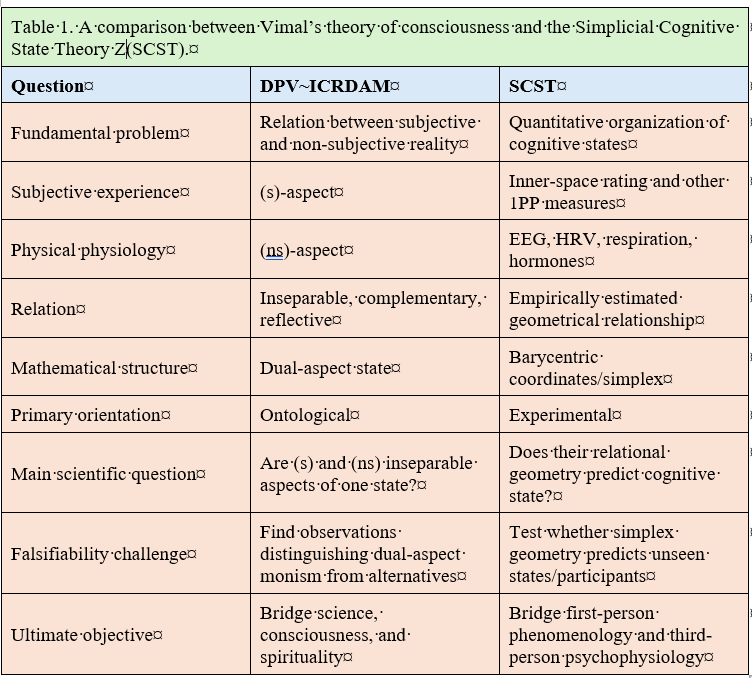
The two approaches therefore need not be competitors.
SCST could potentially provide an experimental language for investigating some claims suggested by dual-aspect theories.
5. But Correlation Is Not Ontology
Here we must be cautious.
Imagine that we conduct an experiment involving 100 people and discover that a particular configuration of EEG, HRV, respiration, cortisol, and inner-space quality predicts deep meditation with 95% accuracy.
That would be scientifically interesting.
But it would not prove dual-aspect monism.
A physicalist could argue that the brain generates both the physiological measurements and the subjective report.
An idealist could argue that consciousness is primary and physical measurements are its appearance.
A neutral monist could say that both arise from something more fundamental.
And Vimal could argue that they are complementary aspects of the same state.
The same experimental correlation might initially be compatible with all four interpretations.
Therefore the deeper scientific challenge is not merely to demonstrate
(s ßà ns) We must search for predictions that distinguish alternative explanations of that relationship.
This is an important point because Vimal himself has increasingly emphasized empirical tests of his framework. His recent DPV~ICRDAM writings explicitly describe the science-facing framework as Inseparable-Complementary-Reflective Dual-Aspect Monism, while his earlier 2009 work already developed a neuroscience-based dual-aspect approach.
6. Is Something Missing Between (s) and (ns)?
Here another idea becomes relevant.
In much of my own work, I have become increasingly interested in the Irreducible Triadic Relation (ITR) [1].
Instead of
A-B,
ITR emphasizes
A-R-B,
where (R), the relation or mediator, cannot always be eliminated without losing something essential about the organization.
Applied to consciousness, this suggests that perhaps we should not write merely
(s ←→ ns).
Instead we might consider
(s ←→ R←→ ns)
where (R) represents the organization relating first-person and third-person reality.
What could (R) be?
SCST suggests an intriguing possibility:
(R = the empirically measured relational geometry)
Thus:
(physiology ßà simplicial organization ßà subjective experience) This is not yet an established scientific result. It is a hypothesis.
But importantly, it is a hypothesis that can begin to be tested.
7. The Three-Layered Reality Hypothesis
This brings us to another framework that I have called the Three-Layered Reality Hypothesis (TLRH) [2].
Very schematically:
(Layer I←—→ Layer II ←—→ Layer III) Layer I corresponds broadly to observable physical reality.
Layer III represents a deeper or less directly accessible dimension of reality.
Layer II is crucial because it provides mediation between them.
This makes TLRH structurally different from a simple two-world ontology.
The interesting correspondence is:
(TLRH: Layer I ←—→ Layer II ←—→ Layer III)
(ITR: ns ←—→ R ←—→ s)
(SCST: Physiology←—→ Geometry ←—→ Phenomenology) I emphasize that these are
But their structural similarity may be significant.
TLRH may therefore provide a larger conceptual framework within which Vimal’s dual-aspect theory and SCST can be compared.
8. From Philosophy to Experiment
The real value of this comparison will ultimately depend on experiment.
Imagine placing a participant in several carefully controlled cognitive states:
ordinary eyes-open rest,
eyes-closed relaxation,
focused attention,
psychological stress,
slow coherent breathing,
meditation,
dreaming or sleep.
During each state we simultaneously measure EEG, HRV, respiration, stress hormones, and subjective inner-space quality.
Each observation becomes a point in the 5-cell.
We then ask:
Do different cognitive states occupy reproducibly different regions?
Next:
Can the geometry predict the cognitive state of a person who was not included in constructing the model?
And finally, the deeper question:
Does first-person experience have a reproducible mathematical relationship with the entire physiological configuration that cannot be adequately described by any individual physiological variable?
If the answer is yes, we will have established something modest but important.
We will not have solved the metaphysical problem of consciousness.
But we may have constructed a quantitative bridge between its two great observational domains:
(First-Person Experience ßà Third-Person Measurement)
9. Duality May Require a Third Term
The comparison between Vimal’s theory and SCST therefore leads to an intriguing possibility.
Perhaps the choice is not simply between matter and consciousness.
Perhaps what has been missing is the relation itself.
Vimal’s DPV~ICRDAM makes an important move by insisting that subjective and non-subjective aspects cannot simply be pulled apart.
SCST asks whether that inseparability has a measurable geometry.
ITR asks whether the relation connecting the two is itself irreducible.
And TLRH places mediation between observable and deeper reality.
These ideas converge upon a common pattern:
(Observable —> Relation > Experiential) or, more generally,
(A—> R —> B) The important scientific question is no longer merely:
Does the brain produce consciousness?
It becomes:
What lawful relational organization connects the measurable physiology of a living human being with the world that the same human being experiences from within?
That question can be approached philosophically.
But increasingly, it can also be approached experimentally.
Perhaps the next step in consciousness science is therefore not to choose prematurely between first-person and third-person reality.
It is to discover the geometry of the relation between them.References:
[1] Ji, S. (2018). The Cell Language Theory: Connecting Mind and Matter. World Scientific Publishing, New Jersey. Pp. 377-373. ITR
[2] Ji, S. (2026) A Geometric Worldview Integrating Modern Physics, Biology, and Jungian Synchronicity: From the Tetrahedron to the 5-Cell https://622622.substack.com/p/a-geometric-worldview-integrating
No posts
Comments
Nothing yet. Say the first thing.
Sign in to join the conversation.