
By Sungchul Ji, Ph.D.
Emeritus Professor of Theoretical Cell Biology, Rutgers University
(with conceptual assistance from ChatGPT)
One of the strangest discoveries of twentieth-century physics is quantum entanglement.
Two particles can be prepared in a joint quantum state and then measured far apart. The individual results appear random, yet when the measurements are compared, their correlations follow quantum mechanics with remarkable precision. Bell’s theorem showed that these correlations cannot, under its assumptions, be reproduced by a theory in which the particles simply carry locally predetermined answers to every possible measurement.
Einstein famously resisted the implications of this picture. He did not doubt the extraordinary predictive success of quantum mechanics. His deeper concern was whether quantum mechanics provided a complete description of physical reality.
Recently, while watching Richard Feynman’s 1983 Esalen workshop Quantum Mechanical View of Reality, I was reminded of this unresolved distinction between our ability to calculate what nature will do and our ability to understand what kind of reality could produce those results.
That question led me to wonder whether entanglement might be viewed from an entirely different geometrical perspective.
Could quantum measurement be interpreted metaphorically as a transition from a higher-dimensional relational state to the lower-dimensional world in which definite observations appear?
I will call this the S5 → S4 transition.
And, for reasons that will become clear, I suggest that it may be viewed as a Reverse Tagore Transition.
1. Einstein, Bell, and the mystery of entanglement
Suppose Alice and Bob receive two particles prepared in an entangled spin state.
They separate and independently choose orientations at which to measure their particles. Each obtains a definite result, conventionally represented as +1 or −1.
One classical possibility would be that each particle already carries instructions specifying what answer it will give for every possible measurement orientation.
That is essentially the intuition tested by Bell-type arguments when combined with locality and the other assumptions entering Bell’s theorem.
Schematically:
predetermined local properties ⟶ measurement results
Bell showed that such local hidden-variable theories impose constraints—Bell inequalities—on the correlations that Alice and Bob can observe.
Quantum mechanics predicts violations of those constraints.
Experiments agree with quantum mechanics.
The lesson is not that information is being sent instantaneously from Alice to Bob; Bell correlations cannot be used for faster-than-light signaling. Nor does Bell’s theorem by itself tell us which interpretation of quantum mechanics is correct.
What it does tell us is profound enough:
The observed quantum correlations cannot be reproduced by the simple picture of independent, locally predetermined properties assumed by Bell-local hidden-variable models.
Perhaps, then, we should reconsider what we mean by the fundamental object.
2. From objects to relations
Classically, we tend to think of Alice’s particle and Bob’s particle as two things:
Each thing has its own properties.
A B.
But an entangled quantum state cannot generally be separated into two independent states:
Ψ_AB /= Ψ_A⊗Ψ_B.
The fundamental mathematical description belongs to the joint system.
That suggests a different conceptual starting point:
A <—> B.
Instead of beginning with two independent objects and asking how they become correlated, perhaps we should begin with the relation constituting the whole and ask how separate observable outcomes emerge from it.
This connects quantum entanglement with a distinction I recently proposed between two geometrical perspectives:
GOS — Geometry of Shapes
and
GOR — Geometry of Relations.
3. The Geometry of Shapes and the Geometry of Relations
Modern physics provides one of humanity’s greatest geometrical achievements: the description of spacetime.
In general relativity, events occur within a Lorentzian geometrical structure. Distances, durations, causal relationships and spacetime curvature can be expressed mathematically.
I have called this perspective, in a deliberately broad sense, the Geometry of Shapes (GOS).
But complex systems suggest another geometrical question.
Instead of asking,
Where are the objects, and what is the geometry within which they exist?
we can ask,
What geometry is created by the relations among the objects themselves?
I call this the Geometry of Relations (GOR).
The distinction can be summarized:
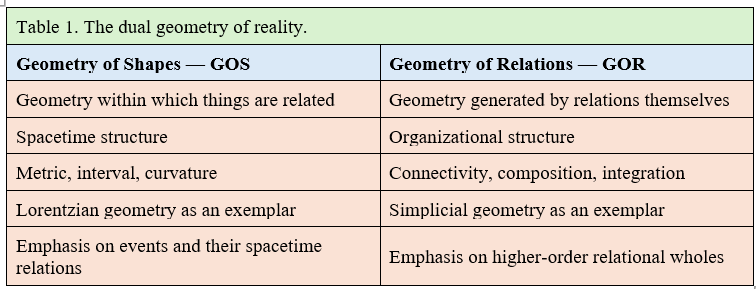
These are not mutually exclusive mathematical worlds. Lorentzian geometry itself is relational, and every biological or quantum system exists physically in spacetime.
GOS and GOR should instead be understood as complementary emphases.
And entanglement may be precisely where their relationship becomes especially interesting.
4. Enter the simplex
A simplex is the simplest geometrical structure capable of representing progressively higher-order relations.
A point is a 0-simplex.
A line segment is a 1-simplex.
A triangle is a 2-simplex.
A tetrahedron is a 3-simplex.
A 4-simplex—sometimes called a 5-cell or hypertetrahedron—has five vertices and cannot be represented without distortion in ordinary three-dimensional space.
Let us denote the tetrahedral level by S4
and the five-vertex hypertetrahedral level by S5.
The notation here refers to the number of vertices, not the conventional mathematical simplex dimension: S4 corresponds to a tetrahedron (3-simplex), while S5 corresponds to a 5-cell (4-simplex).
I have been exploring whether the transition
S4⟶S5
might provide a geometrical metaphor for transitions from an immediately manifest reality toward a larger relational reality that cannot be represented completely within the original dimensional framework.
This is where Rabindranath Tagore [10] enters the story.
5. The Tagore Transition
Tagore repeatedly treated death not simply as annihilation but poetically as passage from the familiar into something beyond the limits of our present experience.
I have borrowed this imagery—not as a physical theory of death, but as a metaphor—and called the passage
S4 → S5
the Tagore Transition.
In its most general form, it represents movement from a lower-dimensional manifest description toward a higher-dimensional relational possibility:
Manifest ⟶ larger relational reality.
But quantum measurement appears to suggest the opposite direction.
And this is where an unexpected connection appears.
6. Quantum measurement as S5 → S4
Before measurement, an entangled pair is represented by a joint quantum state,
Ψ_AB.
After Alice and Bob perform their measurements, they obtain definite recorded results:
A(a) = ±1, B(b) = ±1.
Schematically,
Ψ_AB ⟶ (A_a, B_b).
Suppose, purely as a proposed geometrical interpretation, we associate the entangled relational state with S5 and the manifest world of definite experimental outcomes with S4.
Quantum measurement could then be represented as
S5 ⟶ S4.
This is precisely the reverse of the Tagore Transition.
I therefore propose calling it the Reverse Tagore Transition:
Reverse Tagore Transition ≡ S5 → S4.
The ordinary and reverse transitions would then form a conceptual pair:
S4 ⇄ S5.
The forward direction moves from manifest actuality toward a larger relational possibility.
The reverse direction moves from relational possibility toward manifest actuality.
7. The Dynamic BCT as mediator
There may be an important intermediate step.
I have previously used the body-centered tetrahedron (BCT) as a three-dimensional representation in which an additional fifth vertex interacts dynamically with an ordinary tetrahedral structure.
The BCT may therefore provide a geometrical metaphor for the interface between S5 and S4.
Instead of writing simply
S5→S4,
we can write
S5⟶Dynamic BCT⟶S4.
Applied to quantum measurement:
[S5 / entangled state/ relational possibilities] →
[Dynamic BCT/ measurement interaction / context / mediation] →
[S4 / recorded outcome/actual event]
The measuring apparatus is not merely a passive observer. It interacts physically with the quantum system and environment. The dynamic BCT could therefore represent, at least conceptually, this mediating transition.
8. What Bell’s theorem might be telling us
This framework suggests a new way of posing the Bell problem.
The classical hidden-variable intuition tries to explain correlations from properties belonging independently to the components:
individual properties ⟶ correlations.
The relational interpretation reverses the explanatory order:
relational whole ⟶ measurement context ⟶ individual outcomes.
This does not mean that Bell’s theorem proves the existence of S5, the dynamic BCT, GOR, or a Reverse Tagore Transition.
It does not.
Rather, Bell’s theorem tells us that a particular classical picture based on local predetermined properties cannot account for the observed correlations. That leaves open the deeper ontological question:
What kind of reality does the quantum formalism describe?
S5 → S4 is one possible geometrical language with which to formulate that question.
9. A possible meeting of GOS and GOR
We can now see a broader possibility.
Einstein’s relativity gave physics an extraordinary geometry of spacetime:
GOS⟶Lorentzian geometry⟶spacetime.
Quantum entanglement emphasizes something different—the irreducibility of certain joint relations:
GOR⟶higher-order relational geometry?⟶entangled systems.
Perhaps one of the unfinished tasks of fundamental physics is therefore to understand the relationship between
geometry of spacetime and geometry of quantum relations.
Einstein’s great achievement was geometrizing gravity.
Bell’s theorem may be pointing us—not proving, but pointing us—toward the possibility that relations themselves require a deeper geometrical description.
10. The crucial scientific test
There is an obvious danger in all of this.
A beautiful geometrical analogy is not yet a physical theory.
If S5 → Dynamic BCT → S4 is to become more than a metaphor for quantum measurement, it must reproduce quantitative quantum mechanics.
For the spin-singlet state, quantum mechanics predicts
E(a,b) = −cosθ_ab.
Any genuine S5/BCT model of entanglement would ultimately have to derive this correlation—or an experimentally equivalent result—from its own geometrical principles.
That gives the proposal a clear dividing line:
S5 → BCT → S4
is presently an interpretive hypothesis.
If its geometry could independently generate the experimentally observed Bell correlations, it could begin to become a physical model.
That is a difficult requirement—but precisely because it is difficult, it makes the proposal scientifically meaningful.
11. From Einstein’s gap to a geometry of relations
Einstein asked whether quantum mechanics gives us a complete description of physical reality.
Bell transformed part of that philosophical dispute into mathematics.
Experiments then showed that nature violates Bell inequalities.
Feynman emphasized the extraordinary situation in which we can calculate quantum phenomena with astonishing accuracy while still struggling to say what the underlying reality is.
Perhaps the next step requires changing the question.
Instead of asking only:
What properties do the individual objects possess?
we might also ask:
What relations constitute the whole from which those individual properties emerge in measurement?
That leads from objects to relations,
objects → relations,
from relations to higher-order relations,
relations → relations of relations
and perhaps ultimately from the Geometry of Shapes to a complementary Geometry of Relations.
Within that emerging picture, quantum measurement can be represented provisionally as
S5 relational reality → Dynamic BCT → S4 observable reality.
Or, in the language developed here:
Quantum measurement as a Reverse Tagore Transition.
Whether nature actually works this way remains an open question.
But perhaps that is precisely where the value of the proposal lies. It converts the mystery of quantum measurement into a geometrical question:
Can the geometry of a higher-order relation explain the emergence of the observable event?
That question is, at least in principle, mathematical—and therefore potentially testable.
Comments
Nothing yet. Say the first thing.
Sign in to join the conversation.