
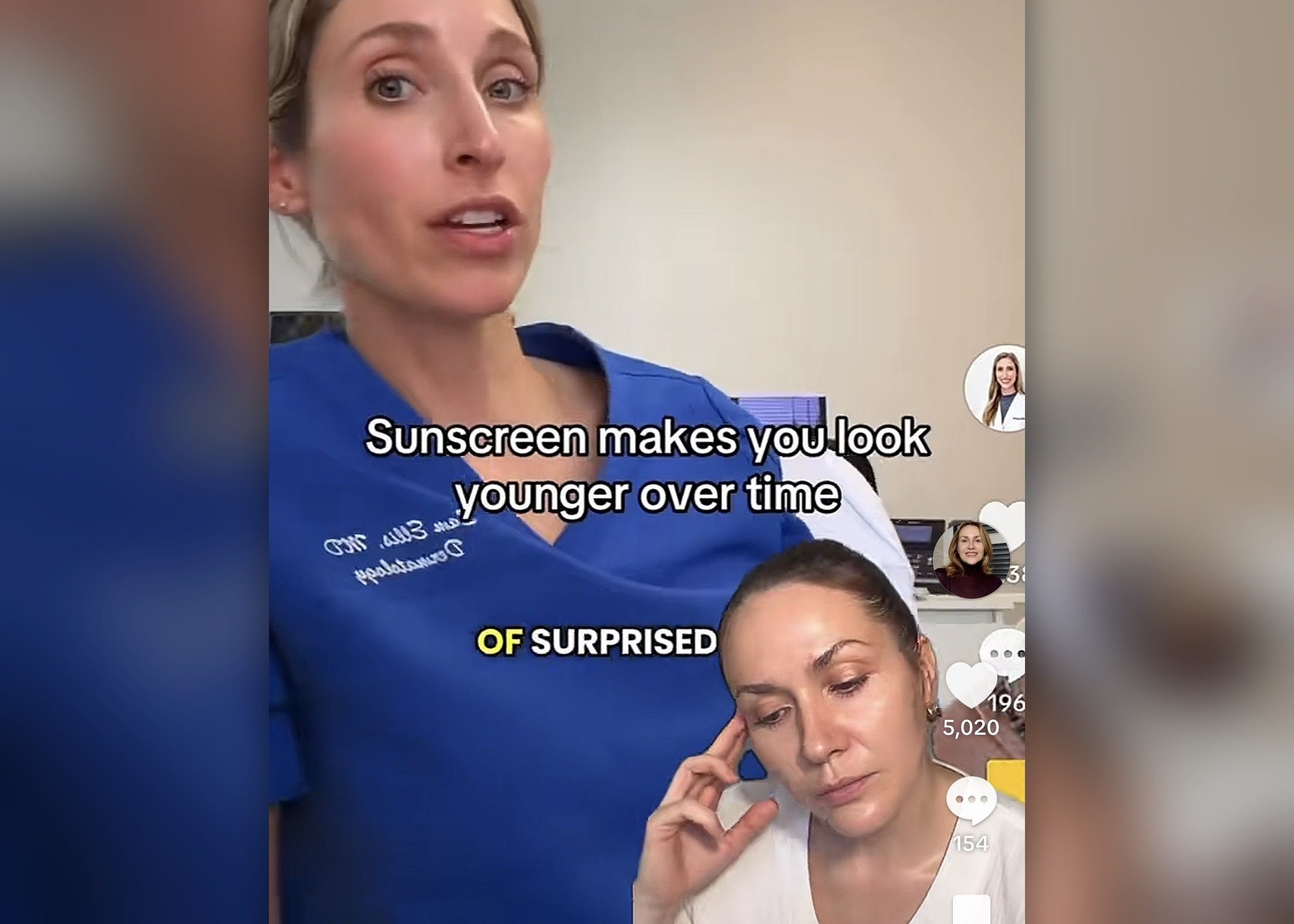
I was scrolling TikTok the other day and a video from Dr Sam Ellis came up. She’s a dermatologist. Her line was that sunscreen isn’t just protection, that it can reverse ageing on its own, as a single ingredient. The job we normally hand to retinoids.
I loved her message, especially right now. The anti-sunscreen movement is growing, and clips of wellness influencers rubbishing SPF, claiming it causes cancer and endocrine disruption, are pulling in millions of views, while the careful, evidence-based stuff barely gets seen. The algorithm has never had much taste for nuance. And underneath Dr Ellis’s video, the comments were full of people asking the obvious thing: how does it actually work.
But you know me, Complexions. I’m a biochemist, and I don’t nod along, even when I agree. I want to know the mechanism. The mechanism is usually the part that convinces me, and in this case, it’s a good one.
So let me show you what’s going on under there. Including why your dark spots fade before anything else does, which I’ll come back to, because it’s my favourite part and I want to make you wait for it.
Your skin isn’t a surface that slowly wears down like a pair of jeans. It’s a building site. One that never actually closes.
Every day it’s repairing sun damage. Proofreading your DNA, clearing out old pigment, laying fresh collagen. None of that stops. It’s happening while you read this, which I find a bit mad when I think about it for too long.
So why does anyone end up with sun damage at all?
Maths, basically. Picture your skin as a bank account. Repair is the money coming in. UV is the money going out. Out in daylight with nothing on, you spend faster than you earn, and you finish every day a little overdrawn. Do that for twenty years and the debt shows up. Dullness, uneven tone, dark spots, texture.
Here’s the shift, though. Sunscreen doesn’t put money in the account. It’s not a repair cream. What it does is stop the spending. It turns off the tap.
And the second the spending stops, your repair crews, who were grafting away the whole time and just never getting ahead, finally get ahead. Repair starts to outrun the damage. The account creeps back into the black.
That’s the “reversal”. It’s your own biology being allowed to win for once.
Three crews are doing that work. Let me introduce them.
UV scrambles your DNA. It fuses neighbouring letters of your genetic code into little faults with names like cyclobutane pyrimidine dimers, which you can immediately forget. Just think typos. Every minute in the sun, UV stamps thousands of tiny typos into your skin cells.
You have a proofreading team for this. Its actual name is nucleotide excision repair and its job is simple: find the typo, cut it out, retype the right letters. We know how much it matters because of a rare condition called xeroderma pigmentosum, where people are born without working proofreaders. Their skin ages and develops cancers terrifyingly young, because the typos never get fixed. It’s a horrible illustration of a beautiful system.
Most of us have a brilliant proofreading team. The issue is volume. Unprotected in the sun, you’re making typos faster than they can fix them, and the errors pile up on the desk.
Sunscreen slows the typing to a trickle. There’s good work showing that even a normal, slightly-too-thin layer (so, how most of us actually apply it) still cuts the DNA damage right down. Suddenly the workload is manageable. The backlog clears.
Down in the deeper layer of your skin, two crews work at all times. Builders, your fibroblasts, who make collagen. And a demolition crew, a set of enzymes called matrix metalloproteinases (MMPs, if we’re being friends about it), who break old collagen down. You want both. Demolition clears the damaged fibres, building lays the new ones. In healthy skin it’s balanced.
UV ruins the balance two ways at once, which is the clever, horrible thing about it.
It pays the demolition crew overtime. Sunlight flips a switch in the cell called AP-1, and AP-1 floods the place with MMP-1, the enzyme that chops collagen up. Wrecking balls everywhere.
And then, at the same time, it sends the builders home. It quietly suppresses the signal that tells your fibroblasts to make new collagen. So you’ve got the wrecking crew on double time and the builders locked out of the site, every sunny day, for years. That is, more or less, how skin loses firmness and starts to wrinkle.
Put the sunscreen on and the overtime gets cancelled.
The builders come back on site. Now your fibroblasts can lay collagen without it being torn down faster than they can make it, and that relentless net loss slows right down. Whether the recovery goes further than that, actually rebuilding collagen you’ve already lost rather than just stopping the loss, is softer than the enthusiasm online suggests, and I’ll be straight with you about it later.
But the direction of travel changes. And it’s worth saying plainly: it isn’t that sunscreen contains collagen, or feeds your skin anything. It just stops the thing that was firing your bricklayers.
Right. The dark spots. I made you wait, here it is.
Your pigment cells, melanocytes, are basically a small factory that makes melanin. UV is the customer who will not stop phoning in rush orders. Every dose of sun is another “more, more, more” down the line. The factory ramps up, pumps melanin into the surrounding skin cells, and if it happens enough in one spot you get a mark that stays. A sun spot. The mottled, patchy tone so many of us are trying to even out.
And the factory itself is usually completely fine, by the way. Not broken. Just being shouted at, constantly.
Stop the shouting and it calms down within days. No new orders. And here’s the satisfying part: the pigment near the surface is held in cells that are always rising up and shedding off, a full turnover roughly every month (a bit slower as you get older). So once production drops, that surface pigment clears out on its own little conveyor belt, and nothing’s topping it up behind it.
That’s why tone and the newer, shallower spots move first. The mechanism is quick, it’s surface-level, it doesn’t need anything deep rebuilt. It just needs the orders to stop, which is exactly what sunscreen does. The older, deeper marks are stubborner, mind you. Pigment that’s settled lower down has no quick way out, so those can take many months, and some won’t shift without a proper pigment-fading active to help them along.
But the surface evening-out is real, and it’s usually the first thing you’ll notice in the mirror.
Mechanism is one thing. I owe you the human studies too, and this is the part where I have to be honest with you.
The strongest evidence in the whole field is a trial run in Nambour, Australia, published 2013, (Hughes and colleagues). It’s the gold standard for two reasons. It was a proper randomised controlled trial, and, rarely, it was government funded rather than paid for by a sunscreen company. Around 900 people, four and a half years. The daily sunscreen group showed no detectable increase in skin ageing, and were roughly a quarter less likely to age visibly than the people who used it whenever they felt like it.
Read that line carefully though. It proves sunscreen stops things getting worse. It’s a prevention result. Rock solid, but prevention.
The study everyone reaches for when they say reversal is a different one. (Randhawa, 2016). Thirty-two women. A daily broad-spectrum SPF for a year, no anti-ageing actives allowed. They reported real improvements in texture, clarity and pigmentation from about twelve weeks in. Lovely.
But I have to tell you the holes, because that’s the entire reason you read me. No control group, so you genuinely cannot separate the UV filters from the nice moisturising base they were sitting in. One assessor doing all the grading. And the whole thing funded by the company that made the sunscreen.
I’m not saying it’s worthless. I’m saying know what’s holding up each claim. Prevention is standing on concrete. The “improves your skin over months” claim is real and makes mechanistic sense, but the cleanest reversal study is standing on something a lot softer. The honest version is still good news. It’s just honest.
A quick intermission before we get back to it. I don’t take brand money to say nice things. That’s exactly why I can tell you when a study was quietly paid for by the company selling the product, or when a claim is propped up on nothing much at all. Readers fund that independence, not sponsors, and it’s what makes the paid tier worth it: honest reviews, “buy it or skip it” verdicts that don’t soften when a brand won’t like them, and routine audits where I’ll tell you what’s worth keeping and what’s just sitting on your shelf doing nothing.
First up for paid subscribers next week: an unfiltered breakdown of the Medik8 Exo-PDRN Prismatic+ Serum. What the formula actually does, and where the claims start to wobble.
£8 a month or £80 a year, full archive included. The rigour isn't going anywhere either way. Subscriptions are just what let me keep it independent of the brands I write about.
If sunscreen quietly rebuilds, why am I not telling you to bin your retinol?
Because of where it runs out of road. The fast, visible wins are pigment, tone, texture. The deep stuff, the etched-in lines and that leathery, sun-toughened quality (the proper word is solar elastosis), is a different beast.
The strong evidence says sunscreen stops that deep damage getting worse. It does not show it rubbing it out. Stopping the slide is a proper win. It’s just not the same as undoing a deep wrinkle, and I’m not going to pretend it is.
If you actually want to rebuild collagen in a measurable way, that’s still a retinoid’s job. Retinoids have the direct, repeated, properly controlled evidence for switching procollagen production back on. They do the heavy lifting.
But here’s the part I love, because it ties the whole thing in a pretty bow. A retinoid only works because you’re wearing sunscreen over it. Skip the sunscreen and you’re running the demolition crew at full strike while begging your retinoid to build. You’d be paying the bricklayers and the wrecking crew to work on the same wall, same afternoon. Can you see that picture?
So sunscreen isn’t the eraser. It’s the foundation that lets everything else do its job.
It’s the reason your retinoid is worth the money.
Here’s something worth understanding, because it changes how you read that little number on your weather app.
The UV index is a sunburn meter. That’s what it was built to be. It’s weighted towards the wavelengths that redden and burn you, which is mostly UVB. It is not really a damage meter. And that matters, because the wavelength doing the deeper work, UVA, is barely in the number at all.
UVA is the one that sinks in and drives oxidative stress and inflammation under the surface, the damage you don’t see happening. Which, when it adds up over years, is exactly what photoageing is.
So let me split that “zero” into two situations, because they really aren’t the same thing.
If it’s dark out, the sun is on the far side of the planet and there’s no UV reaching you. None. You do not need sunscreen at eleven at night.
Winter daytime is the interesting one. The index can sit at zero or one while the sun is low, and people read that as “no UV, no point.” But a low index mostly tells you the burning rays are weak. The deeper rays are a different story.
UVA is the reliable, boring one that sinks further in and does its damage quietly, through oxidative stress and inflammation, with none of the warning a burn would give you. It turns up every day, all year, and pushes through cloud and through glass.
And here’s the part that surprises people: when the sun sits low, in winter or first thing in the morning, the proportion of UVA to UVB actually goes up, not down. So the season you’re most tempted to skip is the season the number is least honest about.
The threshold itself is softer than it sounds, too. The WHO and most public health bodies set “protect your skin” at a UV index of 3 and above, which is sensible, simple advice. But a 2018 paper in Scientific Reports looked hard at that rule and called it seriously flawed for mid-latitudes, which includes us here in the UK.
On plenty of days where the peak index never reaches 3, the dose adding up across the whole day still passes the threshold for damaging skin. It just does it quietly, over hours, with none of the drama of a burn.
None of this is a reason to panic. It just means the number on your app is a smoke alarm for burning, not a full account of what daylight is doing to your skin.
Right. The question I get asked constantly. Do you need sunscreen inside.
Mostly, no. But there are two halves to this and the internet has them the wrong way round.
The half that’s real is windows. Glass is good at blocking the burning rays and much worse at blocking the deeper ones. The evidence on glass is clear enough: ordinary window glass stops nearly all UVB and lets a decent chunk of UVA straight through. Laminated glass, like a car windscreen, blocks most UVA. The side windows of a car usually don’t, which is exactly why dermatologists see more photoageing, and more skin cancers, on the side of the body that faces the car window. The right side, for us.
So if your desk sits in a patch of direct sun for hours, or you drive a lot, ongoing UVA and sunscreen earns its place. If you’re in a normal room away from the window, you’re getting very little, and you do not need to coat yourself in SPF to watch the telly.
The half that’s mostly marketing is your screens. You’ve seen the posts. Blue light from your devices is ageing you, buy this serum. So here’s the actual evidence. Blue light from the sun, at full strength, can drive pigmentation, especially in deeper skin tones, and it matters a lot for anyone with melasma.
But the blue light coming off your phone or laptop is a tiny fraction of that intensity. When researchers actually tested it, short-term screen exposure did not worsen melasma, and a systematic review wouldn’t even classify device blue light as a photoageing hazard. The dose off your screen is a rounding error next to thirty seconds outside. The blue light worth protecting against comes from the sky, not from your phone or computer.
One group I will single out, though. If you have melasma or stubborn pigmentation, visible light from real sunlight is a proper trigger, and a tinted sunscreen (the ones with iron oxides) is the evidence-based pick, because the tint is the bit that blocks visible light.
But again, that’s about daylight on your face, through a window or outdoors. Not your inbox.
If someone in your life has been told to wear SPF to bed, or has bought a “blue light defence” cream for their laptop, do them a kindness and forward this over.
I honestly could not care less.
Dr Ellis was right, with a footnote that makes her point better, not weaker. Sunscreen doesn’t repair your skin. It does something I think is nicer than that. It steps back and lets your skin get on with what it’s been trying to do the whole time.
Turns off the tap. Cancels the demolition overtime. Tells the pigment factory to stop ringing. And then your proofreaders and your builders and your monthly turnover do the work they never stopped wanting to do.
So wear it. Daily. On the grey days too, because UVA doesn’t care what the weather’s doing. Chemical or mineral, fancy or supermarket own-brand, I genuinely don’t mind which one. That whole war exhausts me.
Just wear it. Your future face will thank you for it.
M xx
You’ve made it all the way down here, so you’ve earned the practical bit. These are the sunscreens I’ve personally vetted: the formulas, filters and UVA protection I’m happy to put my name to as a chemist, and not because anyone paid me to. (The boring-but-important disclosure: some of these are affiliate links, so if you buy through them I may earn a small commission at no cost to you. It never changes what makes the list. Nothing goes on here that I wouldn’t put on my own face.)
My chemist-vetted everyday sunscreens → [LINK]. The ones that get the formulation, the filters and the all-important UVA protection right.
Lip SPF → [LINK]. The bit almost everyone forgets, and your lips have barely any natural defence of their own.
Best Korean sunscreens → [LINK]. Beautiful textures, genuinely high UVA protection, and the ones actually worth the hype.
For sensitive eyes → [LINK]. If your usual SPF makes your eyes sting and stream, start here.
For tinted sunscreens → [LINK].
If this was useful, the two kindest things you can do: forward it to someone who needs their SPF myths untangled, and subscribe so the next deep dive finds you.
No posts
Comments
Nothing yet. Say the first thing.
Sign in to join the conversation.