
This is 42 Sidenotes. The place for the incurably curious and endlessly fascinated. Where you’ll find multifaceted, opinionated observations, answers, and questions on life, the universe, and everything. Articles drop every other Sunday.
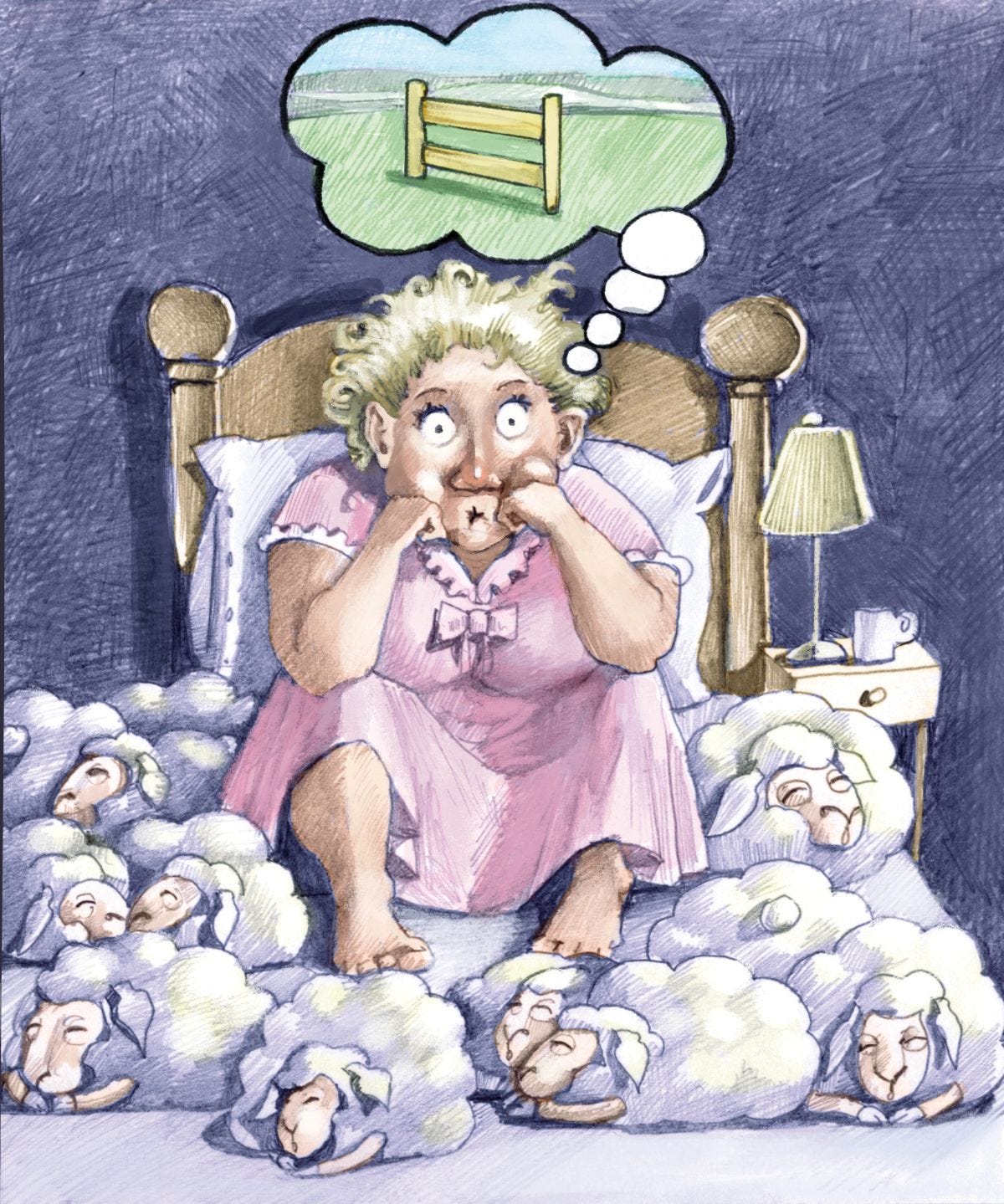
It’s 3:17 in the morning. You’re wide awake. Thoughts whirring around your brain. You worry. How it affects your energy tomorrow. How it’s becoming a pattern. How…
For roughly four centuries, waking in the middle of the night was typical.
Intrigued me. Piqued my curiosity because we now consider it such a problem.
What I dug up:
Four reasons it’s more natural than we now make it out to be (with one caveat).
That we aren’t necessarily all sleep deprived because we sleep less than 8 hours.
Four unexpected tips to improve your sleep.1
First, though:
The CAVEAT
One sleep physician thinks the whole “it’s natural” framing is clinically reckless — that it talks people with real insomnia out of treating it.
He makes an important point.
The discriminator:
Awake and calm, drifting back within the hour → this piece is for you.
Awake and unable to return, night after night, dread building → that’s sleep-maintenance insomnia, it has a name and a treatment (CBT-I). If that’s you, then “Medieval people did it too” is reckless indeed.
Get treatment!
Now we can dig into what I dug up.
First the four reasons it’s more natural than we now think.
As I mentioned above, there was a time in Europe when waking in the middle of the night was a common occurrence.
It was so normal people wrote about it in their diaries. Using vocabulary in common use. Like “first sleep” and “second sleep” or “morning sleep”. Interestingly, the period in between was considered so ordinary it didn’t merit a name, though it was often referred to as “watch” or “watching”.
According to the diaries Every Ekirch2 read, people did all sorts of stuff in that waking period. Obvious stuff like going to the bathroom and having sex. They prayed (it was the Middle Ages), smoked, and talked with anyone else awake. They even visited with neighbors on occasion.
Niall Boyce3 argues that Every Ekirch read routine where there was ambiguity. They point to a 1582 prayer for the middle of the night titled “If you happen to awake”.
So?
That “If” doesn’t make it exceptional either. And that same scholar even mentions that 31% of Europeans today wake on three or more nights per week.
The point is that it was unremarkable.
Nowadays it’s common knowledge that sleep isn’t monotonous. It’s not a single stretch of unconsciousness.
It has cycles of light, deeper, deep, and REM sleep. The latter three each roughly ninety minutes with brief periods of light sleep in between. That’s where your brain surfaces to waking or almost waking (just check your Fitbit or similar if you have one).
REM sleep is short during the early part of the night. The first REM sleeps lasts only about 10 minutes. Then gets progressively longer. So most is in the final third.
Every Ekirch’s argued that the midnight gap is why people were (and are) so obsessed with dreams as they then also had an hour to chew on them. Critics point out that as REM periods lengthen, morning dreams are the more important. One physician in 1642 called them “intire and aptly composed”.
Why does it always have to be “either / or”? Both can be true.
A small study in the 1990s put 16 people in 14 hours of darkness a night. Their sleep broke into fragments. It’s much debated and strongly argued over, but it does suggest that the pattern is alive and kicking, even if we’re not always aware of it.
And I remember once reading a study about someone living (voluntarily) in a cave without daylight experienced something similar.
The real point therefore being: it’s quite natural to wake during light sleep.
Though the physiology leaves little to imagination or interpretation, researchers have felt compelled to study hunter-gatherers tribes, specifically ones not (yet) exposed to artificial light (unless you consider flames to be artificial light).
During one study researchers recorded the activity in a Hadza hunter-gatherer tribe.
The most amazing data it turned up:
During more than the 13,000 minutes the researchers recorded activity, there were only 18 minutes where everyone was asleep.
Outside of those 18 minutes, around 40% of the tribe was awake at any given time.
And see whether this sounds familiar:
Young adults were the night owls. Elder adults the morning larks.
Your parents waking earlier and earlier isn’t them deteriorating. Your teenagers reluctance to go to bed and rising late has little to do with laziness.
It’s natural variation.
It gave rise to the “sentinel hypothesis”: staggered sleep evolved so a tribe’s sleeping members are never undefended. (Well, okay except for those 18 out of 13,000 minutes).
The point: waking alone in a silent house is the anomaly.
Historically someone else was always awake.
Nowadays, we tend to blame the blue light coming from our plethora of screens for keeping us awake or waking us in the middle of the night.
Whether it does or doesn’t, may be less relevant than something we’ve lost completely.
Most people think hunter-gatherers go to sleep as or shortly after the sun sets. “Met de kippen op stok”4 as Dutch expression says.
They don’t.
Darkness isn’t the trigger.5
Modern day hunter-gatherers stay awake for, on average, 3.3 hours after sunset. Sitting and talking by small fires.
If darkness doesn’t trigger sleep, what does?
Falling temperature.
That’s what.
People in hunter-gatherer tribes go to sleep when the ambient temperature drops. They wake around the coldest point of the night (early morning). Measurably shown by the blood vessels in their fingers constricting, clamping down at that time
Who knows, that’s quite possibly a sort of natural alarm clock.
Living in houses has taken us away from those natural signals.
We no longer experience the drop in ambient temperature nor the coldest time of night into morning as a natural wake-up alarm. Walls, doors (instead of some hide “curtain”), our ability to heat homes throughout the night, flattened the temperature curve we evolved with. Insulation took us even further away from these signals!
Temperature is the story we complete lost. Having lost it, we needed another explanation for our modern day supposed sleep deprivation (more on that below). Blue light from our screens and its effect on melatonin became the scapegoat.
That said, light, electric or otherwise, does have an effect. A study of two culturally identical communities in Argentina — one with electricity, the other not — clearly showed that light does push back and shortens sleep.
Again, it’s not either or. But…
So, some of your waking at 3 or 4 in the morning may well be tied to a bedroom that’s warmer than preferable at that time, and warm equals awake.6
The point is that temperature is the cue nobody tells you about (except for ensuring your bedroom isn’t too warm).
When you read articles about sleep there seems to be a bit of a panic going around that “we’re all sleep-deprived”.
There’s truth in that.
Sleep deprivation is widespread. Ying-Hui Fu (who did research into how genes drive sleep patterns7) claims most people nowadays are chronically sleep-deprived.
But that isn’t because so many of us don’t hit the 7-8 hours recommended hours.
That number may be on the high side.
Hunter-gatherer groups don’t outsleep us. They average 5.7-7.1 hours a night. Yet, they don’t have a word for insomnia in their language, though 1.5-2.5% report chronic sleep problems.
In industrial societies that number is 10-30%.
If we are all chronically sleep-deprived it’s because we’re sleeping less than we need.
It’s even become a badge of honor. Among billionaires and in hustle-oriented cultures. And some other high-profile people.
Margaret Thatcher was famous for claiming she functioned on four hours a night. She was partly bluffing. Her authorized biographer took it apart. It’s true she didn’t sleep much, but it often made her less than functioning well (putting it mildly here).
How many hours you need, is personal. It can be as little as 5 and as much as 9.
As Ying-Hui Fu found, it’s driven by genes.
You can’t train yourself to need less than you need.
It may look like you can for a long time, but (chronic) sleep deprivation has a way of catching up with you.8
Most people are still well-advised with at least the 7 of the recommended 7-8. So give yourself a break, get enough sleep and err on the side of more.
I can be very short about that.
The loss isn’t in the hours of sleep.
Sure, you lose some sleep by waking.
But the bigger loss in how you interpret it.
Hunter-gatherers wake, drift, and fall back asleep. They think nothing of it. Don’t even have language for insomnia. We, on the other hand, wake and start litigating, worrying, engaging our brain so the likelihood of drifting off again diminishes.
What’s lost aren’t the hours of sleep, it’s permission.
The permission we could and used to give ourselves to be okay with waking up and drifting off again. With doing something useful for an hour or so.
Now, while not worrying about waking up at 3:17 in the morning is possibly the biggest plus you can give yourself as worry never helps much.
There are uncommon ways to help improve your sleep. Uncommon because they either go against what you commonly hear, or because you’ve never heard them before. They follow from the sleep research. The general research and the research done among modern day hunter-gatherer groups.
Anchor the wake time
I’ve heard this only once before. When I was having particular difficulty with falling asleep. I heard it from Paul Reading.9 When common advice is to go to bed at the same time every night.
Anchoring the wake time is a (now) standard clinical position in CBT-I (Cognitive Behavior Therapy for Insomnia). But it’s still not generally known.
Biological clock knowledge and research also point to this. Waking at a consistent time is known as the most important cue for (re)setting your biological clock. It regulates morning light exposure and it helps you sleep better the next night by increasing your sleep drive.
And Yetish’ data on the Tsimane and San peoples is surprising corroboration from an unexpected direction. The time these people went to bed was all over the place but the hour they got up barely moved. Usually before sunrise. Though in summer the San woke about an hour after.10
Give your bedroom a falling temperature
This is the cue we humans engineered away. Don’t just keep your bedroom cool enough for sleep, cool it further across the night and have it be the coldest around your wake time.
Not sure how to do this except for opening a window and taking advantage of the natural drop in temperature outside. I haven’t been game for sleeping with an open window, especially in winter, but I am reconsidering.
Front load your light
The Tsimane and San peoples’ light exposure peaked around 9 in the morning. It halves by noon as they actively seek shade around midday.Light exposure for sleep is about morning light, not simply more light. It may also be a part of why morning light therapy outperforms many other sleep therapies.
Stop counting wake time in bed as failed sleep
Sleep efficiency in the Tsimane and San was 81–86% — the same as ours. They spent 7–8.5 hours in bed to get 6-odd hours of sleep. They never considered that gap a defect.
Time in bed was never supposed to equal time asleep.
We just have gotten to obsessed with optimizing every little thing of our lives (don’t get me started on bio-hacking) that we’ve set ourselves up for failure.
Creating expectations around sleep that simply do not match our biology.
We want to minimize the time we sleep. Because sleep doesn’t feel productive. And that’s a bad thing for anyone living in or adhering to hustle culture. So we limit time in bed and worry when we don’t spend all of it asleep. When worry is the last thing you want on your mind when you’re trying to sleep.
Next time you wake up at 3:17 in the middle of the night, relax.
The waking isn’t the problem. The panic about it is.
That said, if you genuinely cannot get back to sleep, when it’s most nights and the dread is building despite trying to relax — that’s a real condition that needs real treatment. Seek it.
Live long and prosper.

The other type being taking much longer than the usual 5-20 minutes to fall asleep. Something I am intimately acquainted with having an ADHD brain. It often takes me up to 2 hours to get there. One of the reasons I don’t like going to bed. The other being that it’s boring. Especially when you don’t even remember your dreams.
Literally: “With the chickens on stick” alluding to the (supposed?) chicken habit of go to sleep as the sun sets (or shortly after) early and doing so on a horizontal stick. The latter probably a surrogate for a tree branch.
That it is for non-predator species is hardly surprising as most have not yet gained the ability to control fire. And having control over fire, and thus the ability for “artificial” light could be (my speculation!!!) why hunter-gatherers — both predator and prey — over time postponed the time they went to sleep. Apart from multiple people being awake at any one time, of course.
Doesn’t negate my “cold fingers as a natural alarm” idea. Waking from “unnaturally” warm surroundings can happen just as well as waking from “uncomfortably” cold fingers.
Researchers didn’t look into the normal variations between night owls and morning larks, nor into those between short and long sleepers. Most people accept their pattern as “what it is”. It wasn’t until one person complained to her doctor about her finding her early sleep schedule a curse and she got introduced to Louis Ptáček and Ying-Hui Fu.
Ying-Hui Fu and her team have now identified seven genes associated with natural short sleep.
Many ill-effects of not enough sleep only show up after an extended period. And they can be so gradual you don’t make the connection. Sleep apnea is a well-known cause of sleep deprivation. Yet many people go undiagnosed for 10+ years. When things go really awry or there’s finally a good indication of apnea. Like a friend of mine telling me she thought I stopped breathing during my sleep. I’m still grateful for that. And when I got proper treatment many of the symptoms I had previously tied to other conditions, started to lift. Started because I’m still dealing with some. The effects of 10 years of not getting to, or continually being raised from deep sleep, can take anywhere from days, to months, to several years to clear.
Paul Reading is a neurologist at James Cook University Hospital in Middlesbrough and a past president of the British Sleep Society.
I wonder if that has more to do with the sun being up earlier than anything else. Then again, it was different with the San people, not with the Tsimane.
Comments
Nothing yet. Say the first thing.
Sign in to join the conversation.